欢迎访问《中国农学通报》,

中国农学通报 ›› 2026, Vol. 42 ›› Issue (21): 198-206.doi: 10.11924/j.issn.1000-6850.casb2025-0979
李文议1( ), 吴秋虞2, 段璐瑶1, 张海燕1, 邹成佳1, 章振羽1, 李琳1, 肖润甜1, 李晓1, 崔丽娜1(), 蔡伟莉1()
收稿日期:2025-12-10
修回日期:2026-03-01
出版日期:2026-11-10
发布日期:2026-11-10
通讯作者:
作者简介:李文议,女,1993年出生,甘肃会宁人,助理研究员,硕士,研究方向:玉米病害分子检测与分子机理研究。通信地址:610066 四川省成都市锦江区静居寺路20号 四川省农业科学院植物保护研究所,Tel:028-84590082,E-mail:liwenyi0921@163.com。
基金资助:
LI Wenyi1(), WU Qiuyu2, DUAN Luyao1, ZHANG Haiyan1, ZOU Chengjia1, ZHANG Zhenyu1, LI Lin1, XIAO Runtian1, LI Xiao1, CUI Lina1(), CAI Weili1()
Received:2025-12-10
Revised:2026-03-01
Published:2026-11-10
Online:2026-11-10
摘要:
镰刀菌毒素是由镰刀菌属真菌产生的一类次生代谢产物,严重威胁全球粮食及饲料安全,因此系统梳理其种类特征、检测技术及防控措施具有重要意义。本文围绕镰刀菌毒素的主要类别、生物合成途径与毒性作用,归纳了单端孢霉烯族化合物、伏马毒素、玉米赤霉烯酮及新兴真菌毒素的研究进展;总结了色谱法、免疫学方法和生物传感器等毒素检测技术的原理、优势及应用现状;分析了增强寄主抗性、农业防治、化学防治、生物防治和物理去除等防控策略的研究进展与应用特点。进一步指出,当前镰刀菌毒素研究仍存在新兴毒素风险评估不足、多毒素共污染及协同毒性研究薄弱、快速检测方法标准化程度不高以及绿色高效防控技术应用受限等问题。为此,提出今后应加强毒素数据库建设、多毒素联合毒理学研究、快速精准检测技术研发及绿色可持续防控体系构建,以期为镰刀菌毒素污染防控与农产品安全保障提供理论依据和实践参考。
中图分类号:
李文议, 吴秋虞, 段璐瑶, 张海燕, 邹成佳, 章振羽, 李琳, 肖润甜, 李晓, 崔丽娜, 蔡伟莉. 镰刀菌毒素分类、检测技术及防控策略研究进展[J]. 中国农学通报, 2026, 42(21): 198-206.
LI Wenyi, WU Qiuyu, DUAN Luyao, ZHANG Haiyan, ZOU Chengjia, ZHANG Zhenyu, LI Lin, XIAO Runtian, LI Xiao, CUI Lina, CAI Weili. Research Advances on Classification, Detection, and Control of Fusarium Mycotoxins[J]. Chinese Agricultural Science Bulletin, 2026, 42(21): 198-206.
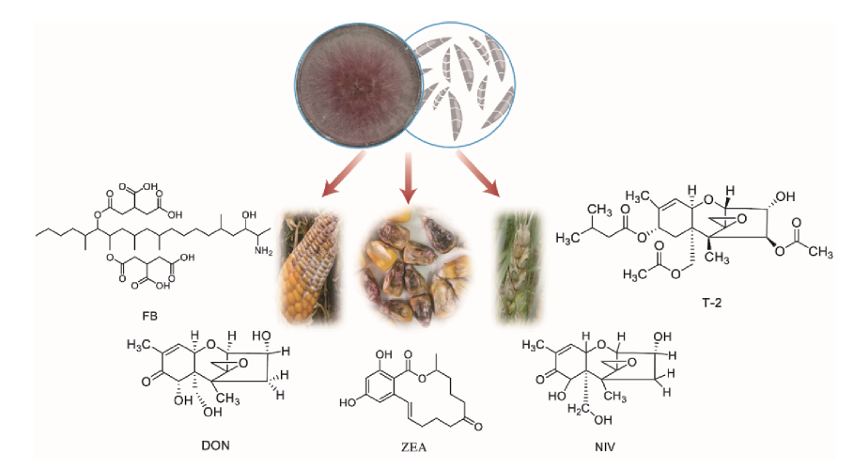
| 毒素类别 | 真菌毒素 | 缩写 | 分子式 | 摩尔质量 | 危害部位 | 参考文献 |
|---|---|---|---|---|---|---|
| 单端孢霉烯族化合物(Trichothecenes) | T-2毒素 | T-2 | C24H34O9 | 466.52 | 免疫、胃肠道和造血系统、皮肤和粘膜等 | [ |
| HT-2毒素 | HT-2 | C22H32O8 | 424.48 | [ | ||
| 蛇形菌素 | DAS | C19H26O7 | 366.41 | [ | ||
| 脱氧雪腐镰刀菌烯醇 | DON | C15H20O6 | 296.32 | [ | ||
| 雪腐镰刀菌烯醇 | NIV | C15H20O7 | 312.32 | [ | ||
| 巴豆菌素 | Crotocin | C19H24O6 | 348.39 | [ | ||
| 白僵菌素 | BEA | C45H57N3O9 | 783.96 | [ | ||
| 伏马毒素(Fumonisins) | 伏马毒素B1 | FB1 | C34H59NO15 | 721.83 | 肝脏、肾脏、神经、免疫和心血管系统、胚胎等 | [ |
| 伏马毒素B2 | FB2 | C34H59NO14 | 705.83 | [ | ||
| 伏马毒素B3 | FB3 | C34H59NO14 | 705.83 | [ | ||
| 玉米赤霉烯酮(Zearalenone) | α-玉米赤霉烯醇 | α-ZEL | C18H24O5 | 320.38 | 生殖系统、肝脏等 | [ |
| β-玉米赤霉烯醇 | β-ZEL | C18H24O5 | 320.38 | [ | ||
| 新兴真菌毒素 (Emerging Mycotoxins) | 恩镰孢菌素A | ENN A | C32H54N3O9 | 639.79 | 遗传毒性、免疫毒性和细胞毒性等 | [ |
| 恩镰孢菌素 A1 | ENN A1 | C33H57N3O9 | 655.82 | [ | ||
| 恩镰孢菌素 B | ENN B | C29H51N3O9 | 639.75 | [ | ||
| 恩镰孢菌素 B1 | ENN B1 | C30H54N3O9 | 655.78 | [ | ||
| 串珠镰刀菌素 | MON | C4H2O3 | 98.06 | [ |
| 检测技术 | 方法 | 优点 | 缺点 | 参考文献 |
|---|---|---|---|---|
| 色谱法 | 高效液相色谱法(HPLC) | 分离能力强;应用范围广 | 自身无法定性,须搭配检测器 | [ |
| 气相色谱法(GC) | 分离效率极高 | 适用范围小,不适用于热不稳定的毒素 | [ | |
| 液相色谱-质谱联用(LC-MS) | 通用性强,具有强大的定性能力 | 仪器昂贵维护成本高;操作复杂,需专业人员 | [ | |
| 液相色谱-荧光检测法(LC-FLD) | 具有极高的灵敏度 | 适用范围小,对无荧光毒素不适用 | [ | |
| 液相色谱-串联质谱(LC-MS/MS) | 抗干扰能力强,顶级的选择性与可靠性 | 操作和维护最复杂;数据解析复杂;成本高 | [ | |
| 免疫学 | 酶联免疫吸附测定(ELISA) | 高通量、批次成本低; 灵敏度和特异性高;定量能力强 | 操作复杂;分析速度慢 | [ |
| 侧向流动免疫测定(LFI) | 分析速度快,操作简单便捷 | 定量能力弱,低通量、单个成本固定 | [ | |
| 生物传感器 | 酶生物传感器 | 适用范围广;灵敏度高;分析速度快; 操作简单;单个检测成本较低 | 研发投入成本高 | [ |
| 免疫传感器 | ||||
| 适体传感器 |
| [1] |
刘登, 余海英, 骆姗, 等. 国内外粮食中主要真菌毒素污染状况及分析[J]. 粮油仓储科技通讯, 2024, 40(6):48-54.
|
| [2] |
doi: 10.1111/j.1364-3703.2009.00538.x pmid: 19400835 |
| [3] |
doi: 10.1111/j.1364-3703.2011.00783.x pmid: 22471698 |
| [4] |
doi: 10.3390/toxins15030192 URL |
| [5] |
doi: 10.3390/ijerph182211741 URL |
| [6] |
|
| [7] |
doi: 10.1080/10408398.2017.1357003 pmid: 28799776 |
| [8] |
孔德旭, 朱延光, 郑焱诚, 等. 玉米中真菌毒素的类型、污染现状及控制对策的研究进展[J]. 粮食储藏, 2024, 53(4):29-39,111.
|
| [9] |
doi: 10.1128/aem.58.12.3857-3863.1992 pmid: 1476428 |
| [10] |
林文凤, 暴怡雪, 张木清. 镰刀菌真菌毒素的分类与研究[J]. 中国糖料, 2024, 46(2):72-77.
|
| [11] |
|
| [12] |
doi: 10.3390/toxins3121518 pmid: 22295175 |
| [13] |
doi: 10.1016/j.toxicon.2022.01.011 pmid: 35104534 |
| [14] |
pmid: 15337591 |
| [15] |
doi: 10.1080/02652030500058403 pmid: 16019807 |
| [16] |
pmid: 16104354 |
| [17] |
doi: 10.1021/acs.jafc.3c09416 pmid: 38331717 |
| [18] |
doi: 10.1016/j.foodchem.2023.138057 URL |
| [19] |
doi: 10.1093/toxsci/kfs239 pmid: 22859312 |
| [20] |
doi: 10.3390/toxins2061300 pmid: 22069639 |
| [21] |
doi: 10.1007/s00204-021-03030-2 pmid: 33765170 |
| [22] |
doi: 10.1080/10408398.2019.1571479 pmid: 30761910 |
| [23] |
pmid: 8850601 |
| [24] |
doi: 10.3390/ijms9112062 pmid: 19330061 |
| [25] |
doi: 10.3390/ijms26010184 URL |
| [26] |
|
| [27] |
doi: 10.1080/09540105.2017.1341400 URL |
| [28] |
路子显, 伍松陵, 孙长坡. 玉米赤霉烯酮生物合成和降解的研究进展[J]. 中国生物工程杂志, 2011, 31(2):116-123.
|
| [29] |
doi: 10.1016/j.fct.2006.07.030 pmid: 17045381 |
| [30] |
doi: 10.3390/toxins12030149 URL |
| [31] |
doi: 10.3390/toxins8120363 URL |
| [32] |
doi: 10.1080/10408390601062021 pmid: 18274964 |
| [33] |
|
| [34] |
doi: 10.1023/A:1020679029993 |
| [35] |
doi: 10.3390/toxins5030504 pmid: 23529186 |
| [36] |
|
| [37] |
doi: 10.3390/toxins10020090 URL |
| [38] |
doi: 10.1007/s00204-025-03988-3 |
| [39] |
doi: 10.3390/toxins17020050 URL |
| [40] |
吴登辉. 粮油真菌毒素检测技术与应用分析[J]. 食品安全导刊, 2024(35):150-152.
|
| [41] |
安强. 镰刀菌毒素检测技术的研究进展[J]. 现代食品, 2024, 30(16): 202-206.
|
| [42] |
doi: 10.3390/molecules26020454 URL |
| [43] |
李蝶, 曹梅荣, 王敬, 等. 色谱技术在真菌毒素检测中的研究进展[J]. 河北省科学院学报, 2025, 42(5):58-65.
|
| [44] |
doi: 10.3390/molecules26195754 URL |
| [45] |
|
| [46] |
doi: 10.1007/s12161-021-02134-w |
| [47] |
路峰. 液相色谱质谱联用法同时测定谷物中3种真菌毒素方法的优化[J]. 食品安全导刊, 2025(19):54-57.
|
| [48] |
|
| [49] |
林小贞, 温馨, 刘阳, 等. 饲料中真菌毒素的检测[J]. 现代农业科技, 2024(22):120-123,37.
|
| [50] |
doi: 10.1002/fsn3.v8.5 URL |
| [51] |
褚洪强, 诸葛宁军, 陈赛赛, 等. 粮油食品中真菌毒素常见检测方法研究进展[J]. 食品安全质量检测学报, 2025, 16(4):1-9.
|
| [52] |
温慧娇, 廖芷晴, 靳贵英. 真菌毒素检测方法进展[J]. 中国药品标准, 2023, 24(5):465-475.
|
| [53] |
doi: 10.1016/j.foodcont.2012.04.035 URL |
| [54] |
doi: 10.1016/j.trac.2020.116087 URL |
| [55] |
doi: 10.1016/j.bios.2020.112178 URL |
| [56] |
doi: 10.3390/toxins14020073 URL |
| [57] |
doi: 10.1186/s40104-020-00531-5 |
| [58] |
doi: 10.1039/c8cs00880a pmid: 30707214 |
| [59] |
|
| [60] |
doi: 10.1186/s43014-019-0001-8 |
| [61] |
doi: 10.1016/j.aca.2008.11.010 pmid: 19110091 |
| [62] |
doi: 10.1002/mlf2.v3.2 URL |
| [63] |
doi: 10.1016/j.chroma.2020.461502 URL |
| [64] |
|
| [65] |
杨庆春, 王芳, 刘玮, 等. 新收获玉米真菌毒素研究进展[J]. 粮食与饲料工业, 2025(5):23-30.
|
| [66] |
doi: 10.1016/j.cj.2017.09.006 URL |
| [67] |
doi: 10.1094/PDIS-04-14-0398-RE pmid: 30688616 |
| [68] |
doi: 10.1094/PHYTO-04-20-0153-R URL |
| [69] |
|
| [70] |
doi: 10.1002/jsfa.7670 pmid: 26867679 |
| [71] |
doi: 10.1016/j.agsy.2021.103198 URL |
| [72] |
doi: 10.3390/agronomy12040797 URL |
| [73] |
doi: 10.1007/s00284-021-02759-4 pmid: 34994875 |
| [74] |
doi: 10.1094/PHYTO-98-9-0999 pmid: 18943738 |
| [75] |
doi: 10.1007/s00248-022-02044-2 pmid: 35604432 |
| [76] |
|
| [77] |
doi: 10.5604/17331331.1234996 URL |
| [78] |
doi: 10.3389/fmicb.2017.02710 URL |
| [79] |
doi: 10.1016/j.envpol.2020.115559 URL |
| [80] |
doi: 10.3389/fcimb.2019.00257 URL |
| [81] |
doi: 10.1080/10408398.2022.2087594 URL |
| [82] |
doi: 10.1080/10408398.2021.1878102 URL |
| [83] |
宋佳淇, 吕鹏雯, 李雪楠. 玉米中真菌毒素的富集规律及脱毒研究进展[J]. 农产品加工, 2025(6):74-81.
|
| [84] |
doi: 10.1186/s40104-021-00661-4 pmid: 35090579 |
| [85] |
doi: 10.1016/j.foodchem.2012.04.045 URL |
| [86] |
|
| [87] |
doi: 10.3390/jof7050395 URL |
| [1] | 刘开军1,2,罗少波1,王亚琴3,何晓明1,谢大森1,彭庆务1. 镰刀菌毒素对植物形态和结构的影响[J]. 中国农学通报, 2010, 26(4): 53-56. |
| [2] | 彭杰. 镰刀菌毒素研究进展[J]. 中国农学通报, 2009, 25(2): 25-27. |
| 阅读次数 | ||||||
|
全文 |
|
|||||
|
摘要 |
|
|||||
