欢迎访问《中国农学通报》,

中国农学通报 ›› 2026, Vol. 42 ›› Issue (3): 163-170.doi: 10.11924/j.issn.1000-6850.casb2025-0520
杨磊1( ), 郝焕焕2, 胡心雨1, 易克1, 荆永锋1, 黄文坤2()
收稿日期:2025-06-25
修回日期:2025-10-11
出版日期:2026-02-15
发布日期:2026-02-09
通讯作者:
作者简介:杨磊,男,1980年出生,山东潍坊人,农艺师,硕士研究生,主要从事烟草栽培技术及推广研究。通信地址:410019 湖南省长沙市雨花区万家丽中路三段188号 湖南中烟工业有限责任公司,E-mail:1092518523@qq.com。
基金资助:
YANG Lei1(), HAO Huanhuan2, HU Xinyu1, YI Ke1, JING Yongfeng1, HUANG Wenkun2()
Received:2025-06-25
Revised:2025-10-11
Published:2026-02-15
Online:2026-02-09
摘要:
针对近年来烟草病虫害发生种类多、危害重,对烟草的产量和质量造成了严重影响,及长期不合理使用化学农药,引发了农药残留超标、环境污染加剧、危害人体健康等一系列问题,为发展绿色高效防控策略,系统总结烟草病虫害的常规控制与生物防治策略,重点阐述植物源农药、天敌昆虫、微生物制剂、RNA农药及纳米递送技术等新型防控手段的最新研究进展。结果显示:(1)传统生物防治中,木霉菌、蠋蝽等对烟草黑胫病、烟蚜等防控效果显著(防效超60%);(2)RNA农药通过特异性沉默靶标基因实现精准防控,纳米递送技术可提升其稳定性与递送效率;(3)新型防控策略具有环境友好、靶标专一等优势,但存在成本高、田间稳定性不足等问题。综上,生物防治技术是烟草病虫害绿色防控的核心方向,传统生物防治与新型RNA农药各具应用价值。未来需深化防控机制研究,推动技术集成创新,优化RNA农药与纳米递送技术,为烟草绿色生产提供更全面的技术支撑。
杨磊, 郝焕焕, 胡心雨, 易克, 荆永锋, 黄文坤. 烟草病虫害生物防治技术研究进展和应用前景[J]. 中国农学通报, 2026, 42(3): 163-170.
YANG Lei, HAO Huanhuan, HU Xinyu, YI Ke, JING Yongfeng, HUANG Wenkun. Biological Control Technology of Tobacco Pests and Diseases: Current Research Status and Future Prospects[J]. Chinese Agricultural Science Bulletin, 2026, 42(3): 163-170.
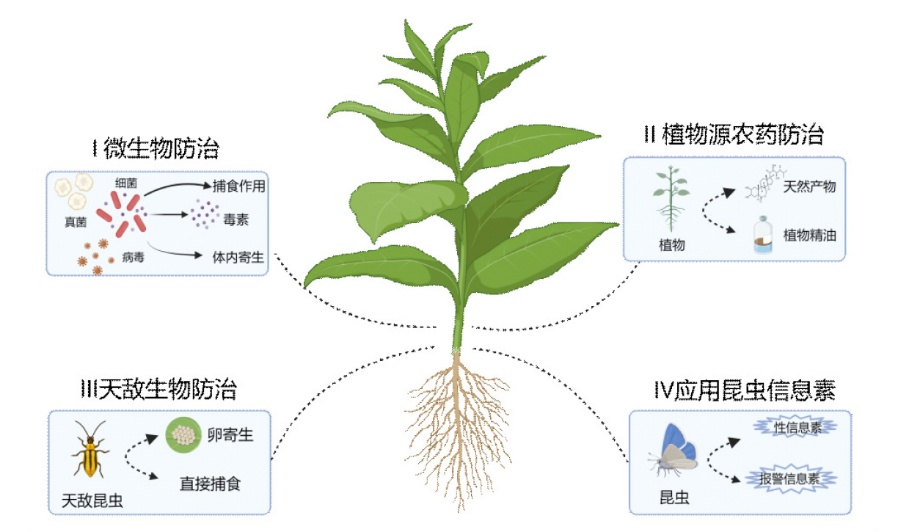
| 生物防治策略 | 具体防治方法 | 生防制剂类型举例 | 参考文献 |
|---|---|---|---|
| 传统生防策略 | 微生物防治 | 核型多角体病毒(NPV)、木霉菌、绿僵菌、苏云金杆菌(Bt)、白僵菌、芽孢杆菌 | [ |
| 植物源农药防治 | 厚朴酚、苦参碱型生物碱、植物精油、瑶药(独脚风、穿破石、贯众)、肉桂醛 | [ | |
| 天敌生物防治 | 蠋蝽雌雄成虫、蚜茧蜂、巴氏新小绥螨和剑毛帕厉螨并与球孢白僵菌 | [ | |
| 昆虫信息素 | 性诱剂、昆虫信息素缓蚀剂、报警信息素 | [ | |
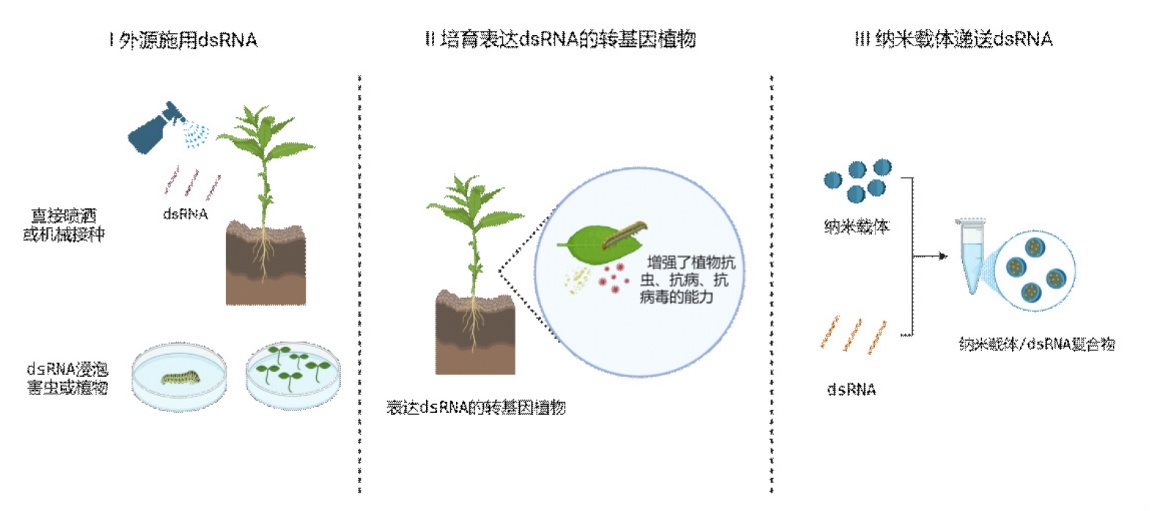
| 新型RNA农药 生防策略 | 外源施用dsRNA | 喷雾诱导,直接施于植物表面、dsRNA直接浸泡、机械接种 | [ |
| 培育表达dsRNA的 转基因植物 | 抗棉铃虫转基因烟草、抗棉粉蚧转基因烟草、抗叶斑病转基因烟草、 抗黄瓜花叶病毒转基因烟草 | [ | |
| 纳米载体递送dsRNA | pH响应型纳米粒子递送、阳离子型纳米载体递送 | [ |
| 生物防治策略 | 具体防治方法 | 生防制剂类型举例 | 参考文献 |
|---|---|---|---|
| 传统生防策略 | 微生物防治 | 核型多角体病毒(NPV)、木霉菌、绿僵菌、苏云金杆菌(Bt)、白僵菌、芽孢杆菌 | [ |
| 植物源农药防治 | 厚朴酚、苦参碱型生物碱、植物精油、瑶药(独脚风、穿破石、贯众)、肉桂醛 | [ | |
| 天敌生物防治 | 蠋蝽雌雄成虫、蚜茧蜂、巴氏新小绥螨和剑毛帕厉螨并与球孢白僵菌 | [ | |
| 昆虫信息素 | 性诱剂、昆虫信息素缓蚀剂、报警信息素 | [ | |
| 新型RNA农药 生防策略 | 外源施用dsRNA | 喷雾诱导,直接施于植物表面、dsRNA直接浸泡、机械接种 | [ |
| 培育表达dsRNA的 转基因植物 | 抗棉铃虫转基因烟草、抗棉粉蚧转基因烟草、抗叶斑病转基因烟草、 抗黄瓜花叶病毒转基因烟草 | [ | |
| 纳米载体递送dsRNA | pH响应型纳米粒子递送、阳离子型纳米载体递送 | [ |
| [1] |
陈丹阳, 甘勇, 张万金, 等. 烟草靶斑病拮抗菌的筛选鉴定及抗逆性研究[J/OL]. 四川农业大学学报, 2025, https://doi.org/10.16036/j.issn.1000-2650.202108044.
|
| [2] |
杨林, 张建华, 范嵘, 等. 烟草黑胫病的绿色防控技术[J]. 安徽农学通报, 2023, 29(13):81-84.
|
| [3] |
doi: 10.1016/j.cj.2017.12.002 URL |
| [4] |
黎听, 刘帅康, 丰慧, 等. 烟草苗期病原微生物病害发生及综合防治[J]. 植物医学, 2023, 2(5):64-70.
|
| [5] |
杜传印, 夏磊, 王德权, 等. 潍坊烟草病虫害绿色防控体系建设实践与思考[J]. 中国烟草科学, 2019, 40(4):92-98.
|
| [6] |
周然, 袁春梅, 张桃, 等. 含喹唑啉酮的查尔酮衍生物的设计、合成及生物活性研究[J]. 有机化学, 2023, 43(9):3196-3209.
doi: 10.6023/cjoc202301020 |
| [7] |
doi: 10.3389/fagro.2022.1021028 URL |
| [8] |
doi: 10.1016/j.pestbp.2024.105803 URL |
| [9] |
doi: 10.1016/j.heliyon.2023.e13810 URL |
| [10] |
黄保宏, 陈方旭, 周旋, 等. 烟草青枯病拮抗菌室内抑菌活性研究[J]. 华北农学报, 2016, 31(S1):453-457.
doi: 10.7668/hbnxb.2016.S1.077 |
| [11] |
马光祥, 夏长剑, 陈德鑫, 等. 防治烟蚜的杀虫剂筛选及对红彩瑞猎蝽安全性评价[J]. 烟草科技, 2023, 56(8):20-27.
|
| [12] |
doi: 10.1016/j.sjbs.2022.103493 URL |
| [13] |
doi: 10.3389/fmicb.2022.974024 URL |
| [14] |
罗宁, 焦阳, 茆振川, 等. 木霉菌对根结线虫和孢囊线虫防治机理研究进展[J]. 生物技术通报, 2023, 39(2):35-50.
doi: 10.13560/j.cnki.biotech.bull.1985.2022-0618 |
| [15] |
doi: 10.26480/rfna.02.2021.63.68 URL |
| [16] |
doi: 10.3390/app10248913 URL |
| [17] |
doi: 10.1039/D2NP00074A URL |
| [18] |
汪娴娴. 药用植物提取物筛选及和厚朴酚对烟草疫霉的抑制作用[D]. 青岛: 青岛农业大学, 2022.
|
| [19] |
doi: 10.1021/acs.jafc.0c06032 URL |
| [20] |
杨若颖, 李婵, 叶明亮, 等. 31种瑶药提取物抑菌活性的筛选[J]. 热带生物学报, 2019, 10(3):226-230.
|
| [21] |
doi: 10.1111/jam.12208 URL |
| [22] |
杨灿, 母银林, 汪洁, 等. 蠋蝽成虫对两种烟草害虫卵及3龄幼虫的捕食功能反应[J]. 植物保护, 2022, 48(1):158-162.
|
| [23] |
贵州省烟草公司遵义市公司. 捕食性天敌昆虫——蠋蝽[J]. 中国烟草学报, 2018, 24(4):135.
|
| [24] |
盛海红. 生物防治在烟草病虫害防治中的运用[J]. 种子科技, 2024, 42(5):109-111.
|
| [25] |
邱睿, 张昭, 李成军, 等. 烟蚜茧蜂对麦田蚜虫的防治效果[J]. 烟草科技, 2021, 54(7):35-40.
|
| [26] |
王恩东, 明蒙, 刘正玲, 等. 巴氏新小绥螨和剑毛帕厉螨与球孢白僵菌田间联合应用防治烟草西花蓟马[J]. 中国生物防治学报, 2024, 40(6):1243-1249.
doi: 10.16409/j.cnki.2095-039x.2024.07.019 |
| [27] |
范成平, 陈恩发, 乐俊明, 等. 黔中地区烟草斜纹夜蛾发生规律及田间性诱效果[J]. 贵州农业科学, 2018, 46(9):67-70.
|
| [28] |
魏波, 陈宝源, 张小娇, 等. 桃蚜对报警信息素和烟草挥发物的电生理和行为反应[J]. 应用昆虫学报, 2020, 57(1):173-180.
|
| [29] |
刘自祥, 张学义, 王贵荣, 等. 白杨透翅蛾性信息素的林间诱捕试验初报[J]. 宁夏农林科技, 2003(1):61-62.
|
| [30] |
doi: 10.1016/j.eng.2019.09.008 URL |
| [31] |
宋修仕, 高静, 周明国. 基于RNA干扰的杀菌剂开发及其对化学杀菌剂的影响[J]. 农药学学报, 2023(11):30-36.
|
| [32] |
关梅, 晁子健, 闫硕, 等. RNA农药的研究现状和发展前景[J]. 现代农药, 2023, 22(2):11-18.
|
| [33] |
高沥文, 陈世国, 张裕, 等. 基于RNA干扰的生物农药的发展现状与展望[J]. 中国生物防治学报, 2022, 38(3):700-715.
doi: 10.16409/j.cnki.2095-039x.2021.11.015 |
| [34] |
doi: 10.1038/s41598-018-25434-4 |
| [35] |
doi: 10.1038/nrg1379 pmid: 15211354 |
| [36] |
doi: 10.1016/j.cell.2009.01.035 pmid: 19239886 |
| [37] |
doi: 10.1002/ps.2016.72.issue-9 URL |
| [38] |
doi: 10.1016/j.jinsphys.2015.11.005 URL |
| [39] |
doi: 10.1002/ps.v76.9 URL |
| [40] |
doi: S2214-5745(14)00096-0 pmid: 32846691 |
| [41] |
doi: 10.1016/j.biotechadv.2019.107463 URL |
| [42] |
doi: 10.3389/fpls.2021.673576 URL |
| [43] |
doi: 10.1038/nbt1359 pmid: 17982443 |
| [44] |
|
| [45] |
王妍, 郭依, 汪汉成, 等. dsRNA-endoPGs和dsRNA-RMK1介导的RNAi对烟草靶斑病的抑制作用[J]. 烟草科技, 2023, 56(12):1-6.
|
| [46] |
|
| [47] |
doi: 10.1371/journal.pone.0038572 URL |
| [48] |
doi: 10.1038/s42003-022-03956-y |
| [49] |
衡友强, 游西龙, 王艳. 费尔干猪毛菜病程相关蛋白SfPR1a基因的异源表达增强了烟草对干旱、盐及叶斑病的抗性[J]. 作物学报, 2020, 46(4):503-512.
doi: 10.3724/SP.J.1006.2020.94082 |
| [50] |
芮鹏环, 宋培培, 蒋磊, 等. 沉默2b基因获得抗黄瓜花叶病毒(CMV)的转基因烟草[J]. 中国烟草学报, 2019, 25(1):111-115.
|
| [51] |
doi: 10.1007/s10340-019-01157-x |
| [52] |
doi: 10.1016/j.molp.2019.06.010 |
| [53] |
doi: 10.1016/j.ijbiomac.2025.141763 URL |
| [54] |
doi: 10.1002/ps.2019.75.issue-7 URL |
| [55] |
doi: 10.1186/s12951-022-01443-4 |
| [1] | 杨蕊萌, 闫国永. 黄河三角洲互花米草入侵轨迹及防治前景[J]. 中国农学通报, 2025, 41(9): 149-156. |
| [2] | 胡娟, 郭涛, 徐宏斌, 郝睿, 王斌. 气象因子对麦长管蚜种群发生量影响分析[J]. 中国农学通报, 2025, 41(33): 88-95. |
| [3] | 肖山, 柴伟纲, 刘健, 刘围围, 谌江华. 2种纳米生物农药对水稻主要害虫的田间防治效果[J]. 中国农学通报, 2025, 41(31): 137-142. |
| [4] | 王润, 魏宇, 刘宏元, 陈峰, 沈钦瑞, 王春鑫. 纳米农药控释剂的研究进展[J]. 中国农学通报, 2023, 39(12): 99-105. |
| [5] | 石笑娜, 陈红, 江旭聪, 高怡, 张孝倩, 唐小倩, 肖新. 农业园区中农业面源污染防治策略初探[J]. 中国农学通报, 2020, 36(26): 112-117. |
| [6] | 刘春来. 我国玉米茎腐病研究进展[J]. 中国农学通报, 2017, 33(30): 130-134. |
| [7] | 胡宏祥,,洪天求,马友华. Agricultural Non-point Source Pollution and Its Tactics of Preventing and Curing[J]. 中国农学通报, 2005, 21(4): 315-315. |
| 阅读次数 | ||||||
|
全文 |
|
|||||
|
摘要 |
|
|||||
