欢迎访问《中国农学通报》,

中国农学通报 ›› 2026, Vol. 42 ›› Issue (17): 1-10.doi: 10.11924/j.issn.1000-6850.casb2025-0594
• 农学·农业基础科学 • 下一篇
李堂( ), 李潜龙, 杜明, 方玉()
收稿日期:2025-07-21
修回日期:2025-12-11
出版日期:2026-09-15
发布日期:2026-09-09
通讯作者:
作者简介:李堂,女,1999年出生,湖南衡阳人,硕士,研究方向:水稻品种改良。通信地址:201506 上海市金山区亭林镇红光村共和2066号,E-mail:lt@zkwbreeding.com。
基金资助:
LI Tang(), LI Qianlong, DU Ming, FANG Yu()
Received:2025-07-21
Revised:2025-12-11
Published:2026-09-15
Online:2026-09-09
摘要:
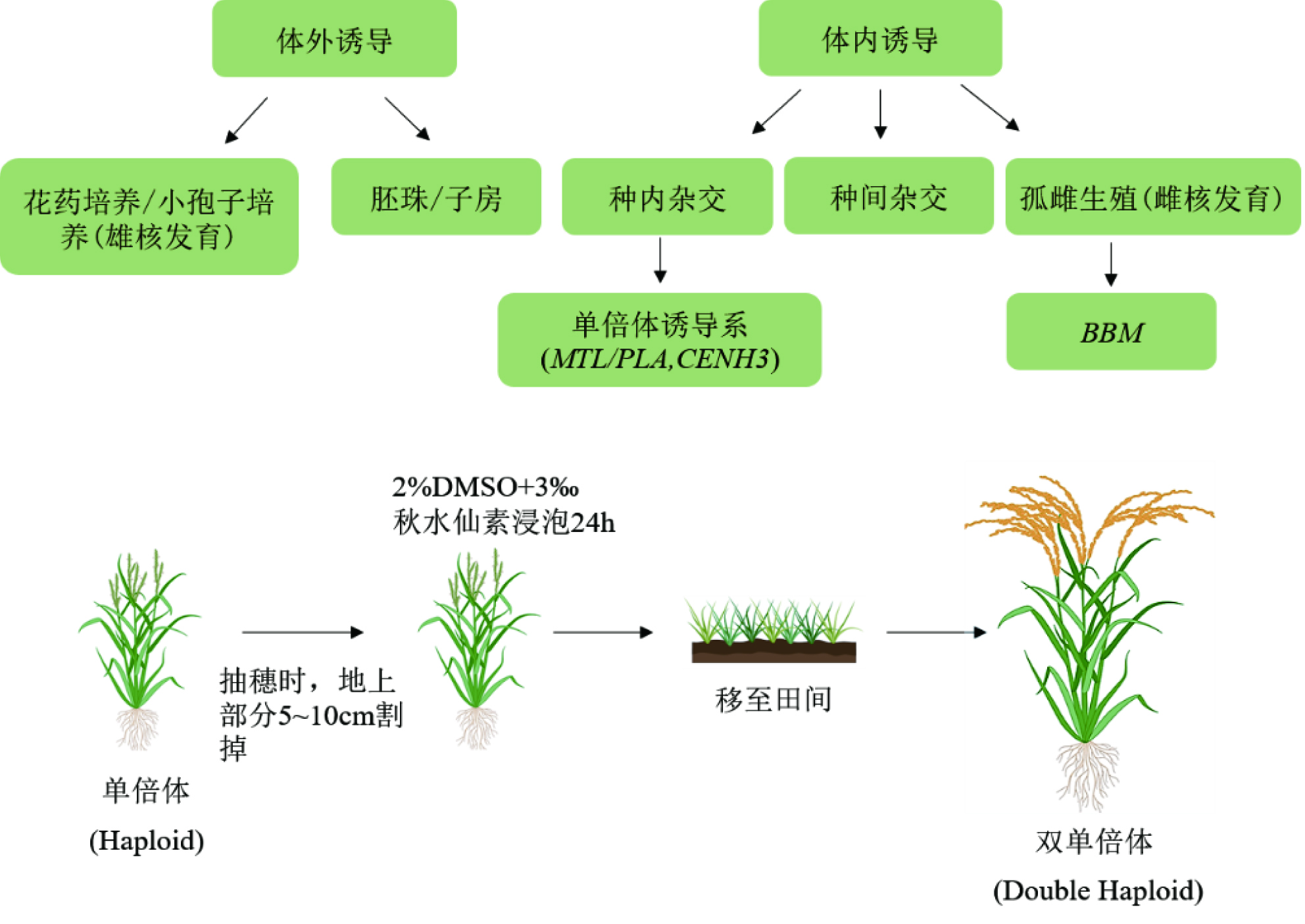
双单倍体(DH)技术能快速实现基因型纯合、缩短选育周期、提高育种效率,该技术在玉米育种中应用广泛。然而,DH技术在水稻品种选育中的研究与报道尚显不足。本文系统梳理了DH技术在水稻中的研究进展,详细阐述了单倍体诱导、染色体加倍、筛选与鉴定的关键流程,分析了其在基础研究中的多元化应用,包括构建遗传图谱、定位数量性状位点(QTLs)、在单倍体阶段进行基因编辑以快速创制纯合突变体,以及在基因组测序等前沿领域的探索。此外,还总结了DH技术在水稻新品种培育中的应用情况。针对当前单倍体技术在水稻育种过程中面临的植株矮小、存活率低、诱导效率不稳定等问题,本文提出了优化该技术的策略,例如通过利用多样化的种质资源进行杂交,在单倍体阶段进行基因编辑,以及整合分子标记辅助选择、全基因组选择或多基因协同编辑等方法。最后,本文对未来水稻DH育种的发展方向进行了前瞻性展望,以期为此项技术在水稻新品种培育中的应用提供理论参考。
中图分类号:
李堂, 李潜龙, 杜明, 方玉. 双单倍体技术在水稻育种中的应用进展[J]. 中国农学通报, 2026, 42(17): 1-10.
LI Tang, LI Qianlong, DU Ming, FANG Yu. Application Progress of Double Haploid Breeding Technology in Rice Breeding[J]. Chinese Agricultural Science Bulletin, 2026, 42(17): 1-10.
| 基因名称 | 诱导过程 | 诱导方式 | 诱导产生单倍体的原因 | 参考文献 |
|---|---|---|---|---|
| OsMTL/PLA1 | 卵细胞受精依赖性 | 孤雌生殖 | 基因突变,诱导父系基因组消除 | [ |
| OspPLAγ | 卵细胞受精依赖性 | 孤雌生殖 | 基因突变,诱导父系基因组消除 | [ |
| OsPLD | 卵细胞受精依赖性 | 孤雌生殖 | 基因突变,在磷脂酶单倍体诱导途径中具有协同作用 | [ |
| OsDMP | 卵细胞受精依赖性 | 不具备独立的单倍体诱导能力 | 与MTL互作诱导产生单倍体 | [ |
| OsCENH3 | 卵细胞受精依赖性 | 着丝粒介导,孤雌生殖 | 自身基因组消除,CENH3蛋白功能缺失,与cenh3突变体共同诱导 | [ |
| OsBBM | 卵细胞受精非依赖性 | 孤雌生殖,无融合生殖 | 卵细胞异位表达,导致亲本基因组消除 | [ |
| 基因名称 | 诱导过程 | 诱导方式 | 诱导产生单倍体的原因 | 参考文献 |
|---|---|---|---|---|
| OsMTL/PLA1 | 卵细胞受精依赖性 | 孤雌生殖 | 基因突变,诱导父系基因组消除 | [ |
| OspPLAγ | 卵细胞受精依赖性 | 孤雌生殖 | 基因突变,诱导父系基因组消除 | [ |
| OsPLD | 卵细胞受精依赖性 | 孤雌生殖 | 基因突变,在磷脂酶单倍体诱导途径中具有协同作用 | [ |
| OsDMP | 卵细胞受精依赖性 | 不具备独立的单倍体诱导能力 | 与MTL互作诱导产生单倍体 | [ |
| OsCENH3 | 卵细胞受精依赖性 | 着丝粒介导,孤雌生殖 | 自身基因组消除,CENH3蛋白功能缺失,与cenh3突变体共同诱导 | [ |
| OsBBM | 卵细胞受精非依赖性 | 孤雌生殖,无融合生殖 | 卵细胞异位表达,导致亲本基因组消除 | [ |
| [1] |
doi: 10.1186/s13007-023-01085-z |
| [2] |
|
| [3] |
|
| [4] |
黄安平, 谭炎宁, 王伟平. 水稻双单倍体育种技术研究进展[J]. 杂交水稻, 2022, 37(6):1-5.
|
| [5] |
张建军, 范昆华. “水稻双单倍体育种技术及应用研究”通过成果鉴定[J]. 上海农业学报, 1998(4):6.
|
| [6] |
doi: 10.1007/s00299-008-0601-2 URL |
| [7] |
doi: 10.1016/j.molp.2017.01.011 URL |
| [8] |
doi: 10.1038/s41477-019-0443-7 |
| [9] |
冯红玉, 姚碧娇, 陈媚, 等. 单倍体育种技术的应用进展[J]. 中国农学通报, 2021, 37(30):1-6.
doi: 10.11924/j.issn.1000-6850.casb2021-0110 |
| [10] |
陈海强, 刘会云, 王轲, 等. 植物单倍体诱导技术发展与创新[J]. 遗传, 2020, 42(5):466-482.
|
| [11] |
doi: 10.1038/s41477-020-0664-9 pmid: 32514145 |
| [12] |
王健. 水稻单倍体诱导系的开发与应用[D]. 北京: 中国农业科学院, 2023.
|
| [13] |
doi: 10.3390/plants13172531 URL |
| [14] |
doi: 10.1111/nph.19523 pmid: 38180262 |
| [15] |
文钦. 水稻孤雌生殖单倍体诱导基因OsMATL突变体的创制与分析[D]. 广州: 华南农业大学, 2021.
|
| [16] |
肖国樱, 肖友伦, 刘建丰, 等. 多抗、优质、高产杂交水稻新品种的培育[A]//中国作物学会.第二十届中国作物学会学术年会论文摘要集[C].中国科学院亚热带农业生态研究所,湖南省植物保护研究所,中国种子集团有限公司, 2023.
|
| [17] |
迟铭, 方兆伟, 李健, 等. 花药培养在水稻育种中的应用研究进展[J]. 江苏农业科学, 2011, 39(6):111-113.
|
| [18] |
王敏, 段海燕, 姜恭好, 等. 水稻花药培养技术的研究进展[J]. 中国农学通报, 2022, 38(14):18-22.
doi: 10.11924/j.issn.1000-6850.casb2021-0686 |
| [19] |
肖婉露, 马培芳, 张伟, 等. 植物小孢子培养技术研究进展[J]. 陕西农业科学, 2021, 67(12):70-73.
|
| [20] |
代金英, 郭桂梅, 程新杰, 等. 水稻F1小孢子培养再生DH系的耐盐性鉴定及稻米品质分析[J]. 大麦与谷类科学, 2022, 39(6):1-5,10.
|
| [21] |
王亮, 邢虎成, 揭雨成. 作物孤雌生殖及其应用研究进展[J]. 安徽农业科学, 2012, 40(12):6993-6995,7003.
|
| [22] |
姬亚捷, 熊杰, 邱先进, 等. 植物孤雌生殖研究进展:助力无融合生殖走向应用[J]. 遗传, 2025, 47(4):448-455.
|
| [23] |
doi: 10.1038/s41477-018-0193-y |
| [24] |
doi: 10.1534/genetics.110.120337 URL |
| [25] |
田光蕾. 基于OsCENH3基因突变创制水稻单倍体诱导系的研究[D]. 福州: 福建农林大学, 2020.
|
| [26] |
doi: 10.1111/pbi.v18.10 URL |
| [27] |
代雨婷. 水稻籼粳杂交DH群体的构建与遗传偏分离位点定位[D]. 南昌: 江西农业大学, 2023.
|
| [28] |
董俊杰, 张馨月, 富昊伟, 等. “粳不籼恢”杂交稻主要农艺性状的遗传参数分析[J]. 杂交水稻, 2023, 38(6):14-21.
|
| [29] |
井文, 杨世翌, 仇泽宇, 等. 磷脂酶在植物单倍体诱导中的功能研究进展[J]. 植物生理学报, 2023, 59(6):1091-1100.
|
| [30] |
沈任佳, 梁思怡, 郭涛, 等. 一种创制可高效固定变异的水稻单倍体诱导系的方法及其应用:CN119020519A[P]. 2024-11-26.
|
| [31] |
郭书磊, 魏昕, 魏良明, 等. 玉米单倍体诱导、加倍技术及相关机理探讨[J]. 玉米科学, 2020, 28(3):52-59,65.
|
| [32] |
王葆生, 刘湘萍, 廉勇, 等. 单倍体育种技术研究进展[J]. 北方农业学报, 2018, 46(5):44-49.
|
| [33] |
doi: 10.1007/s00122-014-2419-3 pmid: 25385333 |
| [34] |
doi: 10.1038/srep02129 |
| [35] |
doi: 10.2135/cropsci2015.10.0653 URL |
| [36] |
doi: 10.1111/tpj.v111.5 URL |
| [37] |
郭涛, 王佳峰, 黄翠红, 等. 一种基于单倍体诱导系的水稻双单倍体育种方法:CN109997683B[P]. 2019-07-12.
|
| [38] |
王克剑, 刘朝雷. 一种培育水稻两系不育系的育种方法:CN115537426A[P]. 2022-12-30.
|
| [39] |
doi: 10.1186/s12284-024-00736-6 pmid: 39249660 |
| [40] |
doi: 10.1186/s12284-018-0262-x |
| [41] |
doi: 10.1038/nature08842 |
| [42] |
doi: 10.15252/embj.201796603 URL |
| [43] |
doi: 10.3390/agriculture12060806 URL |
| [44] |
doi: 10.1016/j.xplc.2024.101067 URL |
| [45] |
doi: 10.1186/s12915-025-02140-y |
| [46] |
doi: 10.1371/journal.pone.0030947 URL |
| [47] |
安保光, 金雄霞, 王健华, 等. 一种提高单倍体诱导效率的突变型OsPLA1m1及其应用.CN116063423A[P]. 2023-05-05.
|
| [48] |
doi: 10.1038/s41477-021-01037-2 |
| [49] |
胡风越, 王健, 王春, 等. 水稻DMP1、DMP2、DMP3基因突变体的创制及其单倍体诱导能力鉴定[J]. 中国水稻科学, 2025, 39(1):55-66.
doi: 10.16819/j.1001-7216.2025.231112 |
| [50] |
doi: 10.1038/s41586-018-0785-8 |
| [51] |
doi: 10.1016/j.molp.2023.01.005 URL |
| [52] |
doi: 10.1111/pbi.14294 pmid: 38345936 |
| [53] |
doi: 10.1371/journal.pone.0092046 URL |
| [54] |
doi: 10.1016/j.biotechadv.2015.07.001 URL |
| [55] |
相志国, 海燕, 康明辉, 等. 单倍体的产生途径及其在作物遗传育种中的应用[J]. 河南农业科学, 2011, 40(11):17-21.
|
| [56] |
郭锐, 钱前, 高振宇. 水稻生物育种研究进展[J]. 中国基础科学, 2022, 24(4):9-17.
|
| [57] |
江杰. 低镉水稻突变系的综合评价与分子标记辅助花培加倍单倍体群体的构建[D]. 杭州: 浙江大学, 2020.
|
| [58] |
张馨月, 钱秋, 陈婕, 等. 分子标记辅助选择与花药培养相结合选育携带抗白叶枯病基因Xa39的水稻恢复系[J]. 浙江农业科学, 2023, 64(11):2607-2610.
doi: 10.16178/j.issn.0528-9017.20221182 |
| [59] |
黄卫峰, 闫影, 王凯, 等. 利用花药培养和分子标记辅助相结合方法选育香软型粳稻新品种[J]. 上海农业学报, 2022, 38(6):41-46.
|
| [60] |
徐华山, 周雷, 李三和, 等. 利用花药培养技术快速创制长粒型优质籼稻材料[A].中国作物学会.第十九届中国作物学会学术年会论文摘要集[C].粮食作物种质创新与遗传改良湖北省重点实验室/湖北省农业科学院粮食作物研究所, 2020.
|
| [61] |
张承妹, 陆家安, 万常照, 等. 粳型杂交稻双单倍体的遗传及其育种意义[J]. 上海农业学报, 2000(4):24-30.
|
| [62] |
王克剑, 熊杰, 姬亚杰. 一种水稻单倍体诱导方法:CN117660525B[P]. 2024-04-26.
|
| [63] |
胡兴明, 钱前. 中国杂交粳稻研究的回顾与思考[J]. 中国稻米, 2021, 27(4):9-11.
doi: 10.3969/j.issn.1006-8082.2021.04.003 |
| [64] |
doi: 10.1111/pbi.14443 pmid: 39150344 |
| [1] | 高红霞, 刘阳, 孙荣宇, 俞志宏. 内蒙古兴安盟水稻成熟期霜冻灾害风险区划[J]. 中国农学通报, 2026, 42(9): 117-123. |
| [2] | 方瑞元, 郭峰, 孙卿, 李晓英, 彭美祥, 赵孝东, 田磊, 孙伟. 花生辐照新品种‘临花16号’选育与适应性评价[J]. 中国农学通报, 2026, 42(9): 16-23. |
| [3] | 陆萍, 陈宇佳, 王站付, 张逸鸣, 蒋杭峰, 汪超凡, 张蓉, 邱韩英. 一次性基施新配比控释掺混尿素对水稻'南粳46'性状、产量及氮素利用的影响[J]. 中国农学通报, 2026, 42(8): 95-103. |
| [4] | 张洁, 邵文奇, 马洪波, 陈川, 章安康, 李传哲. 缓释氮肥对江苏水稻产量及肥料利用率的影响[J]. 中国农学通报, 2026, 42(8): 104-109. |
| [5] | 余林闯, 陈庆明, 陆云, 申关望, 祁玉良, 扶定, 余新春, 常幸远, 沈光辉. 93份水稻骨干亲本稻瘟病抗性基因分子初步鉴定及分析[J]. 中国农学通报, 2026, 42(8): 38-43. |
| [6] | 商小兰, 李丹, 方文英, 徐著, 王强, 陈照明. 机插同步侧深施肥对水稻产量和氮肥利用及土壤氮的影响[J]. 中国农学通报, 2026, 42(7): 1-7. |
| [7] | 文建川, 赖峥嵘, 吴虑, 阮玲丽, 吴必良, 梁平. 黔东南州稻瘟病发生风险等级气象预报[J]. 中国农学通报, 2026, 42(7): 171-175. |
| [8] | 顾艳, 何伟贤, 邓权清, 梅瑜, 徐世强, 李静宇, 王继华. 凉粉草种质资源、育种及栽培技术研究进展[J]. 中国农学通报, 2026, 42(5): 27-34. |
| [9] | 徐军辉, 陈丽妮, 黄芳, 连聪, 莫博程. 两种叶面阻控剂对稻米镉吸收累积的影响及健康风险评价[J]. 中国农学通报, 2026, 42(2): 113-119. |
| [10] | 赖晓凤, 孙靓雯, 李燕芳, 戴阳朔, 肖汉祥, 袁龙宇. 不同施硒水平影响水稻抗氧化和解毒作用的研究[J]. 中国农学通报, 2026, 42(17): 152-159. |
| [11] | 李春艳, 王飞, 付文敏, 牛康康, 王玮玮, 刘梦丽, 叶梦迪. 新疆南疆棉花产业发展现状及品种特性分析[J]. 中国农学通报, 2026, 42(16): 54-60. |
| [12] | 郑兴鑫, 李祖然, 段雨默, 陈玲, 曹力, 祖艳群. 水稻对镉吸收-迁移-分配的多层次互作网络及基因调控研究进展[J]. 中国农学通报, 2026, 42(15): 65-76. |
| [13] | 王宝宝, 许洛, 李中建, 冯健英, 王绍新. 鲜食甜加糯玉米‘石甜糯8号’的选育及推广模式探讨[J]. 中国农学通报, 2026, 42(15): 15-19. |
| [14] | 郭晗, 吴则东. 生物育种技术促进甜菜种质资源创新研究进展[J]. 中国农学通报, 2026, 42(15): 48-53. |
| [15] | 张敏, 王孟兰, 苏舜, 宁运旺. 新型肥料轻简化施用对水稻产量、效益和氮肥效率的影响[J]. 中国农学通报, 2026, 42(14): 63-68. |
| 阅读次数 | ||||||
|
全文 |
|
|||||
|
摘要 |
|
|||||
