欢迎访问《中国农学通报》,

中国农学通报 ›› 2025, Vol. 41 ›› Issue (36): 35-42.doi: 10.11924/j.issn.1000-6850.casb2025-0657
方毅( ), 朱宝庆, 王童欣, 李福雪, 冯建行, 杨思怡, 于旭东()
收稿日期:2025-08-06
修回日期:2025-10-11
出版日期:2025-12-25
发布日期:2025-12-25
通讯作者:
作者简介:方毅,男,2000年出生,硕士,研究方向:航天诱变育种。通信地址:571737 海南儋州宝岛新村海南大学儋州校区、海南省海南大学热带农林学院,E-mail:1260296339@qq.com。
基金资助:
FANG Yi(), ZHU Baoqing, WANG Tongxin, Li Fuxue, FENG Jianhang, YANG Siyi, YU Xudong()
Received:2025-08-06
Revised:2025-10-11
Published:2025-12-25
Online:2025-12-25
摘要:
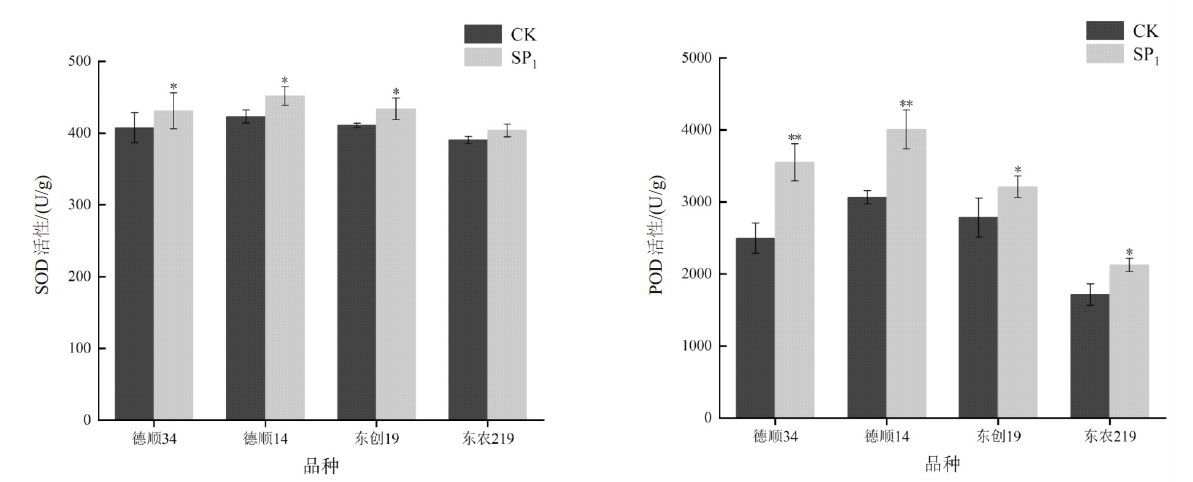
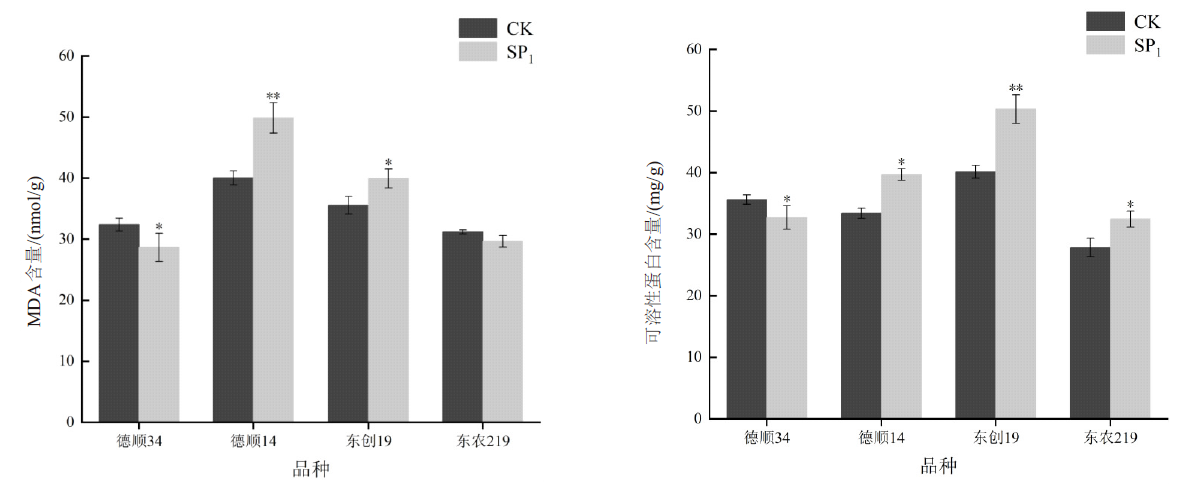
本研究旨在探究航天诱变对不同大豆品种生理指标及抗氧化酶活性的影响,为大豆种质创新与品种选育提供理论依据,同时推动航天诱变育种技术在豆科作物遗传改良中的深入应用。实验以“实践十九号”卫星搭载的4种优良大豆种子为研究对象,经航天诱变处理后返回地面进行SP1代地面种植,未经搭载的大豆种子为CK,对其生长性状、光合指标、抗氧化酶及可溶性蛋白含量进行了测定和分析。结果表明:‘德顺34’、‘东创19’发芽率较CK分别提高13.2%、17.6%,‘东创19’发芽势较CK提高9.4%;‘德顺14’叶长较CK降低8.9%,‘东农219’叶宽较CK下降28.0%;‘德顺34’株高较CK提高5.19%,‘德顺34’、‘德顺14’、‘东创19’株幅较CK分别降低53.2%、54.7%、56.3%,‘东创19’节间长较CK提高10.8%,‘东农219’分枝数较CK降低28.0%;‘东农219’单株荚数较CK提高7.7%。‘德顺14’净光合速率较对照提高17.3%。‘德顺34’、‘德顺14’POD活性较CK均有所提高;‘德顺14’MDA含量极显著高于CK;‘东创19’可溶性蛋白含量较CK极显著提高。综上所述,航天诱变导致大豆植株性状发生广泛变异,尤以株幅变化最为突出;光合指标有所改善,抗氧化酶活性及可溶性蛋白含量波动较大,其中SOD变化最小,且这些变异在不同品种间表现出差异性。
方毅, 朱宝庆, 王童欣, 李福雪, 冯建行, 杨思怡, 于旭东. 大豆种子航天诱变一代(SP1)性状研究[J]. 中国农学通报, 2025, 41(36): 35-42.
FANG Yi, ZHU Baoqing, WANG Tongxin, Li Fuxue, FENG Jianhang, YANG Siyi, YU Xudong. Study on Traits of First Generation (SP1) Soybean Seed Induced by Space Mutagenesis[J]. Chinese Agricultural Science Bulletin, 2025, 41(36): 35-42.
| 品种 | 发芽率/% | 发芽势/% | |||||
|---|---|---|---|---|---|---|---|
| 地面对照(CK) | 航天诱变(SP1) | 比CK± | 地面对照(CK) | 航天诱变(SP1) | 比CK± | ||
| 德顺34 | 50.0±1.9 | 63.2±2.1* | +13.2% | 23.0±1.1 | 26.2±1.3 | +3.2% | |
| 德顺14 | 90.0±2.4 | 73.4±2.3* | -16.6% | 43.6±1.5 | 32.2±1.8* | -11.4% | |
| 东创19 | 63.2±1.7 | 80.8±2.6* | +17.6% | 48.0±1.4 | 57.4±2.1* | +9.4% | |
| 东农219 | 82.0±2.3 | 86.6±2.2 | +4.6% | 56.8±1.2 | 60.2±2.0 | +3.4% | |
| 品种 | 发芽率/% | 发芽势/% | |||||
|---|---|---|---|---|---|---|---|
| 地面对照(CK) | 航天诱变(SP1) | 比CK± | 地面对照(CK) | 航天诱变(SP1) | 比CK± | ||
| 德顺34 | 50.0±1.9 | 63.2±2.1* | +13.2% | 23.0±1.1 | 26.2±1.3 | +3.2% | |
| 德顺14 | 90.0±2.4 | 73.4±2.3* | -16.6% | 43.6±1.5 | 32.2±1.8* | -11.4% | |
| 东创19 | 63.2±1.7 | 80.8±2.6* | +17.6% | 48.0±1.4 | 57.4±2.1* | +9.4% | |
| 东农219 | 82.0±2.3 | 86.6±2.2 | +4.6% | 56.8±1.2 | 60.2±2.0 | +3.4% | |
| 品种 | 叶长/cm | 叶宽/cm | |||||
|---|---|---|---|---|---|---|---|
| 地面对照(CK) | 航天诱变(SP1) | 比CK± | 地面对照(CK) | 航天诱变(SP1) | 比CK± | ||
| 德顺34 | 5.8±0.38 | 5.77±0.82 | -0.5% | 3.31±0.38 | 3.14±0.44* | -5.1% | |
| 德顺14 | 7.39±0.54 | 6.73±0.76** | -8.9% | 4.31±0.74 | 3.81±0.44* | -11.6% | |
| 东创19 | 7.64±0.55 | 7.06±0.51* | -7.6% | 3.61±0.42 | 3.38±0.36* | -6.4% | |
| 东农219 | 6.35±0.75 | 6.03±0.84* | -5.0% | 4.57±0.54 | 3.29±0.57** | -28.0% | |
| 品种 | 叶长/cm | 叶宽/cm | |||||
|---|---|---|---|---|---|---|---|
| 地面对照(CK) | 航天诱变(SP1) | 比CK± | 地面对照(CK) | 航天诱变(SP1) | 比CK± | ||
| 德顺34 | 5.8±0.38 | 5.77±0.82 | -0.5% | 3.31±0.38 | 3.14±0.44* | -5.1% | |
| 德顺14 | 7.39±0.54 | 6.73±0.76** | -8.9% | 4.31±0.74 | 3.81±0.44* | -11.6% | |
| 东创19 | 7.64±0.55 | 7.06±0.51* | -7.6% | 3.61±0.42 | 3.38±0.36* | -6.4% | |
| 东农219 | 6.35±0.75 | 6.03±0.84* | -5.0% | 4.57±0.54 | 3.29±0.57** | -28.0% | |
| 品种 | 株高/cm | 茎粗/mm | |||||
|---|---|---|---|---|---|---|---|
| 地面对照(CK) | 航天诱变(SP1) | 比CK± | 地面对照(CK) | 航天诱变(SP1) | 比CK± | ||
| 德顺34 | 22.54±2.88 | 23.71±2.86* | +5.19% | 1.9±0.36 | 1.7±0.44* | -10.53% | |
| 德顺14 | 20.32±2.68 | 19.42±1.91* | -4.43% | 3.8±0.43 | 3.3±0.52* | -13.16% | |
| 东创19 | 21.75±2.72 | 20.00±3.40* | -8.05% | 4.3±0.51 | 3.9±0.84* | -9.30% | |
| 东农219 | 15.35±2.19 | 15.46±2.53 | +0.72% | 4.0±0.73 | 3.7±0.86* | -7.50% | |
| 品种 | 株高/cm | 茎粗/mm | |||||
|---|---|---|---|---|---|---|---|
| 地面对照(CK) | 航天诱变(SP1) | 比CK± | 地面对照(CK) | 航天诱变(SP1) | 比CK± | ||
| 德顺34 | 22.54±2.88 | 23.71±2.86* | +5.19% | 1.9±0.36 | 1.7±0.44* | -10.53% | |
| 德顺14 | 20.32±2.68 | 19.42±1.91* | -4.43% | 3.8±0.43 | 3.3±0.52* | -13.16% | |
| 东创19 | 21.75±2.72 | 20.00±3.40* | -8.05% | 4.3±0.51 | 3.9±0.84* | -9.30% | |
| 东农219 | 15.35±2.19 | 15.46±2.53 | +0.72% | 4.0±0.73 | 3.7±0.86* | -7.50% | |
| 品种 | 株幅/cm | 底荚高/cm | |||||
|---|---|---|---|---|---|---|---|
| 地面对照(CK) | 航天诱变(SP1) | 比CK± | 地面对照(CK) | 航天诱变(SP1) | 比CK± | ||
| 德顺34 | 22.24±1.78 | 10.4±0.73** | -53.2% | 8.1±0.32 | 7.6±0.36* | -6.2% | |
| 德顺14 | 29.22±2.19 | 13.25±1.12** | -54.7% | 7.21±1.21 | 5.6±2.71** | -22.3% | |
| 东创19 | 23.0±1.75 | 10.05±1.06** | -56.3% | 5.87±1.34 | 5.2±1.56* | -11.4% | |
| 东农219 | 17.16±1.34 | 12.7±0.64* | -26.0% | 6.76±0.73 | 6.13±0.93* | -9.3% | |
| 品种 | 株幅/cm | 底荚高/cm | |||||
|---|---|---|---|---|---|---|---|
| 地面对照(CK) | 航天诱变(SP1) | 比CK± | 地面对照(CK) | 航天诱变(SP1) | 比CK± | ||
| 德顺34 | 22.24±1.78 | 10.4±0.73** | -53.2% | 8.1±0.32 | 7.6±0.36* | -6.2% | |
| 德顺14 | 29.22±2.19 | 13.25±1.12** | -54.7% | 7.21±1.21 | 5.6±2.71** | -22.3% | |
| 东创19 | 23.0±1.75 | 10.05±1.06** | -56.3% | 5.87±1.34 | 5.2±1.56* | -11.4% | |
| 东农219 | 17.16±1.34 | 12.7±0.64* | -26.0% | 6.76±0.73 | 6.13±0.93* | -9.3% | |
| 品种 | 节间长/cm | 分枝数/个 | |||||
|---|---|---|---|---|---|---|---|
| 地面对照(CK) | 航天诱变(SP1) | 比CK± | 地面对照(CK) | 航天诱变(SP1) | 比CK± | ||
| 德顺34 | 8.97±1.51 | 8.56±2.28* | -4.6% | 3.31±0.23 | 3.14±0.51* | -5.1% | |
| 德顺14 | 8.6±2.02 | 7.73±1.50** | -10.1% | 4.31±0.21 | 3.81±0.26* | -11.6% | |
| 东创19 | 7.9±2.07 | 8.75±0.49** | +10.8% | 3.61±0.30 | 3.38±0.32* | -6.4% | |
| 东农219 | 6±0.72 | 5.97±0.73 | -0.5% | 4.57±0.15 | 3.29±0.24** | -28.0% | |
| 品种 | 节间长/cm | 分枝数/个 | |||||
|---|---|---|---|---|---|---|---|
| 地面对照(CK) | 航天诱变(SP1) | 比CK± | 地面对照(CK) | 航天诱变(SP1) | 比CK± | ||
| 德顺34 | 8.97±1.51 | 8.56±2.28* | -4.6% | 3.31±0.23 | 3.14±0.51* | -5.1% | |
| 德顺14 | 8.6±2.02 | 7.73±1.50** | -10.1% | 4.31±0.21 | 3.81±0.26* | -11.6% | |
| 东创19 | 7.9±2.07 | 8.75±0.49** | +10.8% | 3.61±0.30 | 3.38±0.32* | -6.4% | |
| 东农219 | 6±0.72 | 5.97±0.73 | -0.5% | 4.57±0.15 | 3.29±0.24** | -28.0% | |
| 品种 | 单株荚数/个 | ||
|---|---|---|---|
| 地面对照(CK) | 航天诱变(SP1) | 比CK± | |
| 德顺34 | 16.23±3.27 | 14.0±5.72* | -13.7% |
| 德顺14 | 15.81±4.50 | 13.67±4.50* | -13.5% |
| 东创19 | 16.15±3.30 | 14.67±4.90* | -9.2% |
| 东农219 | 13.0±2.16 | 14.0±2.49* | +7.7% |
| 品种 | 单株荚数/个 | ||
|---|---|---|---|
| 地面对照(CK) | 航天诱变(SP1) | 比CK± | |
| 德顺34 | 16.23±3.27 | 14.0±5.72* | -13.7% |
| 德顺14 | 15.81±4.50 | 13.67±4.50* | -13.5% |
| 东创19 | 16.15±3.30 | 14.67±4.90* | -9.2% |
| 东农219 | 13.0±2.16 | 14.0±2.49* | +7.7% |
| 品种 | 净光合速率/[µmol/(m2·s)] | 气孔导度/[mol/(m2·s)] | |||||
|---|---|---|---|---|---|---|---|
| 地面对照(CK) | 航天诱变(SP1) | 比CK± | 地面对照(CK) | 航天诱变(SP1) | 比CK± | ||
| 德顺34 | 20.56±4.38 | 22.49±2.30* | +9.4% | 1.16±0.04 | 1.29±0.31* | +11.2% | |
| 德顺14 | 20.59±4.20 | 24.16±1.50** | +17.3% | 1.04±0.17 | 1.32±0.26** | +26.9% | |
| 东创19 | 19.66±3.12 | 20.86±1.49* | +6.1% | 0.65±0.21 | 0.91±0.15** | +40.0% | |
| 东农219 | 22.18±6.10 | 23.73±2.13* | +6.9% | 1.14±0.50 | 1.27±0.24* | +11.4% | |
| 品种 | 净光合速率/[µmol/(m2·s)] | 气孔导度/[mol/(m2·s)] | |||||
|---|---|---|---|---|---|---|---|
| 地面对照(CK) | 航天诱变(SP1) | 比CK± | 地面对照(CK) | 航天诱变(SP1) | 比CK± | ||
| 德顺34 | 20.56±4.38 | 22.49±2.30* | +9.4% | 1.16±0.04 | 1.29±0.31* | +11.2% | |
| 德顺14 | 20.59±4.20 | 24.16±1.50** | +17.3% | 1.04±0.17 | 1.32±0.26** | +26.9% | |
| 东创19 | 19.66±3.12 | 20.86±1.49* | +6.1% | 0.65±0.21 | 0.91±0.15** | +40.0% | |
| 东农219 | 22.18±6.10 | 23.73±2.13* | +6.9% | 1.14±0.50 | 1.27±0.24* | +11.4% | |
| 品种 | 胞间CO2浓度/(µmol/mol) | 蒸腾速率/[mmol/(m2·s)] | |||||
|---|---|---|---|---|---|---|---|
| 地面对照(CK) | 航天诱变(SP1) | 比CK± | 地面对照(CK) | 航天诱变(SP1) | 比CK± | ||
| 德顺34 | 356.03±12.32 | 374.99±11.28* | +5.3% | 15.58±2.18 | 18.13±2.31* | +16.4% | |
| 德顺14 | 362.46±17.30 | 381.48±14.50* | +5.2% | 14.34±1.64 | 19.44±2.24** | +35.6% | |
| 东创19 | 330.92±18.04 | 366.17±13.44** | +10.7% | 10.40±2.69 | 15.62±3.29** | +50.19% | |
| 东农219 | 347.75±12.39 | 368.01±10.37* | +5.8% | 14.08±3.70 | 18.01±2.38* | +27.9% | |
| 品种 | 胞间CO2浓度/(µmol/mol) | 蒸腾速率/[mmol/(m2·s)] | |||||
|---|---|---|---|---|---|---|---|
| 地面对照(CK) | 航天诱变(SP1) | 比CK± | 地面对照(CK) | 航天诱变(SP1) | 比CK± | ||
| 德顺34 | 356.03±12.32 | 374.99±11.28* | +5.3% | 15.58±2.18 | 18.13±2.31* | +16.4% | |
| 德顺14 | 362.46±17.30 | 381.48±14.50* | +5.2% | 14.34±1.64 | 19.44±2.24** | +35.6% | |
| 东创19 | 330.92±18.04 | 366.17±13.44** | +10.7% | 10.40±2.69 | 15.62±3.29** | +50.19% | |
| 东农219 | 347.75±12.39 | 368.01±10.37* | +5.8% | 14.08±3.70 | 18.01±2.38* | +27.9% | |
| [1] |
官梅. 作物航天育种研究进展[J]. 作物研究, 2009, 23(5):298-305.
|
| [2] |
潘光辉, 尹贤贵, 杨琦凤, 等. 作物航天诱变育种研究进展[J]. 西南农业学报, 2005, 18(6):853-857.
|
| [3] |
刘录祥, 郭会君, 赵林姝, 等. 我国作物航天育种20年的基本成就与展望[J]. 核农学报, 2007(6):589-592.
|
| [4] |
刘鑫磊, 马岩松, 栾晓燕, 等. 航天诱变对大豆品种光合性状的影响[J]. 大豆科学, 2011, 30(4):606-608.
|
| [5] |
吕爽, 郑伟, 郭泰, 等. 大豆航天搭载与60Co-γ辐射复合诱变效果分析[J]. 中国种业, 2012(2):34-36.
|
| [6] |
张勇, 杨兴勇, 董全中, 等. 利用空间诱变技术选育大豆新品种克山1号[J]. 核农学报, 2013, 27(9):1241-1246.
doi: 10.11869/hnxb.2013.09.1241 |
| [7] |
赵曦, 王广金, 李铁, 等. 大豆空间诱变突变体的RAPD分析[J]. 核农学报, 2014, 28(5):772-776.
doi: 10.11869/j.issn.100-8551.2014.05.0772 |
| [8] |
于绍轩, 韩粉霞, 孙君明, 等. 空间环境对大豆主要农艺性状及蛋白品质的诱变效应[J]. 核农学报, 2010, 24(3):453-459.
doi: 10.11869/hnxb.2010.03.0453 |
| [9] |
郑伟, 郭泰, 王志新, 等. 大豆航天育种研究进展[J]. 辐射研究与辐射工艺学报, 2015, 33(5):3-11.
|
| [10] |
宋兴舜, 吴迪, 刘雪梅, 等. 大青杨航天诱变植株早期抗氧化酶生化指标测定[J]. 林业科学, 2009, 45(7):145-149.
|
| [11] |
王朔楠, 孙静, 郭嘉莹, 等. 种子发芽指标及其测算方法[J]. 麦类作物学报, 2023, 43(2):190-196.
|
| [12] |
谢松青, 赵阳, 王颖. 种子发芽势对作物田间出苗率的重要性分析[J]. 现代农村科技, 2019(4):45.
|
| [13] |
何陈林, 拉喜那木吉拉, 红艳, 等. 北苍术种子萌发特性比较研究[J]. 智慧农业导刊, 2022, 2(22):23-25,28.
|
| [14] |
于国栋, 李莲芳, 孙昂, 等. 微波辐射和IBA浸种对云南松种子发芽的影响[J]. 种子, 2014, 33(5):8-12.
|
| [15] |
张玉, 白史且, 王曾珍, 等. 航天搭载菊苣种子的生物学特性研究[J]. 草业学报, 2012, 21(2):300-304.
|
| [16] |
李洁, 马甜甜, 剡转转, 等. 12C6+辐照及航天诱变对无芒隐子草种子萌发、幼苗生长及叶绿素荧光特性的影响[J]. 草业科学, 2019, 36(8):2033-2041.
|
| [17] |
彭依晴. 航天诱变柴胡SP2代优良株系田间筛选及其综合评价研究[D]. 咸阳: 西北农林科技大学, 2023.
|
| [18] |
王建丽, 申忠宝, 潘多锋, 等. 航天搭载紫羊茅SP2代农艺性状诱变效应研究[J]. 北方园艺, 2015(1):63-67.
|
| [19] |
刘自学, 郑群英, 汪玺. 6种草坪草叶片的气孔特征与气孔传导力[J]. 草业科学, 2005, 22(8):71-75.
|
| [20] |
王菲, 尹伟伦, 夏新莉, 等. 空间条件对高羊茅SP1代形态及光合生理特性的诱变效应[J]. 北京林业大学学报, 2010, 32(3):106-111.
|
| [21] |
贺鹏, 朱列书, 钟波. 航天诱变对烤烟大田期SOD活性的影响[J]. 中国农学通报, 2008, 24(7):123-125.
|
| [22] |
林善枝, 李雪平, 张志毅. 低温锻炼对毛白杨幼苗抗冻性和总可溶性蛋白质的影响[J]. 林业科学, 2002(6):137-141.
|
| [23] |
吴岳轩, 曾富华. 空间飞行对番茄种子活力及其活性氧代谢的影响[J]. 园艺学报, 1998, 25(2):165-169.
|
| [1] | 姜子健, 杨茂林, 杨晓旭, 刘畅, 刘大军, 冯国军. 脱落酸对低温胁迫下菜豆幼苗生长及抗寒性的影响[J]. 中国农学通报, 2025, 41(9): 38-46. |
| [2] | 吴素霞, 赵鹏, 范海荣, 宋士涛, 陈丽娜, 靳常敏, 崔悦. 生物有机肥对谷子生长性状的影响[J]. 中国农学通报, 2025, 41(8): 19-24. |
| [3] | 周波, 唐劲驰, 黎健龙, 陈义勇, 张曼, 崔莹莹, 黄秀鑫. 茶树叶片对干旱胁迫的生理响应[J]. 中国农学通报, 2025, 41(7): 67-74. |
| [4] | 刘娇, 胡星, 黄晓霞, 刘文革, 何明雄, 卢昌友, 罗以贵. ‘云烟116’和‘云烟300’在广西河池烟区的种植适应性[J]. 中国农学通报, 2025, 41(7): 22-28. |
| [5] | 王浩毅, 乔巍, 林玉莹, 杨昊博, 接伟光. 细菌降解大豆农药残留研究现状[J]. 中国农学通报, 2025, 41(6): 126-131. |
| [6] | 李相花, 范彩英, 徐芹, 侯剑, 王慧, 刘艳艳, 王恒, 刘光亚, 韩伟. 不同玉米大豆种植模式对作物产量、经济效益与土壤养分的影响[J]. 中国农学通报, 2025, 41(6): 22-28. |
| [7] | 汪扬媚, 刘言, 冯奎, 董红平, 刘绍文, 杨勇, 张荣, 何莲. 川西高原不同马铃薯品种农艺性状与产量的关系研究[J]. 中国农学通报, 2025, 41(6): 29-37. |
| [8] | 王心怡, 郭可为, 康仲英, 康建慧, 张贵敏, 袁涛. 牡丹和伊藤杂种复色品种的花色分类[J]. 中国农学通报, 2025, 41(6): 65-72. |
| [9] | 刘子丹, 胡彬彬, 陈玉昌, 张靖林, 费丽娜, 林金全, 陈颐, 何承刚, 姜永雷. 美引烤烟品种‘NC297’的烘烤特性分析[J]. 中国农学通报, 2025, 41(4): 134-143. |
| [10] | 闫晓花, 曹甜, 张国斌. 水分胁迫对黄瓜幼苗根系生长及抗氧化酶系统的影响[J]. 中国农学通报, 2025, 41(4): 31-38. |
| [11] | 王敏, 韩守安, 谢辉, 刘旭鹏, 麦合木提·图如普, 漆颖, 阿地里太·铁力克, 艾尔买克·才卡斯木, 潘明启, 张雯. 赤霉素穗轴涂抹处理对葡萄果实品质的影响[J]. 中国农学通报, 2025, 41(4): 44-49. |
| [12] | 张煜婷, 韩雪雪, 何芳霞, 严瑞. 50种园林小菊观赏性状综合评价[J]. 中国农学通报, 2025, 41(4): 56-65. |
| [13] | 王彦平, 王雅莹, 王志春, 曲学斌. 内蒙古东北部大豆食心虫发生气候风险区划研究[J]. 中国农学通报, 2025, 41(36): 142-148. |
| [14] | 张华英, 刘佳乐, 杨阳, 许鑫彤, 张硕, 时滢苑, 廖文佳, 董玉新. 干旱胁迫下施用不同保水剂对大豆苗期生长发育的影响[J]. 中国农学通报, 2025, 41(36): 28-34. |
| [15] | 吴亚迪, 代惠蓉, 张燕, 辛梦琦, 刘若馨, 王文波. 生物炭替代对栽培基质性质和作物生长发育的影响[J]. 中国农学通报, 2025, 41(36): 90-99. |
| 阅读次数 | ||||||
|
全文 |
|
|||||
|
摘要 |
|
|||||
