Welcome to Chinese Agricultural Science Bulletin,

Chinese Agricultural Science Bulletin ›› 2026, Vol. 42 ›› Issue (21): 198-206.doi: 10.11924/j.issn.1000-6850.casb2025-0979
Previous Articles Next Articles
LI Wenyi1( ), WU Qiuyu2, DUAN Luyao1, ZHANG Haiyan1, ZOU Chengjia1, ZHANG Zhenyu1, LI Lin1, XIAO Runtian1, LI Xiao1, CUI Lina1(), CAI Weili1()
Received:2025-12-10
Revised:2026-03-01
Online:2026-11-10
Published:2026-11-10
CLC Number:
LI Wenyi, WU Qiuyu, DUAN Luyao, ZHANG Haiyan, ZOU Chengjia, ZHANG Zhenyu, LI Lin, XIAO Runtian, LI Xiao, CUI Lina, CAI Weili. Research Advances on Classification, Detection, and Control of Fusarium Mycotoxins[J]. Chinese Agricultural Science Bulletin, 2026, 42(21): 198-206.
Add to citation manager EndNote|Ris|BibTeX
URL: https://www.casb.org.cn/EN/10.11924/j.issn.1000-6850.casb2025-0979
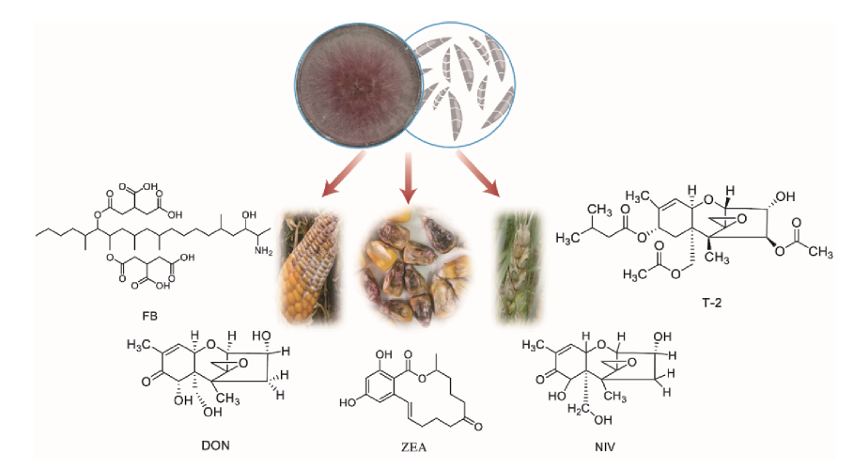
| 毒素类别 | 真菌毒素 | 缩写 | 分子式 | 摩尔质量 | 危害部位 | 参考文献 |
|---|---|---|---|---|---|---|
| 单端孢霉烯族化合物(Trichothecenes) | T-2毒素 | T-2 | C24H34O9 | 466.52 | 免疫、胃肠道和造血系统、皮肤和粘膜等 | [ |
| HT-2毒素 | HT-2 | C22H32O8 | 424.48 | [ | ||
| 蛇形菌素 | DAS | C19H26O7 | 366.41 | [ | ||
| 脱氧雪腐镰刀菌烯醇 | DON | C15H20O6 | 296.32 | [ | ||
| 雪腐镰刀菌烯醇 | NIV | C15H20O7 | 312.32 | [ | ||
| 巴豆菌素 | Crotocin | C19H24O6 | 348.39 | [ | ||
| 白僵菌素 | BEA | C45H57N3O9 | 783.96 | [ | ||
| 伏马毒素(Fumonisins) | 伏马毒素B1 | FB1 | C34H59NO15 | 721.83 | 肝脏、肾脏、神经、免疫和心血管系统、胚胎等 | [ |
| 伏马毒素B2 | FB2 | C34H59NO14 | 705.83 | [ | ||
| 伏马毒素B3 | FB3 | C34H59NO14 | 705.83 | [ | ||
| 玉米赤霉烯酮(Zearalenone) | α-玉米赤霉烯醇 | α-ZEL | C18H24O5 | 320.38 | 生殖系统、肝脏等 | [ |
| β-玉米赤霉烯醇 | β-ZEL | C18H24O5 | 320.38 | [ | ||
| 新兴真菌毒素 (Emerging Mycotoxins) | 恩镰孢菌素A | ENN A | C32H54N3O9 | 639.79 | 遗传毒性、免疫毒性和细胞毒性等 | [ |
| 恩镰孢菌素 A1 | ENN A1 | C33H57N3O9 | 655.82 | [ | ||
| 恩镰孢菌素 B | ENN B | C29H51N3O9 | 639.75 | [ | ||
| 恩镰孢菌素 B1 | ENN B1 | C30H54N3O9 | 655.78 | [ | ||
| 串珠镰刀菌素 | MON | C4H2O3 | 98.06 | [ |
| 检测技术 | 方法 | 优点 | 缺点 | 参考文献 |
|---|---|---|---|---|
| 色谱法 | 高效液相色谱法(HPLC) | 分离能力强;应用范围广 | 自身无法定性,须搭配检测器 | [ |
| 气相色谱法(GC) | 分离效率极高 | 适用范围小,不适用于热不稳定的毒素 | [ | |
| 液相色谱-质谱联用(LC-MS) | 通用性强,具有强大的定性能力 | 仪器昂贵维护成本高;操作复杂,需专业人员 | [ | |
| 液相色谱-荧光检测法(LC-FLD) | 具有极高的灵敏度 | 适用范围小,对无荧光毒素不适用 | [ | |
| 液相色谱-串联质谱(LC-MS/MS) | 抗干扰能力强,顶级的选择性与可靠性 | 操作和维护最复杂;数据解析复杂;成本高 | [ | |
| 免疫学 | 酶联免疫吸附测定(ELISA) | 高通量、批次成本低; 灵敏度和特异性高;定量能力强 | 操作复杂;分析速度慢 | [ |
| 侧向流动免疫测定(LFI) | 分析速度快,操作简单便捷 | 定量能力弱,低通量、单个成本固定 | [ | |
| 生物传感器 | 酶生物传感器 | 适用范围广;灵敏度高;分析速度快; 操作简单;单个检测成本较低 | 研发投入成本高 | [ |
| 免疫传感器 | ||||
| 适体传感器 |
| [1] |
刘登, 余海英, 骆姗, 等. 国内外粮食中主要真菌毒素污染状况及分析[J]. 粮油仓储科技通讯, 2024, 40(6):48-54.
|
| [2] |
doi: 10.1111/j.1364-3703.2009.00538.x pmid: 19400835 |
| [3] |
doi: 10.1111/j.1364-3703.2011.00783.x pmid: 22471698 |
| [4] |
doi: 10.3390/toxins15030192 URL |
| [5] |
doi: 10.3390/ijerph182211741 URL |
| [6] |
|
| [7] |
doi: 10.1080/10408398.2017.1357003 pmid: 28799776 |
| [8] |
孔德旭, 朱延光, 郑焱诚, 等. 玉米中真菌毒素的类型、污染现状及控制对策的研究进展[J]. 粮食储藏, 2024, 53(4):29-39,111.
|
| [9] |
doi: 10.1128/aem.58.12.3857-3863.1992 pmid: 1476428 |
| [10] |
林文凤, 暴怡雪, 张木清. 镰刀菌真菌毒素的分类与研究[J]. 中国糖料, 2024, 46(2):72-77.
|
| [11] |
|
| [12] |
doi: 10.3390/toxins3121518 pmid: 22295175 |
| [13] |
doi: 10.1016/j.toxicon.2022.01.011 pmid: 35104534 |
| [14] |
pmid: 15337591 |
| [15] |
doi: 10.1080/02652030500058403 pmid: 16019807 |
| [16] |
pmid: 16104354 |
| [17] |
doi: 10.1021/acs.jafc.3c09416 pmid: 38331717 |
| [18] |
doi: 10.1016/j.foodchem.2023.138057 URL |
| [19] |
doi: 10.1093/toxsci/kfs239 pmid: 22859312 |
| [20] |
doi: 10.3390/toxins2061300 pmid: 22069639 |
| [21] |
doi: 10.1007/s00204-021-03030-2 pmid: 33765170 |
| [22] |
doi: 10.1080/10408398.2019.1571479 pmid: 30761910 |
| [23] |
pmid: 8850601 |
| [24] |
doi: 10.3390/ijms9112062 pmid: 19330061 |
| [25] |
doi: 10.3390/ijms26010184 URL |
| [26] |
|
| [27] |
doi: 10.1080/09540105.2017.1341400 URL |
| [28] |
路子显, 伍松陵, 孙长坡. 玉米赤霉烯酮生物合成和降解的研究进展[J]. 中国生物工程杂志, 2011, 31(2):116-123.
|
| [29] |
doi: 10.1016/j.fct.2006.07.030 pmid: 17045381 |
| [30] |
doi: 10.3390/toxins12030149 URL |
| [31] |
doi: 10.3390/toxins8120363 URL |
| [32] |
doi: 10.1080/10408390601062021 pmid: 18274964 |
| [33] |
|
| [34] |
doi: 10.1023/A:1020679029993 |
| [35] |
doi: 10.3390/toxins5030504 pmid: 23529186 |
| [36] |
|
| [37] |
doi: 10.3390/toxins10020090 URL |
| [38] |
doi: 10.1007/s00204-025-03988-3 |
| [39] |
doi: 10.3390/toxins17020050 URL |
| [40] |
吴登辉. 粮油真菌毒素检测技术与应用分析[J]. 食品安全导刊, 2024(35):150-152.
|
| [41] |
安强. 镰刀菌毒素检测技术的研究进展[J]. 现代食品, 2024, 30(16): 202-206.
|
| [42] |
doi: 10.3390/molecules26020454 URL |
| [43] |
李蝶, 曹梅荣, 王敬, 等. 色谱技术在真菌毒素检测中的研究进展[J]. 河北省科学院学报, 2025, 42(5):58-65.
|
| [44] |
doi: 10.3390/molecules26195754 URL |
| [45] |
|
| [46] |
doi: 10.1007/s12161-021-02134-w |
| [47] |
路峰. 液相色谱质谱联用法同时测定谷物中3种真菌毒素方法的优化[J]. 食品安全导刊, 2025(19):54-57.
|
| [48] |
|
| [49] |
林小贞, 温馨, 刘阳, 等. 饲料中真菌毒素的检测[J]. 现代农业科技, 2024(22):120-123,37.
|
| [50] |
doi: 10.1002/fsn3.v8.5 URL |
| [51] |
褚洪强, 诸葛宁军, 陈赛赛, 等. 粮油食品中真菌毒素常见检测方法研究进展[J]. 食品安全质量检测学报, 2025, 16(4):1-9.
|
| [52] |
温慧娇, 廖芷晴, 靳贵英. 真菌毒素检测方法进展[J]. 中国药品标准, 2023, 24(5):465-475.
|
| [53] |
doi: 10.1016/j.foodcont.2012.04.035 URL |
| [54] |
doi: 10.1016/j.trac.2020.116087 URL |
| [55] |
doi: 10.1016/j.bios.2020.112178 URL |
| [56] |
doi: 10.3390/toxins14020073 URL |
| [57] |
doi: 10.1186/s40104-020-00531-5 |
| [58] |
doi: 10.1039/c8cs00880a pmid: 30707214 |
| [59] |
|
| [60] |
doi: 10.1186/s43014-019-0001-8 |
| [61] |
doi: 10.1016/j.aca.2008.11.010 pmid: 19110091 |
| [62] |
doi: 10.1002/mlf2.v3.2 URL |
| [63] |
doi: 10.1016/j.chroma.2020.461502 URL |
| [64] |
|
| [65] |
杨庆春, 王芳, 刘玮, 等. 新收获玉米真菌毒素研究进展[J]. 粮食与饲料工业, 2025(5):23-30.
|
| [66] |
doi: 10.1016/j.cj.2017.09.006 URL |
| [67] |
doi: 10.1094/PDIS-04-14-0398-RE pmid: 30688616 |
| [68] |
doi: 10.1094/PHYTO-04-20-0153-R URL |
| [69] |
|
| [70] |
doi: 10.1002/jsfa.7670 pmid: 26867679 |
| [71] |
doi: 10.1016/j.agsy.2021.103198 URL |
| [72] |
doi: 10.3390/agronomy12040797 URL |
| [73] |
doi: 10.1007/s00284-021-02759-4 pmid: 34994875 |
| [74] |
doi: 10.1094/PHYTO-98-9-0999 pmid: 18943738 |
| [75] |
doi: 10.1007/s00248-022-02044-2 pmid: 35604432 |
| [76] |
|
| [77] |
doi: 10.5604/17331331.1234996 URL |
| [78] |
doi: 10.3389/fmicb.2017.02710 URL |
| [79] |
doi: 10.1016/j.envpol.2020.115559 URL |
| [80] |
doi: 10.3389/fcimb.2019.00257 URL |
| [81] |
doi: 10.1080/10408398.2022.2087594 URL |
| [82] |
doi: 10.1080/10408398.2021.1878102 URL |
| [83] |
宋佳淇, 吕鹏雯, 李雪楠. 玉米中真菌毒素的富集规律及脱毒研究进展[J]. 农产品加工, 2025(6):74-81.
|
| [84] |
doi: 10.1186/s40104-021-00661-4 pmid: 35090579 |
| [85] |
doi: 10.1016/j.foodchem.2012.04.045 URL |
| [86] |
|
| [87] |
doi: 10.3390/jof7050395 URL |
| No related articles found! |
| Viewed | ||||||
|
Full text |
|
|||||
|
Abstract |
|
|||||
