Welcome to Chinese Agricultural Science Bulletin,

Chinese Agricultural Science Bulletin ›› 2026, Vol. 42 ›› Issue (2): 191-197.doi: 10.11924/j.issn.1000-6850.casb2025-0302
Previous Articles Next Articles
MA Juan( ), LA Zhen, HU Mingzhu, DAI Jinxia()
Received:2025-04-26
Revised:2025-08-15
Online:2026-01-25
Published:2026-01-22
MA Juan, LA Zhen, HU Mingzhu, DAI Jinxia. Analysis of Endophytic Bacteria Diversity and Community Composition in Soft Rot and Healthy Plant of Allium fistulosum in Tongxin of Ningxia[J]. Chinese Agricultural Science Bulletin, 2026, 42(2): 191-197.
Add to citation manager EndNote|Ris|BibTeX
URL: https://www.casb.org.cn/EN/10.11924/j.issn.1000-6850.casb2025-0302
| 样本 | Coverage指数 | Shannon指数 | Simpson指数 | Ace指数 | Sobs指数 | Chao1指数 |
|---|---|---|---|---|---|---|
| DS | 0.9994a | 2.3556b | 0.1996a | 156.2565b | 109.6667b | 143.3889b |
| HS | 0.9992a | 4.6755a | 0.0436b | 620.1888a | 610.6667a | 621.3491a |
| 样本 | Coverage指数 | Shannon指数 | Simpson指数 | Ace指数 | Sobs指数 | Chao1指数 |
|---|---|---|---|---|---|---|
| DS | 0.9994a | 2.3556b | 0.1996a | 156.2565b | 109.6667b | 143.3889b |
| HS | 0.9992a | 4.6755a | 0.0436b | 620.1888a | 610.6667a | 621.3491a |

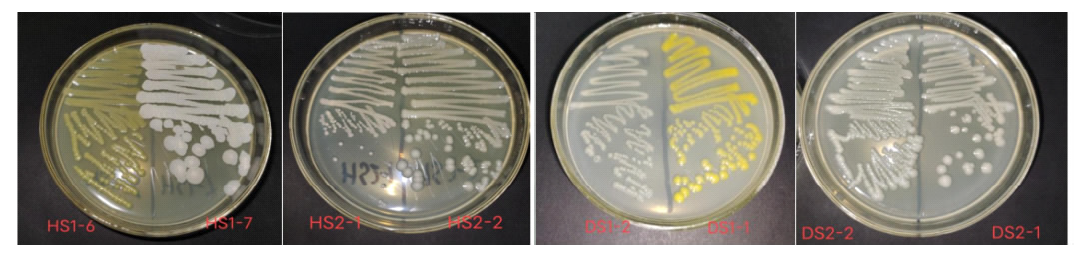
| 菌株 | 革兰氏染色 | H2O2 酶 | 淀粉水解 | V.P实验 | 甲基红试验 | 硝酸盐还原 | 明胶液化 |
|---|---|---|---|---|---|---|---|
| DS1-1 | - | + | + | + | - | + | + |
| DS1-2 | - | + | + | - | + | + | - |
| DS1-3 | - | + | - | - | - | + | - |
| DS1-4 | - | + | - | + | - | + | - |
| DS1-5 | - | + | - | + | - | + | - |
| DS2-1 | + | + | - | + | - | - | - |
| DS2-2 | - | + | - | - | - | + | - |
| DS2-5 | - | + | - | - | - | + | - |
| DS3-2 | - | + | - | + | - | - | + |
| DS3-3 | - | + | - | - | - | + | - |
| DS3-5 | - | + | - | + | - | + | - |
| HS3-7 | - | + | - | - | - | + | + |
| HS2-5 | + | + | + | + | - | - | - |
| 菌株 | 革兰氏染色 | H2O2 酶 | 淀粉水解 | V.P实验 | 甲基红试验 | 硝酸盐还原 | 明胶液化 |
|---|---|---|---|---|---|---|---|
| DS1-1 | - | + | + | + | - | + | + |
| DS1-2 | - | + | + | - | + | + | - |
| DS1-3 | - | + | - | - | - | + | - |
| DS1-4 | - | + | - | + | - | + | - |
| DS1-5 | - | + | - | + | - | + | - |
| DS2-1 | + | + | - | + | - | - | - |
| DS2-2 | - | + | - | - | - | + | - |
| DS2-5 | - | + | - | - | - | + | - |
| DS3-2 | - | + | - | + | - | - | + |
| DS3-3 | - | + | - | - | - | + | - |
| DS3-5 | - | + | - | + | - | + | - |
| HS3-7 | - | + | - | - | - | + | + |
| HS2-5 | + | + | + | + | - | - | - |
| [6] |
李晓颖, 田宇, 张瑾, 等. 大白菜软腐病新病原菌Pectobacterium aroidearum的鉴定及其生物学特性[J]. 植物病理学报, 2018, 48(4):455-465.
doi: 10.13926/j.cnki.apps.000136 |
| [7] |
|
| [8] |
|
| [9] |
|
| [10] |
程亮. 西北地区马铃薯软腐病和黑胫病致病菌鉴定及特性分析[J]. 中国农业科技导报, 2020, 22(7):106-116.
doi: 10.13304/j.nykjdb.2019.0138 |
| [11] |
doi: 10.1016/j.micpath.2023.106497 URL |
| [12] |
杜婵娟, 杨迪, 付岗, 等. 广西香蕉细菌性软腐病病原鉴定及生物学特性研究[J]. 植物保护, 2019, 45(5):148-156.
|
| [13] |
刘坤, 孙文松, 张天静, 等一株人参细菌性软腐病致病假单胞菌的基因组特征与毒力基因分析[J]. 微生物学通报, 2024, 51(11):4667-4686.
|
| [14] |
田保华. 葱属种质资源遗传多样性研[D]. 晋中: 山西大学, 2011.
|
| [15] |
方海田, 刘慧燕, 张光弟, 等. 宁夏3种葱属蔬菜的挥发性成分比较分析[J]. 中国调味品, 2018, 43(11):145-149.
|
| [16] |
吴庆, 刘耀峰, 方海田, 等. 红葱种质资源主要品质性状的分析研究[J]. 中国调味品, 2015, 40(10):11-14.
|
| [17] |
张志轩. 大葱软腐病发生和流行的原因及其绿色防控技术[J]. 中国瓜菜, 2021, 34(1):102-104.
|
| [18] |
东秀珠, 蔡妙英. 常见细菌系统鉴定手册[M]. 北京: 科学出版社, 2001.
|
| [19] |
doi: 10.1002/nt.v1:3 URL |
| [1] |
|
| [2] |
doi: 10.1094/PDIS-09-20-2089-RE URL |
| [3] |
doi: 10.1146/annurev-micro-041222-012242 pmid: 39565948 |
| [4] |
doi: 10.3390/ijms242417553 URL |
| [5] |
doi: 10.1094/PDIS-05-16-0763-RE URL |
| [20] |
张绍智, 田庆红, 董坤, 等. 云南两个花魔芋主产区软腐病害植株腐烂球茎中的菌群组成及特征[J]. 微生物学报, 2024, 64(7):2434-2452.
|
| [21] |
何斐, 田孝威, 雷雨俊, 等. 连作花魔芋软腐病株与健株根域丛枝菌根真菌群落多样性[J]. 微生物学报, 2022, 62(8):3092-3108.
|
| [22] |
|
| [23] |
王寅寒, 谭志琼, 刘海, 等. 丹尼斯凤梨细菌性软腐病拮抗细菌的筛选及鉴定[J]. 广东农业科学, 2012(20):63-67.
|
| [24] |
doi: 10.1002/ps.1800 pmid: 19504536 |
| [25] |
doi: 10.1099/ijsem.0.004123 URL |
| [1] | WANG Chenlong, MIN Jie, LIANG Rui, TAN Xiongyu, WANG Shuo, Umut Hasan. Composition and Diversity of Microbial Bacterial Communities in Paddy Rice Rhizosphere Soil [J]. Chinese Agricultural Science Bulletin, 2025, 41(4): 84-93. |
| [2] | ZHAO Xinxin, WEI Yundong, ZHOU Shiyi, CHEN Ruirui, LI Jun, ZHENG Hua. Rhizosphere Microecological Difference of Different Cassava Cultivars Based on Root Bag Method [J]. Chinese Agricultural Science Bulletin, 2025, 41(31): 60-71. |
| [3] | XIANG Guiqin, YE Yang, ZHANG Nan, GUO Huijuan. Effects of Saline and Alkaline Stress on Abundance and Diversity of Community of Ammonia Oxidizing Microorganisms in Gray Desert Soil [J]. Chinese Agricultural Science Bulletin, 2025, 41(30): 79-89. |
| [4] | GAO Huan, CHENG Wenli, WANG Yiru, WANG Haoyang, CHEN Dongbo, WANG Yang. Isolation and Identification of Endophytic Bacteria in Tomato Seeds and Their Effect for Seed Germination [J]. Chinese Agricultural Science Bulletin, 2025, 41(30): 52-59. |
| [5] | HAN Yao, YANG Xiaoyan, XIE Shuzhang. Contaminated Microorganisms in Plant Tissue Culture: Isolation and Identification and Fungicides Screening [J]. Chinese Agricultural Science Bulletin, 2025, 41(3): 131-138. |
| [6] | ZHANG Shoumei, SHAO Xuehua. Effects of Azadirachtin on Gut Microbiota and Metabolic Function of Bactrocera dorsalis [J]. Chinese Agricultural Science Bulletin, 2025, 41(28): 122-130. |
| [7] | GU Xin, REN Cuimei, FENG Peng, WANG Lina, ZHANG Hongyu, LI Na, SONG Minchao, WANG Di. Effects of Different Amendments on Soil Bacterial Community Structure and Growth of Oats in Saline-alkali Soda Land [J]. Chinese Agricultural Science Bulletin, 2025, 41(21): 107-113. |
| [8] | TANG Xu, TIAN Hui, ZHANG Haoran, CHAI Guohua, WU Xiuwen. Effects of Exogenous L-aspartic Acid Nano-calcium on Physical and Chemical Properties and Microbial Community Distribution in Cadmium Contaminated Soil [J]. Chinese Agricultural Science Bulletin, 2025, 41(2): 98-108. |
| [9] | LIU Donghai, DAI Zhigang, MEI Liangxian, QIAO Yan, ZHANG Zhi, XIAO Zhuoxi, LI Fei, HU Cheng. Effects of Short-term Fertilization on Soil Bacterial Community Composition and Diversity in Wheat Fields [J]. Chinese Agricultural Science Bulletin, 2025, 41(2): 43-48. |
| [10] | LIU Yanchao, WENG Shiyang, WEI Cong. Comparative Study on Gut Microbial Diversity of Three Fish Species in Nujiang River in Xizang [J]. Chinese Agricultural Science Bulletin, 2025, 41(2): 149-156. |
| [11] | CHEN Jie, LONG Ting, CAO Yirong, SUN Ganlin, WANG Wenqian, SHEN Kaiyuan, JIN Sitong, CAI Haosheng, CHEN Bin. Isolation and Identification of Culturable Intestinal Bacteria of Holotrichia scrobiculata Brenske Feeding on Ginkgo biloba [J]. Chinese Agricultural Science Bulletin, 2025, 41(2): 123-132. |
| [12] | JIN Yongping, LIU Lianjin, REN Jing, FA Ze, LI Jinhua, WANG Huiling, WU Wentao, ZHU Youyong, HE Xiahong, GUO Liwei. Effects of Growth, Root Rot Disease, and Rhizosphere Microbial Community Structure of Panax notoginseng: A Combined Application of L-Lysine and Trichoderma harzianum [J]. Chinese Agricultural Science Bulletin, 2025, 41(17): 115-125. |
| [13] | WANG Jia, ZHOU Debao, ZHANG Junsheng, QIAN Yingying, Mansoor HAYAT, WANG Zhanbin. High-throughput Sequencing Analysis of Leaf Disease of Pinus sylvestris var. mongolica and Diversity of Interleaf Fungal Communities [J]. Chinese Agricultural Science Bulletin, 2024, 40(5): 27-33. |
| [14] | WANG Yue, CAO Chunmei, CHEN Han, WANG Xiaojiao, YU Qianpeng, LI Xueyang, ZHANG Zhikai, HU Baigeng. Species and Pathogenicity Identification of Streptomyces Species Causing Potato Common Scab in Ulanqab Area [J]. Chinese Agricultural Science Bulletin, 2024, 40(32): 151-156. |
| [15] | LANG Tao, YANG Feiyang, PU Zhigang, ZHANG Cong, LI Ming, YU Ma, QU Huijuan, WU Jingyu, ZHANG Lu, DIAO Du, FENG Junyan. Application of Transcriptome Sequencing Technology in Sweetpotato (Ipomoea batatas L.) Research [J]. Chinese Agricultural Science Bulletin, 2024, 40(30): 94-102. |
| Viewed | ||||||
|
Full text |
|
|||||
|
Abstract |
|
|||||
