Welcome to Chinese Agricultural Science Bulletin,

Chinese Agricultural Science Bulletin ›› 2026, Vol. 42 ›› Issue (19): 1-8.doi: 10.11924/j.issn.1000-6850.casb2026-0149
WU Zexin1,2( ), WANG Jinming1,2, ZHANG Lijun1,2, CHEN Chao1,3, WU Rugang4()
Received:2026-02-14
Revised:2026-06-03
Online:2026-10-15
Published:2026-10-15
CLC Number:
WU Zexin, WANG Jinming, ZHANG Lijun, CHEN Chao, WU Rugang. Effects of Sowing Date and Sowing Rate on Growth and Development and Yield of Winter Wheat[J]. Chinese Agricultural Science Bulletin, 2026, 42(19): 1-8.
Add to citation manager EndNote|Ris|BibTeX
URL: https://www.casb.org.cn/EN/10.11924/j.issn.1000-6850.casb2026-0149
| 物候期 | 播期 | 播量 | |||||||
|---|---|---|---|---|---|---|---|---|---|
| B1 | B2 | B3 | B4 | B5 | L1 | L2 | L3 | ||
| 越冬开始 | 5.7±0.6 | 3.9±0.4 | 2.6±0.4 | 1.5±0.2 | 0.2±0.1 | 2.4±1.5 | 2.6±1.5 | 3.3±1.8 | |
| 返青期 | 5.8±0.4 | 4.2±0.3 | 2.9±0.5 | 1.6±0.3 | 0.2±0.1 | 2.6±1.6 | 2.7±1.5 | 3.4±1.9 | |
| 物候期 | 播期 | 播量 | |||||||
|---|---|---|---|---|---|---|---|---|---|
| B1 | B2 | B3 | B4 | B5 | L1 | L2 | L3 | ||
| 越冬开始 | 5.7±0.6 | 3.9±0.4 | 2.6±0.4 | 1.5±0.2 | 0.2±0.1 | 2.4±1.5 | 2.6±1.5 | 3.3±1.8 | |
| 返青期 | 5.8±0.4 | 4.2±0.3 | 2.9±0.5 | 1.6±0.3 | 0.2±0.1 | 2.6±1.6 | 2.7±1.5 | 3.4±1.9 | |
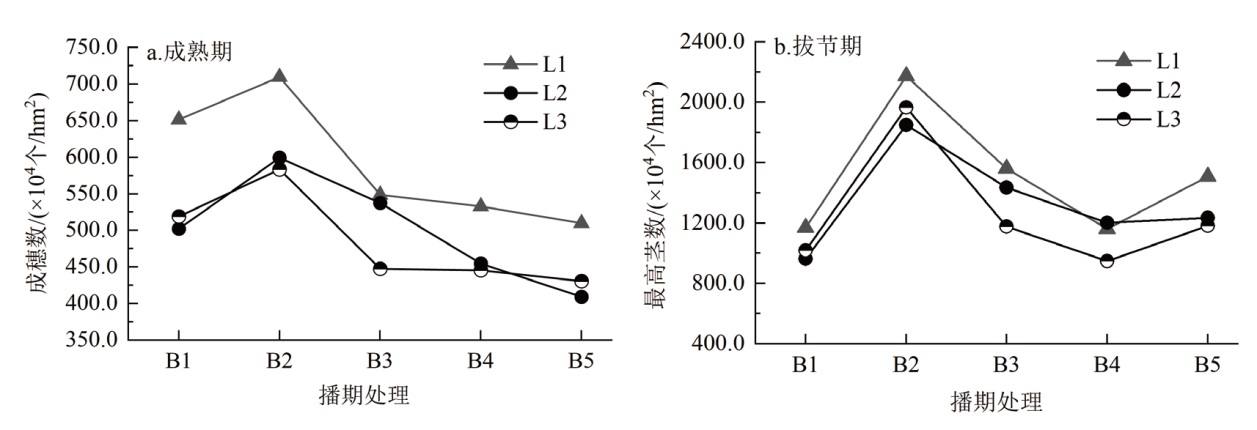
| 播期 | 播量 | 成穗数/(×104个/hm2) | 穗粒数/粒 | 千粒重/g | 产量/(kg/hm2) |
|---|---|---|---|---|---|
| B1 | L1 | 651.7±15.1 bcdeK | 35.3±2.5deK | 35.9±1.3e | 8489.3±148.2acdeK |
| L2 | 502.1±35.5 bcdeK | 34.8±3.3deK | 39.9±1.3e | 8333.7±133.3acdeK | |
| L3 | 519.1±14.0 bcdeK | 34.9±4.1deGI | 33.3±1.9e | 8089.4±148.2acdeGI | |
| B2 | L1 | 709.5±21.1 acdeK | 38.0±2.9eK | 42.3±1.4e | 8756.0±148.2bcdeK |
| L2 | 599.5±35.0 acdeK | 37.1±3.1eK | 41.0±1.5e | 8889.3±163.0bcdeK | |
| L3 | 583.7±30.6 acdeK | 39.8±2.6eGI | 38.9±1.2e | 8667.2±88.9bcdeGI | |
| B3 | L1 | 548.5±22.3abdeK | 33.8±2.5eK | 40.7±1.3e | 8355.9±103.7abeK |
| L2 | 537.3±19.7abdeK | 39.6±3.5eK | 42.0±1.2e | 7844.9±148.2abeK | |
| L3 | 447.7±13.3abdeGI | 42.6±2.6eGI | 36.8±1.1e | 7200.3±222.2abeGI | |
| B4 | L1 | 532.7±22.5abceK | 38.4±3.9aK | 41.9±1.2e | 8133.8±88.9abeK |
| L2 | 454.5±20.3abceK | 42.1±2.9aK | 43.2±1.4e | 7689.3±251.9abeK | |
| L3 | 445.5±24.4abceGI | 46.4±3.7aGI | 41.2±1.0e | 6778.1±296.3abeGI | |
| B5 | L1 | 510.0±16.4abcdK | 39.1±2.3aK | 40.5±0.6abcd | 4266.9±222.2abcdK |
| L2 | 409.1±14.3abcdK | 38.1±3.3aK | 42.1±0.7abcd | 4400.3±400.0abcdK | |
| L3 | 430.7±18.2abcdGI | 51.3±3.5aGI | 41.8±0.7abcd | 4644.8±414.8ancdGI | |
| F播期 | 70.971** | 5.369* | 2.603* | 279.870** | |
| F播量 | 75.099** | 8.764** | 2.262 | 11.479** | |
| F播期×播量 | 23.984* | 1.799 | 0.442 | 4.361** | |
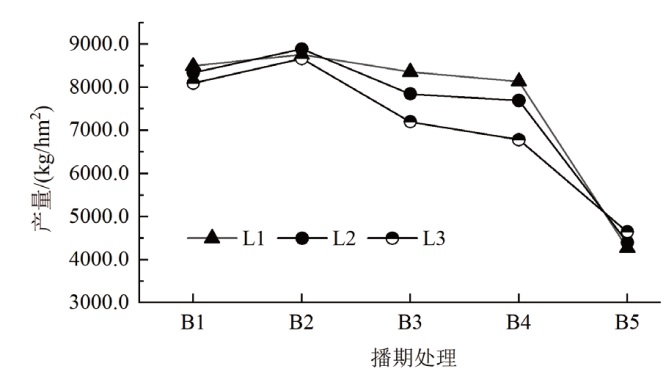
| [1] |
闵锐, 马柳彬, 王艳婷. 中国粮食收入性补贴政策的研究热点与演化发展:基于CiteSpace的文献计量分析[J]. 中南林业科技大学学报(社会科学版), 2025, 19(5):30-41.
|
| [2] |
山东省统计局. 山东统计年鉴2024[M]. 北京: 中国统计出版社, 2024.
|
| [3] |
赵花荣, 周广胜, 齐月, 等. 播期调整对华北北部冬小麦、夏玉米产量和品质的影响[J]. 中国农业科学, 2024, 57(15):2964-2985.
doi: 10.3864/j.issn.0578-1752.2024.15.005 |
| [4] |
衣政伟, 胡中泽, 杨大柳, 等. 播量和播期对苏中地区小麦生长发育及产量的影响[J]. 江苏农业科学, 2020, 48(11):67-72.
|
| [5] |
曲静, 王楠, 樊婷丽, 等. 基于气候变暖背景的西安市冬小麦适播期分析[J]. 贵州农业科学, 2021, 49(6):34-40.
|
| [6] |
赵花荣, 任三学, 齐月, 等. 基于分期播种试验的冬小麦越冬冻害调查分析[J]. 干旱气象, 2019, 37(4):648-655.
|
| [7] |
李华英, 代兴龙, 张宇, 等. 播期对冬小麦产量和抗倒性能的影响[J]. 麦类作物学报, 2015, 35(3):357-363.
|
| [8] |
牟海萌, 孙丽芳, 王壮壮, 等. 施氮量和种植密度对两冬小麦品种抗倒性能和籽粒产量的影响[J]. 中国农业科学, 2023, 56(15):2863-2879.
doi: 10.3864/j.issn.0578-1752.2023.15.003 |
| [9] |
王凯, 贾永红, 罗四维, 等. 播种方式和种植密度对冬小麦根系生长和产量的影响[J]. 麦类作物学报, 2023, 43(2):225-232.
|
| [10] |
张明明, 董宝娣, 乔匀周, 等. 播期、播量对旱作小麦‘小偃60’生长发育、产量及水分利用的影响[J]. 中国生态农业学报, 2016, 24(8):1095-1102.
|
| [11] |
余梦, 谷晓博, 李援农, 等. 播期和种植模式对冬小麦氮转运和产量的影响[J]. 河南农业科学, 2021, 50(10):27-36.
|
| [12] |
张向前, 杜世州, 曹承富, 等. 种植密度对小麦群体质量叶绿素荧光参数和产量的影响[J]. 干旱地区农业研究, 2014, 32(5):93-99.
|
| [13] |
张向前, 杜世州, 曹承富, 等. 播期对冬小麦群体性状、产量和叶绿素荧光特性的影响[J]. 麦类作物学报, 2014, 34(1):71-77.
|
| [14] |
马尚宇, 王艳艳, 刘雅男, 等. 播期、播量和施氮量对小麦干物质积累、转运和分配及产量的影响[J]. 中国生态农业学报(中英文), 2020, 28(3):375-385.
|
| [15] |
裴艳婷, 董策, 魏龙雪, 等. 播期对济麦22产量及主要农艺性状的影响[J]. 安徽农业科学, 2023, 51(2):41-43.
|
| [16] |
王志成, 李春艳, 张立强, 等. 不同播量、播期和肥力对小麦品种普冰151植株性状及产量的影响[J]. 陕西农业科学, 2020, 66(9):15-18.
|
| [17] |
王婷, 常旭虹, 王艳杰, 等. 冬小麦群体结构及产量对播期和追氮时期的响应[J]. 麦类作物学报, 2025, 45(3):395-403.
|
| [18] |
易媛, 马红勃, 王静, 等. 播期和播量对不同穗型小麦品种群体性状和产量的影响[J]. 河南农业科学, 2022, 51(7):13-21.
|
| [19] |
刘萍, 魏建军, 张东升, 等. 播期和播量对滴灌冬小麦群体性状及产量的影响[J]. 麦类作物学报, 2013, 33(6):1202-1207.
|
| [20] |
任建成, 谷山青, 冯存峨, 等. 气候变化背景下山东省气温与降水时空变化特征分析[J]. 水利水电技术(中英文), 2023, 54(5):27-37.
|
| [21] |
史后蕊, 王京京, 毛瑞喜, 等. 山东省小麦种业发展现状及对策[J]. 中国种业, 2024(6):29-33.
|
| [22] |
赵广才. 中国小麦种植区域的生态特点[J]. 麦类作物学报, 2010, 30(4):684-686.
|
| [23] |
中国气象局. 农业气象观测规范(主要作物卷)[M]. 北京: 气象出版社,2025:51-57.
|
| [24] |
任海建, 李世峰, 朱秋丽. 播期、 播量对小麦扬麦23生长特性及产量的影响[J]. 陕西农业科学, 2022, 68(9):14-18.
|
| [25] |
刘琳, 李建, 李文. 不同播种量对小麦农艺性状及产量的影响[J]. 农业技术与装备, 2025(8):154-156.
|
| [26] |
于振文, 王璞, 谢甫绨, 等. 作物栽培学各论[M]. 北京: 中国农业出版社,2023:38-44.
|
| [1] | LI Ke, CHEN Geng, JIA Hong, SUN Xue. Characteristics of Grain Filling in Winter Wheat at Different Sowing Dates and Their Relationship with Meteorological Factors [J]. Chinese Agricultural Science Bulletin, 2026, 42(8): 165-173. |
| [2] | YANG Jiaqun, WANG Xianghua, ZHOU Zhihua, HU Bing, REN Tao, LU Jianwei. Effects of Bolting Yield on Yield of Vegetable and Oilseed Dual Purpose Rape [J]. Chinese Agricultural Science Bulletin, 2026, 42(8): 23-29. |
| [3] | WANG Lili, WANG Yuefu, XU Jie, SI Tong, LI Yingke, JIANG Wei. Investigation of Yield and its Constitution of Peanut Varieties Across Different Eras in Shandong Province [J]. Chinese Agricultural Science Bulletin, 2026, 42(5): 21-26. |
| [4] | LIU Yeqiong, OU Aijia, DONG Xingyuan, LI Bing, SUN Pengpeng. Influence of Different Sowing and Planting Periods on Growth of Yellow Onion in Hilly Areas of Southern Jiangsu [J]. Chinese Agricultural Science Bulletin, 2026, 42(5): 62-68. |
| [5] | FAN Yongxin, SONG Yuyang, LI Ruirui, FAN Shaopeng, ZOU Xiaoxia, FAN Yijie, YU Xiaona, ZHANG Xiaojun, SI Tong, NI Yu. Study on Optimal Sowing Dates for Rapeseed in Saline-alkali Soil of Yellow River Delta and Effects of Wood Vinegar in Alleviating Salt Stress [J]. Chinese Agricultural Science Bulletin, 2026, 42(4): 27-33. |
| [6] | DING Jinyang, XIAO Jingjing, LI Zhengquan, JIN Liang, ZHOU Xiaoyan, FENG Bo, ZHANG Yonghui, ZHANG Libo, HE Liang. Analysis of Climatic Advantages and Disadvantages and Optimal Sowing Date for Double-cropping Late Rice Under Climate Warming: A Case Study of Keqiao District, Shaoxing City [J]. Chinese Agricultural Science Bulletin, 2026, 42(20): 104-109. |
| [7] | WANG Kun, WANG Rongying, MA Mingjun, WU Suozhi, XING Hanchong, LIU Xu. Changes in Growth Period of Winter Wheat in Hengshui City and Its Response to Agricultural Meteorological Conditions [J]. Chinese Agricultural Science Bulletin, 2026, 42(20): 110-117. |
| [8] | WANG Jun, ZUO Xi, QIU Jingtao, YANG Wuguang, QIAN Chencheng. Differences Analysis of Agronomic Traits and Yield of Different Wheat Varieties Under Late-Sowing Conditions [J]. Chinese Agricultural Science Bulletin, 2026, 42(2): 25-31. |
| [9] | LIU Sixi, HUANG Xiangqing, DAI Tingyun, SUN Jiawei, CHEN Huihuan, GAO Tian, TANG Xueqin, YANG Yuping, YAN Hong. Effects of Sowing Date and Seeding Rate on Population Growth and Yield of Winter Wheat in Chengdu Plain Area [J]. Chinese Agricultural Science Bulletin, 2026, 42(2): 32-39. |
| [10] | LI Yali, LU Guoliang, WU Zhenghu, GUO Fei, ZHANG Xisheng, LIU An. Effects of Different Amendments on Yield and Nutrient Uptake of Winter Wheat and Soil Nutrients [J]. Chinese Agricultural Science Bulletin, 2026, 42(2): 128-132. |
| [11] | WEI Dongping, WEI Jianfeng, HU Guijuan, DENG Dongmei, LUO Xiaofen, MA Ji, LU Lizhengxiong, WU Xuanke. Effects of Sowing Date on Sugarcane Yield, Nutrient Accumulation, and Soil Nutrient Status [J]. Chinese Agricultural Science Bulletin, 2026, 42(19): 38-43. |
| [12] | LIU Xuefeng, XIN Haifeng, HUANG Yadong, WANG Hongmei, LYU Jilong, LI Pingfang. Screening of 60 Winter Wheat Varieties in Huanghuaihai Wheat Region Based on Principal Component and Cluster Analysis [J]. Chinese Agricultural Science Bulletin, 2026, 42(17): 11-22. |
| [13] | YANG Wenbo, XIA Quan, XUE Yang, MA Jianing. Meteorological Response of Winter Wheat Yield and Near-future Scenario Projection in Main Production Areas of Tianshui, Gansu Based on AgERA5 and CMIP6 [J]. Chinese Agricultural Science Bulletin, 2026, 42(17): 121-130. |
| [14] | LIU Li, DU Xiaoyu, LUO Youming, FU Yong, PU Chunlei, WANG Peng, LI Yang. Effects of Sowing Date on Growth and Yield of Spring-sown Maize in Hilly Area of Northeast Sichuan [J]. Chinese Agricultural Science Bulletin, 2026, 42(14): 16-24. |
| [15] | TIAN Shunshun, WANG Chong, LIN Kun, GUO Fengzhi, LI Sitong, REN Zichao, WANG Yingdang, GUO Lingyun, YUAN Yang, LI Yuhao. Studies on Grain Yield, Biological Yield and Harvest Index of Wheat [J]. Chinese Agricultural Science Bulletin, 2026, 42(13): 6-11. |
| Viewed | ||||||
|
Full text |
|
|||||
|
Abstract |
|
|||||
