Welcome to Chinese Agricultural Science Bulletin,

Chinese Agricultural Science Bulletin ›› 2026, Vol. 42 ›› Issue (20): 172-182.doi: 10.11924/j.issn.1000-6850.casb2025-0506
Previous Articles Next Articles
LIU Xingyou1( ), FENG Xiaoyan1, GONG Yuehua1(), YIN Liguo2, ZHOU Wanhai1
Received:2025-06-21
Revised:2025-10-11
Online:2026-10-25
Published:2026-10-26
CLC Number:
LIU Xingyou, FENG Xiaoyan, GONG Yuehua, YIN Liguo, ZHOU Wanhai. Study on Essential Oil Extraction, Emulsion Preparation, and Antibacterial Activity of Lemongrass Introduced in Yibin[J]. Chinese Agricultural Science Bulletin, 2026, 42(20): 172-182.
Add to citation manager EndNote|Ris|BibTeX
URL: https://www.casb.org.cn/EN/10.11924/j.issn.1000-6850.casb2025-0506
| 试验号 | 因素 | ||||
|---|---|---|---|---|---|
| A | B | C | D | 精油得率/% | |
| 1 | 1 | 1 | 1 | 1 | 1.55 |
| 2 | 1 | 2 | 2 | 2 | 2.1 |
| 3 | 1 | 3 | 3 | 3 | 1.81 |
| 4 | 2 | 1 | 2 | 3 | 2.24 |
| 5 | 2 | 2 | 3 | 1 | 1.96 |
| 6 | 2 | 3 | 1 | 2 | 2.34 |
| 7 | 3 | 1 | 3 | 2 | 1.68 |
| 8 | 3 | 2 | 1 | 3 | 1.76 |
| 9 | 3 | 3 | 2 | 1 | 2.00 |
| 均值 | 1.82 | 1.82 | 1.88 | 1.84 | |
| 均值 | 2.18 | 1.94 | 2.11 | 2.04 | |
| 均值 | 1.81 | 2.05 | 1.82 | 1.94 | |
| 极差 | 0.37 | 0.23 | 0.29 | 0.2 | |
| 因素 | 平方和(SS) | 自由度(df) | 均方(MS) | F值 | P值 | 显著性 |
|---|---|---|---|---|---|---|
| A.超声时间 | 0.215 | 2 | 0.108 | 18.2 | 0.003 | ** |
| B.NaCl浓度 | 0.095 | 2 | 0.048 | 8.1 | 0.023 | * |
| C.料液比 | 0.182 | 2 | 0.091 | 15.4 | 0.005 | ** |
| D.蒸馏时间 | 0.072 | 2 | 0.036 | 6.1 | 0.037 | * |
| 误差 | 0.035 | 6 | 0.006 |
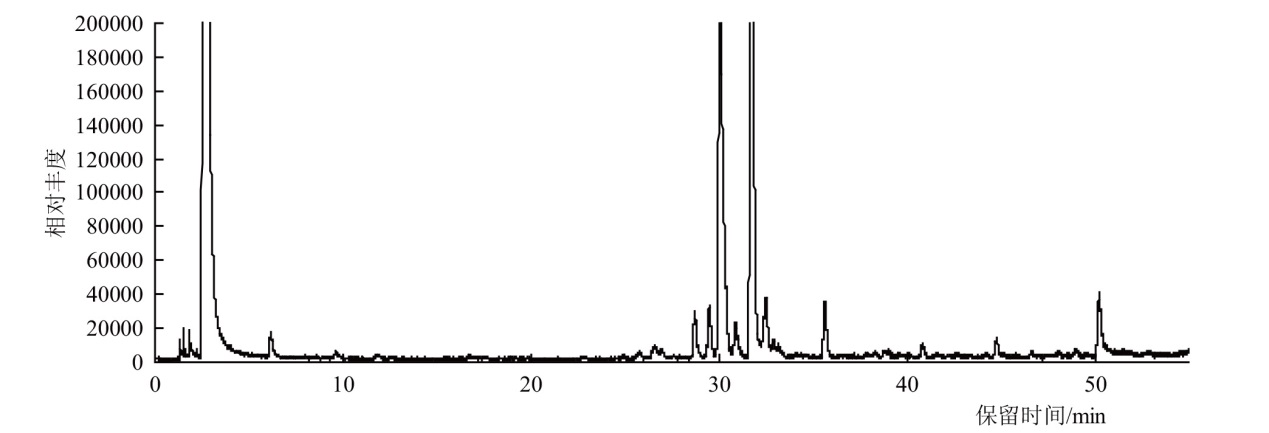
| 序号 | 化合物名称 | 保留时间/min | 分子式 | 分子量 | 相对含量/% |
|---|---|---|---|---|---|
| 1 | β-月桂烯 | 18.394 | C10H16 | 136 | 8.49 |
| 2 | 柠檬烯 | 20.29 | C10H18O2 | 136 | 0.04 |
| 3 | 1,3,8-对甲苯三烯 | 21.577 | C10H14 | 134 | 0.17 |
| 4 | 反式β-罗勒烯 | 22.346 | C10H16 | 136 | 1.05 |
| 5 | (Z)-3,7-二甲基-1,3,6-十八烷三烯 | 23.366 | C10H16 | 136 | 0.55 |
| 6 | 邻伞花烃 | 24.779 | C10H14 | 134 | 0.15 |
| 7 | 环己硅氧烷 | 28.339 | C12H36O6Si6 | 444 | 0.03 |
| 8 | 呋喃,3-(4-甲基-3-戊烯基)- | 33.857 | C10H14O | 150 | 0.31 |
| 9 | 2,4-二甲基苯乙烯 | 35.047 | C10H12 | 132 | 0.07 |
| 10 | 香茅醛 | 37.644 | C10H18O | 154 | 0.19 |
| 11 | 附生柠檬醛A | 37.992 | C10H16O | 152 | 0.13 |
| 12 | 芳樟醇 | 41.871 | C10H18O | 154 | 1.23 |
| 13 | 1--石竹烯 | 45.073 | C15H24 | 204 | 0.42 |
| 14 | 橙花醛 | 50.398 | C10H16O | 152 | 28.06 |
| 15 | 香叶醛 | 53.475 | C10H16O | 152 | 49.38 |
| 16 | 乙酸香叶酯 | 54.06 | C12H20O2 | 196 | 1.76 |
| 17 | 香茅醇 | 54.606 | C10H20O | 156 | 1.07 |
| 18 | 橙花醇 | 56.473 | C10H18O | 154 | 0.43 |
| 19 | 2-十三烷酮 | 56.894 | C13H26O | 198 | 0.41 |
| 20 | 香叶醇 | 59.037 | C10H18O | 154 | 3.37 |
| 21 | 氧化石竹烯 | 65.716 | C15H24O | 220 | 0.05 |
| 22 | 6,10,14-三甲基-2-十五烷酮 | 72.744 | C18H36O | 268 | 0.26 |
| 23 | 长叶烯 | 76.768 | C15H24 | 204 | 0.10 |
| 24 | 棕榈酸乙酯 | 78.664 | C18H36O2 | 284 | 0.46 |
| 25 | 香叶酸 | 80.332 | C10H16O2 | 168 | 0.93 |
| 26 | 2,4-二叔丁基苯酚 | 81.024 | C14H22O | 206 | 0.06 |
| 27 | 3,7,11-三甲基-2,6,10-十二烷三烯-1-醇 | 83.06 | C15H26O | 222 | 0.08 |
| 28 | 十四烷 | 84.052 | C14H30 | 196 | 0.17 |
| 29 | 油酸乙酯 | 88.289 | C20H38O2 | 310 | 0.05 |
| 30 | 月桂酸 | 88.434 | C12H24O2 | 200 | 0.09 |
| 31 | 叶绿醇 | 93.638 | C20H40O | 296 | 0.10 |
| 32 | 棕榈酸 | 110.271 | C16H32O2 | 256 | 0.34 |
| 序号 | X1 | X2 | X3 | Y |
|---|---|---|---|---|
| 1 | 9 | 3 | 3 | 1.16 |
| 2 | 11 | 3 | 3 | 1.22 |
| 3 | 9 | 5 | 3 | 1.07 |
| 4 | 11 | 5 | 3 | 1.15 |
| 5 | 9 | 4 | 2 | 1.22 |
| 6 | 11 | 4 | 2 | 1.12 |
| 7 | 9 | 4 | 4 | 1.06 |
| 8 | 11 | 4 | 4 | 1.16 |
| 9 | 10 | 3 | 2 | 1.21 |
| 10 | 10 | 5 | 2 | 1.12 |
| 11 | 10 | 3 | 4 | 1.21 |
| 12 | 10 | 5 | 4 | 1.05 |
| 13 | 10 | 4 | 3 | 0.87 |
| 14 | 10 | 4 | 3 | 0.88 |
| 15 | 10 | 4 | 3 | 0.85 |
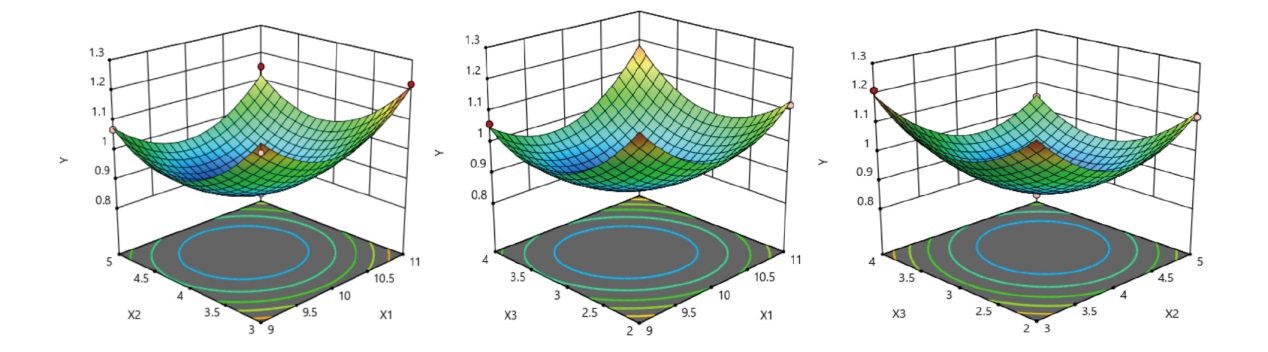
| 方差来源 | 平方和 | 均方 | F值 | P值 | 显著性 |
|---|---|---|---|---|---|
| 模型 | 0.2266 | 0.0252 | 29.67 | 0.0008 | ** |
| X1 | 0.0025 | 0.0025 | 2.89 | 0.1500 | |
| X2 | 0.0210 | 0.0210 | 24.77 | 0.0042 | * |
| X3 | 0.0045 | 0.0045 | 5.32 | 0.0692 | |
| X1X2 | 0.0001 | 0.0001 | 0.1179 | 0.7453 | |
| X1X3 | 0.0100 | 0.0100 | 11.79 | 0.0186 | * |
| X2X3 | 0.0012 | 0.0012 | 1.44 | 0.2833 | |
| X1² | 0.0702 | 0.0702 | 82.79 | 0.0003 | ** |
| X2² | 0.0781 | 0.0781 | 92.04 | 0.0002 | ** |
| X3² | 0.0677 | 0.0677 | 79.81 | 0.0003 | ** |
| 失拟项 | 0.0038 | 0.0013 | 5.39 | 0.1604 | 不显著 |
| [1] |
李佳屹, 高晓余, 胡一凡, 等. 香茅草种质资源功能性分析评价[J]. 热带作物学报, 2024, 45(9):1840-1850.
doi: 10.3969/j.issn.1000-2561.2024.09.008 |
| [2] |
南京中医药大学. 中药大辞典(2版)[M]. 上海: 上海科学技术出版社, 2006:3506.
|
| [3] |
郇树乾, 李岩, 王坚, 等. 不同施肥水平对香茅草生物量及香茅油产量的影响[J]. 热带农业科学, 2014, 34(10):33-35.
|
| [4] |
陈志洋, 唐雅婷, 吕泽, 等. 香茅油纳米乳剂的构建、表征、抗菌性能和细胞毒性(英文)[J]. 物理化学学报, 2022, 38(12):206-214.
|
| [5] |
秦荣秀, 周丽珠, 陈明江, 等. 不同种植模式对不同香茅品种产量和含油率的影响[J]. 热带农业科学, 2018, 38(3):109-111,117.
|
| [6] |
冷进松, 朱珠, 周跃勇. 超声波辅助水酶法提取啤酒花精油的研究[J]. 食品研究与开发, 2014, 35(1):34-41.
|
| [7] |
杜永华, 范静, 魏琴, 等. 油樟叶挥发油水乳剂制备工艺的优化[J]. 湖北农业学, 2014, 53(18):4381-4386.
|
| [8] |
doi: 10.1016/j.foodres.2008.02.006 URL |
| [9] |
程作慧, 段慧娟, 李婧婧, 等. 前沿科研成果融入药物化学实验教学—香茅精油微乳液的制备和理化性能研究[J]. 广东化工, 2024, 51(19):232-234.
|
| [10] |
何建国, 李少华, 熊国红, 等. 香茅精油微乳剂的制备及驱蚊效果评价[J]. 中华卫生杀虫药械, 2019, 25(1):7-9.
|
| [11] |
张晓宏, 赵秀峰, 张九龙, 等. Box-Behnken效应面法优化制备氯诺昔康柔性脂质体[J]. 沈阳药科大学学报, 2016, 33(4):264-270.
|
| [12] |
侯绪和, 杨梦娇, 韦升艳, 等. 7种植物精油对空气自然菌落抑制作用研究[J]. 广东化工, 2024, 51(6):137-140.
|
| [13] |
国家质检总局. 公共场所卫生检验方法第3部分:空气微生物:GX2/T 18204.3-2013[S]. 2013.
|
| [14] |
宓宇, 王晗毓, 郑家勤, 等. Box-Behnken响应面法优化二甲硅油乳剂的制备工艺[J]. 当代化工研究, 2022(7):150-152.
|
| [15] |
许智萍, 何璐, 范建成, 等. 干热河谷区香茅草的品种特性及栽培技术[J]. 中国热带农业, 2019(6):80-85.
|
| [16] |
黄俊葵, 杨启晟, 范雪雁, 等. 低月桂烯柠檬香茅和食材柠檬香茅的引种对比试验[J]. 饲料博览, 2022(3):48-5255.
|
| [17] |
梁宗武, 邹幸江, 陈明宇, 等. 不同提取条件对香茅草精油产量的影响[J]. 畜牧与饲料科学, 2017, 38(9):17-19.
|
| [18] |
丁华, 王建清. 香茅精油的超声辅助提取及成分分析[J]. 中国调味品, 2017, 42(3):141-145.
|
| [19] |
张洪军, 曹亚斌, 薛文博, 等. 香茅精油提取工艺优化及其气相抑菌性能研究[J]. 保鲜与加工, 2017(4):37-42.
|
| [20] |
邱珊莲, 林宝妹, 洪佳敏, 等. 3个香茅品种精油与鲜草挥发性成分分析[J]. 饲料研究, 2022, 45(24):117-121.
|
| [21] |
董晓敏, 刘布鸣, 林霄, 等. 广西产香茅草挥发油的化学成分分析[J]. 广西科学, 2009, 16(3):302-304.
|
| [22] |
欧阳婷, 杨琼梁, 颜红, 等. 不同产地香茅挥发油的化学成分比较研究[J]. 林产化学与工业, 2017, 37(1):141-148.
|
| [23] |
雷津美, 张莉, 杜凤沛. 表面活性剂类农药助剂在农药中的应用研究进展[J]. 日用化学工业(中英文), 2025, 55(2):131-141.
|
| [24] |
王子旋, 高园, 颛孙相勋, 等. 薄荷精油纳米乳剂制备及对耐药金葡菌抑制研究[J]. 扬州大学学报(农业与生命科学版), 2022, 43(3):40-46.
|
| [25] |
余海艳, 李康, 崔荣洽, 等. 迷迭香精油纳米乳的制备研究[J]. 中国食品添加剂, 2022, 33(8):28-36.
|
| [26] |
靳若宁, 钱雪, 赵孔发, 等. 青花椒精油纳米乳的制备及其体外抑菌活性研究[J]. 中国野生植物资源, 2022, 41(10):36-41,53.
|
| [27] |
钱雪, 王晓东, 陈斌, 等. 薰衣草精油纳米乳的制备及其体外抑菌活性研究[J]. 中国野生植物资源, 2022, 41(4):10-15,21.
|
| [28] |
白师茹, 唐璐, 范蓓, 等. 薄荷精油纳米乳液工艺优化及其稳定性研究[J]. 食品科技, 2025(1):265-274.
|
| [29] |
林霜霜, 邱珊莲, 郑开斌, 等. 香茅精油的成分分析及抑菌作用研究[J]. 中国农业科技导报, 2017, 19(10):89-95.
|
| [1] | LI Shimeng, NAN Zhiqiang, BAIMA Yangzhen, WANG Jinxiong. Comprehensive Evaluation and Adaptability Analysis of Rapeseed Agronomic Traits in Xizang [J]. Chinese Agricultural Science Bulletin, 2026, 42(6): 31-40. |
| [2] | KONG Xiangbin, YANG Hongguang, GUO Wenjuan, LIU Ying, HOU Zhenghong, ZHANG Huijun, LI Xia, YANG Lin, XU Ligong, ZHANG Lianxiao, LU Yuan, QIN Meiling. Introduction and Evaluation of 25 Mini Pumpkin Varieties (Lines) in Kaizhou District of Chongqing [J]. Chinese Agricultural Science Bulletin, 2026, 42(17): 56-66. |
| [3] | WU Jialong, LI Ting, CUI Cheng, ZHANG Juntao, HUANG Yingmei, XU Changchao, SU Yang, TANG Jiaohua, YANG Xiao, ZHANG Menghao. Pathways of Soil Ecological Restoration in Urban Green Spaces Based on Earthworm Introduction:A Case Study of Guangzhou [J]. Chinese Agricultural Science Bulletin, 2026, 42(11): 74-83. |
| [4] | RAN Yongzheng, RAN Dongsheng. Synergistic Control of Fludioxonil Combined with Bacillus amyloliquefaciens on Tomato Gray Mold [J]. Chinese Agricultural Science Bulletin, 2025, 41(35): 103-109. |
| [5] | DANG Haihong, HE Keyan, HE Lili, LI Jiyun, WANG Jiahao, WANG Xiaoli, WANG Qian, WEI Xiaoxing. Comprehensive Evaluation of Production Performance and Nutritional Value of Eight Oat Varieties in Maduo Region [J]. Chinese Agricultural Science Bulletin, 2025, 41(34): 112-120. |
| [6] | BU Huirong, YIN Shiyu, XU Weizhou, CHANG Yuchi, SHI Lei, JIA Jianying. Selection and Comprehensive Performance Evaluation of Alfalfa Varieties in Wind-sand Grassland Area [J]. Chinese Agricultural Science Bulletin, 2025, 41(31): 149-158. |
| [7] | LIU Wei, CAI Weijia, WANG Hao, LUO Guijie, LIU Xu. Research Progress on Edible Dock [J]. Chinese Agricultural Science Bulletin, 2025, 41(3): 36-41. |
| [8] | SHAO Qinglong, MA Xiqing, WEI Junmei, WANG Wanrong, YAO Xiaoqin, WU Yurong, ZHANG Donghai, SHAO Ming. Analysis of Adaptability of Eight Introduced Alfalfa Varieties in Tumushuke Reclamation Area [J]. Chinese Agricultural Science Bulletin, 2025, 41(23): 117-124. |
| [9] | HAN Hongliang, CHENG Meng, LI Ying, CHEN Baoni, YE Jiamin, LI Jie, JI Ruifeng, ZHOU Xiuteng. Maianthemum japonicum Seeds: Aseptic Germination and Tissue Culture [J]. Chinese Agricultural Science Bulletin, 2025, 41(19): 56-63. |
| [10] | HUANG Huaxi, LU Enke, ZANG Qingmin, XU Shijuan, CHEN Rong, LIU Qin. Analysis of Volatile Oil Components in Different Organs of Echinacea purpurea [J]. Chinese Agricultural Science Bulletin, 2025, 41(19): 143-150. |
| [11] | SHEN Yujiang, DU Chunyu, LIU Shuxia, GUAN Xiangjun, XU Haijun, WANG Xiaofei, XIAO Yu. Adaptability Evaluation of Astragalus Introduction in Daqing of Heilongjiang Province [J]. Chinese Agricultural Science Bulletin, 2025, 41(1): 82-88. |
| [12] | YANG Hang, LI Yixuan, LI Qiang, LIU Xiaoming, YANG Tao, LUO Zhumei, LIU Jiangtao. Growth Characteristics of Switchgrass in Mu Us Sandy Land of Northern Shaanxi [J]. Chinese Agricultural Science Bulletin, 2024, 40(34): 42-49. |
| [13] | JIANG Yan, YAN Wei, NI Zhangguang, CHEN Yufu, ZHANG Yong, WANG Tieyun, ZHANG Cuixian, LUO Xinping, YANG Linyuan, WANG Meicun. Introduction and Evaluation of Four Varieties of Lucuma nervosa in Menglian [J]. Chinese Agricultural Science Bulletin, 2024, 40(28): 37-41. |
| [14] | CHEN Qin, FU Zhuorui, XIAO Xingcui, GU Yunjie, PAN Xin. Research Progress of Styrax Species [J]. Chinese Agricultural Science Bulletin, 2024, 40(22): 40-46. |
| [15] | SONG Yiying, WEI Mingyue, HAO Lei, QIN Yuanyuan, CHAI Guaiqiang, SHI Jianguo, DUAN Yizhong. Introduction and Cultivation of Protein Mulberry in Wind-sand Area of Northern Shaanxi and Its Adaptability Analysis [J]. Chinese Agricultural Science Bulletin, 2024, 40(22): 32-39. |
| Viewed | ||||||
|
Full text |
|
|||||
|
Abstract |
|
|||||
