欢迎访问《中国农学通报》,

中国农学通报 ›› 2026, Vol. 42 ›› Issue (2): 84-92.doi: 10.11924/j.issn.1000-6850.casb2025-0493
秦小欢1,2,3( ), 焦多朵1,2,3, 金铁棚1, 孙师1, 郜坤媛1, 胡建霖1,2()
收稿日期:2025-06-18
修回日期:2025-08-15
出版日期:2026-01-25
发布日期:2026-01-22
通讯作者:
作者简介:秦小欢,女,2000年出生,陕西汉中人,硕士研究生,研究方向:药用植物微生态学。通信地址:650500 云南省昆明市呈贡区聚贤街768号,E-mail:1402506244@qq.com。
基金资助:
QIN Xiaohuan1,2,3(), JIAO Duoduo1,2,3, JIN Tiepeng1, SUN Shi1, GAO Kunyuan1, HU Jianlin1,2()
Received:2025-06-18
Revised:2025-08-15
Published:2026-01-25
Online:2026-01-22
摘要:
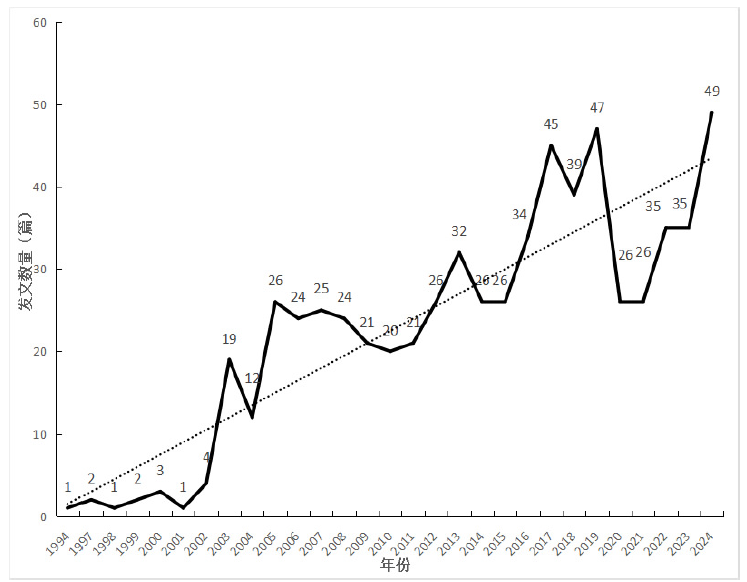
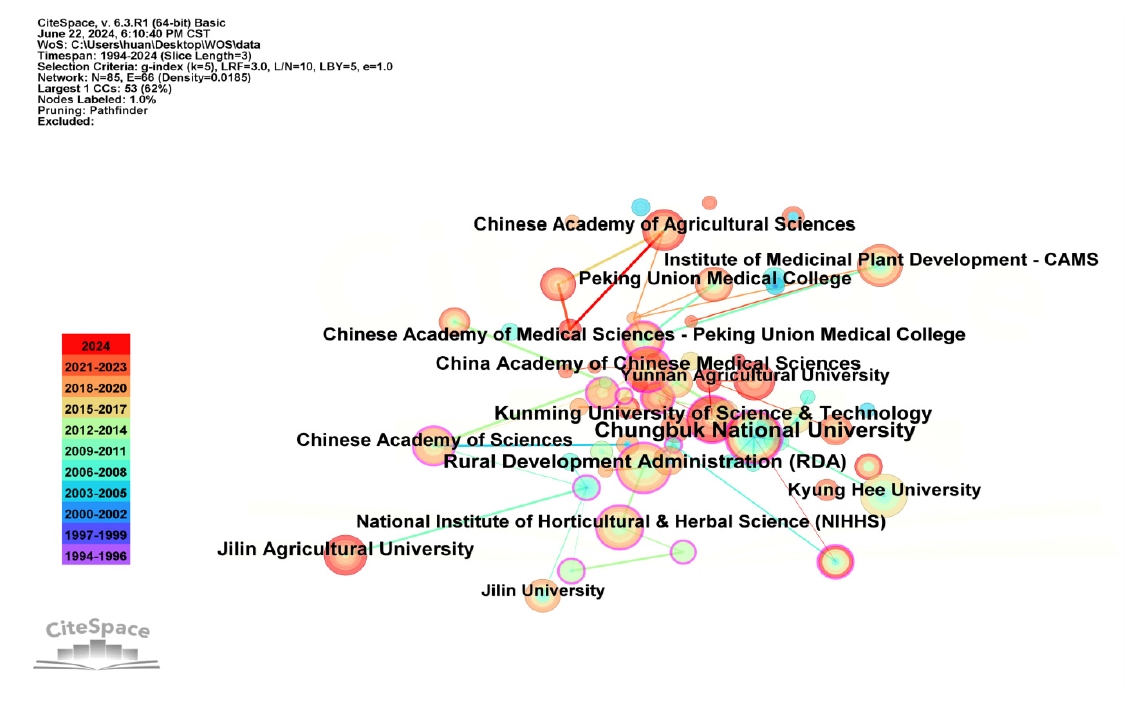
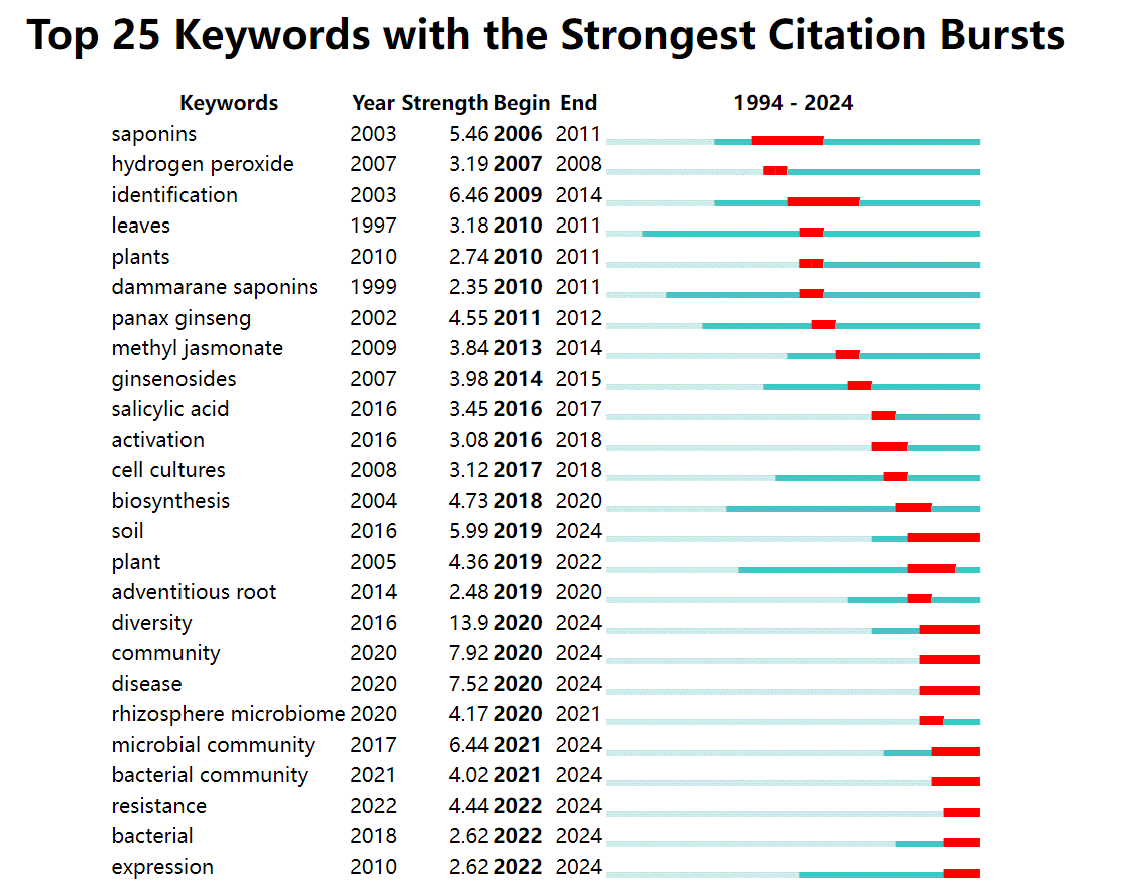
针对人参属药用植物产业受连作障碍和根系病害制约等问题,为系统梳理人参属植物根系微生态的研究现状与发展趋势,本研究基于Web of Science核心合集数据库1994—2024年间收录的652篇相关文献,采用CiteSpace 6.3.R1软件对发文作者、研究机构及关键词等信息进行可视化分析。结果表明:(1)该领域研究始于1994年,自2003年起研究热度持续上升,2006年后进入稳步增长阶段,2020年后迈入快速发展期。(2)研究力量主要集中于中国、韩国等亚洲国家,并逐步构建起稳定的合作网络。(3)关键词突现分析共识别出“皂苷生物合成”、“微生物多样性”和“根际互作”等14个研究主题,“群落”(Community)、“疾病”(Disease)、“根际微生物”(Rhizosphere microbiome)、“细菌群落”(Bacterial community)和“抗性”(Resistance)成为2020年后主要的研究热点。(4)研究主要以人参(Panax ginseng)和三七(Panax notoginseng)为研究对象;变形菌门(Proteobacteria)和子囊菌门(Ascomycota)为人参属植物根系微生态系统中的核心微生物类群。当前研究已从早期的化学成分分析逐步转向对“植物—土壤—微生物”互作机制的深入探讨,呈现出以中韩为主导、多学科交叉融合的发展格局。未来应进一步推进植物化学、土壤学、多组学技术及分子生物学等跨学科方法在根系微生态研究中的综合应用,为人参属药用植物产业的可持续发展与创新转型提供科学支撑。
秦小欢, 焦多朵, 金铁棚, 孙师, 郜坤媛, 胡建霖. 人参属植物根系微生态研究态势分析[J]. 中国农学通报, 2026, 42(2): 84-92.
QIN Xiaohuan, JIAO Duoduo, JIN Tiepeng, SUN Shi, GAO Kunyuan, HU Jianlin. Analysis of Research Trends in Root Microecology of Panax Plant[J]. Chinese Agricultural Science Bulletin, 2026, 42(2): 84-92.
| 序号 | 期刊 | 国家 | 论文数量 | 论文百分比/% | 影响因子(2023) |
|---|---|---|---|---|---|
| 1 | Journal of Ginseng Research | 韩国 | 42 | 6.442 | 6.8 |
| 2 | Molecules | 瑞士 | 23 | 3.528 | 4.2 |
| 3 | Journal of Agricultural and Food Chemistry | 美国 | 19 | 2.914 | 5.7 |
| 4 | Frontiers in Microbiology | 瑞士 | 17 | 2.607 | 4.0 |
| 5 | Industrial Crops and Products | 荷兰 | 14 | 2.147 | 5.6 |
| 6 | Plant Cell Tissue and Organ Culture | 荷兰 | 12 | 1.84 | 2.3 |
| 7 | Plant and Soil | 荷兰 | 11 | 1.687 | 3.9 |
| 8 | Agronomy-Basel | 瑞士 | 8 | 1.227 | 3.3 |
| 9 | Antonie van Leeuwenhoek International Journal of General and Molecular Microbiology | 荷兰 | 8 | 1.227 | 1.8 |
| 10 | Applied Soil Ecology | 荷兰 | 8 | 1.227 | 4.8 |
| 序号 | 期刊 | 国家 | 论文数量 | 论文百分比/% | 影响因子(2023) |
|---|---|---|---|---|---|
| 1 | Journal of Ginseng Research | 韩国 | 42 | 6.442 | 6.8 |
| 2 | Molecules | 瑞士 | 23 | 3.528 | 4.2 |
| 3 | Journal of Agricultural and Food Chemistry | 美国 | 19 | 2.914 | 5.7 |
| 4 | Frontiers in Microbiology | 瑞士 | 17 | 2.607 | 4.0 |
| 5 | Industrial Crops and Products | 荷兰 | 14 | 2.147 | 5.6 |
| 6 | Plant Cell Tissue and Organ Culture | 荷兰 | 12 | 1.84 | 2.3 |
| 7 | Plant and Soil | 荷兰 | 11 | 1.687 | 3.9 |
| 8 | Agronomy-Basel | 瑞士 | 8 | 1.227 | 3.3 |
| 9 | Antonie van Leeuwenhoek International Journal of General and Molecular Microbiology | 荷兰 | 8 | 1.227 | 1.8 |
| 10 | Applied Soil Ecology | 荷兰 | 8 | 1.227 | 4.8 |
| 序号 | 作者 | 国家 | 机构 | 论文数量 | 占论文百分比/% |
|---|---|---|---|---|---|
| 1 | Paek KY | 韩国 | 忠北大学 | 36 | 5.521 |
| 2 | Hahn EJ | 韩国 | 水原大学 | 25 | 3.834 |
| 3 | Wang Y | 中国 | 文山学院 | 21 | 3.221 |
| 4 | Cui XM | 中国 | 昆明理工大学 | 18 | 2.761 |
| 5 | Yang DC | 韩国 | 庆熙大学 | 18 | 2.761 |
| 6 | Chen SL | 中国 | 成都中医药大学 | 17 | 2.607 |
| 7 | Li Y | 中国 | 中国医学科学院 | 17 | 2.607 |
| 8 | Wang J | 中国 | 天津大学 | 17 | 2.607 |
| 9 | Dong LL | 中国 | 安徽财经大学 | 16 | 2.454 |
| 10 | Gao WY | 中国 | 天津大学 | 15 | 2.301 |
| 序号 | 作者 | 国家 | 机构 | 论文数量 | 占论文百分比/% |
|---|---|---|---|---|---|
| 1 | Paek KY | 韩国 | 忠北大学 | 36 | 5.521 |
| 2 | Hahn EJ | 韩国 | 水原大学 | 25 | 3.834 |
| 3 | Wang Y | 中国 | 文山学院 | 21 | 3.221 |
| 4 | Cui XM | 中国 | 昆明理工大学 | 18 | 2.761 |
| 5 | Yang DC | 韩国 | 庆熙大学 | 18 | 2.761 |
| 6 | Chen SL | 中国 | 成都中医药大学 | 17 | 2.607 |
| 7 | Li Y | 中国 | 中国医学科学院 | 17 | 2.607 |
| 8 | Wang J | 中国 | 天津大学 | 17 | 2.607 |
| 9 | Dong LL | 中国 | 安徽财经大学 | 16 | 2.454 |
| 10 | Gao WY | 中国 | 天津大学 | 15 | 2.301 |
| 序号 | 研究单位 | 国家 | 论文数量 | 占论文百分比/% |
|---|---|---|---|---|
| 1 | 忠北大学 | 韩国 | 48 | 7.362 |
| 2 | 农村振兴厅 | 韩国 | 35 | 5.368 |
| 3 | 昆明理工大学 | 中国 | 32 | 4.908 |
| 4 | 中国中医科学院 | 中国 | 30 | 4.601 |
| 5 | 吉林农业大学 | 中国 | 29 | 4.448 |
| 6 | 中国医学科学院-北京协和医学院 | 中国 | 27 | 4.141 |
| 7 | 中国科学院 | 中国 | 27 | 4.141 |
| 8 | 北京协和医学院 | 中国 | 26 | 3.988 |
| 9 | 庆熙大学 | 韩国 | 25 | 3.834 |
| 10 | 中国医学科学院药用植物研究所 | 中国 | 24 | 3.681 |
| 序号 | 研究单位 | 国家 | 论文数量 | 占论文百分比/% |
|---|---|---|---|---|
| 1 | 忠北大学 | 韩国 | 48 | 7.362 |
| 2 | 农村振兴厅 | 韩国 | 35 | 5.368 |
| 3 | 昆明理工大学 | 中国 | 32 | 4.908 |
| 4 | 中国中医科学院 | 中国 | 30 | 4.601 |
| 5 | 吉林农业大学 | 中国 | 29 | 4.448 |
| 6 | 中国医学科学院-北京协和医学院 | 中国 | 27 | 4.141 |
| 7 | 中国科学院 | 中国 | 27 | 4.141 |
| 8 | 北京协和医学院 | 中国 | 26 | 3.988 |
| 9 | 庆熙大学 | 韩国 | 25 | 3.834 |
| 10 | 中国医学科学院药用植物研究所 | 中国 | 24 | 3.681 |
| 序号 | 关键词 | 频次 | 中心性 |
|---|---|---|---|
| 1 | 人参(Panax ginseng) | 238 | 0.37 |
| 2 | 三七(Panax notoginseng) | 112 | 0.75 |
| 3 | 生长(Growth) | 93 | 0.66 |
| 4 | 皂苷(Saponins) | 67 | 0.11 |
| 5 | 多样性(Diversity) | 66 | 0.22 |
| 6 | 人参皂苷(Ginsenosides) | 66 | 0.03 |
| 7 | 鉴别(Identification) | 62 | 0.13 |
| 8 | 西洋参(American ginseng) | 48 | 0.18 |
| 9 | 人参(Ginseng) | 46 | 0.03 |
| 10 | 生物合成(Biosynthesis) | 43 | 0.31 |
| 11 | 土壤(Soil) | 37 | 0.53 |
| 12 | 积累(Accumulation) | 36 | 0.52 |
| 13 | 植物(Plant) | 29 | 0.03 |
| 14 | 微生物群落(Microbial community) | 27 | 0.06 |
| 15 | 叶片(Leaves) | 26 | 0.7 |
| 16 | 酸(Acid) | 25 | 0.85 |
| 17 | 不定根(Adventitious roots) | 25 | 0.2 |
| 18 | 茉莉酸甲酯(Methyl jasmonate) | 24 | 0.22 |
| 19 | 表达(Expression) | 23 | 0.03 |
| 20 | 群落(Community) | 23 | 0 |
| 序号 | 关键词 | 频次 | 中心性 |
|---|---|---|---|
| 1 | 人参(Panax ginseng) | 238 | 0.37 |
| 2 | 三七(Panax notoginseng) | 112 | 0.75 |
| 3 | 生长(Growth) | 93 | 0.66 |
| 4 | 皂苷(Saponins) | 67 | 0.11 |
| 5 | 多样性(Diversity) | 66 | 0.22 |
| 6 | 人参皂苷(Ginsenosides) | 66 | 0.03 |
| 7 | 鉴别(Identification) | 62 | 0.13 |
| 8 | 西洋参(American ginseng) | 48 | 0.18 |
| 9 | 人参(Ginseng) | 46 | 0.03 |
| 10 | 生物合成(Biosynthesis) | 43 | 0.31 |
| 11 | 土壤(Soil) | 37 | 0.53 |
| 12 | 积累(Accumulation) | 36 | 0.52 |
| 13 | 植物(Plant) | 29 | 0.03 |
| 14 | 微生物群落(Microbial community) | 27 | 0.06 |
| 15 | 叶片(Leaves) | 26 | 0.7 |
| 16 | 酸(Acid) | 25 | 0.85 |
| 17 | 不定根(Adventitious roots) | 25 | 0.2 |
| 18 | 茉莉酸甲酯(Methyl jasmonate) | 24 | 0.22 |
| 19 | 表达(Expression) | 23 | 0.03 |
| 20 | 群落(Community) | 23 | 0 |
| 物种 | 根际真菌 | 根际细菌 | 内生真菌 | 内生细菌 | 参考文献 |
|---|---|---|---|---|---|
| 人参 (Panax ginseng) | 子囊菌门(Ascomycota) 担子菌门(Basidiomycota) 被孢霉门(Mortierellomycota) | 酸杆菌门(Acidobacteriota) 变形菌门(Proteobacteria) 放线菌门(Actinobacteriota) | 子囊菌门(Ascomycota) 接合菌门(Zygomycota) 担子菌门(Basidiomycota) | 变形菌门(Proteobacteria) 厚壁菌门(Firmicutes) 放线菌门(Actinobacteria) 拟杆菌门(Bacteroidetes) | [ |
| 三七 (Panax notoginseng) | 担子菌门(Basidiomycota) 子囊菌门(Ascomycota) 被孢霉门(Mortierellomycota) | 放线菌门(Actinobacteriota) 变形菌门(Proteobacteria) 绿弯菌门(Chloroflexi) 酸杆菌门(Acidobacteriota) | 厚壁菌门(Firmicutes) 变形菌门(Proteobacteria) 拟杆菌门(Bacteroidetes) 芽孢杆菌属(Bacillus) 类芽孢杆菌属(Paenibacillus) | [ | |
| 西洋参 (Panax quinquefolium) | 子囊菌门(Ascomycota) 担子菌门(Basidiomycota) | 变形菌门(Proteobacteria) 酸杆菌门(Acidobacteria) 拟杆菌门(Bacteroidetes) | 子囊菌门(Ascomycota) | [ | |
| 越南参 (Panax vietnamensis) | 木霉属(Trichoderma) 镰孢属(Fusarium) 被孢霉属(Mortierella) | 假单胞菌属(Pseudomonas) 慢生根瘤菌属 (Bradyrhizobium) | [ |
| 物种 | 根际真菌 | 根际细菌 | 内生真菌 | 内生细菌 | 参考文献 |
|---|---|---|---|---|---|
| 人参 (Panax ginseng) | 子囊菌门(Ascomycota) 担子菌门(Basidiomycota) 被孢霉门(Mortierellomycota) | 酸杆菌门(Acidobacteriota) 变形菌门(Proteobacteria) 放线菌门(Actinobacteriota) | 子囊菌门(Ascomycota) 接合菌门(Zygomycota) 担子菌门(Basidiomycota) | 变形菌门(Proteobacteria) 厚壁菌门(Firmicutes) 放线菌门(Actinobacteria) 拟杆菌门(Bacteroidetes) | [ |
| 三七 (Panax notoginseng) | 担子菌门(Basidiomycota) 子囊菌门(Ascomycota) 被孢霉门(Mortierellomycota) | 放线菌门(Actinobacteriota) 变形菌门(Proteobacteria) 绿弯菌门(Chloroflexi) 酸杆菌门(Acidobacteriota) | 厚壁菌门(Firmicutes) 变形菌门(Proteobacteria) 拟杆菌门(Bacteroidetes) 芽孢杆菌属(Bacillus) 类芽孢杆菌属(Paenibacillus) | [ | |
| 西洋参 (Panax quinquefolium) | 子囊菌门(Ascomycota) 担子菌门(Basidiomycota) | 变形菌门(Proteobacteria) 酸杆菌门(Acidobacteria) 拟杆菌门(Bacteroidetes) | 子囊菌门(Ascomycota) | [ | |
| 越南参 (Panax vietnamensis) | 木霉属(Trichoderma) 镰孢属(Fusarium) 被孢霉属(Mortierella) | 假单胞菌属(Pseudomonas) 慢生根瘤菌属 (Bradyrhizobium) | [ |
| [1] |
|
| [2] |
doi: 10.1038/srep22006 |
| [3] |
王希付, 张雪, 赵荣华, 等. 丛枝菌根真菌在药用植物中的作用及机制研究进展[J]. 中国实验方剂学杂志, 2020, 26(11):217-226.
|
| [4] |
doi: 10.3389/fpls.2022.1062982 URL |
| [5] |
doi: 10.1186/s12866-020-02081-2 |
| [6] |
doi: 10.1002/jssc.v30:6 URL |
| [7] |
方悦, 唐梦雪, 丰志培. 全球参类药材贸易网络的特征分析[J]. 南京中医药大学学报(社会科学版), 2022, 23(5):316-323.
|
| [8] |
doi: 10.1016/j.pmpp.2022.101878 URL |
| [9] |
doi: 10.1016/j.scitotenv.2018.03.219 URL |
| [10] |
|
| [11] |
doi: S1369-5274(17)30014-0 pmid: 28437663 |
| [12] |
doi: 10.1186/s12863-023-01154-1 pmid: 37710149 |
| [13] |
|
| [14] |
doi: 10.1186/s12866-021-02430-9 pmid: 34991491 |
| [15] |
doi: 10.1038/s41598-017-16181-z |
| [16] |
doi: 10.3389/fmicb.2021.673512 URL |
| [17] |
|
| [18] |
doi: 10.1007/s00284-020-02068-2 pmid: 32506240 |
| [19] |
doi: 10.1016/j.ecolind.2022.109748 URL |
| [20] |
doi: 10.1016/j.scitotenv.2024.170005 URL |
| [21] |
doi: 10.1186/s12870-023-04282-z |
| [22] |
|
| [23] |
doi: 10.1038/ismej.2011.159 URL |
| [24] |
doi: 10.1016/j.jgr.2015.04.004 pmid: 26843819 |
| [25] |
doi: 10.1007/s11104-018-03928-4 |
| [26] |
doi: 10.1016/j.apsoil.2022.104397 URL |
| [27] |
doi: 10.1007/s11104-021-05000-0 |
| [28] |
doi: 10.3389/fmicb.2024.1283492 URL |
| [29] |
|
| [30] |
|
| [31] |
doi: 10.3389/fmicb.2021.676880 URL |
| [32] |
|
| [33] |
doi: 10.1016/j.indcrop.2022.114544 URL |
| [34] |
|
| [35] |
|
| [36] |
doi: 10.1016/j.apsoil.2021.104229 URL |
| [37] |
doi: 10.1166/mex.2023.2369 URL |
| [38] |
|
| [39] |
doi: 10.1016/j.geoderma.2019.114155 URL |
| [40] |
|
| [41] |
doi: 10.1016/j.rhisph.2022.100568 URL |
| [42] |
doi: 10.1146/arplant.2023.74.issue-1 URL |
| [43] |
doi: 10.3389/fmicb.2023.1194224 URL |
| [44] |
doi: 10.1016/j.jgr.2023.11.005 URL |
| [1] | 周佳慧, 唐浦林, 张诗野, 张爱华, 汪树理, 魏航, 任新龙, 郜玉钢, 王艳芳. 基于CNKI数据库的土壤酸化调节措施文献计量分析[J]. 中国农学通报, 2026, 42(2): 203-210. |
| [2] | 卢云峰, 李锐群, 曾润华, 李树忠, 王忠美, 李智海, 贾冬冬. 基于Web of Science文献计量的香蕉枯萎病研究态势分析[J]. 中国农学通报, 2025, 41(8): 149-158. |
| [3] | 徐静, 王超, 万小刚, 赵岳, 伍勇. 基于文献计量的中国植物内生真菌学位论文研究热点与趋势分析[J]. 中国农学通报, 2025, 41(8): 140-148. |
| [4] | 王安娜, 秦健, 赵志刚, 赖多, 肖维强, 庄庆礼, 邵雪花, 阳成伟, 董涛. 基于CiteSpace的油梨采后保鲜研究进展与热点可视化分析[J]. 中国农学通报, 2025, 41(7): 145-153. |
| [5] | 王彦, 刘晓丽, 张怡, 陈宏灏. 基于CiteSpace的葡萄阿小叶蝉研究进展可视化分析[J]. 中国农学通报, 2025, 41(7): 121-127. |
| [6] | 王平, 张同祯, 孙振荣, 王菲, 刘善霞. 基于CiteSpace可视化分析强筋小麦生产现状与研究进展[J]. 中国农学通报, 2025, 41(35): 122-132. |
| [7] | 钱海林, 王诗岩, 任鹏, 杨芳, 常佳琪, 常阳阳, 王东印. 基于文献计量分析的油莎豆研究热点及趋势[J]. 中国农学通报, 2025, 41(32): 145-157. |
| [8] | 魏丹, 崔福星, 李虹, 潘虹, 郭媛, 杨立宾, 付晓宇, 李海军. 基于CiteSpace的土壤动物研究现状与热点分析[J]. 中国农学通报, 2025, 41(29): 137-145. |
| [9] | 王彦, 陈宏灏, 刘晓丽, 马建华. 基于VOSviewer和CiteSpace的介壳虫研究进展及趋势[J]. 中国农学通报, 2025, 41(24): 151-164. |
| [10] | 胡明航, 周玉柳, 叶彦辉, 荆澳航, 刘爽, 任世强, 韩艳英. 水肥耦合研究的演进脉络、热点跃迁与未来路径——基于CiteSpace的文献计量与知识图谱解析[J]. 中国农学通报, 2025, 41(22): 89-99. |
| [11] | 安艳, 欧巧明, 王丽, 梁婷玉, 崔文娟, 朱旭. 紫苏叶活性化学成分研究进展及其抗氧化与抑菌活性的物质基础[J]. 中国农学通报, 2025, 41(20): 128-142. |
| [12] | 张银翠, 刘晓婷, 姚拓. 合成微生物群落在农业领域的应用研究进展——基于VOSviewer和CiteSpace的文献计量分析[J]. 中国农学通报, 2025, 41(20): 143-156. |
| [13] | 郭媛, 张士芳, 魏丹, 常旭东, 付晓宇, 李海军, 刘应竹, 朱世兵. 基于CiteSpace的东北林蛙研究热点及趋势的可视化分析[J]. 中国农学通报, 2025, 41(17): 137-143. |
| [14] | 田媛, 李靖思, 张艳华, 姜睿原. 基于CiteSpace的四照花研究进展可视化分析[J]. 中国农学通报, 2025, 41(17): 45-53. |
| [15] | 周玉柳, 荆澳航, 叶彦辉, 任世强, 韩艳英. 基于文献计量学对苹果树施肥研究的可视化分析[J]. 中国农学通报, 2025, 41(16): 108-118. |
| 阅读次数 | ||||||
|
全文 |
|
|||||
|
摘要 |
|
|||||
