欢迎访问《中国农学通报》,

中国农学通报 ›› 2026, Vol. 42 ›› Issue (13): 1-5.doi: 10.11924/j.issn.1000-6850.casb2025-0652

• 农学·农业基础科学 •    下一篇

中日优质粳稻叶片光合及产量和品质的比较研究

孙建权(), 殷春渊(), 黄金华, 刘贺梅, 胡秀明, 王和乐, 张金霞, 张倩倩, 田芳慧, 王书玉   

  1. 新乡市农业科学院, 河南新乡 453002
  • 收稿日期:2025-08-05 修回日期:2026-01-17 出版日期:2026-07-15 发布日期:2026-07-09
  • 通讯作者:
    殷春渊,女,1978年出生,河南驻马店人,研究员,博士,主要从事水稻栽培及生理育种研究。通信地址:453002 河南省新乡市新二街518号,E-mail:
  • 作者简介:

    孙建权,男,1979年出生,陕西韩城人,副研究员,本科,主要从事水稻育种与高产栽培研究。通信地址:453002 河南省新乡市新二街518号,E-mail:

  • 基金资助:
    河南省现代农业产业技术体系“粳稻遗传育种岗位专家”(HARS-22-03-G1); 河南省重点研发专项“优质高产绿色高效水稻新品种选育与应用”(231111110500); 河南省科技攻关计划项目“基于香味基因Badh2创制优质、抗病香稻新种质”(242102110276); 河南省科技攻关计划项目“基于蜡质基因Wx调控直链淀粉含量创制优良食味软米新种质”(252102110294)

A Comparative Study on Flag Leaf Photosynthetic Characteristics, Yield and Quality of High-quality Japonica Rice Between China and Japan

SUN Jianquan(), YIN Chunyuan(), HUANG Jinhua, LIU Hemei, HU Xiuming, WANG Hele, ZHANG Jinxia, ZHANG Qianqian, TIAN Fanghui, WANG Shuyu   

  1. Xinxiang Academy of Agricultural Sciences, Xinxiang, Henan 453002
  • Received:2025-08-05 Revised:2026-01-17 Published:2026-07-15 Online:2026-07-09

摘要:

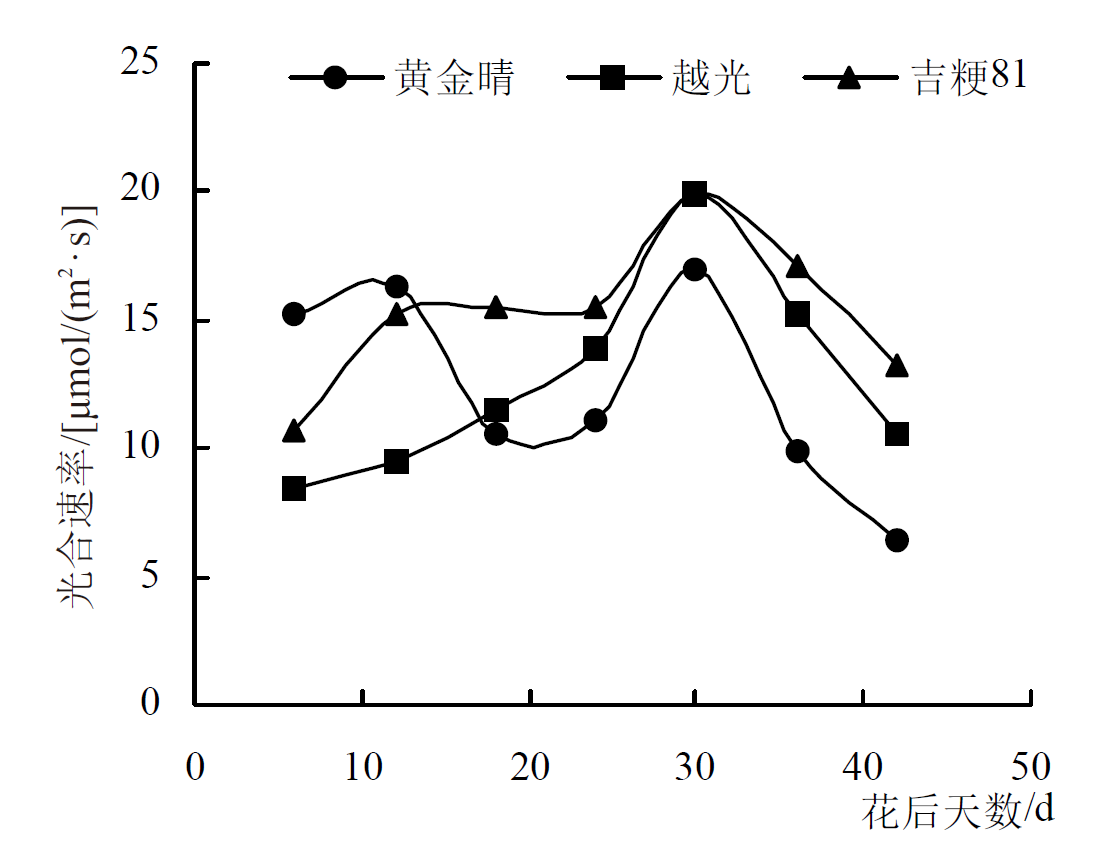
为明确中国东北、沿黄地区及日本不同生态区优质粳稻在产量和品质上的差异,选取各区域代表性的水稻品种‘吉粳81’‘黄金晴’‘越光’为试验材料,在河南新乡大田采用统一的水肥管理和高产栽培措施,系统探究其剑叶光合速率在生育期的动态变化规律,以及产量与品质特性。结果表明,‘吉粳81’的产量最高,达9.50 t/hm2,‘越光’次之(7.83 t/hm2),‘黄金晴’最低(6.50 t/hm2)。‘越光’的产量优势主要源于较高的有效穗数,最高有效穗数达41.44万穗/hm2,最低有效穗数亦近30万穗/hm2,显著高于生产上普通品种的20万穗/hm2水平,说明3个品种具有较强的分蘖潜力。综合外观、加工和食味品质各指标分析,‘越光’表现出明显优势,其长宽比仅1.77、垩白粒率14.00%、垩白度5.22%,直链淀粉含量14.6%,各项指标均处于较低水平,表明该品种品质优良且稳定性突出。剑叶光合速率比较显示,在整个籽粒灌浆期内,3个品种的平均叶片光合速率表现为‘吉粳81’[19.96 μmol/(m2·s)]>‘越光’[19.88 μmol/(m2·s)]>‘黄金晴’[16.95 μmol/(m2·s)],与产量的排序完全一致,说明水稻产量的提升主要依赖剑叶光合速率的提高,即剑叶光合速率与产量具有良好的正相关性,而品质与产量未表现出协同关系。综上,以高产为育种目标时,可将剑叶光合速率作为核心参考指标;在优质稻育种中,则宜以低垩白、低直链淀粉含量和高整精米率、高食味值(即“双低双高”)为关键选育方向。

关键词: 粳稻, 产量, 品质, 东北粳稻, 沿黄粳稻, 日本粳稻

Abstract:

To clarify the differences in yield and quality of high-quality japonica rice varieties cultivated in three distinct ecological zones, namely Northeast China, the Yellow River Basin of China, and Japan, this study used three representative varieties ‘Jijing 81’, ‘Huangjinqing’ and ‘Yueguang’ as experimental materials. Under the conditions of unified water and fertilizer management for high-yield cultivation in the field of Xinxiang, Henan, we systematically investigated the dynamic changes in flag leaf photosynthetic rate during the growth period, as well as the yield and quality characteristics of the test varieties. The results showed that ‘Jijing 81’ achieved the highest yield of 9.50 t/hm2, followed by ‘Yueguang’ (7.83 t/hm2), while ‘Huangjinqing’ had the lowest yield (6.50 t/hm2). The yield advantage of ‘Yueguang’ was attributed to the increase of effective panicle number, with the maximum effective panicle number reaching 414400 panicles/hm2 and the minimum number of 300000 panicles/hm2. This was significantly higher than that of conventional varieties (200000 panicles/hm2) in production, indicating that all three varieties had strong tillering potential. A comprehensive analysis of appearance, processing and eating quality indicators showed that, compared with the other two varieties, ‘Yueguang’ exhibited distinct advantages. It had a low length-width ratio of only 1.77, a chalky grain rate of 14.00%, a chalkiness degree of 5.22% and an amylose content of 14.6%, with all indicators at low levels, demonstrating that this variety had excellent and stable quality. The comparison of flag leaf photosynthetic rate indicated that during the whole grain filling period, the average photosynthetic rate of the three varieties was ranked as ‘Jijing 81’[19.96 μmol/(m2·s)]> ‘Yueguang’ [19.88 μmol/(m2·s)]> ‘Huangjinqing’ [16.95 μmol/(m2·s)], which was completely consistent with the yield ranking. This confirmed that the improvement of rice yield mainly depended on the increase of flag leaf photosynthetic rate, indicating a good coordination between flag leaf photosynthetic rate and yield, and no synergistic relationship was observed between quality and yield. In conclusion, flag leaf photosynthetic rate can be used as a core reference index for high-yield japonica rice breeding. For high-quality japonica rice breeding, the criterion of low chalkiness, low amylose content, and high head rice rate and high eating quality value should be taken as the key breeding direction.

Key words: japonica rice, yield, quality, Northeast japonica rice, Yellow River japonica rice, Japanese japonica rice

中图分类号: