欢迎访问《中国农学通报》,

中国农学通报 ›› 2026, Vol. 42 ›› Issue (8): 84-89.doi: 10.11924/j.issn.1000-6850.casb2025-0384

• 林学·园艺·园林 • 上一篇    下一篇

14个八角优良无性系挥发油含量及化学成分分析

杨卓颖1(), 曾祥艳1, 黄开顺1, 付军2, 陈金艳1, 黄彩枝2()   

  1. 1 广西壮族自治区林业科学研究院广西林业实验室,广西特色经济林培育与利用重点实验室, 南宁 530002
    2 广西壮族自治区国有派阳山林场, 广西崇左 532500
  • 收稿日期:2025-05-21 修回日期:2025-10-11 出版日期:2026-04-25 发布日期:2026-04-23
  • 通讯作者:
    黄彩枝,女,1985年出生,广西扶绥人,高级工程师,硕士,主要从事森林培育方面的研究。通信地址:532500 广西宁明县城中镇骆越大道1号,Tel:0771-8620986,E-mail:
  • 作者简介:

    杨卓颖,男,1995年出生,广西平南人,工程师,本科,主要从事经济林育种与栽培方面的研究。通信地址:530002 广西南宁市邕武路23号,Tel:0771-2319966,E-mail:

  • 基金资助:
    广西科技重大专项“中国-澜湄地区国家天然香料种质资源收集、评价与病虫害智能识别研究”(桂科AA24263014-2); 广西林业科技专项“八角保果壮果关键技术研究与集成应用”(2024GXLK02); 广西科技重大专项“桂十味”等广西特色药材产品开发”(桂科 AA23023035); 广西自筹经费林业科技项目“八角丰产栽培技术研究”(2023GXZCLK53)

Analysis of Volatile Oil Content and Chemical Composition of 14 Excellent Clones of Illicium verum

YANG Zhuoying1(), ZENG Xiangyan1, HUANG Kaishun1, FU Jun2, CHEN Jinyan1, HUANG Caizhi2()   

  1. 1 Guangxi Forestry Research Institute/ Guangxi Laboratory of Forestry/ Guangxi Key Laboratory of Special Non-wood Forest Cultivation and Utilization, Nanning 530002
    2 Guangxi State-owned Paiyangshan Forest Farm, Chongzuo, Guangxi 532500
  • Received:2025-05-21 Revised:2025-10-11 Published:2026-04-25 Online:2026-04-23

摘要:

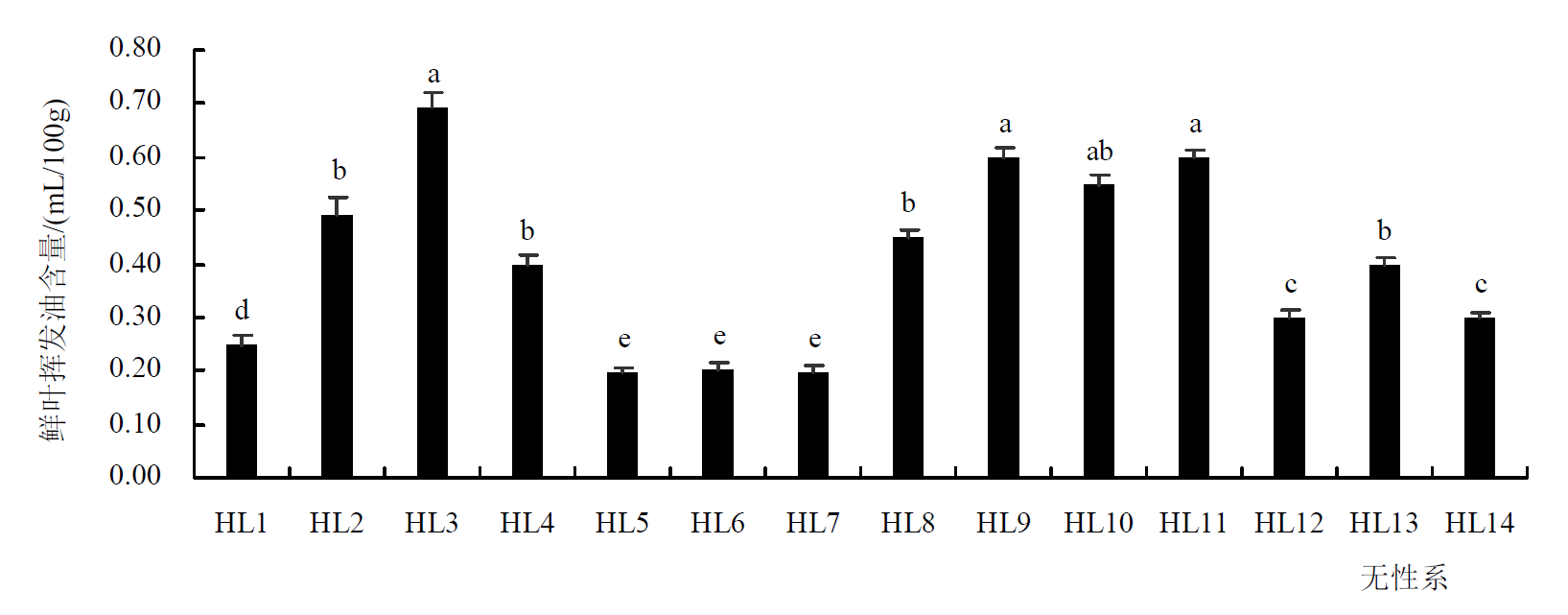
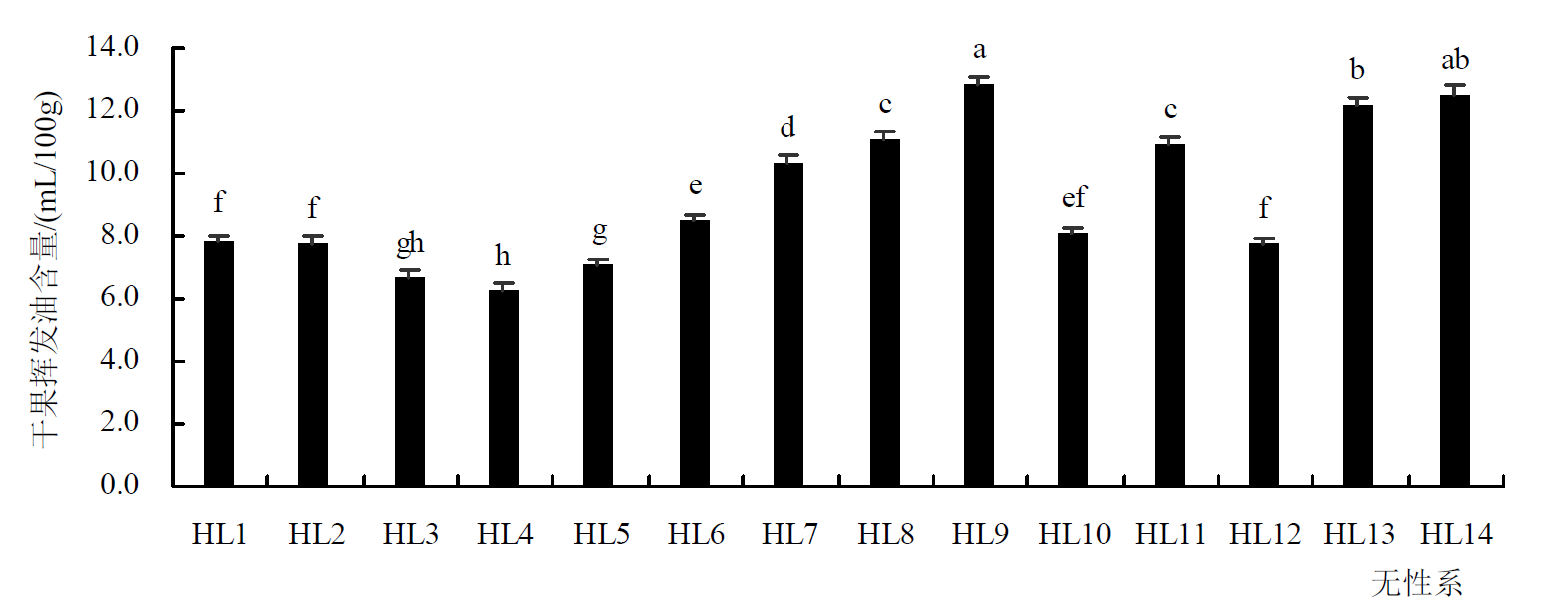
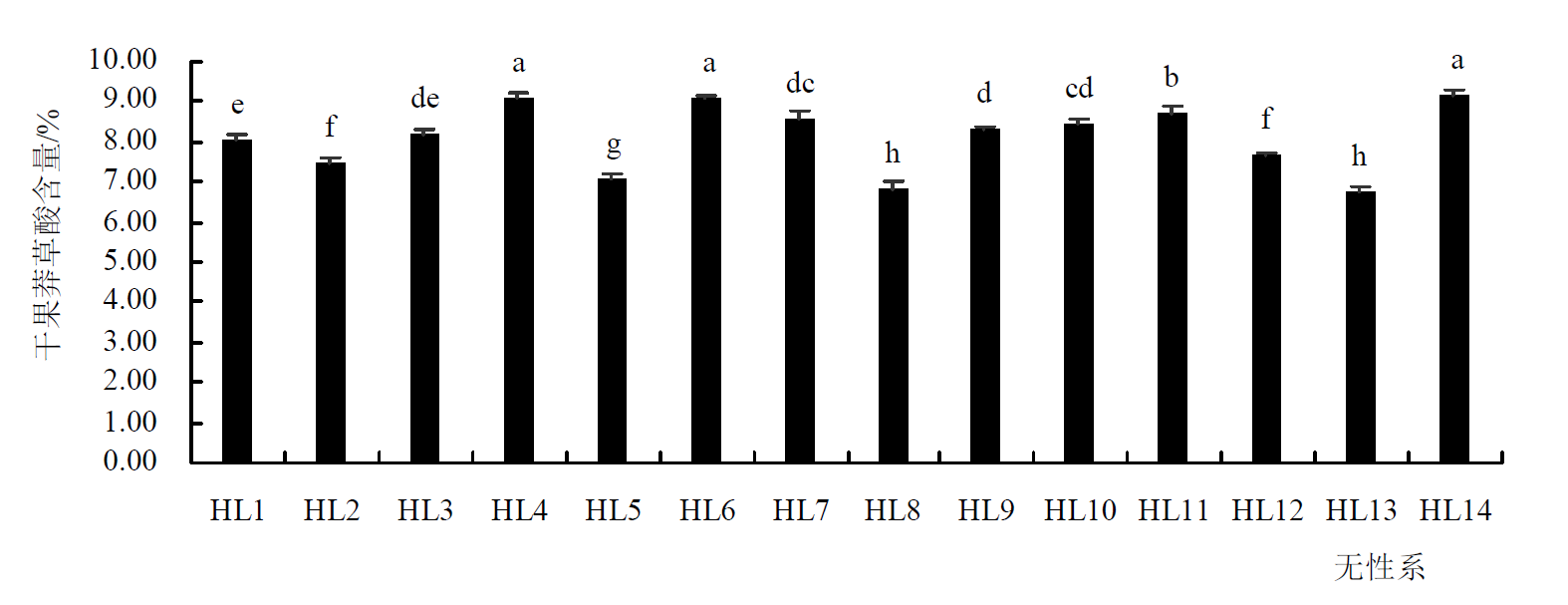
针对八角优良无性系品质评价体系不完善、专用型良种筛选缺乏依据的问题,为筛选高挥发油、高莽草酸、高龙蒿脑等专用型八角优良种质,以同一产地14个八角优良无性系 (HL1~HL14)植株的鲜叶和干果为材料,采用水蒸气蒸馏法、高效液相色谱法、气相色谱法,测定叶片、果实挥发油含量、莽草酸含量及4种关键挥发油组分含量,并进行主成分分析。结果表明:14个优良无性系八角叶片含油量在0.2~0.69 mL/100g;干果含油量在6.3~12.8 mL/100g,均高于6%的选优阈值标准,其中HL9最高,为12.8 mL/100g;HL4、HL6及HL14的干果莽草酸含量均超过9.0%;HL10龙蒿脑含量最高,为0.71%;各指标在无性系间差异均达显著水平。主成分分析显示,14个八角无性系综合表现优劣排序为HL9、HL13、HL10、HL14、HL8、HL11、HL7、HL2、HL3、HL12、HL4、HL1、HL6、HL5;综合得分较高的无性系HL9、HL13、HL10和HL14可作为选择栽培对象,其中HL9(果实挥发油含量最高)、HL10(龙蒿脑含量最高)、HL14(莽草酸含量最高)以及HL3(鲜叶挥发油含量最高)具备专项利用价值,可在生产中针对性选择利用。本研究为八角良种选育、定向栽培与深加工利用提供科学依据,未来可开展区域化试验与配套栽培技术研究。

关键词: 八角, 无性系, 挥发油, 龙蒿脑, 反式茴香脑, 顺式茴香脑, 大茴香醛, 莽草酸

Abstract:

In order to screen high volatile oil, high shikimic acid, high estragole and other special type of Illicium verum excellent germplasm and provide a basis for resource exploitation and varietal breeding of Illicium verum, fresh leaves and dried fruits were collected from 14 excellent clones plant (HL1-HL14) of Illicium verum from the same production area. Volatile oil content in leaves and fruits was determined by steam distillation, shikimic acid content was quantified using high-performance liquid chromatography (HPLC), and volatile oil components were analyzed by gas chromatography (GC). Principal component analysis (PCA) was performed to evaluate the samples. The results indicated that the leaf oil content ranged from 0.2 to 0.69 mL/100g of excellent 14 clones, while the dried fruit oil content varied from 6.3 to 12.8 mL/100g, all up to the selection criterion of 6%. Clone HL9 exhibited the highest fruit oil content at 12.8 mL/100g. The shikimic acid content in dried fruits of HL4, HL6, and HL14 exceeded 9.0%. HL10 showed the highest estragole content at 0.71%. Considerable variation was observed among clones in terms of volatile oil content, shikimic acid content, and chemical composition. PCA-based comprehensive ranking of the 14 clones in descending order was: HL9, HL13, HL10, HL14, HL8, HL11, HL7, HL2, HL3, HL12, HL4, HL1, HL6, and HL5. Clones with higher composite scores include HL9, HL13, HL10, and HL14, which are recommended for selective cultivation. Among these, HL9 (highest fruit volatile oil content), HL10 (highest estragole content), HL14 (highest shikimic acid content), and HL3 (highest leaf volatile oil content) possess specific utilizable traits and can be targeted for production applications.

Key words: Illicium verum, clone, volatile oil, estragole, trans-anethole, cis-anethole, anisic aldehyde, shikimi acid

中图分类号: