欢迎访问《中国农学通报》,

中国农学通报 ›› 2026, Vol. 42 ›› Issue (17): 106-112.doi: 10.11924/j.issn.1000-6850.casb2026-0071

• 资源环境生态土壤气象 • 上一篇    下一篇

大兴安岭林区季节性冻土冻融规律及驱动因子分析

杨丽萍(), 王宇宸, 张岚彪, 唐家琦, 张依尧, 张存厚()   

  1. 内蒙古生态与农业气象中心, 呼和浩特 010051
  • 收稿日期:2026-01-23 修回日期:2026-04-29 出版日期:2026-09-09 发布日期:2026-09-09
  • 通讯作者:
    张存厚,男,1977年出生,内蒙古呼和浩特人,正高级工程师,博士,主要从事生态气象与干旱评估方面的研究。通信地址:010051 内蒙古呼和浩特市新城区海拉尔大街49号 内蒙古自治区生态与农业气象中心,Tel:0471-3335057,E-mail:
  • 作者简介:

    杨丽萍,女,1977年出生,内蒙古赤峰人,正高级工程师,博士,主要从事生态气象、林业气象及遥感应用方面的研究。通信地址:010051内蒙古呼和浩特市新城区海拉尔大街49号 内蒙古自治区生态与农业气象中心,Tel:0471-3335057,E-mail:

  • 基金资助:
    内蒙古自治区科技计划项目“气候变化下大兴安岭森林地上碳储量监测与固碳潜力评估及应用”(2026YFDZ0120); “自然恢复下内蒙古草原固碳增汇过程机制与量化评估技术研究(2026YFDZ0071); “内蒙古黄河流域西鄂尔多斯高原洪旱灾害遥感监测技术研发与应用”(2025YFHH0005)

Analysis of Freeze-Thaw Patterns and Driving Factors of Seasonal Frozen Soil in Daxing’anling Forest Area

YANG Liping(), WANG Yuchen, ZHANG Lanbiao, TANG Jiaqi, ZHANG Yiyao, ZHANG Cunhou()   

  1. Inner Mongolia Center of Ecology and Agrometeorology, Hohhot 010051
  • Received:2026-01-23 Revised:2026-04-29 Published:2026-09-09 Online:2026-09-09

摘要:

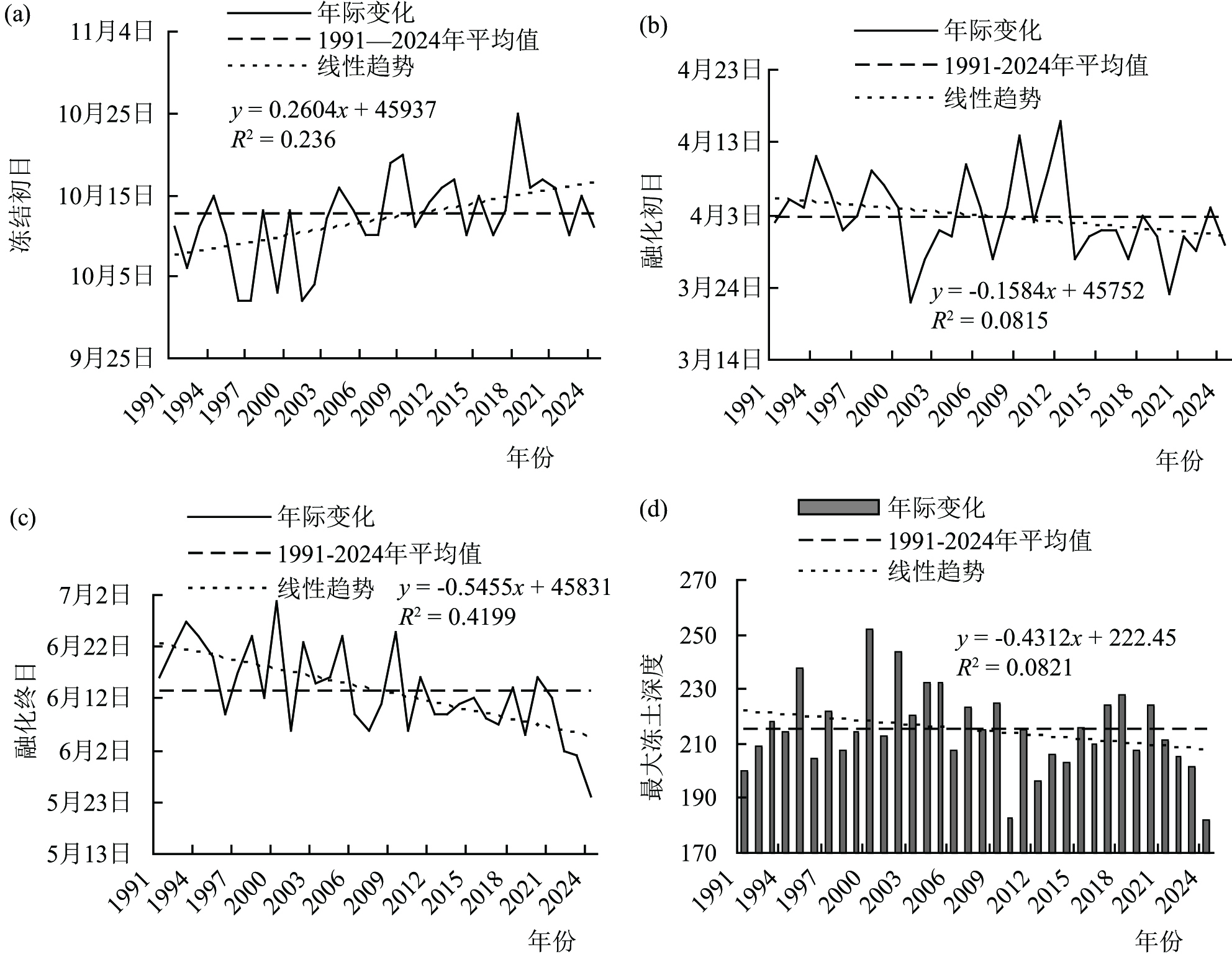
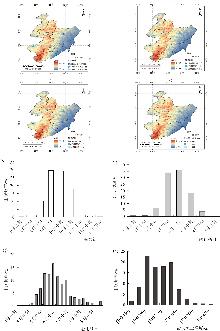
为了合理利用冻土资源及推动区域可持续发展,本研究基于1991—2024年大兴安岭林区长序列地面气象站冻土资料和同期气象观测数据,采用线性倾向估计、Pearson相关系数等统计分析方法,系统分析冻土冻融关键参数的时空变化特征及其与气象、地理要素的关联。结果表明:(1)研究期内,大兴安岭林区季节性冻土退化趋势显著,呈现“冻结期推迟、融化期提前、冻结深度减小”特征,具体而言,冻结初日平均每10 a推迟2.6 d,融化初日和融化终日平均每10 a分别提前1.6 d和5.5 d,最大冻土深度平均每10 a下降4.3 cm,导致冻融周期持续缩短;(2)冻融过程及最大冻土深度的时空分异明显,冻结初日空间分布上表现为“北早南晚”的格局,融化初日则表现为“东南部早于西北部”。融化终日的空间跨度近4个月,最大冻土深度呈“东南浅、西北深”分布特点;(3)气象与地理因子协同季节性驱动冻土的变化。关键气象因子包括:秋季平均气温/秋季降水量(影响冻结初日)、年平均气温(影响融化初日)及年/夏季降水量(影响最大冻土深度)。核心地理因子为海拔(调控冻融时间)、经度(影响融化初日与冻土深度)和纬度(作用于冻融关键时间与冻土深度)。研究成果揭示了大兴安岭林区季节性冻土的冻融规律及主要驱动因子,为该区域冻土资源管理、生态保护及应对气候变化提供科学依据。

关键词: 季节性冻土, 冻融规律, 时空演变, 驱动机制, 气候变化, 冻土退化, 大兴安岭

Abstract:

To rationally utilize frozen soil resources and promote regional sustainable development, based on long-term (1991-2024) frozen soil data and synchronous meteorological observation data from surface meteorological stations in the Daxing’anling forest area, statistical analysis methods such as linear trend estimation and Pearson correlation coefficient were employed to systematically analyze the spatiotemporal variation characteristics of key freeze-thaw parameters of frozen soil and their correlations with meteorological and geographical factors. The results indicated that: (1) during the study period, the seasonal frozen soil showed a significant degradation trend, characterized by “delayed freezing, advanced thawing, and reduced freezing depth”. The initial freezing date was delayed by 2.6 days per decade; the initial thawing date and final thawing date were advanced by 1.6 days and 5.5 days per decade, respectively; the maximum frozen soil depth decreased by 4.3 cm per decade, and the freeze-thaw cycle continued to be shortened. (2) The freeze-thaw process exhibited obvious spatiotemporal differentiation: the initial freezing date was earlier in the north and later in the south, the initial thawing date was earlier in the southeast than in the northwest, the final thawing date spanned nearly 4 months, and the maximum frozen soil depth presented a distribution feature of “shallow in the southeast and deep in the northwest”. (3) Meteorological and geographical factors synergistically drove the changes of frozen soil. The key meteorological factors were autumn average temperature and autumn precipitation (affecting the initial freezing date), annual average temperature (affecting the initial thawing date), and annual/summer precipitation (affecting the maximum frozen soil depth). The core geographical factors were altitude (regulating freeze-thaw timing), longitude (influencing the initial thawing date and frozen soil depth), and latitude (acting on key freeze-thaw timing and frozen soil depth). This study clarifies the freeze-thaw patterns and main driving factors of seasonal frozen soil in the Daxing’anling forest area, providing a scientific basis for frozen soil resource management, ecological protection, and climate change adaptation in the forest area.

Key words: seasonal frozen soil, freeze-thaw patterns, spatiotemporal evolution, driving mechanism, climate change, frozen soil degradation, Daxing’anling

中图分类号: