欢迎访问《中国农学通报》,

中国农学通报 ›› 2026, Vol. 42 ›› Issue (14): 75-83.doi: 10.11924/j.issn.1000-6850.casb2026-0211

• 资源·环境·生态·土壤·气象 • 上一篇    下一篇

扎赉特旗气候变化对水稻产量的影响研究

吴志峰1(), 周怡诺2, 王文婧3, 杨玉辉1(), 王建国1, 刘冠华1   

  1. 1 扎赉特旗气象局, 内蒙古兴安盟 137600
    2 乌兰浩特市气象局, 内蒙古兴安盟 137400
    3 科右中旗气象局, 内蒙古兴安盟 029400
  • 收稿日期:2026-03-26 修回日期:2026-05-13 出版日期:2026-07-25 发布日期:2026-07-24
  • 通讯作者:
    杨玉辉,男,1983年出生,辽宁康平人,高级工程师,硕士研究生,研究方向:气象服务与应用气象、综合观测。通信地址:137600 内蒙古兴安盟扎赉特旗气象局,E-mail:
  • 作者简介:

    吴志峰,男,1999年出生,内蒙古扎赉特旗人,助理工程师,本科,研究方向:综合观测。通信地址:137600 内蒙古兴安盟扎赉特旗气象局,E-mail:

  • 基金资助:
    内蒙古兴安盟气象局科研项目“扎赉特旗气候变化对水稻产量的影响”(xaqx2025--11)

Impacts of Climate Change on Rice Yield in Zhalaite Banner

WU Zhifeng1(), ZHOU Yinuo2, WANG Wenjing3, YANG Yuhui1(), WANG Jianguo1, LIU Guanhua1   

  1. 1 Zhalaiteqi Banner Meteorological Bureau, Xing'an League, Inner Mongolia 137600
    2 Wulanhaote City Meteorological Bureau, Xing'an League, Inner Mongolia 137400
    3 Keyouzhongqi Meteorological Bureau, Xing'an League, Inner Mongolia 029400
  • Received:2026-03-26 Revised:2026-05-13 Published:2026-07-25 Online:2026-07-24

摘要:

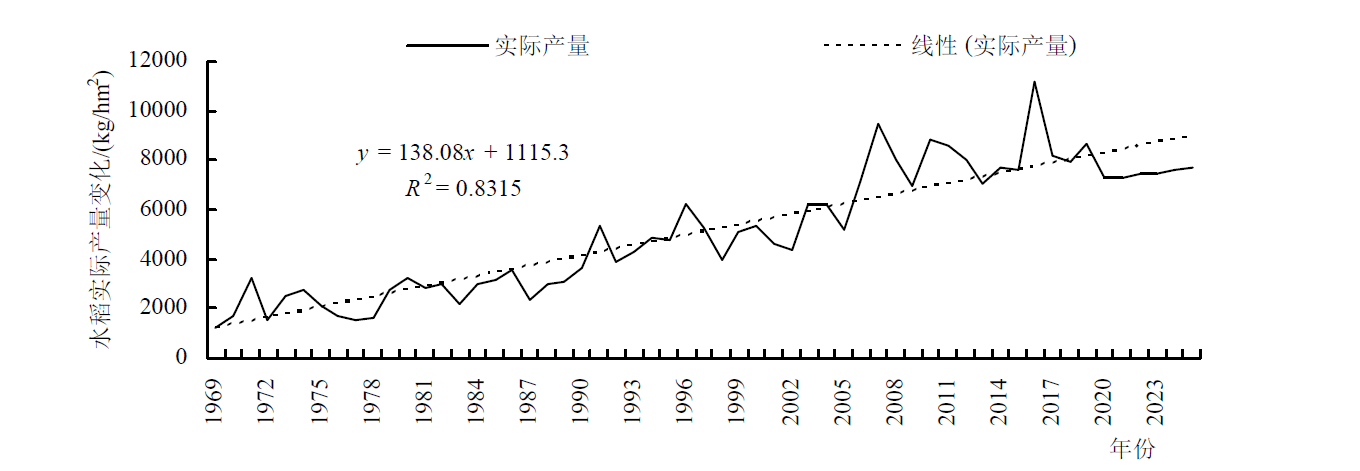
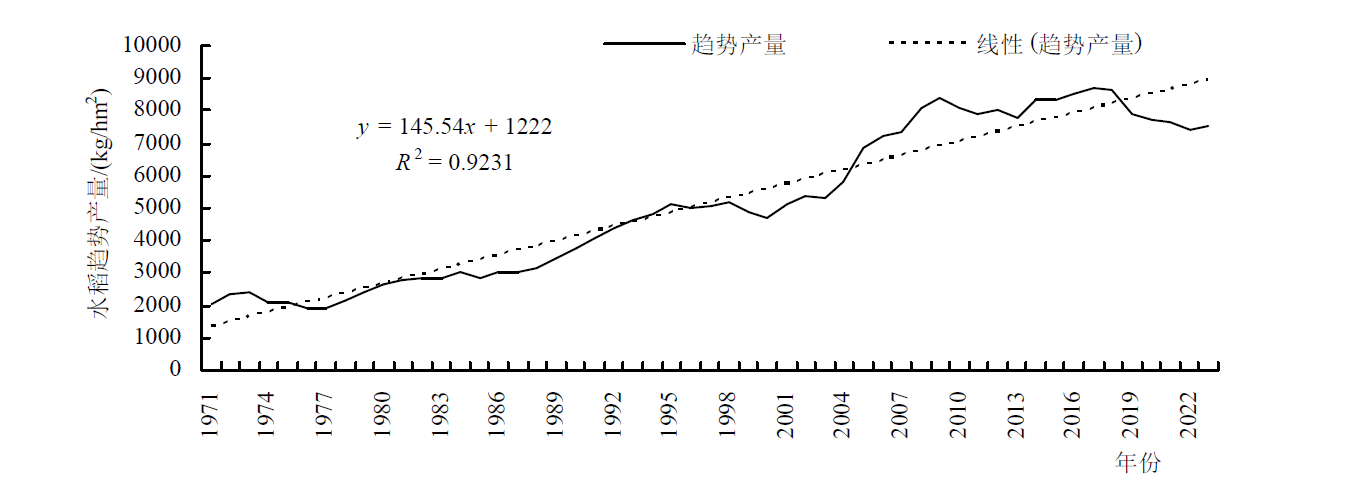
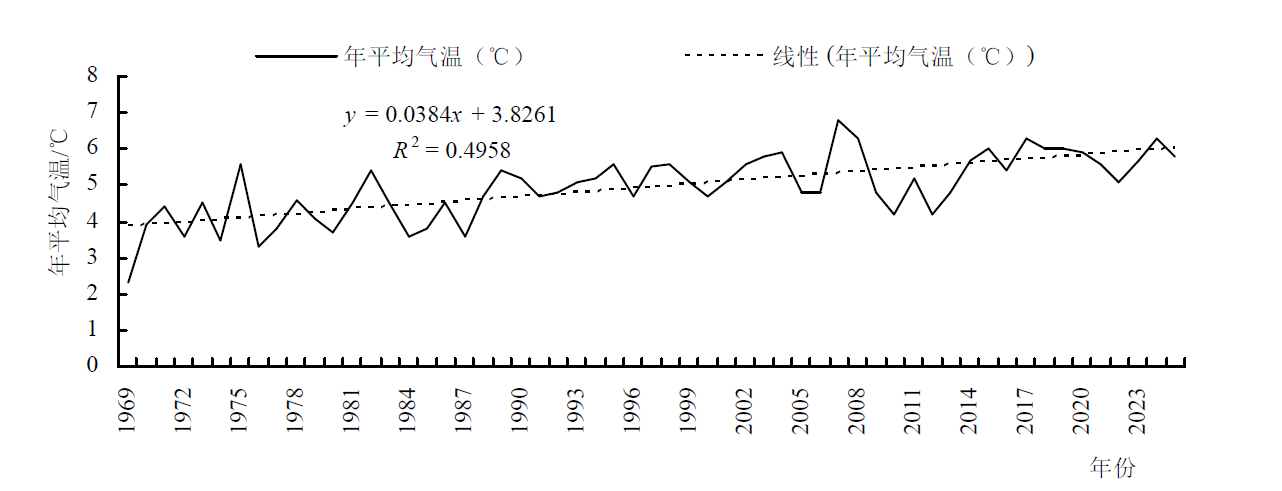
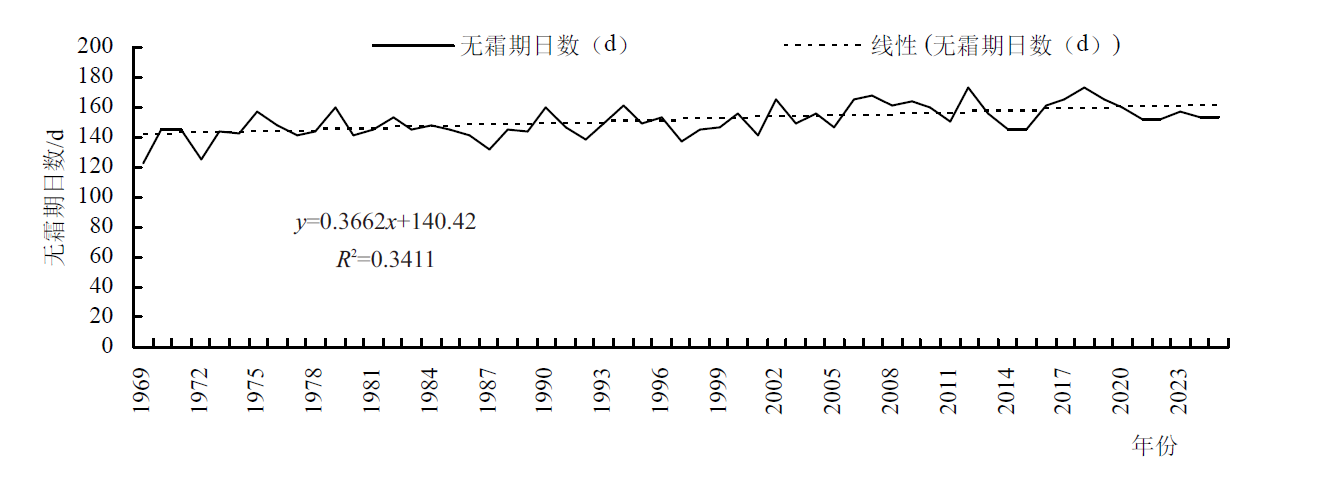
本研究基于内蒙古扎赉特旗1969—2025年气象观测数据和水稻产量资料,采用5 a滑动平均法分离了趋势产量与气象产量,运用Mann-Kendall检验和多元回归分析,系统研究了当地热量、水分、光照等气候资源的演变规律及其对水稻产量的定量影响,构建了产量预测模型。结果表明:(1)扎赉特旗气候呈显著变暖趋势,年平均气温每10 a上升0.4℃,无霜期每10 a延长3.6 d,≥10℃活动积温每10 a增多86.2℃·d;(2)水稻实际产量呈极显著上升趋势(每10 a增加1380.8 kg/hm2),57 a间增长约8.4倍,主要归因于技术进步驱动,而气象产量受气候年际波动影响剧烈(CV=38.5%),其中丰收年、平年、减产年分别占29.1%、27.3%、43.6%;(3)建立的二次多项式模型可解释气象产量变异的88.44%,经2024—2025年独立样本验证,预测相对误差小于0.5%。结论认为:热量资源增加通过延长生育期、扩大高产品种布局,对趋势产量提升有显著贡献;但热量与气象产量呈非线性关系(中低热量区间正相关、超过阈值后负相关),叠加水分条件年际波动大、极端气候事件频发,是产量不稳定的主要风险;技术进步是产量提升的主导因素,但未来可能面临边际效益递减的风险。建议优化品种布局、强化水分管理、完善预警体系,以提高水稻生产对气候变化的适应能力。

关键词: 气候变化, 水稻产量, 气象产量, 趋势产量, 气候资源

Abstract:

Based on meteorological observation data and rice yield records from Zhalaite Banner from 1969 to 2025, this study employed the 5-year moving average method to separate trend yield from meteorological yield. Using the Mann-Kendall test and multiple regression analysis, it systematically investigated the evolution patterns of thermal, water, and light resources and their quantitative impacts on rice yield, and constructed a yield prediction model. The results show that: (1) the climate of Zhalaite Banner exhibits a significant warming trend, with the annual average temperature increasing by 0.4℃ per decade, the frost-free period extending by 3.6 days per decade, and the ≥10℃ accumulated active temperature increasing by 86.2℃·d per decade. (2) The actual rice yield shows an extremely significant upward trend (increasing by 1380.8 kg/hm2 per decade), growing approximately 8.4 times over 57 years, mainly driven by technological progress. However, the meteorological yield fluctuates violently (CV=38.5%), with bumper years, normal years, and yield-reduction years accounting for 29.1%, 27.3%, and 43.6%, respectively. (3) The established quadratic polynomial model can explain 88.44% of the variance in meteorological yield. Validation using independent samples from 2024 to 2025 shows that the relative prediction error is less than 0.5%. The conclusion holds that the increase in thermal resources has significantly contributed to the improvement of trend yield by extending the growth period and expanding the layout of high-yield varieties. However, there is a nonlinear relationship between heat and meteorological yield (positively correlated in the low-to-moderate heat range but negatively correlated beyond the threshold). Coupled with large interannual fluctuations in water conditions and frequent extreme climate events, these factors constitute the main risks to yield stability. Technological progress is the dominant factor in yield enhancement but faces the risk of diminishing marginal returns. It is recommended to optimize variety layout, strengthen water management, and improve early warning systems to enhance the adaptability of rice production to climate change.

Key words: climate change, rice yield, meteorological yield, trend yield, climatic resources

中图分类号: