Welcome to Chinese Agricultural Science Bulletin,

Chinese Agricultural Science Bulletin ›› 2026, Vol. 42 ›› Issue (11): 1-8.doi: 10.11924/j.issn.1000-6850.casb2025-0854
SUN Wurina1( ), LIANG Shuang1, LIU Jia2, HAN Feng1, WEN Li1, LUO Wei1, BAI Lu1, XUE Hainan1, HAN Lei1, LIU Jicong1, MA Benchi1, LI Zifan1, GAO Yanan2, XU Xingjian1()
Received:2025-10-10
Revised:2025-12-05
Online:2026-06-12
Published:2026-06-12
CLC Number:
SUN Wurina, LIANG Shuang, LIU Jia, HAN Feng, WEN Li, LUO Wei, BAI Lu, XUE Hainan, HAN Lei, LIU Jicong, MA Benchi, LI Zifan, GAO Yanan, XU Xingjian. Adaptability Evaluation of Aromatic Rice Germplasm and Screening of Elite Parental Lines in Inner Mongolia Rice-growing Region[J]. Chinese Agricultural Science Bulletin, 2026, 42(11): 1-8.
Add to citation manager EndNote|Ris|BibTeX
URL: https://www.casb.org.cn/EN/10.11924/j.issn.1000-6850.casb2025-0854
| 性状 | 类型 | 品种数量 | 频率/% | 多样性指数H’ | 性状 | 类型 | 品种数量 | 频率/% | 多样性指数H’ |
|---|---|---|---|---|---|---|---|---|---|
| 全生育期 | 早熟(125~135 d) | 3 | 2.36 | 1.15 | 倒伏性 | 直立型 | 115 | 90.55 | 0.4 |
| 中熟(136~145 d) | 43 | 33.86 | 中间型 | 6 | 4.72 | ||||
| 中晚熟(146~155 d) | 53 | 41.73 | 倾斜型 | 5 | 3.94 | ||||
| 晚熟(>155 d) | 28 | 22.05 | 倒伏型 | 1 | 0.79 | ||||
| 分蘖力 | 强 | 15 | 11.81 | 0.36 | 芒长 | 无 | 101 | 79.53 | 0.65 |
| 中 | 112 | 88.19 | 短 | 20 | 15.75 | ||||
| 弱 | 0 | 0 | 中 | 2 | 1.57 | ||||
| 谷粒形状 | 椭圆形 | 46 | 36.22 | 1.31 | 长 | 4 | 3.15 | ||
| 短圆形 | 1 | 0.79 | 极长 | 0 | 0 | ||||
| 阔卵形 | 35 | 27.56 | 剑叶角度 | 直立 | 45 | 35.43 | 1.02 | ||
| 中长形 | 36 | 28.35 | 平展 | 14 | 11.02 | ||||
| 细长形 | 9 | 7.09 | 中间 | 66 | 51.97 | ||||
| 穗型 | 密集型 | 27 | 21.26 | 1.04 | 披垂 | 2 | 1.57 | ||
| 中间型 | 61 | 48.03 | 种皮色 | 白色 | 119 | 93.7 | 0.28 | ||
| 散开型 | 39 | 30.71 | 红色 | 1 | 0.79 | ||||
| 穗立形状 | 直立 | 11 | 8.66 | 1.29 | 黑色 | 6 | 4.72 | ||
| 半直立 | 43 | 33.86 | 褐色 | 1 | 0.79 | ||||
| 下垂 | 31 | 24.41 | 紫色 | 0 | 0 | ||||
| 弯曲 | 42 | 33.07 | 颖尖色 | 秆黄色 | 117 | 92.13 | 0.33 | ||
| 二次枝梗 | 无 | 0 | 0 | 0.69 | 颖尖色 | 红色 | 5 | 3.94 | 0.33 |
| 少 | 69 | 54.33 | 黑色 | 5 | 3.94 | ||||
| 多 | 58 | 45.67 | 紫色 | 0 | 0 | ||||
| 聚集 | 0 | 0 | 褐色 | 0 | 0 |
| 性状 | 类型 | 品种数量 | 频率/% | 多样性指数H’ | 性状 | 类型 | 品种数量 | 频率/% | 多样性指数H’ |
|---|---|---|---|---|---|---|---|---|---|
| 全生育期 | 早熟(125~135 d) | 3 | 2.36 | 1.15 | 倒伏性 | 直立型 | 115 | 90.55 | 0.4 |
| 中熟(136~145 d) | 43 | 33.86 | 中间型 | 6 | 4.72 | ||||
| 中晚熟(146~155 d) | 53 | 41.73 | 倾斜型 | 5 | 3.94 | ||||
| 晚熟(>155 d) | 28 | 22.05 | 倒伏型 | 1 | 0.79 | ||||
| 分蘖力 | 强 | 15 | 11.81 | 0.36 | 芒长 | 无 | 101 | 79.53 | 0.65 |
| 中 | 112 | 88.19 | 短 | 20 | 15.75 | ||||
| 弱 | 0 | 0 | 中 | 2 | 1.57 | ||||
| 谷粒形状 | 椭圆形 | 46 | 36.22 | 1.31 | 长 | 4 | 3.15 | ||
| 短圆形 | 1 | 0.79 | 极长 | 0 | 0 | ||||
| 阔卵形 | 35 | 27.56 | 剑叶角度 | 直立 | 45 | 35.43 | 1.02 | ||
| 中长形 | 36 | 28.35 | 平展 | 14 | 11.02 | ||||
| 细长形 | 9 | 7.09 | 中间 | 66 | 51.97 | ||||
| 穗型 | 密集型 | 27 | 21.26 | 1.04 | 披垂 | 2 | 1.57 | ||
| 中间型 | 61 | 48.03 | 种皮色 | 白色 | 119 | 93.7 | 0.28 | ||
| 散开型 | 39 | 30.71 | 红色 | 1 | 0.79 | ||||
| 穗立形状 | 直立 | 11 | 8.66 | 1.29 | 黑色 | 6 | 4.72 | ||
| 半直立 | 43 | 33.86 | 褐色 | 1 | 0.79 | ||||
| 下垂 | 31 | 24.41 | 紫色 | 0 | 0 | ||||
| 弯曲 | 42 | 33.07 | 颖尖色 | 秆黄色 | 117 | 92.13 | 0.33 | ||
| 二次枝梗 | 无 | 0 | 0 | 0.69 | 颖尖色 | 红色 | 5 | 3.94 | 0.33 |
| 少 | 69 | 54.33 | 黑色 | 5 | 3.94 | ||||
| 多 | 58 | 45.67 | 紫色 | 0 | 0 | ||||
| 聚集 | 0 | 0 | 褐色 | 0 | 0 |
| 性状 | 均值±标准差 | 变异系数/% | 最小值 | 最大值 | 峰度 | 偏度 |
|---|---|---|---|---|---|---|
| 株高/cm | 105.08±11.65 | 11.09 | 70.2 | 131.2 | -0.27 | 0.01 |
| 茎秆长度/cm | 83.64±10.37 | 12.39 | 56.8 | 115.0 | -0.10 | 0.31 |
| 穗长/cm | 20.06±2.12 | 10.57 | 14.5 | 25.7 | 0.20 | 0.24 |
| 有效穗/(万/hm2) | 405.53±115.98 | 28.60 | 195.01 | 820.04 | 1.11 | 0.94 |
| 最高苗/(万/hm2) | 498.65±109.58 | 21.99 | 266.68 | 850.04 | 0.15 | 0.52 |
| 剑叶长/cm | 27.07±4.81 | 17.75 | 14.0 | 40.8 | 0.54 | -0.05 |
| 剑叶宽/cm | 1.52±0.19 | 12.66 | 1.0 | 2.1 | 0.57 | 0.49 |
| 倒二叶长/cm | 33.26±4.45 | 13.37 | 21.8 | 44.0 | 0.22 | -0.05 |
| 倒二叶宽/cm | 1.15±0.19 | 16.37 | 0.8 | 1.6 | -0.26 | 0.58 |
| 茎秆直径/mm | 3.68±0.39 | 10.71 | 2.9 | 4.6 | -0.42 | 0.19 |
| 实粒数/粒 | 119.62±31.88 | 26.65 | 65.8 | 204.2 | -0.50 | 0.53 |
| 总粒数/粒 | 137.58±38.41 | 27.92 | 72.6 | 228.2 | -0.69 | 0.34 |
| 结实率/% | 87.77±8.10 | 9.23 | 63.73 | 98.2 | 0.12 | -0.90 |
| 成穗率/% | 81.25±12.77 | 15.72 | 48.8 | 97.0 | -0.65 | -0.77 |
| 千粒重/g | 25.64±3.42 | 13.34 | 14.7 | 37.4 | 1.24 | -0.03 |
| 性状 | 均值±标准差 | 变异系数/% | 最小值 | 最大值 | 峰度 | 偏度 |
|---|---|---|---|---|---|---|
| 株高/cm | 105.08±11.65 | 11.09 | 70.2 | 131.2 | -0.27 | 0.01 |
| 茎秆长度/cm | 83.64±10.37 | 12.39 | 56.8 | 115.0 | -0.10 | 0.31 |
| 穗长/cm | 20.06±2.12 | 10.57 | 14.5 | 25.7 | 0.20 | 0.24 |
| 有效穗/(万/hm2) | 405.53±115.98 | 28.60 | 195.01 | 820.04 | 1.11 | 0.94 |
| 最高苗/(万/hm2) | 498.65±109.58 | 21.99 | 266.68 | 850.04 | 0.15 | 0.52 |
| 剑叶长/cm | 27.07±4.81 | 17.75 | 14.0 | 40.8 | 0.54 | -0.05 |
| 剑叶宽/cm | 1.52±0.19 | 12.66 | 1.0 | 2.1 | 0.57 | 0.49 |
| 倒二叶长/cm | 33.26±4.45 | 13.37 | 21.8 | 44.0 | 0.22 | -0.05 |
| 倒二叶宽/cm | 1.15±0.19 | 16.37 | 0.8 | 1.6 | -0.26 | 0.58 |
| 茎秆直径/mm | 3.68±0.39 | 10.71 | 2.9 | 4.6 | -0.42 | 0.19 |
| 实粒数/粒 | 119.62±31.88 | 26.65 | 65.8 | 204.2 | -0.50 | 0.53 |
| 总粒数/粒 | 137.58±38.41 | 27.92 | 72.6 | 228.2 | -0.69 | 0.34 |
| 结实率/% | 87.77±8.10 | 9.23 | 63.73 | 98.2 | 0.12 | -0.90 |
| 成穗率/% | 81.25±12.77 | 15.72 | 48.8 | 97.0 | -0.65 | -0.77 |
| 千粒重/g | 25.64±3.42 | 13.34 | 14.7 | 37.4 | 1.24 | -0.03 |
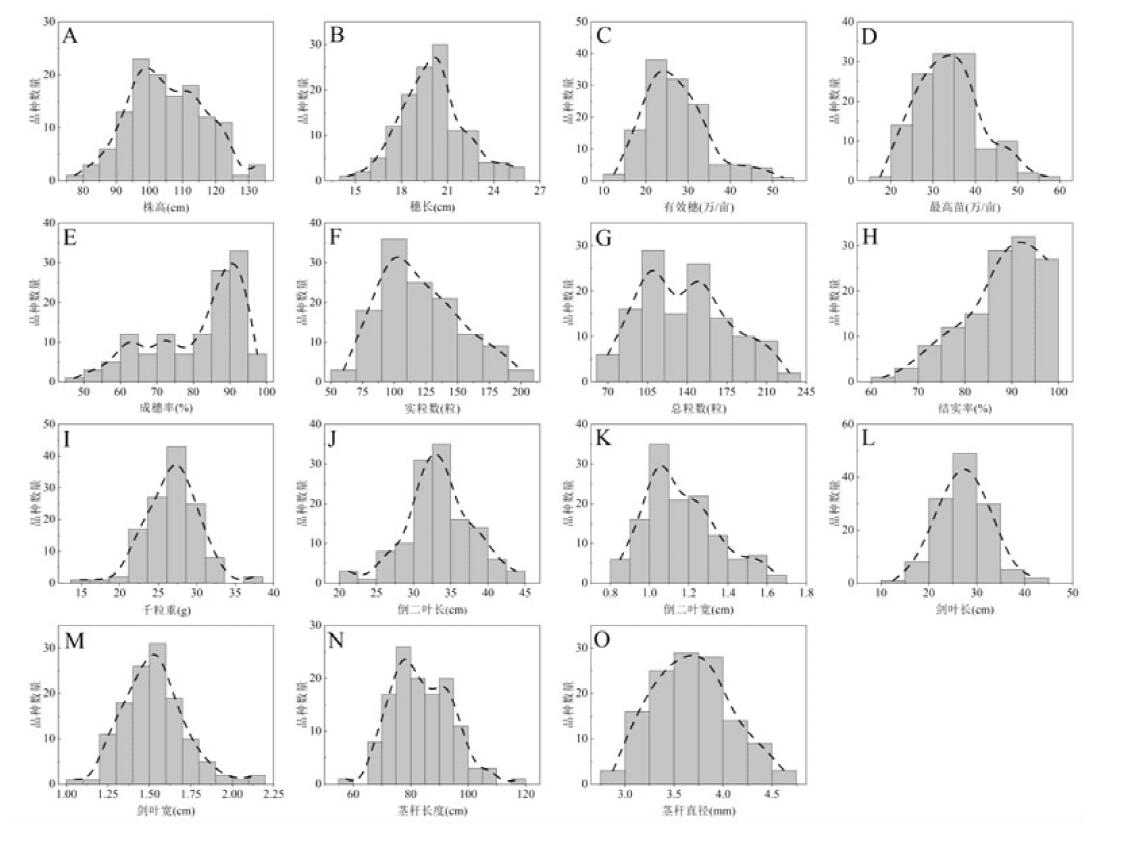
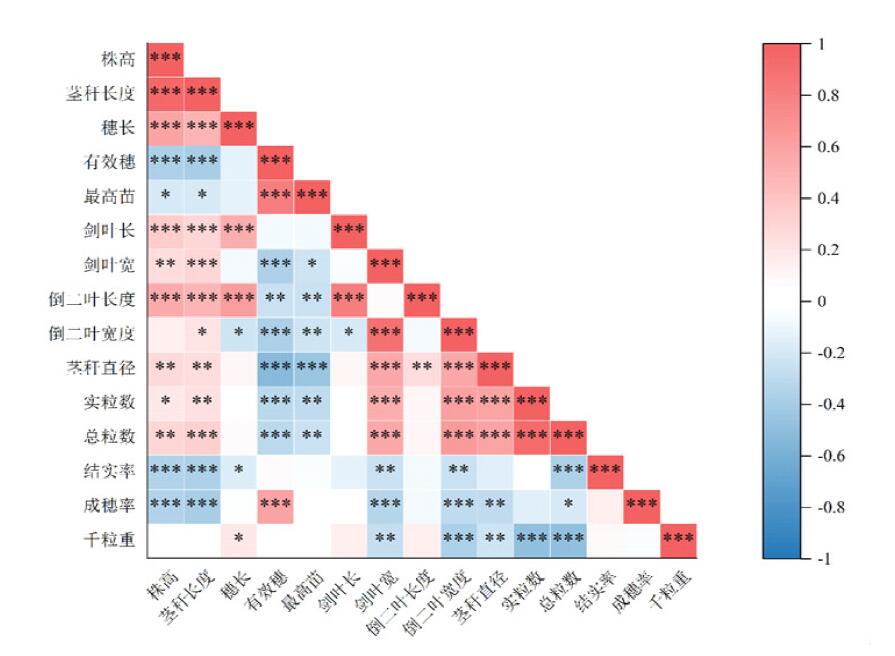
| [1] |
李初军, 刘建萍, 贾丽颖, 等. 我国水稻育种的现状与展望[J]. 中国种业, 2007(1):11-12.
|
| [2] |
黄众基, 朱镕一, 荆凤鸽, 等. 不同水稻品种稻米品质性状与种子活力的相关性研究[J]. 浙江农林大学学报, 2024, 41(4):679-687.
|
| [3] |
刘进, 勒思, 周慧颖, 等. 江西省水稻地方品种资源的收集与鉴定评价[J]. 植物遗传资源学报, 2023, 24(5):1267-1276.
|
| [4] |
韩龙植. 水稻种质资源基础性工作研究进展[J]. 植物遗传资源学报, 2013, 14(1):195.
|
| [5] |
任三娟, 周屹峰, 孙出, 等. 利用香味基因(fgr)的功能分子标记1F/1R高效选育籼稻香型不育系[J]. 农业生物技术学报, 2011, 19 (4):589-596.
|
| [6] |
doi: 10.3136/fstr.20.1251 URL |
| [7] |
doi: 10.1021/jf072360c pmid: 18081248 |
| [8] |
周继华, 张安鹏, 许闻科, 等. 重组聚合酶扩增(RPA)快速检测水稻香味等位基因badh2-E7[J/OL]. 分子植物育种,1-7[2025-12-12]. https://link.cnki.net/urlid/46.1068.S.20230531.0855.002.
|
| [9] |
潘阳阳, 黄道强, 王重荣, 等. 香稻Badh2基因单倍型及香气成分2-乙酰-1-吡咯啉代谢通路的研究进展[J]. 广东农业科学, 2021, 48(7):9-16.
|
| [10] |
张玉红, 张倩倩, 胡秀明, 等. 24份香稻材料抗稻瘟病基因的检测与分析[J]. 江苏农业科学, 2025, 53(17):52-56.
|
| [11] |
韩龙植, 高熙宗, 魏兴华, 等. 水稻种质资源研究与利用进展[J]. 中国水稻科学, 2020, 34(1):1-16.
|
| [12] |
doi: 10.1016/j.molp.2025.10.019 URL |
| [13] |
杨文博, 秦子钰, 马锦霞, 等. 河南省水稻种质资源调查收集与鉴定评价[J]. 植物遗传资源学报, 2025, 26(4):633-645.
|
| [14] |
熊强强, 孙长辉, 顾雯霏, 等. 基于生育期、产量和品质对70份粳糯品种(系)的综合评价[J]. 作物学报, 2025, 51(3):728-743.
doi: 10.3724/SP.J.1006.2025.42026 |
| [15] |
何冬冬, 陈丽茹, 王坤, 等. 兴安盟水稻产业发展现状、存在问题及对策[J]. 北方水稻, 2025, 55(1):65-68.
|
| [16] |
韩龙植, 魏兴华, 曹桂兰, 等. 水稻种质资源描述规范和数据标准[M]. 北京: 中国农业出版社, 2006.
|
| [17] |
关峰, 石博, 万新建, 等. 江西省地方冬瓜种质资源表型性状遗传多样性分析[J]. 植物遗传资源学报, 2022, 23(2):385-397.
doi: 10.13430/j.cnki.jpgr.20210830001 |
| [18] |
刘欣欣. 水稻Hd2基因uORF的功能研究[D]. 哈尔滨: 东北林业大学, 2022.
|
| [19] |
王凌志, 黄婷, 龙凯珍, 等. 水稻地方种质资源表型遗传多样性分析及综合评价[J]. 江苏农业科学, 2025, 53(19):80-87.
|
| [20] |
杨长志. 水稻抗倒伏化控试验[J]. 农民致富之友, 2015(7):83.
|
| [21] |
罗肖郧, 郑兴飞, 彭宣国, 等. 水稻抗倒伏研究:现状、挑战与未来方向[J]. 中国水稻科学, 2026, 40(2):181-195.
doi: 10.16819/j.1001-7216.2026.240905 |
| [22] |
曹阳. “稻花香2号”抗倒伏高产栽培技术探讨[J]. 农业科技通讯, 2013(4):158-159.
|
| [23] |
邵鹏, 程婉莹, 谢瑞, 等. 258份水稻种质资源遗传多样性分析及评价[J]. 种子, 2025, 44(10):136-143.
|
| [24] |
孙建军, 曹地, 豆丹丹, 等. 351份水稻种质资源多样性研究[J]. 江苏农业科学, 2025, 53(19):71-79.
|
| [25] |
|
| [26] |
聂守军, 刘宇强, 高世伟, 等. 优质高产香粳水稻新品种绥粳18育成及应用[J]. 黑龙江农业科学, 2016(10):175-176.
|
| [27] |
李锋. 优质高产香型粳稻品种龙稻22的选育及栽培技术[J]. 种子世界, 2016(10):49-50.
|
| [1] | FANG Ruiyuan, GUO Feng, SUN Qing, LI Xiaoying, PENG Meixiang, ZHAO Xiaodong, TIAN Lei, SUN Wei. Breeding and Adaptability Evaluation of New Irradiation-Induced Peanut Variety‘Linhua 16’ [J]. Chinese Agricultural Science Bulletin, 2026, 42(9): 16-23. |
| [2] | XU Yudong, LI Haiyang, YANG Jianming, WANG Guifang, WEI Gaigai. Experimental Study on Yield Impact of Potato Planting Density Under Double Ridge Full Film Furrow Sowing in Arid Area of Ningxia [J]. Chinese Agricultural Science Bulletin, 2026, 42(8): 11-16. |
| [3] | CHENG Fanyi, ZHOU Qixuan, LAN Lingkai, ZHANG Ruoxi, YIN Yidi, HOU Bohan, DUO Liangyu, GU Jiageng, YAO Yiduo, ZHANG Zishuo, LANG Xuping. Effects of Potassium Deficiency Stress on Growth and Antioxidant Characteristics in Lycium barbarum Seedlings [J]. Chinese Agricultural Science Bulletin, 2026, 42(7): 92-96. |
| [4] | WANG Shuo, YANG Hetuan, WANG Fang, ZHANG Lichun, YANG Run, MA Yulian, LI Shanshan, YANG Nan, HU Qianqian, FU Changhao, LI Mingyu, LIANG Yanli. Screening of Dominant Germplasm of Dipsacus asperoides and Comparison of Agronomic Traits of Plants with Different Colored Anthers [J]. Chinese Agricultural Science Bulletin, 2026, 42(7): 113-120. |
| [5] | LI Shimeng, NAN Zhiqiang, BAIMA Yangzhen, WANG Jinxiong. Comprehensive Evaluation and Adaptability Analysis of Rapeseed Agronomic Traits in Xizang [J]. Chinese Agricultural Science Bulletin, 2026, 42(6): 31-40. |
| [6] | ZHENG Xiaoyuan, CHEN Jingyu, WANG Huicong, WANG Zhenjiang, WANG Dan. Fruit Quality Analysis and Comprehensive Evaluation of 38 Mulberry Germplasm Resources [J]. Chinese Agricultural Science Bulletin, 2026, 42(6): 72-84. |
| [7] | GU Yan, HE Weixian, DENG Quanqing, MEI Yu, XU Shiqiang, LI Jingyu, WANG Jihua. Research Progress on Germplasm Resources, Breeding and Cultivation Techniques of Platostoma palustre [J]. Chinese Agricultural Science Bulletin, 2026, 42(5): 27-34. |
| [8] | YU Yangyang, ZHANG Changyuan, ZHANG Huiyao, WU Tingquan, XIE Qi, GUO Jinju. Research Progress on Parthenocarpy in Cucurbitaceae Crops [J]. Chinese Agricultural Science Bulletin, 2026, 42(5): 55-61. |
| [9] | ZHAO Hui, HE Xuemei, LI Biao, Feng Hui, DENG Li, SUN Chuanqi, MA Jie, FU Liang. Agronomic Traits and Nutritional Components Analysis of Lepista sordida E70 Cultivated with Different Raw Materials [J]. Chinese Agricultural Science Bulletin, 2026, 42(5): 83-91. |
| [10] | WANG Zhengfeng, ZHAO Feng, LIU Jing, BAO Qijun. Evaluation of Forage Barley Germplasm Resources Based on Multiple Traits [J]. Chinese Agricultural Science Bulletin, 2026, 42(5): 1-11. |
| [11] | FAN Yongxin, SONG Yuyang, LI Ruirui, FAN Shaopeng, ZOU Xiaoxia, FAN Yijie, YU Xiaona, ZHANG Xiaojun, SI Tong, NI Yu. Study on Optimal Sowing Dates for Rapeseed in Saline-alkali Soil of Yellow River Delta and Effects of Wood Vinegar in Alleviating Salt Stress [J]. Chinese Agricultural Science Bulletin, 2026, 42(4): 27-33. |
| [12] | FU Kairui, SHI Haoliang, ZHOU Shunbao, WANG Zhongyuan, ZHOU Hongxia, LI Wenting, YANG Yunli, LI Guangyang, TIAN Minghui, FU Limei, YU Lei, HUANG Feiyan, ZHOU Houfa. Effects of Different Cultivation Measures on Growth and Quality of ‘Yunyan 116’ in Shuangjiang of Yunnan [J]. Chinese Agricultural Science Bulletin, 2026, 42(4): 34-45. |
| [13] | LI Xinjian, LEI Ting, WEI Xingqi, YOU Andi, ZHOU Yangheng, LUO Mingquan, MO Zegang, LIU Xiaoang, ZHU Yinghua, TANG Xinggui. Influence of Leaf Pruning on Key Indicators of Cellar Transplanting Tobacco Seedlings [J]. Chinese Agricultural Science Bulletin, 2026, 42(4): 46-51. |
| [14] | WANG Ping, WANG Lei, XIE Chengjun, SUN Zhenrong, CHEN Juan. Comprehensive Evaluation of Drought Resistance of Potato Varieties in Longzhong Region [J]. Chinese Agricultural Science Bulletin, 2026, 42(4): 8-16. |
| [15] | LIAO Yuanyuan, ZHENG Zhangyun, ZHANG Zitao, CHEN Li, XIA Chuanlin, REN Jiequn, TAN Lixin. Analysis of Phenotypic and Leaf Nutritional Traits of 42 Mulberry Germplasm Resources [J]. Chinese Agricultural Science Bulletin, 2026, 42(4): 105-116. |
| Viewed | ||||||
|
Full text |
|
|||||
|
Abstract |
|
|||||
