Welcome to Chinese Agricultural Science Bulletin,

Chinese Agricultural Science Bulletin ›› 2026, Vol. 42 ›› Issue (20): 148-160.doi: 10.11924/j.issn.1000-6850.casb2026-0431
Previous Articles Next Articles
XU Hao1( ), ZHOU Xiaoping2, MA Xuelian3, BAI Zhiqiang4, GU Shiyou1, AN Lei5, GUO Yanying6, YE Lin1()
Received:2026-05-27
Revised:2026-09-18
Online:2026-10-25
Published:2026-10-26
CLC Number:
XU Hao, ZHOU Xiaoping, MA Xuelian, BAI Zhiqiang, GU Shiyou, AN Lei, GUO Yanying, YE Lin. Effects of Different Mineral Filter Stones on Water Quality Purification and Organism Growth in Aquaponics Systems[J]. Chinese Agricultural Science Bulletin, 2026, 42(20): 148-160.
Add to citation manager EndNote|Ris|BibTeX
URL: https://www.casb.org.cn/EN/10.11924/j.issn.1000-6850.casb2026-0431
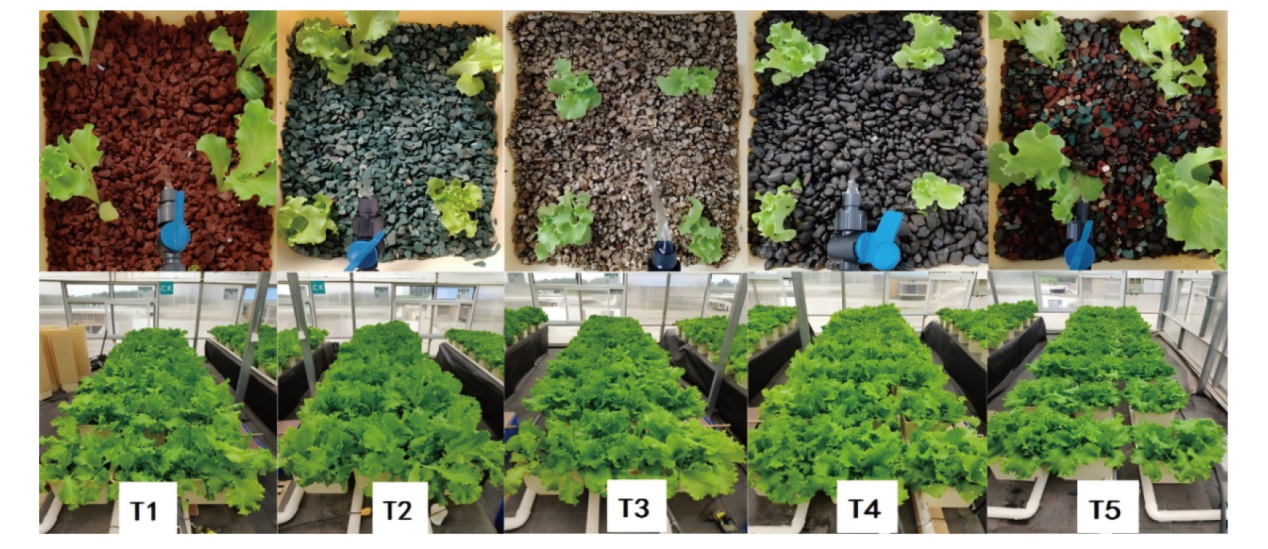
| 过滤材料 | 处理组 | 直径/mm | 孔隙率/% | 比表面积/(m2/kg) | 总孔体积/(cm3/g) | 主要化学成分/% |
|---|---|---|---|---|---|---|
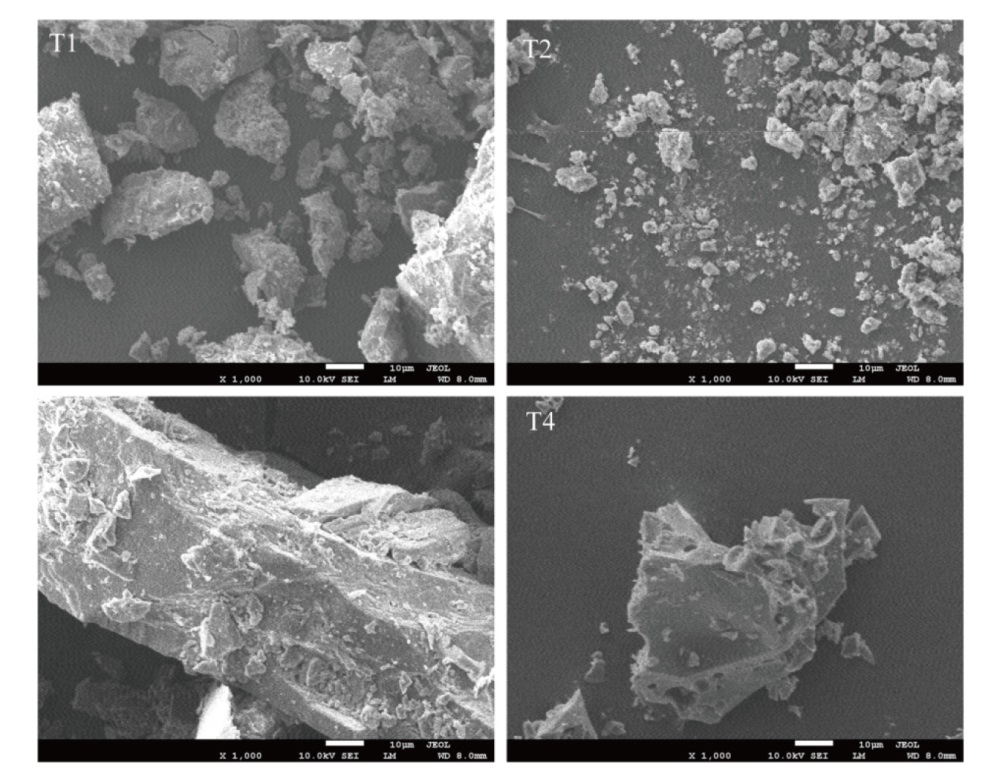
| 火山石 | T1 | 7~12 | 50~75 | 18.78 | 0.059 | SiO2(53.82);Al2O3(16.89);Fe2O3(9.08);CaO(8.36) |
| 沸石 | T2 | 7~12 | 20~32 | 12.32 | 0.035 | SiO2(68.60);Al2O3(10.91);Na2O(3.75) |
| 麦饭石 | T3 | 7~12 | 32~39 | 14.37 | 0.038 | SiO2(59.60);Al2O3(16.50);K2O(3.30) |
| 陶粒 | T4 | 7~12 | 42~56 | 13.39 | 0.036 | SiO2(62.12);Al2O3(16.32);Fe2O3(7.84) |
| 混合石 | T5 | \ | \ | \ | \ | \ |
| 处理组 | 株高/cm | 单株鲜重/g | 产量/(kg/hm2) |
|---|---|---|---|
| T1 | 41.7±0.71ab | 46.82±1.75a | 35674±1333a |
| T2 | 34.55±0.70c | 31.80±0.68d | 24230±518d |
| T3 | 43.37±1.02a | 37.64±0.5b | 28680±381b |
| T4 | 30.73±0.82d | 33.50±1.61cd | 25556±1227cd |
| T5 | 40.23±0.52b | 35.74±0.56bc | 27232±427bc |
| 处理组 | 维生素C/(mg/100 g) | 可溶性糖/% | 可溶性蛋白/(mg/g) | 硝酸盐/(mg/100 g) |
|---|---|---|---|---|
| T1 | 5.08±0.11a | 1.44±0.03b | 12.36±0.75d | 142.03±4.58b |
| T2 | 3.91±0.10b | 2.07±0.07a | 16.57±0.75d | 182.14±2.44a |
| T3 | 4.01±0.34b | 1.15±0.07c | 29.18±1.16a | 125.12±3.54c |
| T4 | 4.33±0.14b | 0.72±0.06d | 8.75±0.27e | 168.87±4.08a |
| T5 | 3.32±0.11c | 1.41±0.06b | 19.51±0.32b | 121.03±7.99c |
| 模型2 | 输入回归系数 | t | 显著性 | 偏相关 | 共线性统计 | ||
|---|---|---|---|---|---|---|---|
| 容差 | 方差膨胀因子 | 最小容差 | |||||
| 株高 | 0.069 | 0.815 | 0.432 | 0.239 | 0.529 | 1.89 | 0.529 |
| 茎粗 | 0.023 | 0.323 | 0.753 | 0.097 | 0.794 | 1.26 | 0.773 |
| 叶片数 | 0.016 | 0.156 | 0.879 | 0.047 | 0.371 | 2.696 | 0.371 |
| 叶面积 | 0.082 | 0.936 | 0.369 | 0.272 | 0.492 | 2.033 | 0.492 |
| 根长 | 0.016 | 0.138 | 0.893 | 0.041 | 0.281 | 3.554 | 0.281 |
| 根表面积 | 0.099 | 0.592 | 0.566 | 0.176 | 0.141 | 7.079 | 0.141 |
| 根尖数 | 0.089 | 1.139 | 0.279 | 0.325 | 0.587 | 1.704 | 0.587 |
| 氨氮 | -0.14 | -1.232 | 0.244 | -0.348 | 0.277 | 3.606 | 0.277 |
| 亚硝酸盐氮 | -0.048 | -0.746 | 0.471 | -0.22 | 0.919 | 1.088 | 0.881 |
| 硝酸盐氮 | 0.031 | 0.35 | 0.733 | 0.105 | 0.504 | 1.985 | 0.482 |
| 气孔导度 | 0.025 | 0.329 | 0.749 | 0.099 | 0.715 | 1.398 | 0.715 |
| 净光合速率 | 0.127 | 1.949 | 0.077 | 0.507 | 0.714 | 1.4 | 0.714 |
| 胞间CO2浓度 | 0.14 | 2.061 | 0.064 | 0.528 | 0.632 | 1.583 | 0.632 |
| 最大荧光 | 0.045 | 0.355 | 0.729 | 0.107 | 0.251 | 3.98 | 0.25 |
| 最大光化学效率 | 0.07 | 0.989 | 0.344 | 0.286 | 0.735 | 1.36 | 0.726 |
| 非光化学猝灭系数 | -0.018 | -0.274 | 0.789 | -0.082 | 0.967 | 1.035 | 0.927 |
| 指标 | 维生素C | 可溶性糖 | 可溶性蛋白 | 硝酸盐 | |||||||
|---|---|---|---|---|---|---|---|---|---|---|---|
| 重要度 | 排序 | 重要度 | 排序 | 重要度 | 排序 | 重要度 | 排序 | ||||
| NH3-N | 6.314 | 4 | 7.421 | 3 | 3.449 | 5 | 5.046 | 4 | |||
| NO2--N | 6.307 | 5 | 3.493 | 5 | 1.057 | 9 | 3.258 | 6 | |||
| NO3--N | 6.859 | 3 | 10.707 | 1 | 2.767 | 7 | 3.898 | 5 | |||
| Tr | 3.071 | 7 | 4.268 | 4 | 5.926 | 3 | 9.086 | 1 | |||
| Gs | 4.015 | 6 | 9.172 | 2 | 2.569 | 8 | 5.578 | 3 | |||
| Pn | 1.058 | 8 | 3.229 | 6 | 7.866 | 2 | 2.919 | 7 | |||
| Ci | 1.038 | 9 | 0.047 | 10 | 5.260 | 4 | 6.021 | 2 | |||
| Fm | 10.851 | 1 | 2.796 | 8 | 9.149 | 1 | 1.379 | 8 | |||
| Fv/Fm | 7.749 | 2 | 3.002 | 7 | 2.796 | 6 | 1.291 | 9 | |||
| NPQ | 0.766 | 10 | 0.156 | 9 | -0.389 | 10 | 0.021 | 10 | |||
| 处理组 | 总增重量/g | 特定生长率/(%/d) | 谷丙转氨酶/(U/L) | 谷草转氨酶/(U/L) | 白蛋白/球蛋白 | 尿素氮/(mmol/L) |
|---|---|---|---|---|---|---|
| T1 | 147.67±2.33a | 0.50±0.007a | 6.97±0.50b | 392.20±15.99c | 0.82±0.21a | 1.90±0.02b |
| T2 | 108.33±5.61c | 0.38±0.016b | 8.71±0.29a | 753.03±20.29a | 0.62±0.03b | 2.33±0.1a |
| T3 | 139.33±1.45ab | 0.49±0.005a | 7.13±0.53b | 382.87±11.67c | 0.59±0.24b | 2.06±0.05b |
| T4 | 138.33±1.67ab | 0.49±0.005a | 6.60±0.32b | 590.57±49.47b | 0.62±0.05b | 2.27±0.13a |
| T5 | 131.33±4.18b | 0.47±0.022a | 7.73±0.29ab | 524.67±4.03b | 0.67±0.03b | 2.18±0.06ab |
| [1] |
蒋金辰, 高霞婷, 徐琰斐, 等. 鱼菜共生系统氮、磷利用效率研究现状和展望[J]. 农业工程学报, 2022, 38(S1):292-300.
|
| [2] |
徐慧敏, 陈曦, 孟顺龙, 等. 鱼菜共生系统中的微生物群落研究进展与展望[J]. 渔业科学进展, 2025, 46(2):15-26.
|
| [3] |
焦巨龙, 杨苏文, 谢宇, 等. 多种材料对水中氨氮的吸附特性[J]. 环境科学, 2019, 40(8):3633-3641.
|
| [4] |
陈登龙, 张雨翔, 宋佳佳, 等. 火山石沉积对鱼菜共生系统运行的探究[J]. 中国农业科技导报, 2023, 25(7):207-214.
|
| [5] |
罗太友, 裴青宝, 朱积军, 等. 火山石粒径对鱼菜共生脱氮除磷及雍菜生长影响[J]. 扬州大学学报(农业与生命科学版), 2026, 47(1):1-11.
|
| [6] |
马云曦, 张智玮, 李倩儒, 等. 麦饭石对鱼菜共生系统的影响试验[J]. 农业工程, 2021, 11(11):121-126.
|
| [7] |
宋晓聪, 邓陈宁, 朱芳, 等. 基于碳足迹视角的固废再生陶粒项目碳减排分析与实证研究[J]. 中国环境科学, 2026, 46(1):1-11.
|
| [8] |
徐琰斐, 单建军, 顾川川, 等. 菜-鱼复合设施种养系统构建与运行试验分析[J]. 农业工程学报, 2023, 39(2):150-156.
|
| [9] |
|
| [10] |
|
| [11] |
|
| [12] |
|
| [13] |
夏桂敏, 刘光辉, 沙炎, 等. 斜发沸石对干湿交替稻田土壤速效钾和产量的影响[J]. 农业工程学报, 2019, 35(18):101-109.
|
| [14] |
夏桂敏, 姚珍珠, 王淑君, 等. 水分胁迫和斜发沸石应用对花生产量及水分利用的影响[J]. 干旱地区农业研究, 2018, 36(1):133-139.
|
| [15] |
陈丽红, 张翔凌, 何春艳, 等. Zn-LDHs覆膜改性麦饭石对Cd(Ⅱ)吸附性能及其作用机理研究[J]. 环境科学学报, 2019, 39(12):4004-4014.
|
| [16] |
张翔凌, 陈俊杰, 郭露, 等. 垂直流人工湿地LDHs覆膜改性沸石基质强化除磷效果及其机制[J]. 环境科学, 2014, 35(12):4553-4559.
|
| [17] |
高寒, 贺振洲, 赵军, 等. 组合型生态浮岛原位修复重污染水体[J]. 环境工程学报, 2019, 13(12):2884-2889.
|
| [18] |
陈朝辉, 魏廷邦. 水肥耦合对玉米光合作用、干物质积累量和产量的影响[J]. 中国农学通报, 2025, 41(4):1-9.
doi: 10.11924/j.issn.1000-6850.casb2024-0520 |
| [19] |
周陈平, 林伟, 杨敏, 等. 水肥耦合对香蕉和番木瓜幼苗生长的影响[J]. 中国农学通报, 2024, 40(10):68-75.
doi: 10.11924/j.issn.1000-6850.casb2023-0232 |
| [20] |
陈哲栋, 侯会静, 徐晓, 等. 水肥一体追肥减量对黄心菜生长、产量及基质环境的影响[J]. 中国农学通报, 2022, 38(30):72-76.
doi: 10.11924/j.issn.1000-6850.casb2021-1091 |
| [21] |
|
| [22] |
doi: 10.1016/j.aquaculture.2024.741107 URL |
| [23] |
|
| [24] |
王振华. 循环水养鱼系统水质参数关系分析[J]. 中国农学通报, 2014, 30(8):57-62.
|
| [25] |
王岚, 史东杰, 朱建亚, 等. 鱼菜共生系统中种养密度和投喂频率对大口黑鲈生长及水质的影响[J]. 中国农业科技导报, 2025, 27(11):43-55.
|
| [26] |
马聪, 曹树槟, 李建设, 等. 氮肥施用量对甘蓝穴盘苗生长发育的影响[J]. 农业科学研究:中英文, 2025, 46(1):77-83.
|
| [27] |
樊悦, 宋丽华, 曹兵, 等. 设施栽培环境下灵武长枣开花的生物学特性观察[J]. 农业科学研究:中英文, 2025, 46(1):91-96.
|
| [28] |
胡浩东, 高航, 胡振. 磺胺嘧啶对鱼菜共生系统氮元素转化的影响[J]. 中国环境科学, 2021, 41(4):1697-1703.
|
| [29] |
郑晨烨, 闫豫疆. 矿质元素含量对新疆灰枣果实品质的影响[J]. 中国农学通报, 2025, 41(22):65-74.
doi: 10.11924/j.issn.1000-6850.casb2024-0764 |
| [30] |
张淑彬, 王红菊, 王幼珊, 等. 不同育苗基质对黄瓜生长及丛枝菌根真菌侵染的影响[J]. 中国农学通报, 2011, 27(10):275-279.
|
| [31] |
吴亚迪, 代惠蓉, 张燕, 等. 生物炭替代对栽培基质性质和作物生长发育的影响[J]. 中国农学通报, 2025, 41(36):90-99.
doi: 10.11924/j.issn.1000-6850.casb2025-0274 |
| [32] |
李建柱, 侯杰, 张鹏飞, 等. 空心菜浮床对鱼塘水质和微生物多样性的影响[J]. 中国环境科学, 2016, 36(10):3071-3080.
|
| [33] |
doi: 10.1021/es300110x URL |
| [34] |
doi: 10.3390/w15030391 URL |
| [1] | WANG Hengjie, DAI Mengyang, WANG Qian, XIONG Xinyu, WANG Canli, YUAN Xiangyang. Research Progress on Impact of Environmental Stress Factors on Fish Health [J]. Chinese Agricultural Science Bulletin, 2025, 41(2): 157-164. |
| [2] | GAO Di, LIU Xianbin, ZHOU Jueding, PENG Xinxin, LIU Qiaogang. Impacts of Cultivation Methods on Growth of Canna glauca [J]. Chinese Agricultural Science Bulletin, 2024, 40(28): 57-66. |
| [3] | CHEN Maohua, YANG Yongxue, LIU Kun. Study on Purification Effect of Euryale ferox on Eutrophic Waters Along Huai River [J]. Chinese Agricultural Science Bulletin, 2024, 40(22): 66-71. |
| [4] | KE Ruilin, REN Lihua, MENG Shunlong. Research Progress of Aquaculture Tail Water Treatment Technology [J]. Chinese Agricultural Science Bulletin, 2023, 39(29): 146-151. |
| [5] | Gao Xiating, Song Hongqiao, Zhang Haigeng, Ni Qi, Zhang Yulei. Lettuce and Celery at Different Growth Stages: Comparison of Water Purification Capacity [J]. Chinese Agricultural Science Bulletin, 2021, 37(23): 125-132. |
| [6] | Yu Zhenhai, Chen Youguang, Lu Hong, Zheng Yuzhen, Liu Hongcai, Sun Hua. N and P Purification in Aquatic Water with Three Plants [J]. Chinese Agricultural Science Bulletin, 2020, 36(5): 131-137. |
| [7] | Yang Jing, Guan Chongwu, Zhang Yulei. Research on Water Purification Equipment Technology of Circulating Aquaculture System [J]. Chinese Agricultural Science Bulletin, 2020, 36(14): 138-141. |
| [8] | . Whole-process Control Technology of Typical Rice Field Polluted with Cadmium in Hunan: A Case Study [J]. Chinese Agricultural Science Bulletin, 2019, 35(35): 94-99. |
| [9] | 王琦. The Application of Protozoa in Environmental Toxicology Rresearch [J]. Chinese Agricultural Science Bulletin, 2015, 31(5): 139-142. |
| [10] | . The Investigation of Pollutant Removal of Terrestrial Plants from Ecological Use of Rainwater [J]. Chinese Agricultural Science Bulletin, 2014, 30(16): 131-138. |
| [11] | Jing Xiaojun, Miao Weimin, Yuan Xinhua, Dong Zaijie. Review on the Biological Purification Techniques of Intensive Ponds Water Quality [J]. Chinese Agricultural Science Bulletin, 2008, 24(9): 490-495. |
| Viewed | ||||||
|
Full text |
|
|||||
|
Abstract |
|
|||||
