Welcome to Chinese Agricultural Science Bulletin,

Chinese Agricultural Science Bulletin ›› 2026, Vol. 42 ›› Issue (15): 157-164.doi: 10.11924/j.issn.1000-6850.casb2025-0523
Previous Articles Next Articles
YANG Yuling( ), WANG Can, SUN Hongwei, PENG Cuixian, YANG Qingsong, LI Ling, GUO Kaiji, ZHAO Dawei, TAO Yonghong()
Received:2025-05-21
Revised:2025-10-11
Online:2026-08-15
Published:2026-08-13
CLC Number:
YANG Yuling, WANG Can, SUN Hongwei, PENG Cuixian, YANG Qingsong, LI Ling, GUO Kaiji, ZHAO Dawei, TAO Yonghong. Comparative Study on Diversity of Rhizosphere Soil Microbial Communities in Different Medicinal Plants[J]. Chinese Agricultural Science Bulletin, 2026, 42(15): 157-164.
Add to citation manager EndNote|Ris|BibTeX
URL: https://www.casb.org.cn/EN/10.11924/j.issn.1000-6850.casb2025-0523
| Group | Sample | Bacterial | Fungal | |||||||||||||
|---|---|---|---|---|---|---|---|---|---|---|---|---|---|---|---|---|
| SeqNum | BaseNum | MeanLen | SeqNum | BaseNum | MeanLen | |||||||||||
| 1 | BJ1 | 55 437 | 22 998 549 | 414.86 | 47 259 | 11 545 382 | 244.30 | |||||||||
| 2 | BJ2 | 60 378 | 25 102 933 | 415.76 | 60 892 | 15 154 968 | 248.88 | |||||||||
| 3 | BJ3 | 51 708 | 21 439 846 | 414.63 | 63 187 | 15 543 855 | 246.00 | |||||||||
| 4 | CK1 | 43 175 | 18 408 431 | 426.37 | 49 133 | 12 087 721 | 246.02 | |||||||||
| 5 | CK2 | 41 430 | 17 653 134 | 426.10 | 70 725 | 17 421 818 | 246.33 | |||||||||
| 6 | CK3 | 46 150 | 19 701 264 | 426.90 | 75 413 | 18 416 315 | 244.21 | |||||||||
| 7 | HJ1 | 61 184 | 25 329 179 | 413.98 | 56 960 | 15 145 530 | 265.90 | |||||||||
| 8 | HJ2 | 52 769 | 21 911 384 | 415.23 | 50 722 | 12 544 694 | 247.32 | |||||||||
| 9 | HJ3 | 71 272 | 29 515 050 | 414.12 | 58 713 | 14 789 341 | 251.89 | |||||||||
| 10 | SJ1 | 57 851 | 23 967 940 | 414.30 | 62 131 | 15 253 138 | 245.50 | |||||||||
| 11 | SJ2 | 50 718 | 21 007 303 | 414.20 | 48 938 | 12 420 015 | 253.79 | |||||||||
| 12 | SJ3 | 53 953 | 22 393 230 | 415.05 | 50 552 | 12 609 526 | 249.44 | |||||||||
| Group | Sample | Bacterial | Fungal | |||||||||||||
|---|---|---|---|---|---|---|---|---|---|---|---|---|---|---|---|---|
| SeqNum | BaseNum | MeanLen | SeqNum | BaseNum | MeanLen | |||||||||||
| 1 | BJ1 | 55 437 | 22 998 549 | 414.86 | 47 259 | 11 545 382 | 244.30 | |||||||||
| 2 | BJ2 | 60 378 | 25 102 933 | 415.76 | 60 892 | 15 154 968 | 248.88 | |||||||||
| 3 | BJ3 | 51 708 | 21 439 846 | 414.63 | 63 187 | 15 543 855 | 246.00 | |||||||||
| 4 | CK1 | 43 175 | 18 408 431 | 426.37 | 49 133 | 12 087 721 | 246.02 | |||||||||
| 5 | CK2 | 41 430 | 17 653 134 | 426.10 | 70 725 | 17 421 818 | 246.33 | |||||||||
| 6 | CK3 | 46 150 | 19 701 264 | 426.90 | 75 413 | 18 416 315 | 244.21 | |||||||||
| 7 | HJ1 | 61 184 | 25 329 179 | 413.98 | 56 960 | 15 145 530 | 265.90 | |||||||||
| 8 | HJ2 | 52 769 | 21 911 384 | 415.23 | 50 722 | 12 544 694 | 247.32 | |||||||||
| 9 | HJ3 | 71 272 | 29 515 050 | 414.12 | 58 713 | 14 789 341 | 251.89 | |||||||||
| 10 | SJ1 | 57 851 | 23 967 940 | 414.30 | 62 131 | 15 253 138 | 245.50 | |||||||||
| 11 | SJ2 | 50 718 | 21 007 303 | 414.20 | 48 938 | 12 420 015 | 253.79 | |||||||||
| 12 | SJ3 | 53 953 | 22 393 230 | 415.05 | 50 552 | 12 609 526 | 249.44 | |||||||||
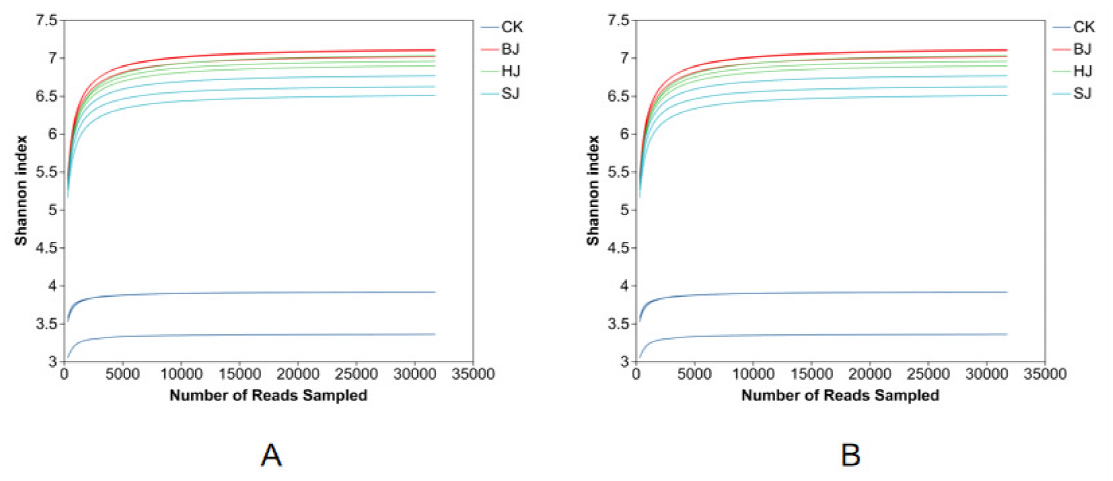
| 处理 | ace | chao | shannon | simpson | |
|---|---|---|---|---|---|
| 细菌 | CK | 396.101±26.623 c | 395.677±28.698 c | 3.729±0.220 b | 0.902±0.016 b |
| BJ | 2 374.591±124.13 a | 2,374.591±118.95 a | 7.073±0.251 a | 0.998±0.013 a | |
| HJ | 2 496.573±154.77 a | 2,469.195±109.23 a | 6.960±0.301 a | 0.997±0.011 a | |
| SJ | 1 893.688±194.73 b | 1,872.626±156.37 b | 6.631 ±0.278 a | 0.996±0.010 a | |
| 真菌 | CK | 68.823±7.544 c | 67.846±7.215 c | 1.170±0.125 b | 0.418± 0.075 b |
| BJ | 553.826±52.520 a | 554.324±53.761 a | 4.493±0.102 a | 0.966±0.014 a | |
| HJ | 558.696±60.024 a | 558.709 ±61.221 a | 4.277±0.261 a | 0.949±0.017 a | |
| SJ | 457.011±78.694 b | 456.764±43.261 b | 4.177±0.201 a | 0.949±0.025 a | |
| 处理 | ace | chao | shannon | simpson | |
|---|---|---|---|---|---|
| 细菌 | CK | 396.101±26.623 c | 395.677±28.698 c | 3.729±0.220 b | 0.902±0.016 b |
| BJ | 2 374.591±124.13 a | 2,374.591±118.95 a | 7.073±0.251 a | 0.998±0.013 a | |
| HJ | 2 496.573±154.77 a | 2,469.195±109.23 a | 6.960±0.301 a | 0.997±0.011 a | |
| SJ | 1 893.688±194.73 b | 1,872.626±156.37 b | 6.631 ±0.278 a | 0.996±0.010 a | |
| 真菌 | CK | 68.823±7.544 c | 67.846±7.215 c | 1.170±0.125 b | 0.418± 0.075 b |
| BJ | 553.826±52.520 a | 554.324±53.761 a | 4.493±0.102 a | 0.966±0.014 a | |
| HJ | 558.696±60.024 a | 558.709 ±61.221 a | 4.277±0.261 a | 0.949±0.017 a | |
| SJ | 457.011±78.694 b | 456.764±43.261 b | 4.177±0.201 a | 0.949±0.025 a | |
| [1] |
doi: 10.3389/fmicb.2020.596472 URL |
| [2] |
doi: 10.1007/s10725-019-00523-0 |
| [3] |
doi: 10.1007/s00344-023-11019-7 |
| [4] |
doi: 10.1016/j.jenvman.2023.120012 URL |
| [5] |
张永敢, 赵娟, 张玉洁. 药用植物凤丹(Paeonia suffruticosa)根基土壤细菌群落16S rRNA基因的ARDRA分析[J]. 生态学报, 2016, 36(17):5564-5574.
|
| [6] |
彭翠仙, 王灿, 蔡群虎, 等. 滇黄精对土壤真菌群落结构的影响[J]. 农学学报, 2024(1):53-58.
doi: 10.11923/j.issn.2095-4050.cjas2023-0039 |
| [7] |
陈骋, 时东方, 李福森, 等. Biolog-ECO解析通化县西洋参根际微生物群落功能多样性[J]. 生物化工, 2024, 10(5):159-164.
|
| [8] |
李永芹, 周思彤, 许乐乐, 等. 健康与患病穿心莲根际土壤理化性质及微生物多样性分析[J]. 中国实验方剂学杂志, 2025, 31(7):172-181.
|
| [9] |
陈克克, 林佳轩, 文晓杰. 白及属植物种质资源分布及利用影响[J]. 西安文理学院学报(自然科学版), 2025(1):58-62.
|
| [10] |
中国科学院中国植物志编辑委员会. 中国植物志:第18卷[M]. 北京: 科学出版社,1999:46-47.
|
| [11] |
国家药典委员会. 中华人民共和国药典. 一部[M]. 北京: 中国医药科技出版社,2015:103.
|
| [12] |
doi: 10.1007/s11418-022-01652-z |
| [13] |
陈孝赏, 汤紫依, 何海叶, 等. 基于ISSR标记的姜种质资源遗传多样性分析[J]. 分子植物育种, 2024, 22(20):6757-6766.
|
| [14] |
严辉, 郭盛, 张振宇, 等. 药食两用资源姜的产业发展现状与提质增效策略[J]. 中国中药杂志, 2024, 49(11):2853-2862.
|
| [15] |
国家药典委员会. 中华人民共和国药典. 一部[M]. 北京: 中国医药科技出版社, 2015:101.
|
| [16] |
罗霜, 王剑波, 陈柯宇, 等. 不同产地药食同源黄精的成分及体外抗氧化研究[J]. 中国调味品, 2023, 48(6):59-65.
|
| [17] |
杨德, 薛淑静, 卢琪, 等. 黄精药理作用研究进展及产品开发[J]. 湖北农业科学, 2020, 59(21):5-9.
|
| [18] |
徐锦龙, 马卫成, 张明, 等. 黄精成方治疗早期糖尿病肾病的荟萃分析[J]. 中国现代应用药学, 2018, 35(4):561-565.
|
| [19] |
doi: 10.1016/j.bse.2021.104275 URL |
| [20] |
王灿, 杨玉玲, 李玲, 等. 林下野生滇黄精生长对土壤细菌群落多样性的影响[J]. 中国野生植物资源, 2025, 44(9):59-67,138.
|
| [21] |
doi: 10.1264/jsme2.ME19030 URL |
| [22] |
doi: 10.3389/fmicb.2019.02277 pmid: 31649632 |
| [23] |
吴林坤. 根系分泌物介导下的连作地黄根际互作与作用机制研究[D]. 福州: 福建农林大学, 2014.
|
| [24] |
刘泽淼, 王海燕, 李洋, 等. 外源芍药内酯苷对芍药生长发育及根际土壤的影响[J]. 植物生理学报, 2022, 58(5):873-888.
|
| [25] |
杨波. 连作下太子参根系分泌物对根际微生物群落的调控作用[D]. 福州: 福建农林大学, 2020.
|
| [26] |
李运涛, 孟忠祥, 董晋, 等. 不同药用植物根际土壤原核微生物多样性研究[J]. 微生物学杂志, 2024, 44(1):90-99.
|
| [27] |
李威. 茶苗扦插过程中根际微生物组的作用[D]. 北京: 北京化工大学, 2023.
|
| [28] |
王启. 思茅区有机茶园土壤养分与微生态研究[D]. 昆明: 云南农业大学, 2023.
|
| [29] |
刘辉, 韦璐璐, 朱龙发, 等. 鞘氨醇单胞菌的研究进展[J]. 微生物学通报, 2023, 50(6):2738-2752.
|
| [30] |
doi: 10.3389/fpls.2022.1002772 URL |
| [31] |
吴杭涛. 冬季铁皮石斛富集鞘氨醇单胞菌的动态与机制[D]. 杭州: 浙江理工大学, 2023.
|
| [32] |
doi: 10.5941/MYCO.2014.42.4.401 URL |
| [33] |
|
| [34] |
doi: 10.1007/s00203-024-03912-w |
| [35] |
高鹏, 王进, 黄天悦, 等. 产有机酸菌株的筛选及其对盐碱土改良的初步研究[J]. 中国农学通报, 2018, 34(35):72-78.
doi: 10.11924/j.issn.1000-6850.casb18030055 |
| [36] |
|
| [1] | XU Mingwei, FENG Guojun, LIU Dajun, LIU Chang, YAN Zhishan, ZHANG Taifeng, XU Di, YANG Xiaoxu. Selection of Salt-tolerant Growth-promoting Bacteria and Their Effects on Growth of Common Beans Under Salt Stress [J]. Chinese Agricultural Science Bulletin, 2026, 42(9): 59-67. |
| [2] | WANG Lina, QI Guochao, REN Cuimei, GU Xin, ZHANG Hongyu, WANG Di, RUI Haiying. Study on Improvement Effects of Three Agricultural Wastes on Soda Saline-alkali Wasteland [J]. Chinese Agricultural Science Bulletin, 2026, 42(9): 76-81. |
| [3] | LIU Qiangli, AO Man, GUAN Yixin, HAN Ke, CHEN Song, CHEN Xin, BAI Yumei, CHEN Zhiyuan, CUI Zhenhai. Research Progress on Genetic Improvement of Temperate Maize Utilizing Tropical Maize Germplasm [J]. Chinese Agricultural Science Bulletin, 2026, 42(8): 1-10. |
| [4] | YAN Hong, CHEN Taichun, FENG Zhizhen, CHEN Zhijie, XU Jin, XU Ximei, DONG Zhen, FU Bo. Effects of Tillage Practices on Soil Physicochemical Properties, Microbial Communities and Yield of Wheat [J]. Chinese Agricultural Science Bulletin, 2026, 42(8): 110-119. |
| [5] | WANG Lihua, YAN Huijun, YANG Xiumei, LIAO Jiawei, DUAN Jinhui, WANG Huichun, CHEN Min, YANG Wei, WANG Qigang. Study on Rhizosphere Nutrient Content and Microbial Diversity of Cut Rose Under Different Cultivation Modes [J]. Chinese Agricultural Science Bulletin, 2026, 42(7): 141-152. |
| [6] | FANG Xiangliang, DING Siqi, HUANG Taixu, ZHANG Fukang, BAI Yunfeng, MU Yuyan, FU Yue. Study on Diversity and Occurrence Patterns of Insect Pests of Artemisia argyi [J]. Chinese Agricultural Science Bulletin, 2026, 42(6): 180-186. |
| [7] | LUO Junxia, GUO Zhigang, DUAN Lumei, ZHAO Qianqian, WANG Jing, LI Qing, ZHANG Qiang, AN Xiaoliang, ZHAO Jianbo, LIU Yanmin, LI Guijin, DONG Yajie. Research Progress on Allelopathy and Planting Mode of Garlic [J]. Chinese Agricultural Science Bulletin, 2026, 42(6): 85-94. |
| [8] | REN Jialong, LI Hongjuan, LIU Jiliang, XIN Weidong. Impact of Long-term No-tillage and Mulching on Community Structure and Diversity of Soil Macrofauna [J]. Chinese Agricultural Science Bulletin, 2026, 42(5): 92-100. |
| [9] | LUO Guohui, YU Shikang, ZHAI Yangni, GU Huizhan, LI Fucheng, WANG Bin, WU Tao. Characteristics of Allelochemicals and Microbial Diversity in Soils with Different Types of Tobacco Continuous Cropping Obstacles [J]. Chinese Agricultural Science Bulletin, 2026, 42(5): 101-108. |
| [10] | YANG Siqi, XUE Tingting, ZHAO Xinru, GAO Lei, CAO Lingxiao, ZHAO Zhipeng, ZHANG Liang. Structure of Carbon Sequestration Bacterial Community and Screening of Carbon Sequestration Microorganisms in Rhizosphere Soil of Wine Grapes [J]. Chinese Agricultural Science Bulletin, 2026, 42(5): 117-127. |
| [11] | YANG Siqi, ZHAO Xinru, ZHANG Junxiang, LI Yang, ZHANG Liang, XUE Tingting. Research Progress on Soil Microbial Community and Soil Metabolism Under Organic Mulching Conditions in Vineyards [J]. Chinese Agricultural Science Bulletin, 2026, 42(4): 146-155. |
| [12] | LIU Guiying, PENG Liya, WANG Lei. Impact of Recreational Trampling on Soil Microbial Community Structure in Urban Green Spaces: A Case Study of Shenzhen Parks [J]. Chinese Agricultural Science Bulletin, 2026, 42(4): 156-163. |
| [13] | MA Juan, LA Zhen, HU Mingzhu, DAI Jinxia. Analysis of Endophytic Bacteria Diversity and Community Composition in Soft Rot and Healthy Plant of Allium fistulosum in Tongxin of Ningxia [J]. Chinese Agricultural Science Bulletin, 2026, 42(2): 191-197. |
| [14] | SUN Tianqi, ZHOU Lei, XU Lingui, SUN Xiaobo, CHEN Yong, SUI Chun. Analysis of SSR Loci and Development of Molecular Markers in Isatis indigotica Genome [J]. Chinese Agricultural Science Bulletin, 2026, 42(2): 50-56. |
| [15] | SHI Xiujuan, ZHAO Ruiming, QI Yaodong, LI Mengfei, WEI Xueping. Research Progress and Emerging Trends in Plant Radiation Breeding and Space Breeding [J]. Chinese Agricultural Science Bulletin, 2026, 42(15): 36-47. |
| Viewed | ||||||
|
Full text |
|
|||||
|
Abstract |
|
|||||
