Welcome to Chinese Agricultural Science Bulletin,

Chinese Agricultural Science Bulletin ›› 2026, Vol. 42 ›› Issue (15): 36-47.doi: 10.11924/j.issn.1000-6850.casb2025-1009
Previous Articles Next Articles
SHI Xiujuan1( ), ZHAO Ruiming1, QI Yaodong2, LI Mengfei1, WEI Xueping2()
Received:2025-12-30
Revised:2026-05-16
Online:2026-08-15
Published:2026-08-13
CLC Number:
SHI Xiujuan, ZHAO Ruiming, QI Yaodong, LI Mengfei, WEI Xueping. Research Progress and Emerging Trends in Plant Radiation Breeding and Space Breeding[J]. Chinese Agricultural Science Bulletin, 2026, 42(15): 36-47.
Add to citation manager EndNote|Ris|BibTeX
URL: https://www.casb.org.cn/EN/10.11924/j.issn.1000-6850.casb2025-1009
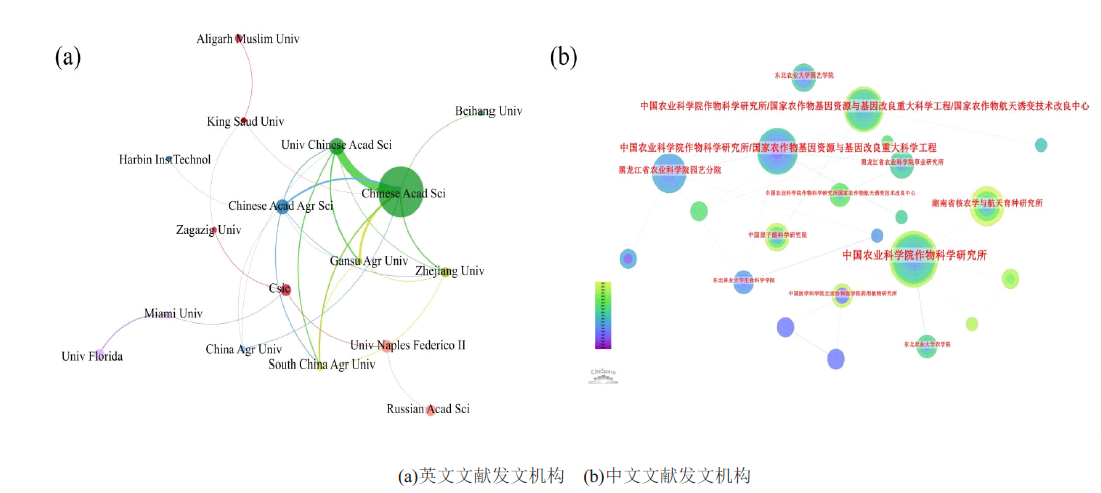
| 排行 | 英文文献 | 中文文献 | |||||
|---|---|---|---|---|---|---|---|
| 机构 | 发文量 | 引用量 | 平均被引量 | 机构 | 发文量 | ||
| 1 | 中国科学院 | 86 | 1476 | 17.16 | 中国农业科学院作物科学研究所 | ||
| 2 | 韩国原子能研究院 | 45 | 501 | 11.13 | 华南农业大学植物航天育种研究中心 | ||
| 3 | 日本理化学研究所 | 32 | 769 | 24.03 | 中国科学院近代物理研究所 | ||
| 4 | 印度巴巴原子能研究中心 | 29 | 296 | 10.21 | 中国科学院大学 | ||
| 5 | 中国科学院大学 | 29 | 485 | 16.72 | 湖南省核农学与航天育种研究所 | ||
| 排行 | 英文文献 | 中文文献 | |||||
|---|---|---|---|---|---|---|---|
| 机构 | 发文量 | 引用量 | 平均被引量 | 机构 | 发文量 | ||
| 1 | 中国科学院 | 86 | 1476 | 17.16 | 中国农业科学院作物科学研究所 | ||
| 2 | 韩国原子能研究院 | 45 | 501 | 11.13 | 华南农业大学植物航天育种研究中心 | ||
| 3 | 日本理化学研究所 | 32 | 769 | 24.03 | 中国科学院近代物理研究所 | ||
| 4 | 印度巴巴原子能研究中心 | 29 | 296 | 10.21 | 中国科学院大学 | ||
| 5 | 中国科学院大学 | 29 | 485 | 16.72 | 湖南省核农学与航天育种研究所 | ||
| 排行 | 英文文献 | 中文文献 | |||||
|---|---|---|---|---|---|---|---|
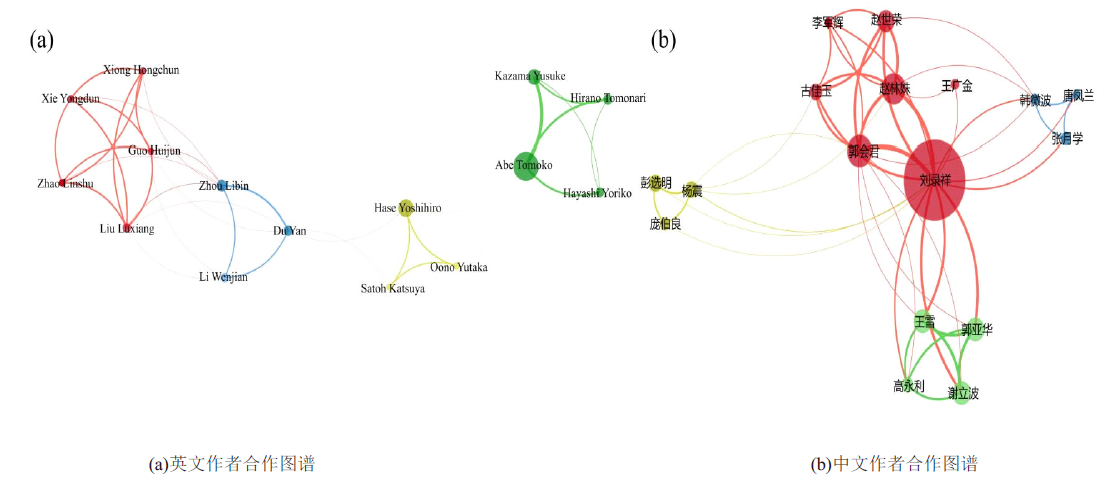
| 作者 | 发文量 | 被引量 | 平均被引量 | 作者 | 发文量 | ||
| 1 | ABE TOMOKO | 39 | 686 | 17.59 | 刘录祥 | ||
| 2 | KIM JIN-BAEK | 26 | 322 | 12.38 | 王慧 | ||
| 3 | HASE YOSHIHIRO | 24 | 1022 | 42.58 | 陈志强 | ||
| 4 | HERRANZ RAUL | 24 | 703 | 29.29 | 郭涛 | ||
| 5 | KISS JOHN Z. | 23 | 884 | 38.43 | 刘永柱 | ||
| 排行 | 英文文献 | 中文文献 | |||||
|---|---|---|---|---|---|---|---|
| 作者 | 发文量 | 被引量 | 平均被引量 | 作者 | 发文量 | ||
| 1 | ABE TOMOKO | 39 | 686 | 17.59 | 刘录祥 | ||
| 2 | KIM JIN-BAEK | 26 | 322 | 12.38 | 王慧 | ||
| 3 | HASE YOSHIHIRO | 24 | 1022 | 42.58 | 陈志强 | ||
| 4 | HERRANZ RAUL | 24 | 703 | 29.29 | 郭涛 | ||
| 5 | KISS JOHN Z. | 23 | 884 | 38.43 | 刘永柱 | ||
| 序号 | 英文文献 | 中文文献 | |||
|---|---|---|---|---|---|
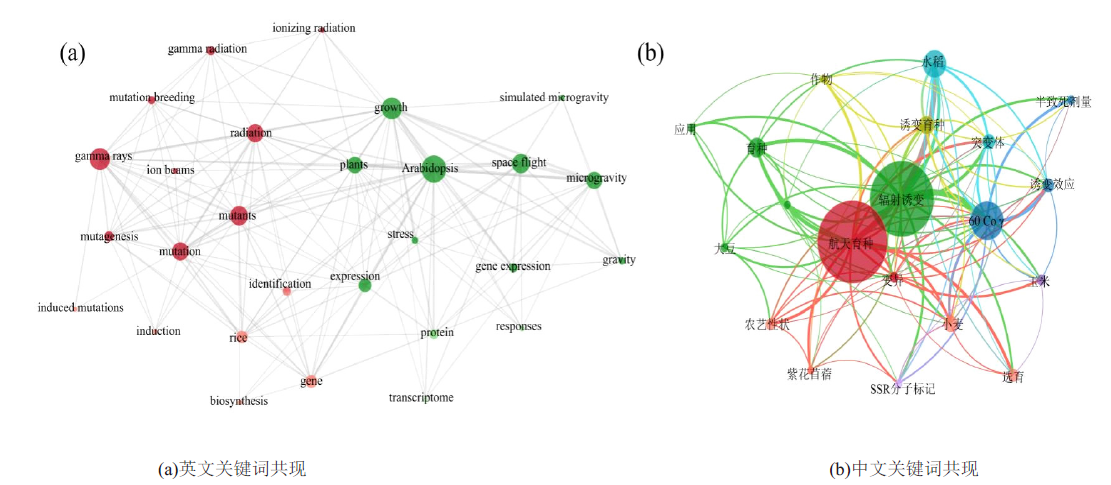
| 关键词 | 频次 | 关键词 | 频次 | ||
| 1 | Arabidopsis | 228 | 航天育种 | 356 | |
| 2 | gamma rays | 184 | 辐射诱变 | 318 | |
| 3 | growth | 183 | 60 Co-γ | 143 | |
| 4 | mutants | 161 | 水稻 | 95 | |
| 5 | space flight | 161 | 育种 | ||
| 6 | mutation | 154 | 诱变育种 | ||
| 7 | radiation | 153 | 小麦 | ||
| 8 | microgravity | 145 | 突变体 | ||
| 9 | plants | 139 | 诱变效应 | ||
| 10 | expression | 115 | 选育 | ||
| 序号 | 英文文献 | 中文文献 | |||
|---|---|---|---|---|---|
| 关键词 | 频次 | 关键词 | 频次 | ||
| 1 | Arabidopsis | 228 | 航天育种 | 356 | |
| 2 | gamma rays | 184 | 辐射诱变 | 318 | |
| 3 | growth | 183 | 60 Co-γ | 143 | |
| 4 | mutants | 161 | 水稻 | 95 | |
| 5 | space flight | 161 | 育种 | ||
| 6 | mutation | 154 | 诱变育种 | ||
| 7 | radiation | 153 | 小麦 | ||
| 8 | microgravity | 145 | 突变体 | ||
| 9 | plants | 139 | 诱变效应 | ||
| 10 | expression | 115 | 选育 | ||
| 聚类名称 | 节点数 | 轮廓值 | 聚类包含关键词 |
|---|---|---|---|
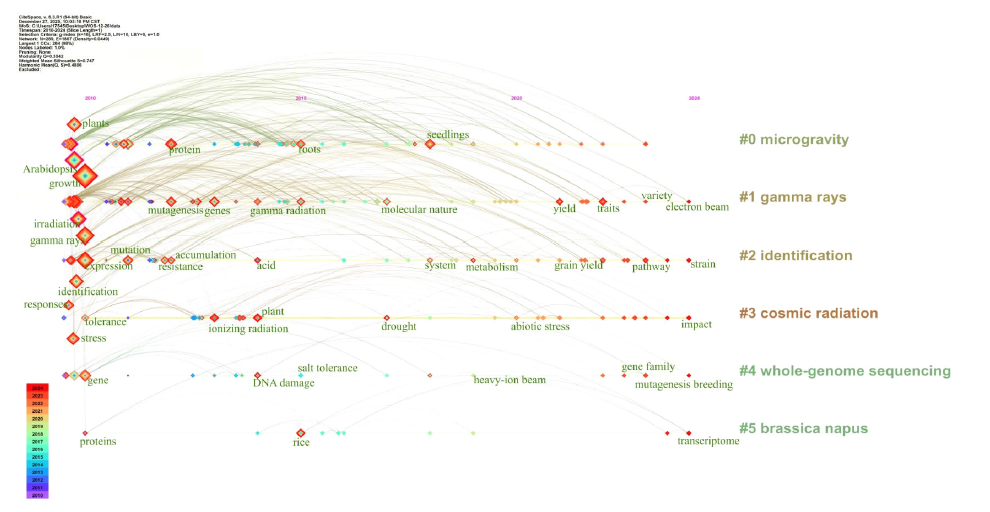
| #0 microgravity | 82 | 0.797 | Arabidopsis thaliana; cytosolic calcium; calcium transport inhibitors; calcium sensor; altered gravity; simulated microgravity; space biology; Medicago truncatula; parabolic flight; outer space |
| #1 gamma rays | 81 | 0.734 | mutation breeding; ion beam irradiation; total chlorophyll; total soluble protein content; induced mutagenesis; genetic variability; mutation induction; Triticum aestivum; Daucus carota; inter-simple sequence repeats |
| #2 identification | 40 | 0.751 | expression; responses; elongation growth; handed helical growth; plant-cells; flower color; gene expression; pigment biosynthesis; flavor compound; stem cell length |
| #3 cosmic radiation | 38 | 0.817 | plants; chlorophyll fluorescence; sequence; evolution; photosynthesis; ionizing radiation; DNA damage response; stress memory; growth stimulation; reactive oxygen species |
| #4 whole-genome sequencing | 37 | 0.743 | whole-genome sequencing; tfl1; gamma-ray irradiation; heavy-ion irradiation; plant-microbe interactions; tfl1; inflorescence architecture; gene family; yield; transition |
| #5 Brassica napus | 32 | 0.584 | transcriptome analysis; salinity stress; gene regulation; salt-tolerant wheat; gamma ray; Gossypium hirsutum; in-vitro; registration; crispr-cas9; genetic diversity |
| 聚类名称 | 节点数 | 轮廓值 | 聚类包含关键词 |
|---|---|---|---|
| #0 microgravity | 82 | 0.797 | Arabidopsis thaliana; cytosolic calcium; calcium transport inhibitors; calcium sensor; altered gravity; simulated microgravity; space biology; Medicago truncatula; parabolic flight; outer space |
| #1 gamma rays | 81 | 0.734 | mutation breeding; ion beam irradiation; total chlorophyll; total soluble protein content; induced mutagenesis; genetic variability; mutation induction; Triticum aestivum; Daucus carota; inter-simple sequence repeats |
| #2 identification | 40 | 0.751 | expression; responses; elongation growth; handed helical growth; plant-cells; flower color; gene expression; pigment biosynthesis; flavor compound; stem cell length |
| #3 cosmic radiation | 38 | 0.817 | plants; chlorophyll fluorescence; sequence; evolution; photosynthesis; ionizing radiation; DNA damage response; stress memory; growth stimulation; reactive oxygen species |
| #4 whole-genome sequencing | 37 | 0.743 | whole-genome sequencing; tfl1; gamma-ray irradiation; heavy-ion irradiation; plant-microbe interactions; tfl1; inflorescence architecture; gene family; yield; transition |
| #5 Brassica napus | 32 | 0.584 | transcriptome analysis; salinity stress; gene regulation; salt-tolerant wheat; gamma ray; Gossypium hirsutum; in-vitro; registration; crispr-cas9; genetic diversity |
| 聚类名称 | 节点数 | 轮廓值 | 聚类包含关键词 |
|---|---|---|---|
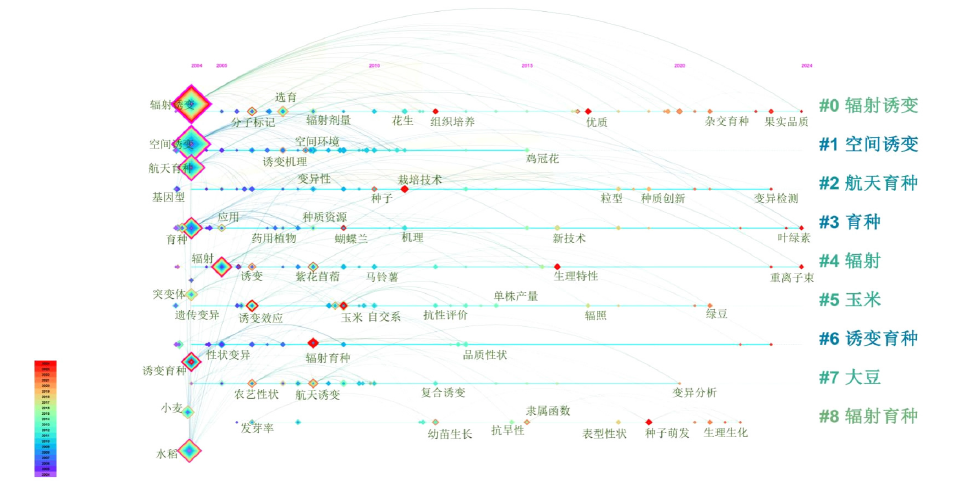
| #0 辐射诱变 | 44 | 0.912 | 辐射诱变;不育系选育;杂交糯稻;‘嘉农wx5a’;空间诱变育种;分子标记; 组织培养;半纤维素;‘m76优212’;单倍体技术 |
| #1 空间诱变 | 33 | 0.832 | 空间诱变;航天育种;育种方法;子粒营养品质;生物效应;空间环境;超微结构; 育种方法;子粒营养品质;生物效应 |
| #2 航天育种 | 32 | 0.837 | 航天育种;mt工程菌株;金属硫蛋白;育种方法;近红外透射光谱;空间诱变; 俄罗斯番茄;空间条件;性状变异;三系杂交稻 |
| #3 育种 | 31 | 0.734 | 航天育种;mt工程菌株;金属硫蛋白;育种方法;近红外透射光谱;空间诱变; 俄罗斯番茄;空间条件;性状变异;三系杂交稻 |
| #4 辐射 | 30 | 0.755 | 紫花苜蓿;辐射诱变;体细胞胚;耐盐变异体;抗病变异体;定向筛选;胚性愈伤组织; 半致死剂量;抗病变异体;遗传多样性 |
| #5 玉米 | 27 | 0.829 | 诱变效应;优良株系;农艺性状;分子标记辅助选择;胚乳突变体;遗传分析;辐射诱变; 低温响应;高油酸性状;种质创新 |
| #6 诱变育种 | 25 | 0.737 | 诱变育种;诱变效应;品质性状;混合粒子场;空间环境诱变;空间诱变;生物学效应; 生物效应;农艺性状;专用辣椒 |
| #7 大豆 | 21 | 0.716 | 农艺性状;60Co-γ诱变;光温敏核不育水稻;航天搭载;诱变效果;辐射诱变; 化学诱变;SP1代;生理响应;逆境胁迫 |
| #8 辐射育种 | 17 | 0.885 | 辐射育种;60Co-γ辐射;隶属函数;幼苗生长;表型性状;幼苗生长; 60Co-γ射线;表型性状;柳叶马鞭草;根系形态 |
| 聚类名称 | 节点数 | 轮廓值 | 聚类包含关键词 |
|---|---|---|---|
| #0 辐射诱变 | 44 | 0.912 | 辐射诱变;不育系选育;杂交糯稻;‘嘉农wx5a’;空间诱变育种;分子标记; 组织培养;半纤维素;‘m76优212’;单倍体技术 |
| #1 空间诱变 | 33 | 0.832 | 空间诱变;航天育种;育种方法;子粒营养品质;生物效应;空间环境;超微结构; 育种方法;子粒营养品质;生物效应 |
| #2 航天育种 | 32 | 0.837 | 航天育种;mt工程菌株;金属硫蛋白;育种方法;近红外透射光谱;空间诱变; 俄罗斯番茄;空间条件;性状变异;三系杂交稻 |
| #3 育种 | 31 | 0.734 | 航天育种;mt工程菌株;金属硫蛋白;育种方法;近红外透射光谱;空间诱变; 俄罗斯番茄;空间条件;性状变异;三系杂交稻 |
| #4 辐射 | 30 | 0.755 | 紫花苜蓿;辐射诱变;体细胞胚;耐盐变异体;抗病变异体;定向筛选;胚性愈伤组织; 半致死剂量;抗病变异体;遗传多样性 |
| #5 玉米 | 27 | 0.829 | 诱变效应;优良株系;农艺性状;分子标记辅助选择;胚乳突变体;遗传分析;辐射诱变; 低温响应;高油酸性状;种质创新 |
| #6 诱变育种 | 25 | 0.737 | 诱变育种;诱变效应;品质性状;混合粒子场;空间环境诱变;空间诱变;生物学效应; 生物效应;农艺性状;专用辣椒 |
| #7 大豆 | 21 | 0.716 | 农艺性状;60Co-γ诱变;光温敏核不育水稻;航天搭载;诱变效果;辐射诱变; 化学诱变;SP1代;生理响应;逆境胁迫 |
| #8 辐射育种 | 17 | 0.885 | 辐射育种;60Co-γ辐射;隶属函数;幼苗生长;表型性状;幼苗生长; 60Co-γ射线;表型性状;柳叶马鞭草;根系形态 |
| 诱变技术 | 技术特点 | 优势作物 | 改良成效 | 局限性 |
|---|---|---|---|---|
| γ辐射 | 经典成熟,穿透力强,突变率高 | 水稻、小麦、豆类等 | 半矮秆、抗倒伏、高产抗病 | 多为点突变,显性突变少; 需大规模M2筛选 |
| 航天诱变 | 变异幅度大,有益突变多 | 水稻、小麦等主要粮食作物 | 高产、优质、抗旱 | 机会少、成本高; 突变机理尚不明确 |
| 重离子辐射 | 能量沉积高,突变谱较窄,性状稳定快 | 花卉、观赏植物等 | 新奇花色、花型、叶色 | 设备昂贵; 剂量-效应模型尚不完善 |
| 复合诱变 | 先辐照后化学,或交替处理;扩大突变谱 | 油菜等 | 早熟、高产 | 实验设计复杂; 需验证突变累加效应 |
| 诱变技术 | 技术特点 | 优势作物 | 改良成效 | 局限性 |
|---|---|---|---|---|
| γ辐射 | 经典成熟,穿透力强,突变率高 | 水稻、小麦、豆类等 | 半矮秆、抗倒伏、高产抗病 | 多为点突变,显性突变少; 需大规模M2筛选 |
| 航天诱变 | 变异幅度大,有益突变多 | 水稻、小麦等主要粮食作物 | 高产、优质、抗旱 | 机会少、成本高; 突变机理尚不明确 |
| 重离子辐射 | 能量沉积高,突变谱较窄,性状稳定快 | 花卉、观赏植物等 | 新奇花色、花型、叶色 | 设备昂贵; 剂量-效应模型尚不完善 |
| 复合诱变 | 先辐照后化学,或交替处理;扩大突变谱 | 油菜等 | 早熟、高产 | 实验设计复杂; 需验证突变累加效应 |
| [1] |
赵林姝, 刘录祥. 农作物辐射诱变育种研究进展[J]. 激光生物学报, 2017, 26(6):481-489.
|
| [2] |
中华人民共和国国务院新闻办公室. 2006年中国的航天白皮书[M]. 北京: 北京科学出版社,2006:10-16.
|
| [3] |
张丰收, 王青. 植物辐射诱变育种的研究进展[J]. 河南师范大学学报:自然科学版, 2020, 48(6):39-49.
|
| [4] |
周利斌, 李文建, 曲颖, 等. 重离子束辐照育种研究进展及发展趋势[J]. 原子核物理评论, 2008, 25(2):165-170.
|
| [5] |
靳芳, 李云爽, 杨喜霞, 等. 电子束辐射对玉米及陆地棉花粉萌发率的影响[J]. 中国农学通报, 2011, 27(24):164-168.
|
| [6] |
杨爱红, 刘腾云, 周利斌, 等. 猕猴桃种子高能碳离子束辐射诱变育种适宜剂量的研究[J]. 江西科学, 2019, 37(6):839-845.
|
| [7] |
胡瑶, 周毅吉, 张跃龙, 等. 60Co-γ射线辐射对中国水仙的诱变效应[J]. 南方农业学报, 2020, 51(1):42-47.
|
| [8] |
doi: 10.22319/rmcp.v10i1.4327 URL |
| [9] |
张福彦, 杨保安, 范家霖, 等. 航天诱变与Co60辐照相结合选育国审小麦新品种豫丰11[J]. 种子, 2019, 38(3):123-126.
|
| [10] |
刘晓娜, 张丽华, 李红军. 农作物辐射诱变育种技术中国专利分析[J]. 核农学报, 2023, 37(2):298-305.
doi: 10.11869/j.issn.1000-8551.2023.02.0298 |
| [11] |
IAEA. Mutant Variety Database[DB/OL]. Https://mvd.iaea.org,2024-12-31.
|
| [12] |
|
| [13] |
赵中莹. 60Co-γ射线对半夏诱变效应的研究[D]. 成都: 四川农业大学,2020:1-74.
|
| [14] |
杨先国. 太空丹参SP1-1的生物学效应及诱变育种研究[D]. 长沙: 湖南中医药大学,2012:1-141.
|
| [15] |
doi: 10.1016/j.indcrop.2018.12.056 URL |
| [16] |
张蕾, 王瑛, 朱惠照, 等. 赤灵芝新菌株‘仙芝2号’的选育[J]. 食用菌学报, 2014, 21(1):15-20.
|
| [17] |
王志芬, 单成钢, 苏学合, 等. 丹参种子航天搭载的诱变效应研究[J]. 现代中药研究与实践, 2007, 21(4):6-8.
|
| [18] |
doi: 10.1016/j.joi.2017.08.007 URL |
| [19] |
doi: 10.3389/fpls.2024.1352564 URL |
| [20] |
doi: 10.1111/tpj.v120.2 URL |
| [21] |
doi: 10.1016/j.plaphy.2016.06.008 URL |
| [22] |
田立平, 单福华, 高新欢, 等. 小麦新品种京冬23号的选育、特性及应用分析[J]. 种子, 2014, 33(11):94-95.
|
| [23] |
韦忠沸. 嘉糯1优6号水稻特征特性及高产栽培技术[J]. 现代农业科技, 2012(15):34-35.
|
| [24] |
谢皓, 陈学珍, 白宝良, 等. 大豆新品种北农103的选育及栽培要点[J]. 农业科技通讯, 2010(4):157-158.
|
| [25] |
姜言生. 花生新品种‘花育32号’在山东问世[J]. 农村百事通, 2009(23):11.
|
| [26] |
王俊敏, 骆荣挺, 金庆生, 等. 晚粳稻航香18的特征特性及栽培要点[J]. 浙江农业科学, 2012(6):788-789.
|
| [27] |
涂诗航, 董瑞霞, 周鹏, 等. 优质杂交水稻两优航2号示范表现及高产栽培技术[J]. 福建稻麦科技, 2012, 30(2):55-56.
|
| [28] |
冯家春, 夏云祥, 葛勇, 等. 矮秆早熟航天小麦新品种——阜航麦1号[J]. 麦类作物学报, 2021, 41(6):650.
|
| [29] |
|
| [30] |
孔滢, 白锦荣, 尚宏忠, 等. 重离子束辐射技术在花卉育种中的应用[J]. 园艺学报, 2013, 40(9):1837-1845.
|
| [31] |
|
| [32] |
doi: 10.2503/hrj.12.245 URL |
| [33] |
范建新, 邓仁菊, 李金强. 果树诱变育种研究进展[J]. 安徽农业科学, 2008(22):9455-9457,9598.
|
| [34] |
斯琴图雅, 汤明威, 张丹丹, 等. 刺五加复合诱变效应分析及诱变体系的构建[J]. 黑龙江科学, 2025, 16(8):96-99.
|
| [35] |
温岚, 龚友才, 陈基权, 等. EMS和60Co-γ射线辐照复合诱变黄麻突变体苗期生理生化特性研究[J]. 中国麻业科学, 2014, 36(5):224-228,257.
|
| [36] |
中华人民共和国国务院.国家中长期科学和技术发展规划纲要(2006—2020年)[Z].2006.
|
| [37] |
IAEA. Accelerating growth:IAEA launches plant mutation breeding network for Asia and the Pacific[EB/OL]. Vienna: International Atomic Energy Agency, 2017-08-29. Https://www.iaea.org/newscenter/news/accelerating-growth-iaea-launches-plant-mutation-breeding-network-for-asia-and-the-pacific, 2025-12-02.
|
| [38] |
|
| [39] |
张毅, 孔令博, 杨玲珊, 等. 日本功能农业政策、产业布局及对中国的启示[J]. 农业展望, 2024, 20(8):22-29.
|
| [40] |
doi: 10.1016/j.plaphy.2023.108060 URL |
| [41] |
杨福, 李景鹏, 余丽霞, 等. 关于高能重离子束辐射诱变北方粳稻育种方法的思考[J]. 中国稻米, 2023, 29(1):72-75,81.
doi: 10.3969/j.issn.1006-8082.2023.01.011 |
| [42] |
贾彩凤, 李艾莲, 兰金旭, 等. 药用植物金荞麦60Co-γ辐射诱变的(-)-表儿茶素研究[J]. 中国医药导刊, 2009, 11(3):452-454.
|
| [43] |
胡泊, 宾丽慧, 容敏坚, 等. 淮山药零余子60Co-γ辐射的诱变效应[J]. 热带作物学报, 2023, 44(5):986-993.
doi: 10.3969/j.issn.1000-2561.2023.05.014 |
| [44] |
doi: 10.1186/1471-2229-7-19 |
| [45] |
doi: 10.1016/j.stress.2021.100053 URL |
| [46] |
杨红善, 于铁峰, 常根柱, 等. 航苜1号紫花苜蓿多叶性状遗传特性及分子标记检测[J]. 中国草地学报, 2014, 36(5):46-50.
|
| [47] |
赵华帅, 朱迪, 王永芬, 等. 航天诱变水稻雌性半不育突变体rs(s)的变异特性分析[J]. 华南农业大学学报, 2023, 44(6):875-880.
|
| [48] |
doi: 10.3389/fpls.2022.878420 URL |
| [49] |
|
| [50] |
李俊华, 姬汉轩, 关世丽, 等. 水稻物理—生物协同诱变联合分子标记辅助育种技术体系的构建与应用[J]. 种业导刊, 2025(2):33-37.
|
| [51] |
doi: 10.1007/s00425-025-04723-z |
| [52] |
刘录祥, 郭会君, 赵林姝, 等. 植物诱发突变技术育种研究现状与展望[J]. 核农学报, 2009, 23(6):1001-1007.
doi: 10.11869/hnxb.2009.06.1001 |
| [53] |
张宏. 基于专利计量的农作物育种技术发展态势及热点分析[D]. 南京: 南京农业大学,2022:1-86.
|
| [54] |
张健. 中国重要农作物生物育种产业化应用的展望[J]. 中国农业科技导报, 2022, 24(12):15-24.
doi: 10.13304/j.nykjdb.2022.0697 |
| [55] |
doi: 10.9787/KJBS.2023.55.2.110 URL |
| [56] |
doi: 10.3390/plants12122245 URL |
| [57] |
陈志强, 周丹华, 郭涛, 等. 水稻航天生物育种研究进展[J]. 华南农业大学学报, 2019, 40(5):195-202.
|
| [58] |
郭亚华, 毕宏文, 王雪, 等. 利用空间诱变育种技术培育番茄新品种宇番2号[J]. 黑龙江农业科学, 2006(4):63-65.
|
| [59] |
pmid: 17157025 |
| [60] |
吴萍, 郭俊霞, 王晓宇, 等. 60Co-γ射线辐射对姜黄的诱变效应研究[J]. 核农学报, 2021, 35(1):1-6.
doi: 10.11869/j.issn.100-8551.2021.01.0001 |
| [61] |
朋冬琴, 郭欣慰, 栗孟飞, 等. 60Co-γ辐射对北柴胡的诱变效应研究[J/OL]. 甘肃农业大学学报,1-8. Https://link.cnki.net/urlid/62.1055.S.20240428.1441.052, 2025-11-20.
|
| [62] |
杨改儿, 张璇, 王嘉栋, 等. 60Co-γ射线辐射宁夏枸杞的生物效应[J/OL]. 核农学报,1-11. Https://link.cnki.net/urlid/11.2265.s.20251014.0922.002, 2025-11-22.
|
| [63] |
刘霄. 桔梗对重离子束和X射线辐射响应机制的比较研究[D]. 兰州:中国科学院大学: 中国科学院近代物理研究所,2023:1-114.
|
| [64] |
杨剑波, 周锋杰, 朱云华, 等. 基于近红外光谱分析技术的洞庭(山)碧螺春茶品质快速检测模型构建研究[J]. 中国茶叶, 2025, 47(11):68-73.
|
| [65] |
孙庆文, 温迪, 郭文凯, 等. 小花清风藤及其同属药用植物近红外光谱鉴定研究[J]. 中国现代中药, 2020, 22(5):707-714.
|
| [66] |
李春燕. 近红外光谱法在葛根活性成分含量快速测定中的应用研究[D]. 新乡: 新乡医学院,2018:1-70.
|
| [67] |
雷晓晴, 李耿, 王秀丽, 等. 基于近红外光谱法快速测定丹参中5种成分模型的建立[J]. 中草药, 2018, 49(11):2653-2661.
|
| [68] |
陈芳, 黄强, 董好胜, 等. 药用植物诱变育种研究进展[J]. 现代中药研究与实践, 2024, 38(3):96-102.
|
| [69] |
周孟焦, 史芳芳, 康明, 等. 航天育种技术对药用植物影响的研究进展[J]. 中国中医药现代远程教育, 2019, 17(20):129-131.
|
| [70] |
毛仁俊, 梁宗锁, 韩蕊莲, 等. 药用植物航天诱变育种研究的现状与展望[J]. 分子植物育种, 2025, 23(6):2020-2027.
|
| [71] |
王停, 涂灿, 张林, 等. 中药潜在毒性研究及其科学监管探讨[J/OL]. 中国实验方剂学杂志,1-11. Https://doi.org/10.13422/j.cnki.syfjx.20251629,2025-10-25.
|
| [72] |
薛正莲, 潘文洁, 杨超英. 采用He-Ne激光诱变选育速生高产茯苓菌[J]. 食品与发酵工业, 2005(2):51-54.
|
| [73] |
殷红, 刘瑛颖, 李洪宾. 药用真菌猪苓的紫外线及氦-氖激光诱变育种研究[J]. 西北大学学报:自然科学版, 2008, 38(6):963-966.
|
| [74] |
单成钢, 倪大鹏, 王维婷, 等. 丹参种子航天搭载的生物学效应[J]. 核农学报, 2009, 23(6):947-950.
doi: 10.11869/hnxb.2009.06.0947 |
| [75] |
doi: 10.3389/fpls.2025.1509193 URL |
| [76] |
doi: 10.1007/s12298-025-01581-7 |
| [77] |
doi: 10.1186/s12870-025-06060-5 |
| [78] |
doi: 10.1111/tpj.13485 pmid: 28109168 |
| [79] |
樊丛照. 基于多组学分析的新疆阿魏开花调控机制研究[D]. 北京: 北京协和医学院,2024:1-182.
|
| [80] |
doi: 10.1038/s41586-021-04269-6 |
| [81] |
毕竞男, 樊兆博, 殷祥贞, 等. 花生杂交种AhMITE分子标记及近红外光谱技术的鉴定研究[J]. 花生学报, 2025, 54(2):125-133.
|
| [82] |
许玲, 何秋伶, 梁宗锁. 药用植物育种现状、存在的问题及对策[J]. 科技通报, 2021, 37(8):1-7.
|
| [83] |
余文忠, 王竹信, 叶祝慧. 药用植物育种现状、存在的问题及对策[J]. 种子科技, 2022, 40(14):142-144.
|
| [84] |
杨莹, 朱燕, 孟登科, 等. 基于代谢组学和转录组学对不同形态乌药根的差异研究[J]. 中国医药科学, 2025, 15(11):19-23,116.
|
| [85] |
李嘉瑜. 基于空间代谢组学开展野生及栽培型地黄化学成分初步研究[D]. 郑州: 河南农业大学,2025:1-77.
|
| [86] |
doi: 10.3389/fphar.2024.1448731 URL |
| [87] |
刘童, 肖小河. 中药新安全观在临床药学中的应用[J]. 时珍国医国药, 2025, 36(19):3699-3703.
|
| [88] |
宿美凤. 苦参实的安全性评价及其化学成分分析[D]. 北京: 北京中医药大学,2019:1-102.
|
| [89] |
王家祺, 郭顺星. 铁皮石斛食用安全性评价因素及风险评估研究进展[J]. 中国现代中药, 2021, 23(5):950-954.
|
| [1] | HUANG Yinhong, GUO Jinjin, XUE Yang, ZENG Wen, CHEN Yajuan, YUAN Yong. Panax notoginseng Saponins: Bibliometric Analysis and Visual Analysis Based on Knowledge Graph Analysis [J]. Chinese Agricultural Science Bulletin, 2026, 42(9): 207-218. |
| [2] | WEI Dan, CUI Fuxing, PAN Hong, LI Hong, GUO Yuan, YANG Libin, FU Xiaoyu, LI Haijun. Effects of Fire Disturbance on Soil Fauna Based on Bibliometric Analysis [J]. Chinese Agricultural Science Bulletin, 2026, 42(6): 111-119. |
| [3] | ZHOU Jiahui, TANG Pulin, ZHANG Shiye, ZHANG Aihua, WANG Shuli, WEI Hang, REN Xinlong, GAO Yugang, WANG Yanfang. Bibliometric Analysis of Soil-Acidification-Regulation Measures Based on CNKI Database [J]. Chinese Agricultural Science Bulletin, 2026, 42(2): 203-210. |
| [4] | LIU Cunzhen, LI Qidong, DONG Haibin, GAO Changyu, JIANG Qishen, YIN Yanting, HOU Xiangyang. Research on Herdsman Households' Cooperation at Home and Abroad Based on Visual Analysis of CiteSpace: Review, Comparison and Reflection [J]. Chinese Agricultural Science Bulletin, 2026, 42(14): 181-194. |
| [5] | WANG Yu, WANG Xie, LUO Yongxia. Impact of Interactions Between Microplastics and Heavy Metals in Soil: Based on Bibliometric and Visualization Analysis [J]. Chinese Agricultural Science Bulletin, 2026, 42(14): 172-180. |
| [6] | HE Liang, ZHANG Yitao, DONG Kuijun. Research and Development Trend of Farmland Utilization of Sewage Sludge at Home and Abroad [J]. Chinese Agricultural Science Bulletin, 2026, 42(13): 124-134. |
| [7] | LI Zhen, LEI Chenxi, DENG Yixiang, LUO Weiqiang, WANG Shaocong, ZHANG Xu, ZHANG Qian. Medicinal Characteristics and Resource Diversity of Toxic Medicinal Plants in Fujian [J]. Chinese Agricultural Science Bulletin, 2026, 42(10): 79-86. |
| [8] | LI Rong, HU Tingting, WEI Chizhang, LI Xixi, BI Jiyuan, SUN Yu. Research Status, Hotspots and Prospects of Tillage and Land Preparation Agricultural Machinery and Equipment: A Bibliometric-based Analysis [J]. Chinese Agricultural Science Bulletin, 2026, 42(10): 179-194. |
| [9] | GUO Jialong, HU Feng, YANG Zhangqing, ZHANG Jie, ZANG Hezang, CHANG Baofang, LI Guoqiang, XIN Yinping. Research Progress on Soil Nutrient Detection Sensors Based on Bibliometrics [J]. Chinese Agricultural Science Bulletin, 2026, 42(10): 171-178. |
| [10] | CHEN Qiuru, WANG Jingjing, LU Can, XIAO Shihong, WEI Long, LI Yifan, WANG Xiaojun, XIE Jiawei, YIN Zuoyun. A Study on Fronts Trends of Plant Purification of Water Quality Based on CiteSpace [J]. Chinese Agricultural Science Bulletin, 2026, 42(10): 106-116. |
| [11] | LU Yunfeng, LI Ruiqun, ZENG Runhua, LI Shuzhong, WANG Zhongmei, LI Zhihai, JIA Dongdong. A Bibliometric Study on Banana Fusarium Wilt Based on Web of Science Database [J]. Chinese Agricultural Science Bulletin, 2025, 41(8): 149-158. |
| [12] | WANG Yan, LIU Xiaoli, ZHANG Yi, CHEN Honghao. Visual Analysis of Research Progress on Arboridia kakogawana Based on CiteSpace [J]. Chinese Agricultural Science Bulletin, 2025, 41(7): 121-127. |
| [13] | QIAN Shuai, WANG Mingda, ZHU Hui, LIU Shuyuan, WANG Haoyu, FAN Lichao. Bibliometric Analysis of Research Progress on Earthworms Affecting Transformation of Soil Organic Carbon [J]. Chinese Agricultural Science Bulletin, 2025, 41(32): 61-73. |
| [14] | QIAN Hailin, WANG Shiyan, REN Peng, YANG Fang, CHANG Jiaqi, CHANG Yangyang, WANG Dongyin. Research Hotspots and Trends of Cyperus esculentus Based on Bibliometric Analysis [J]. Chinese Agricultural Science Bulletin, 2025, 41(32): 145-157. |
| [15] | LIU Yajun, HE Han, LI Shuang, SUN Xiaochun, WANG Xiaorui, SHI Xinbo, CAI Xinghang, HUANG Wenjing. Global Knowledge Network of Research on Panacis Majoris Rhizoma: Bibliometric and Visualization Analysis [J]. Chinese Agricultural Science Bulletin, 2025, 41(31): 47-59. |
| Viewed | ||||||
|
Full text |
|
|||||
|
Abstract |
|
|||||
