Welcome to Chinese Agricultural Science Bulletin,

Chinese Agricultural Science Bulletin ›› 2026, Vol. 42 ›› Issue (15): 65-76.doi: 10.11924/j.issn.1000-6850.casb2025-0675
Previous Articles Next Articles
ZHENG Xingxin1( ), LI Zuran2, DUAN Yumo1, CHEN Ling3, CAO Li3, ZU Yanqun1()
Received:2025-08-11
Revised:2025-12-22
Online:2026-08-13
Published:2026-08-13
CLC Number:
ZHENG Xingxin, LI Zuran, DUAN Yumo, CHEN Ling, CAO Li, ZU Yanqun. Research Advances on Multi-level Interaction Networks and Gene Regulation of Cadmium Absorption, Translocation, and Distribution in Rice (Oryza sativa L.)[J]. Chinese Agricultural Science Bulletin, 2026, 42(15): 65-76.
Add to citation manager EndNote|Ris|BibTeX
URL: https://www.casb.org.cn/EN/10.11924/j.issn.1000-6850.casb2025-0675
| 基因符号 | 表达部位 | 亚细胞定位 | 功能 | 参考文献 | ||||
|---|---|---|---|---|---|---|---|---|
| OsNRAMP1 | 根、叶片 | 质膜 | 促进镉、锰吸收,调控镉毒性 | [ | ||||
| OsNRAMP2 | 根、叶片 | 液泡膜 | 介导镉运输及籽粒累积 | [ | ||||
| OsNRAMP4 | 根系 | 细胞膜 | 改变镉的细胞分布和籽粒镉含量 | [ | ||||
| OsNRAMP5 | 根系 | 质膜 | 介导镉和锰的被动吸收,敲除后显著降低根系镉积累 | [ | ||||
| OsHMA2 | 茎节 | 质膜 | 外排镉,减少向籽粒的转运 | [ | ||||
| OsHMA3 | 根系、液泡 | 液泡膜 | 液泡区隔镉,减少镉装载和累积 | [ | ||||
| OsLCT1/2 | 韧皮部 | 质膜 | 介导Cd由韧皮部向籽粒分配 | [ | ||||
| OsLCT3 | 根系 | 质膜 | 正调控籽粒Cd积累;敲除显著降低茎叶和糙米镉含量 | [ | ||||
| OsZIP1 | 根系 | 质膜 | 外排镉、锌和铜,减少根系镉积累 | [ | ||||
| OsZIP5 | 全株 | 质膜 | 介导镉吸收 | [ | ||||
| OsZIP6/9 | 根、茎 | 质膜 | 调控镉吸收和转运 | [ | ||||
| OsSPR1 | 根系 | 质膜 | 突变体影响镉吸收 | [ | ||||
| OsABCC1 | 液泡 | 液泡膜 | 螯合镉-植物螯合肽复合物至液泡,减少籽粒镉累积 | [ | ||||
| OsABCC9 | 液泡 | 液泡膜 | 液泡隔离镉,增强镉耐受性 | [ | ||||
| OsABCG36 | 根系 | 质膜 | 敲除使水稻对镉敏感,增加根部镉积累 | [ | ||||
| OsABCG43 | 叶片、根系 | 质膜 | 调控水稻中的镉累积 | [ | ||||
| OsABCG48 | 根系 | 质膜 | 外排镉,降低根系对镉的吸收 | [ | ||||
| OsCCX2 | 茎节 | 质膜 | 调控镉木质部装载 | [ | ||||
| OsCd1 | 根、茎 | 质膜 | 介导根系对镉的吸收及籽粒积累 | [ | ||||
| CF1 | 茎节、籽粒 | 细胞膜 | 减少籽粒镉含量 | [ | ||||
| OsMTP11 | 叶片 | 反式高尔基体、液泡膜 | 将镉区室化到液泡,减少镉向籽粒转运 | [ | ||||
| OsLCD | 根、籽粒 | 细胞质、细胞核 | 调控籽粒中镉的累积,敲除后籽粒镉含量降低 | [ | ||||
| OsNTP1 | 根系 | 叶绿体 | 介导镉向地上部运输 | [ | ||||
| OsWRKY15 | 根系、叶片 | 细胞核 | 调控镉胁迫响应基因表达,增强镉耐性 | [ | ||||
| OsWRKY49 | 根系 | 细胞核 | 调控OsHMA3表达,增强镉耐性 | [ | ||||
| OsVIT1/2 | 根系 | 液泡膜 | 将镉隔离至液泡,降低地上部镉累积 | [ | ||||
| miR535 | 全株 | 非编码RNA | 抑制镉转运 | [ | ||||
| miR166/390 | 根系 | 非编码RNA | 调控镉累积和镉耐性 | [ | ||||
| 基因符号 | 表达部位 | 亚细胞定位 | 功能 | 参考文献 | ||||
|---|---|---|---|---|---|---|---|---|
| OsNRAMP1 | 根、叶片 | 质膜 | 促进镉、锰吸收,调控镉毒性 | [ | ||||
| OsNRAMP2 | 根、叶片 | 液泡膜 | 介导镉运输及籽粒累积 | [ | ||||
| OsNRAMP4 | 根系 | 细胞膜 | 改变镉的细胞分布和籽粒镉含量 | [ | ||||
| OsNRAMP5 | 根系 | 质膜 | 介导镉和锰的被动吸收,敲除后显著降低根系镉积累 | [ | ||||
| OsHMA2 | 茎节 | 质膜 | 外排镉,减少向籽粒的转运 | [ | ||||
| OsHMA3 | 根系、液泡 | 液泡膜 | 液泡区隔镉,减少镉装载和累积 | [ | ||||
| OsLCT1/2 | 韧皮部 | 质膜 | 介导Cd由韧皮部向籽粒分配 | [ | ||||
| OsLCT3 | 根系 | 质膜 | 正调控籽粒Cd积累;敲除显著降低茎叶和糙米镉含量 | [ | ||||
| OsZIP1 | 根系 | 质膜 | 外排镉、锌和铜,减少根系镉积累 | [ | ||||
| OsZIP5 | 全株 | 质膜 | 介导镉吸收 | [ | ||||
| OsZIP6/9 | 根、茎 | 质膜 | 调控镉吸收和转运 | [ | ||||
| OsSPR1 | 根系 | 质膜 | 突变体影响镉吸收 | [ | ||||
| OsABCC1 | 液泡 | 液泡膜 | 螯合镉-植物螯合肽复合物至液泡,减少籽粒镉累积 | [ | ||||
| OsABCC9 | 液泡 | 液泡膜 | 液泡隔离镉,增强镉耐受性 | [ | ||||
| OsABCG36 | 根系 | 质膜 | 敲除使水稻对镉敏感,增加根部镉积累 | [ | ||||
| OsABCG43 | 叶片、根系 | 质膜 | 调控水稻中的镉累积 | [ | ||||
| OsABCG48 | 根系 | 质膜 | 外排镉,降低根系对镉的吸收 | [ | ||||
| OsCCX2 | 茎节 | 质膜 | 调控镉木质部装载 | [ | ||||
| OsCd1 | 根、茎 | 质膜 | 介导根系对镉的吸收及籽粒积累 | [ | ||||
| CF1 | 茎节、籽粒 | 细胞膜 | 减少籽粒镉含量 | [ | ||||
| OsMTP11 | 叶片 | 反式高尔基体、液泡膜 | 将镉区室化到液泡,减少镉向籽粒转运 | [ | ||||
| OsLCD | 根、籽粒 | 细胞质、细胞核 | 调控籽粒中镉的累积,敲除后籽粒镉含量降低 | [ | ||||
| OsNTP1 | 根系 | 叶绿体 | 介导镉向地上部运输 | [ | ||||
| OsWRKY15 | 根系、叶片 | 细胞核 | 调控镉胁迫响应基因表达,增强镉耐性 | [ | ||||
| OsWRKY49 | 根系 | 细胞核 | 调控OsHMA3表达,增强镉耐性 | [ | ||||
| OsVIT1/2 | 根系 | 液泡膜 | 将镉隔离至液泡,降低地上部镉累积 | [ | ||||
| miR535 | 全株 | 非编码RNA | 抑制镉转运 | [ | ||||
| miR166/390 | 根系 | 非编码RNA | 调控镉累积和镉耐性 | [ | ||||
| 转录因子家族 | 基因 | 在植物中的作用 | 植物 | 参考 文献 | |||
|---|---|---|---|---|---|---|---|
| WRKY | AtWRKY12 | 负调控拟南芥的镉耐受性;调控镉螯合和区室化 | 拟南芥 | [ | |||
| AtWRKY13 | 正调控拟南芥的镉耐受性;抑制镉吸收,减少整体镉累积 | 拟南芥 | [ | ||||
| CaWRKY41 | 通过清除ROS增强镉耐受性;正向调控镉吸收 | 辣椒 | [ | ||||
| PyWRKY75 | 过表达增强镉耐性;增强镉吸收和螯合 | 杨树 | [ | ||||
| GmWRKY142 | 上调镉耐受Ⅰ类似基因赋予镉抗性;抑制镉吸收 | 大豆 | [ | ||||
| HSF | SaHsfA4c | 通过清除ROS增强镉耐性;促进镉吸收和累积,调控镉向地上部转运 | 东南景天 | [ | |||
| HSFIA | 上调褪黑素生物合成赋予植株镉耐性;增强镉液泡区隔 | 番茄 | [ | ||||
| bHLH | AtbHLH104 | 正调控重金属吸收和解毒相关基因表达;抑制镉向地上部转运 | 拟南芥 | [ | |||
| MYB | SbMYB15 | 过表达赋予转基因烟草镉和镍耐受性;抑制镉吸收和向地上部转运 | 烟草 | [ | |||
| AtMYB4 | 增强抗氧化防御系统和协调PCS1/MT1C表达调控拟南芥镉耐性;增强镉累积能力,间接调控镉累积和分配 | 拟南芥 | [ | ||||
| C2H2 | ZAT17 | 与RNA剪接复合体MAC互作,负调控镉耐受性,影响镉响应基因的选择性剪接;正调控镉吸收,抑制镉转运 | 拟南芥 | [ | |||
| bZIP | SpbZIP60 | 保护光合器官并降低镉含量;抑制镉吸收和累积 | 拟南芥 | [ | |||
| NAC | ANAC004 | 增强细胞壁半纤维素对镉的固定,减少根细胞Cd2+内流; 抑制镉吸收和转运,促进镉液泡区隔 | 拟南芥 | [ | |||
| 转录因子家族 | 基因 | 在植物中的作用 | 植物 | 参考 文献 | |||
|---|---|---|---|---|---|---|---|
| WRKY | AtWRKY12 | 负调控拟南芥的镉耐受性;调控镉螯合和区室化 | 拟南芥 | [ | |||
| AtWRKY13 | 正调控拟南芥的镉耐受性;抑制镉吸收,减少整体镉累积 | 拟南芥 | [ | ||||
| CaWRKY41 | 通过清除ROS增强镉耐受性;正向调控镉吸收 | 辣椒 | [ | ||||
| PyWRKY75 | 过表达增强镉耐性;增强镉吸收和螯合 | 杨树 | [ | ||||
| GmWRKY142 | 上调镉耐受Ⅰ类似基因赋予镉抗性;抑制镉吸收 | 大豆 | [ | ||||
| HSF | SaHsfA4c | 通过清除ROS增强镉耐性;促进镉吸收和累积,调控镉向地上部转运 | 东南景天 | [ | |||
| HSFIA | 上调褪黑素生物合成赋予植株镉耐性;增强镉液泡区隔 | 番茄 | [ | ||||
| bHLH | AtbHLH104 | 正调控重金属吸收和解毒相关基因表达;抑制镉向地上部转运 | 拟南芥 | [ | |||
| MYB | SbMYB15 | 过表达赋予转基因烟草镉和镍耐受性;抑制镉吸收和向地上部转运 | 烟草 | [ | |||
| AtMYB4 | 增强抗氧化防御系统和协调PCS1/MT1C表达调控拟南芥镉耐性;增强镉累积能力,间接调控镉累积和分配 | 拟南芥 | [ | ||||
| C2H2 | ZAT17 | 与RNA剪接复合体MAC互作,负调控镉耐受性,影响镉响应基因的选择性剪接;正调控镉吸收,抑制镉转运 | 拟南芥 | [ | |||
| bZIP | SpbZIP60 | 保护光合器官并降低镉含量;抑制镉吸收和累积 | 拟南芥 | [ | |||
| NAC | ANAC004 | 增强细胞壁半纤维素对镉的固定,减少根细胞Cd2+内流; 抑制镉吸收和转运,促进镉液泡区隔 | 拟南芥 | [ | |||
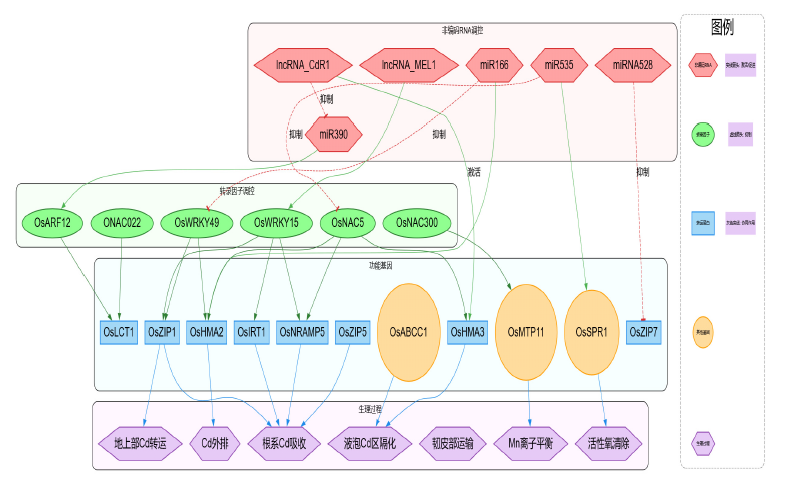
| 调控类型 | 基因/RNA符号 | 靶基因 | 作用机制 | 表型效果 | 参考文献 |
|---|---|---|---|---|---|
| miRNA | miRNA535 | OsLCT | 结合OsLCT1 mRNA 3'UTR诱导降解, 过表达降低籽粒镉含量 | 阻断韧皮部 镉转运 | [ |
| lncRNA | lncRNA-CdR1 | OsHMA3 | 染色质重塑激活OsHMA3启动子, 过表达株系提高液泡镉隔离效率 | 降低籽粒镉 含量 | [ |
| DNA甲基化 | — | OsNRAMP5 | 镉胁迫下启动子区去甲基化, 促进OsNRAMP5表达 | 镉吸收: 籼稻>粳稻 | [ |
| 调控类型 | 基因/RNA符号 | 靶基因 | 作用机制 | 表型效果 | 参考文献 |
|---|---|---|---|---|---|
| miRNA | miRNA535 | OsLCT | 结合OsLCT1 mRNA 3'UTR诱导降解, 过表达降低籽粒镉含量 | 阻断韧皮部 镉转运 | [ |
| lncRNA | lncRNA-CdR1 | OsHMA3 | 染色质重塑激活OsHMA3启动子, 过表达株系提高液泡镉隔离效率 | 降低籽粒镉 含量 | [ |
| DNA甲基化 | — | OsNRAMP5 | 镉胁迫下启动子区去甲基化, 促进OsNRAMP5表达 | 镉吸收: 籼稻>粳稻 | [ |
| 技术 | 降镉效率 | 生长影响 | 应用潜力 | 参考文献 |
|---|---|---|---|---|
| OsHMA3过表达 | ***** | 低 | 高,多作物适用 | [ |
| OsNRAMP5敲除 | **** | 中 | 中,需基因型适配 | [ |
| OsLCT1敲除 | *** | 低 | 高,易整合至品种 | [ |
| 多基因编辑 (OsNRAMP5+ OsLCT1) | **** | 中 | 中,复杂性高 | [ |
| 技术 | 降镉效率 | 生长影响 | 应用潜力 | 参考文献 |
|---|---|---|---|---|
| OsHMA3过表达 | ***** | 低 | 高,多作物适用 | [ |
| OsNRAMP5敲除 | **** | 中 | 中,需基因型适配 | [ |
| OsLCT1敲除 | *** | 低 | 高,易整合至品种 | [ |
| 多基因编辑 (OsNRAMP5+ OsLCT1) | **** | 中 | 中,复杂性高 | [ |
| 策略 | 靶基因 | 效果 | 优势/局限 | 参考文献 |
|---|---|---|---|---|
| 敲除吸收基因 | OsNRAMP5 | 降低糙米镉含量 | 高效,但可能导致锰缺乏 | [ |
| 敲除转运基因 | OsLCT1 | 降低籽粒镉含量 | 不影响必需元素,易应用 | [ |
| 多基因编辑 | OsNRAMP5+ OsLCT1 | 叠加降镉效果 | 协同作用,可能影响生长 | [ |
| 组成型过表达 | OsHMA3 | 根部镉含量增加,降低籽粒镉含量 | 效果优于敲除OsNRAMP5 | [ |
| 组织特异性表达 | OsHMA3 | 节点特异表达,降低籽粒镉含量 | 避免组成型表达的生长抑制 | [ |
| 启动子编辑 | OsNRAMP5调控区 | 降低表达但不完全敲除, 平衡镉吸收与锰需求 | 减少副作用,维持产量 | [ |
| 策略 | 靶基因 | 效果 | 优势/局限 | 参考文献 |
|---|---|---|---|---|
| 敲除吸收基因 | OsNRAMP5 | 降低糙米镉含量 | 高效,但可能导致锰缺乏 | [ |
| 敲除转运基因 | OsLCT1 | 降低籽粒镉含量 | 不影响必需元素,易应用 | [ |
| 多基因编辑 | OsNRAMP5+ OsLCT1 | 叠加降镉效果 | 协同作用,可能影响生长 | [ |
| 组成型过表达 | OsHMA3 | 根部镉含量增加,降低籽粒镉含量 | 效果优于敲除OsNRAMP5 | [ |
| 组织特异性表达 | OsHMA3 | 节点特异表达,降低籽粒镉含量 | 避免组成型表达的生长抑制 | [ |
| 启动子编辑 | OsNRAMP5调控区 | 降低表达但不完全敲除, 平衡镉吸收与锰需求 | 减少副作用,维持产量 | [ |
| [1] |
李慧君, 明荔莉, 张文生. 植物对镉吸收、转运及耐性调控机制研究进展[J]. 生态毒理学报, 2022, 17(2):86-95.
|
| [2] |
doi: 10.1007/s00128-020-03088-1 pmid: 33486543 |
| [3] |
付季城, 陈胜艳, 岳莉然, 等. 过表达野菊CiWRKY15基因增强拟南芥镉耐性[J]. 东北林业大学学报, 2025, 53(4):30-36.
|
| [4] |
肖莎莎, 曹霞, 贺成峰, 等. 镉胁迫对水稻抗氧化酶和营养品质的影响[J]. 延边大学农学学报, 2023, 45(4):26-31.
|
| [5] |
doi: 10.1016/j.scitotenv.2020.142188 URL |
| [6] |
丁仕林, 刘朝雷, 钱前, 等. 水稻重金属镉吸收和转运的分子遗传机制研究进展[J]. 中国水稻科学, 2019, 33(5):383-390.
doi: 10.16819/j.1001-7216.2019.9040 |
| [7] |
doi: 10.1016/j.molp.2017.01.003 URL |
| [8] |
许肖博, 安鹏虎, 郭天骄, 等. 水稻镉胁迫响应机制及防控措施研究进展[J]. 中国水稻科学, 2021, 35(5):415-426.
doi: 10.16819/j.1001-7216.2021.201209 |
| [9] |
doi: 10.1016/j.scitotenv.2020.139805 URL |
| [10] |
doi: S0269-7491(16)32137-6 pmid: 28242254 |
| [11] |
doi: 10.1016/j.ecolind.2024.112601 URL |
| [12] |
曾民, 陈佳, 李娥贤, 等. 元江普通野生稻后代镉分布特点及镉积累动态变化规律[J]. 生态环境学报, 2022, 31(3):565-571.
doi: 10.16258/j.cnki.1674-5906.2022.03.015 |
| [13] |
李开叶, 赵婷婷, 陈佳, 等. 不同有机物料对水稻根表铁膜及砷镉吸收转运的影响[J]. 环境科学, 2021, 42(4):2047-2055.
|
| [14] |
doi: 10.1007/s11356-022-23705-2 |
| [15] |
郭宝, 李雪姣, 唐静, 等. 水稻木质部伤流液响应镉胁迫的蛋白组鉴定[J]. 植物营养与肥料学报, 2023, 29(9):1597-1617.
|
| [16] |
谷建诚, 郭彬, 林义成, 等. 根表铁膜对水稻镉吸收的影响[J]. 浙江农业学报, 2020, 32(6):963-970.
doi: 10.3969/j.issn.1004-1524.2020.06.03 |
| [17] |
王璐瑶, 陈謇, 赵守清, 等. 水稻镉积累特性的生理和分子机制研究概述[J]. 植物学报, 2022, 57(2):236-249.
doi: 10.11983/CBB21222 |
| [18] |
doi: 10.3390/cells11030569 URL |
| [19] |
doi: 10.1016/j.envpol.2021.118497 URL |
| [20] |
余沁, 何林燊, 霍春松, 等. 烟草NRAMP家族全基因组鉴定及响应重金属胁迫的表达分析[J]. 分子植物育种, 2022, 20(5):1496-1504.
|
| [21] |
刘选明, 肖庆, 周正琨, 等. 水稻镉吸收、转运及积累的生理过程和分子机制研究进展[J]. 生命科学研究, 2024, 28(6):503-520.
|
| [22] |
doi: 10.1111/pce.v43.10 URL |
| [23] |
doi: 10.1186/s12284-018-0254-x pmid: 30465288 |
| [24] |
doi: 10.1016/j.repbre.2022.10.001 URL |
| [25] |
于江辉, 李焱瑶, 秦冠男, 等. 水稻OsNRAMP5基因低镉积累突变位点功能标记的开发与验证[J]. 江苏农业学报, 2022, 38(2):289-295.
|
| [26] |
doi: 10.1093/jxb/erac302 URL |
| [27] |
doi: 10.1007/s11356-025-36061-8 |
| [28] |
doi: 10.1111/nph.2010.189.issue-1 URL |
| [29] |
doi: 10.1093/jxb/eru340 URL |
| [30] |
李东屏, 郝小花, 陈良碧, 等. 水稻镉积累的遗传调控及低镉水稻育种的研究进展与展望[J]. 生命科学研究, 2021, 25(5):432-441,454.
|
| [31] |
doi: 10.1016/j.jhazmat.2019.120853 URL |
| [32] |
李兴容, 谭志兵, 赵燕, 等. 水稻低亲和性阳离子转运蛋白基因OsLCT3的克隆与功能研究[J]. 生物技术通报, 2024, 40(4):97-109.
doi: 10.13560/j.cnki.biotech.bull.1985.2023-1025 |
| [33] |
|
| [34] |
doi: 10.1186/s12870-019-1899-3 pmid: 31248369 |
| [35] |
doi: 10.1104/pp.19.01569 pmid: 32341004 |
| [36] |
doi: 10.1016/j.plaphy.2015.10.005 URL |
| [37] |
赵秋芳, 马海洋, 贾利强, 等. 水稻(Oryza sativa)OsSPR1突变体及过表达株系对锰胁迫的响应[J]. 分子植物育种, 2020, 18(2):520-525.
|
| [38] |
doi: 10.1007/s00425-025-04644-x |
| [39] |
doi: 10.1016/j.plantsci.2021.110894 URL |
| [40] |
doi: 10.1093/jxb/erz335 pmid: 31328224 |
| [41] |
doi: 10.3390/agronomy11050918 URL |
| [42] |
doi: 10.3389/fpls.2018.00476 pmid: 29696032 |
| [43] |
doi: 10.1038/s41467-019-10544-y pmid: 31189898 |
| [44] |
罗秋红, 吴俊, 柏斌, 等. 水稻镉吸收与转运机理的研究进展[J]. 土壤, 2021, 53(6):1142-1151.
|
| [45] |
doi: 10.1111/tpj.v110.5 URL |
| [46] |
doi: 10.1016/j.molp.2024.09.012 URL |
| [47] |
doi: 10.1016/j.jes.2022.05.047 URL |
| [48] |
doi: 10.1016/j.jhazmat.2024.136766 URL |
| [49] |
doi: 10.1007/s00122-024-04772-0 |
| [50] |
doi: 10.1007/s11103-023-01405-w |
| [51] |
doi: 10.1016/j.jes.2022.10.005 URL |
| [52] |
doi: 10.1104/pp.18.00485 pmid: 29925586 |
| [53] |
|
| [54] |
宋嘉俊, 翁绿水, 李锦江, 等. 两类水稻Nramp5基因突变体衍生系在镉污染稻田中糙米镉锰积累特征分析[J]. 杂交水稻, 2024, 39(1):17-26.
|
| [55] |
doi: 10.1093/jxb/erab159 URL |
| [56] |
doi: 10.1016/j.cj.2022.09.013 URL |
| [57] |
doi: 10.1248/yakushi.20-00243-5 URL |
| [58] |
郭明欣, 郑玲, 赵旭升. 水稻铁吸收、转运及调控的分子机制研究进展[J]. 遗传, 2017, 39(5):388-395.
|
| [59] |
doi: 10.1007/s13762-022-04550-9 |
| [60] |
doi: 10.1007/s00344-020-10148-7 |
| [61] |
doi: 10.1021/acs.est.0c02877 URL |
| [62] |
doi: 10.1007/s11032-019-0964-9 |
| [63] |
doi: 10.1016/j.envpol.2022.120058 URL |
| [64] |
doi: 10.1186/s12284-021-00530-8 |
| [65] |
doi: 10.1038/s41467-018-03088-0 |
| [66] |
doi: 10.1007/s10534-023-00569-8 |
| [67] |
|
| [68] |
doi: 10.1016/j.envexpbot.2025.106138 URL |
| [69] |
doi: 10.1186/s12864-020-6474-7 pmid: 32028884 |
| [70] |
doi: 10.1016/j.jhazmat.2024.133531 URL |
| [71] |
doi: 10.1038/s41467-023-40176-2 pmid: 37488129 |
| [72] |
doi: 10.1186/s12284-024-00740-w |
| [73] |
doi: 10.1016/j.chemosphere.2020.129136 URL |
| [74] |
钱志龙, 刘晨晨, 李雪娇, 等. 镉和砷在植物中的积累及其分子调控机制研究[J]. 西北植物学报, 2019, 39(2):371-380.
|
| [75] |
尹协, 张贞宇, 谭洁, 等. 过表达NtMYB4a基因通过调节激素平衡调控烟草植株生长发育[J]. 山地农业生物学报, 2024, 43(6):21-26,42.
|
| [76] |
|
| [77] |
doi: 10.1104/pp.18.01380 pmid: 30782964 |
| [78] |
doi: 10.1104/pp.16.01729 pmid: 28073984 |
| [79] |
doi: 10.3390/agronomy11010095 URL |
| [80] |
doi: 10.1186/s12870-019-1883-y pmid: 31238869 |
| [81] |
doi: 10.1016/j.plaphy.2020.06.006 URL |
| [82] |
doi: S0168-9452(17)30544-7 pmid: 28969789 |
| [83] |
doi: 10.1016/j.jhazmat.2024.135702 URL |
| [84] |
doi: 10.1007/s11103-018-0809-7 |
| [85] |
doi: 10.1111/pce.v42.3 URL |
| [86] |
doi: 10.1093/jxb/erz006 URL |
| [87] |
|
| [88] |
|
| [89] |
|
| [90] |
|
| [91] |
doi: 10.1071/FP18234 pmid: 31023418 |
| [92] |
doi: 10.1016/j.plantsci.2020.110501 URL |
| [93] |
doi: 10.1016/j.jhazmat.2024.133528 URL |
| [94] |
doi: 10.3389/fpls.2022.859386 URL |
| [95] |
doi: 10.1016/j.jhazmat.2022.129121 URL |
| [96] |
doi: 10.1016/j.plgene.2021.100281 URL |
| [97] |
doi: 10.1016/j.envexpbot.2020.104369 URL |
| [98] |
doi: 10.1007/s11356-017-8593-5 URL |
| [99] |
doi: 10.1021/acs.jafc.7b01164 pmid: 28657742 |
| [100] |
doi: 10.1021/acs.jafc.9b07468 pmid: 32003983 |
| [101] |
doi: 10.1016/j.jhazmat.2023.133251 URL |
| [102] |
doi: 10.1007/s11033-023-08648-2 pmid: 37450076 |
| [103] |
doi: 10.1007/s44154-023-00117-x |
| [104] |
doi: 10.1186/s13104-025-07112-7 |
| [105] |
彭喜旭, 白宁宁, 王海华. 响应镉胁迫的水稻WRKY15转录因子基因的分离与表达特征[J]. 中国水稻科学, 2018, 32(2):103-110.
doi: 10.16819/j.1001-7216.2018.7056 |
| [106] |
刘元峰, 李素贞, 郭晋杰, 等. 植物YSL家族基因研究进展[J]. 生物技术通报, 2017, 33(9):1-9.
doi: 10.13560/j.cnki.biotech.bull.1985.2017-0375 |
| [107] |
doi: 10.1007/s12374-022-09379-w |
| [108] |
doi: 10.1073/pnas.1116531109 URL |
| [109] |
doi: 10.1186/s12284-021-00548-y |
| [110] |
doi: 10.1007/s00344-024-11538-x |
| [1] | GAO Hongxia, LIU Yang, SUN Rongyu, YU Zhihong. Zoning of Rice Frost Disasters During Rice Maturity Period in Xing'an League of Inner Mongolia [J]. Chinese Agricultural Science Bulletin, 2026, 42(9): 117-123. |
| [2] | HUANG Wanyi, GAO Lin, QIU Tian, LIN Changhua, PAN Huirou, GUO Yinan, CHEN Leilei. Spatial Distribution Characteristics of Cadmium and Lead in Agricultural Soil of Typical Mining Area in Northern Guangdong and Its Pollution Assessment [J]. Chinese Agricultural Science Bulletin, 2026, 42(9): 82-91. |
| [3] | LU Ping, CHEN Yujia, WANG Zhanfu, ZHANG Yiming, JIANG Hangfeng, WANG Chaofan, ZHANG Rong, QIU Hanying. Effects of One-time Basal Application of a Newly Formulated Controlled-release Blended Urea on Traits, Yield and Nitrogen Utilization of Rice (Oryza sativa L. 'Nanjing 46') [J]. Chinese Agricultural Science Bulletin, 2026, 42(8): 95-103. |
| [4] | ZHANG Jie, SHAO Wenqi, Ma Hongbo, CHEN Chuan, ZHANG Ankang, LI Chuanzhe. Effect of Slow-release Nitrogen Fertilizer on Rice Yield and Fertilizer Utilization Efficiency in Jiangsu Province [J]. Chinese Agricultural Science Bulletin, 2026, 42(8): 104-109. |
| [5] | YU Linchuang, CHEN Qingming, LU Yun, SHEN Guanwang, QI Yuliang, FU Ding, YU Xinchun, CHANG Xingyuan, SHEN Guanghui. Preliminary Molecular Characterization and Allelic Profiling of Blast Resistance Genes in 93 Core Parental Lines of Oryza sativa L [J]. Chinese Agricultural Science Bulletin, 2026, 42(8): 38-43. |
| [6] | SHANG Xiaolan, LI Dan, FANG Wenying, XU Zhu, WANG Qiang, CHEN Zhaoming. Effect of Machine-Transplanting Synchronized with Side-deep Fertilization on Rice Yield, Nitrogen Fertilizer Utilization and Soil Nitrogen Content [J]. Chinese Agricultural Science Bulletin, 2026, 42(7): 1-7. |
| [7] | WEN Jianchuan, LAI Zhengrong, WU Lyu, RUAN Lingli, WU Biliang, LIANG Ping. Meteorological Forecast of Rice Blast Risk Level in Qiandongnan Prefecture [J]. Chinese Agricultural Science Bulletin, 2026, 42(7): 171-175. |
| [8] | YE Pei, FENG Dehao, YANG Jun, LIU Kaiwen, CHEN Sicheng. Study on Vulnerability and Meteorological Disaster Thresholds of High-Temperature and Drought Combined Stress During Heading and Flowering Stage of Mid-season Rice [J]. Chinese Agricultural Science Bulletin, 2026, 42(6): 120-126. |
| [9] | GE Yi, LIU Xiaoyue, WANG Xianglin, SHI Xuefeng, QUAN Shengxiang. Study on Remediation Effect of Artemisia argyi on Cadmium-Contaminated Cultivated Land [J]. Chinese Agricultural Science Bulletin, 2026, 42(5): 157-161. |
| [10] | ZHANG Qiming, GUO Shuilian, OUYANG Dongmei. Variation Analysis of Climate Condition for Double-cropping Rice in Yichun Based on GIS [J]. Chinese Agricultural Science Bulletin, 2026, 42(3): 133-143. |
| [11] | HUANG Wei, PAN Huixiao, WU Xuanke, HE Yan, TAN Mengxiang, LIU Yongyu. Analysis of Risk Zoning and Meteorological Factors of Double Cropping Rice Yield Disaster in Guangxi [J]. Chinese Agricultural Science Bulletin, 2026, 42(3): 144-154. |
| [12] | XU Junhui, CHEN Lini, HUANG Fang, LIAN Cong, MO Bocheng. Effects of Two Foliar Inhibitors on Absorption and Accumulation of Cd in Rice and Related Health Risk Assessment [J]. Chinese Agricultural Science Bulletin, 2026, 42(2): 113-119. |
| [13] | WANG Jingwen, YUAN Hangjie, LOU Ling, ZHANG Xiumei, YANG Wenye, WANG Zhong. Influence of Different Fallowing Methods on Soil Quality of Degraded Vegetable Fields [J]. Chinese Agricultural Science Bulletin, 2026, 42(2): 146-152. |
| [14] | ZHOU Fengjue, MA Jieping, HU Junming, LU Zhancai, LI Shi, LI Tingting, ZHANG Junhui, ZHENG Fuhai, LI Yuxiang, LIU Meikun. Effects of Combined Application of Organic Materials on Soil Organic Matter and Rice Quality in Rice-duck Farming System [J]. Chinese Agricultural Science Bulletin, 2026, 42(15): 1-6. |
| [15] | YANG Xin, YE Shuifeng. Effects of Controlled-release Urea Combined with Straw Biochar on Rice Yield and Nitrogen Utilization Efficiency [J]. Chinese Agricultural Science Bulletin, 2026, 42(14): 57-62. |
| Viewed | ||||||
|
Full text |
|
|||||
|
Abstract |
|
|||||
