Welcome to Chinese Agricultural Science Bulletin,

Chinese Agricultural Science Bulletin ›› 2026, Vol. 42 ›› Issue (20): 19-28.doi: 10.11924/j.issn.1000-6850.casb2025-0775
Previous Articles Next Articles
ZHONG Nan1( ), NIU Jie2, GAN Xiaoyan1, CHEN Yuchao1, TIAN Li1, SHI Lei1, QIN Ken2()
Received:2025-09-21
Revised:2026-01-11
Online:2026-10-25
Published:2026-10-26
CLC Number:
ZHONG Nan, NIU Jie, GAN Xiaoyan, CHEN Yuchao, TIAN Li, SHI Lei, QIN Ken. Screening of Heat Tolerance Indexes and Evaluation of Heat Tolerance in Different Wolfberry Varieties at Germination and Seedling Growth Stages[J]. Chinese Agricultural Science Bulletin, 2026, 42(20): 19-28.
Add to citation manager EndNote|Ris|BibTeX
URL: https://www.casb.org.cn/EN/10.11924/j.issn.1000-6850.casb2025-0775
| 编号 | 品种名称 | 千粒重/g |
|---|---|---|
| 1 | N1 | 0.88 |
| 2 | N5 | 0.88 |
| 3 | N7 | 0.72 |
| 4 | N9 | 1.14 |
| 5 | 14-02 | 1.18 |
| 6 | 7-8 | 0.87 |
| 7 | 1-173 | 1.12 |
| 8 | 2-182 | 0.64 |
| 9 | 2-184 | 0.96 |
| 10 | 19008-28 | 0.87 |
| 11 | 19008-194 | 1.23 |
| 12 | 19009-11 | 0.76 |
| 13 | 19009-20 | 0.95 |
| 14 | 18-8-32 | 1.04 |
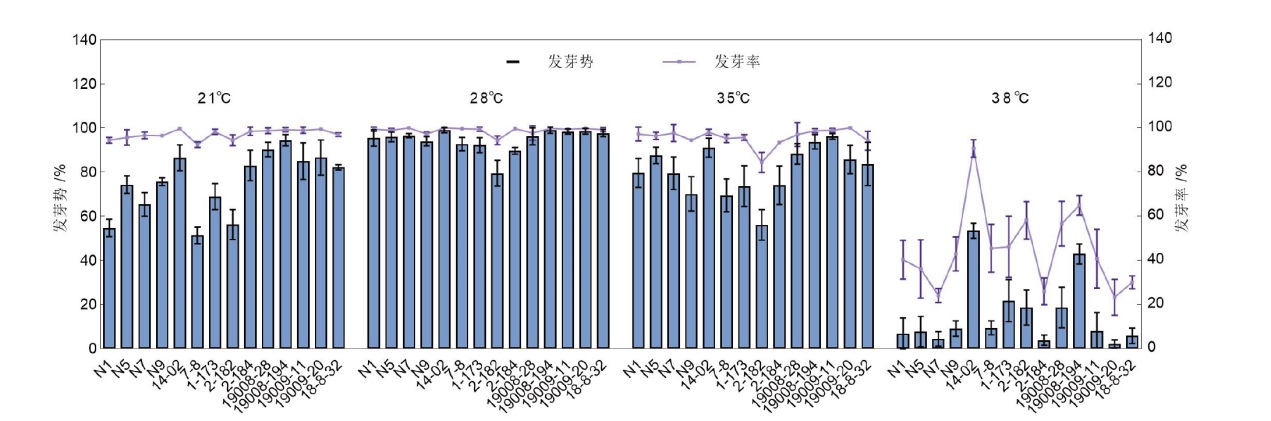
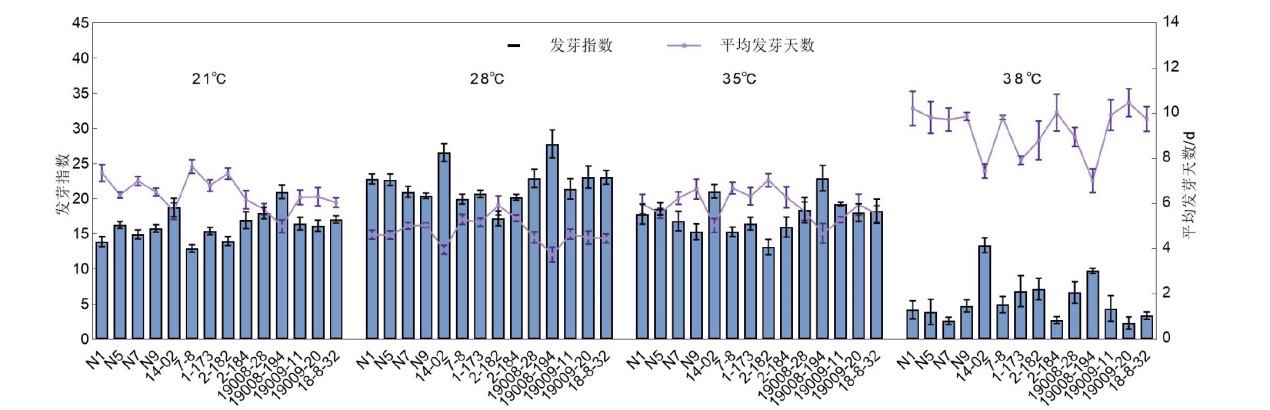
| 品种名称 | 发芽率 | 发芽势 | 发芽指数 | ||||||||
|---|---|---|---|---|---|---|---|---|---|---|---|
| 21℃ | 35℃ | 38℃ | 21℃ | 35℃ | 38℃ | 21℃ | 35℃ | 38℃ | |||
| N1 | 0.95±0.01a | 0.98±0.03ab | 0.37±0.06d | 0.57±0.04c | 0.84±0.05ab | 0.04±0.02c | 0.61±0.03b | 0.78±0.06ab | 0.16±0.03c | ||
| N5 | 0.97±0.04a | 0.97±0.02ab | 0.30±0.07de | 0.78±0.04b | 0.91±0.03ab | 0.04±0.01c | 0.77±0.02ab | 0.82±0.04ab | 0.13±0.02c | ||
| N7 | 0.97±0.02a | 0.98±0.05ab | 0.24±0.03e | 0.68±0.06bc | 0.83±0.08b | 0.05±0.03c | 0.71±0.03ab | 0.80±0.07ab | 0.12±0.03c | ||
| N9 | 0.99±0.01a | 0.96±0.02ab | 0.48±0.03cd | 0.81±0.02b | 0.75±0.09b | 0.08±0.02c | 0.75±0.03ab | 0.75±0.06b | 0.23±0.04bc | ||
| 14-02 | 1.00±0.01a | 0.98±0.01ab | 0.91±0.04a | 0.87±0.06ab | 0.92±0.05ab | 0.54±0.03a | 0.65±0.05ab | 0.79±0.04ab | 0.50±0.04a | ||
| 7-8 | 0.93±0.01a | 0.96±0.02ab | 0.51±0.05c | 0.55±0.04c | 0.76±0.08b | 0.12±0.02bc | 0.72±0.03ab | 0.77±0.03b | 0.25±0.06bc | ||
| 1-173 | 0.99±0.01a | 0.97±0.01ab | 0.46±0.14cd | 0.75±0.06b | 0.79±0.11b | 0.24±0.10bc | 0.74±0.03ab | 0.79±0.04ab | 0.33±0.11b | ||
| 2-182 | 1.00±0.03a | 0.88±0.04b | 0.62±0.09bc | 0.71±0.09bc | 0.70±0.09b | 0.27±0.07b | 0.70±0.04ab | 0.76±0.06b | 0.41±0.09ab | ||
| 2-184 | 0.99±0.02a | 0.94±0.01ab | 0.26±0.06de | 0.93±0.08ab | 0.82±0.10b | 0.04±0.03c | 0.74±0.06ab | 0.79±0.07ab | 0.14±0.03c | ||
| 19008-28 | 1.01±0.01a | 1.01±0.02a | 0.58±0.10bc | 0.94±0.03ab | 0.92±0.05ab | 0.15±0.07bc | 0.77±0.04ab | 0.80±0.08ab | 0.29±0.07bc | ||
| 19008-194 | 0.99±0.01a | 0.99±0.01a | 0.65±0.04b | 0.95±0.03a | 0.94±0.04ab | 0.43±0.05ab | 0.84±0.04a | 0.82±0.06ab | 0.35±0.01b | ||
| 19009-11 | 1.00±0.01a | 0.99±0.01a | 0.34±0.02de | 0.86±0.08ab | 0.98±0.01a | 0.04±0.02c | 0.78±0.04a | 0.90±0.01a | 0.16±0.01c | ||
| 19009-20 | 1.00±0.01a | 1.00±0.00a | 0.23±0.08e | 0.88±0.08ab | 0.87±0.06ab | 0.03±0.02c | 0.71±0.03ab | 0.78±0.05ab | 0.10±0.04c | ||
| 18-8-32 | 0.98±0.01a | 0.95±0.04ab | 0.30±0.03de | 0.84±0.01ab | 0.86±0.10ab | 0.06±0.04c | 0.81±0.02a | 0.79±0.08ab | 0.15±0.02c | ||
| 品种名称 | 根长(7 d) | 芽长(7 d) | 根冠比(7 d) | ||||||||
|---|---|---|---|---|---|---|---|---|---|---|---|
| 25℃ | 35℃ | 38℃ | 25℃ | 35℃ | 38℃ | 25℃ | 35℃ | 38℃ | |||
| 1.09±0.15b | 0.44±0.16a | 0.13±0.06a | 1.09±0.15b | 1.34±0.29ab | 0.57±0.14b | 0.49±0.13ab | 0.80±0.25c | 0.72±0.20a | 0.27±0.13b | ||
| 0.79±0.17c | 0.28±0.14ab | 0.14±0.05a | 0.79±0.17c | 0.64±0.12e | 0.41±0.09b | 0.29±0.07b | 1.23±0.27a | 0.70±0.35a | 0.47±0.23a | ||
| 1.02±0.46b | 0.20±0.13b | 0.10±0.04a | 1.02±0.46b | 1.14±0.23bc | 0.67±0.13ab | 0.52±0.13ab | 0.94±0.34bc | 0.30±0.19bc | 0.20±0.10b | ||
| 0.79±0.40c | 0.17±0.07b | 0.08±0.02a | 0.79±0.40c | 0.90±0.12cd | 0.54±0.14b | 0.43±0.08b | 0.99±0.12bc | 0.32±0.14bc | 0.17±0.03b | ||
| 1.03±0.12b | 0.27±0.10ab | 0.10±0.03a | 1.03±0.12b | 1.03±0.18c | 0.60±0.18ab | 0.50±0.14ab | 0.99±0.22bc | 0.46±0.23b | 0.20±0.08b | ||
| 0.78±0.32c | 0.26±0.11ab | 0.16±0.04a | 0.78±0.32c | 0.83±0.18d | 0.51±0.13b | 0.49±0.12ab | 1.03±0.25b | 0.48±0.15b | 0.32±0.10ab | ||
| 1.30±0.35a | 0.26±0.12ab | 0.13±0.04a | 1.30±0.35a | 1.29±0.29b | 0.75±0.15a | 0.65±0.10a | 1.03±0.18b | 0.36±0.14bc | 0.21±0.08b | ||
| 0.67±0.48c | 0.25±0.12ab | 0.14±0.06a | 0.67±0.48c | 0.93±0.30cd | 0.71±0.19ab | 0.57±0.13ab | 0.85±0.33bc | 0.37±0.16bc | 0.27±0.13b | ||
| 0.94±0.18bc | 0.30±0.13ab | 0.10±0.03a | 0.94±0.18bc | 1.13±0.22bc | 0.70±0.12ab | 0.44±0.11b | 0.87±0.25bc | 0.42±0.15bc | 0.23±0.06b | ||
| 0.76±0.26c | 0.27±0.12ab | 0.14±0.05a | 0.76±0.26c | 1.24±0.24b | 0.65±0.20ab | 0.59±0.14ab | 0.61±0.20d | 0.42±0.17bc | 0.26±0.13b | ||
| 0.78±0.20c | 0.16±0.07b | 0.12±0.04a | 0.78±0.20c | 0.85±0.20d | 0.71±0.18ab | 0.56±0.07ab | 0.94±0.24bc | 0.24±0.08c | 0.23±0.08b | ||
| 1.02±0.26b | 0.29±0.09ab | 0.18±0.05a | 1.02±0.26b | 0.80±0.09de | 0.58±0.12b | 0.50±0.12ab | 1.32±0.22a | 0.54±0.17a | 0.38±0.11ab | ||
| 1.18±0.33ab | 0.25±0.07ab | 0.14±0.04a | 1.18±0.33ab | 1.47±0.33a | 0.64±0.06ab | 0.58±0.15ab | 0.83±0.23c | 0.39±0.11bc | 0.24±0.08b | ||
| 1.06±0.15b | 0.29±0.15ab | 0.10±0.02a | 1.06±0.15b | 0.99±0.09cd | 0.72±0.15ab | 0.52±0.12ab | 1.01±0.16bc | 0.38±0.14bc | 0.19±0.05b | ||
| 品种名称 | 根长(14 d) | 芽长(14 d) | |||||
|---|---|---|---|---|---|---|---|
| 25℃ | 35℃ | 38℃ | 25℃ | 35℃ | 38℃ | ||
| N1 | 0.69±0.12c | 0.33±0.14ab | 0.09±0.03a | 1.21±0.20a | 0.60±0.16a | 0.33±0.09a | |
| N5 | 0.68±0.15c | 0.33±0.20ab | 0.09±0.03a | 0.68±0.11d | 0.43±0.09b | 0.27±0.06a | |
| N7 | 0.65±0.20cd | 0.18±0.13b | 0.04±0.01a | 0.96±0.19bc | 0.53±0.11ab | 0.33±0.08a | |
| N9 | 0.84±0.18bc | 0.22±0.11b | 0.05±0.02a | 0.88±0.12bc | 0.41±0.12b | 0.26±0.06a | |
| 14-02 | 0.97±0.13ab | 0.38±0.17a | 0.10±0.04a | 0.88±0.15bc | 0.56±0.18ab | 0.30±0.09a | |
| 7-8 | 0.80±0.27bc | 0.23±0.11b | 0.10±0.03a | 0.87±0.14c | 0.51±0.12ab | 0.36±0.06a | |
| 1-173 | 0.73±0.17c | 0.15±0.06b | 0.06±0.01a | 1.00±0.21b | 0.46±0.11b | 0.33±0.05a | |
| 2-182 | 0.63±0.36cd | 0.19±0.14b | 0.10±0.05a | 0.98±0.27bc | 0.55±0.11ab | 0.39±0.08a | |
| 2-184 | 0.50±0.11d | 0.24±0.08b | 0.04±0.01a | 0.89±0.16bc | 0.62±0.14a | 0.26±0.07a | |
| 19008-28 | 0.46±0.13d | 0.19±0.11b | 0.06±0.02a | 0.87±0.15c | 0.52±0.10ab | 0.33±0.08a | |
| 19008-194 | 0.91±0.19b | 0.17±0.07b | 0.06±0.03a | 0.75±0.12cd | 0.54±0.13ab | 0.36±0.10a | |
| 19009-11 | 1.09±0.24a | 0.22±0.10b | 0.10±0.03a | 0.84±0.12c | 0.54±0.11ab | 0.38±0.10a | |
| 19009-20 | 0.53±0.09d | 0.15±0.05b | 0.06±0.02a | 1.09±0.23ab | 0.50±0.05ab | 0.34±0.06a | |
| 18-8-32 | 0.85±0.10bc | 0.27±0.15ab | 0.06±0.02a | 0.77±0.11cd | 0.55±0.15ab | 0.32±0.09a | |
| 品种名称 | 总长(14 d) | 根冠比(14 d) | |||||
|---|---|---|---|---|---|---|---|
| 25℃ | 35℃ | 38℃ | 25℃ | 35℃ | 38℃ | ||
| N1 | 0.77±0.11bc | 0.37±0.12ab | 0.12±0.04a | 0.56±0.15e | 0.50±0.14b | 0.24±0.06a | |
| N5 | 0.68±0.13c | 0.33±0.13ab | 0.13±0.03a | 0.99±0.20bc | 0.75±0.33a | 0.32±0.08a | |
| N7 | 0.65±0.17cd | 0.19±0.11b | 0.08±0.02a | 0.71±0.17de | 0.27±0.22c | 0.13±0.04b | |
| N9 | 0.85±0.15b | 0.24±0.11b | 0.09±0.03a | 0.95±0.24c | 0.53±0.24b | 0.20±0.09a | |
| 14-02 | 0.90±0.10ab | 0.41±0.13a | 0.12±0.04a | 1.06±0.21bc | 0.66±0.21ab | 0.24±0.09a | |
| 7-8 | 0.81±0.24b | 0.28±0.10b | 0.14±0.03a | 0.89±0.26cd | 0.44±0.18bc | 0.26±0.10a | |
| 1-173 | 0.75±0.07bc | 0.19±0.06b | 0.09±0.01a | 0.75±0.18d | 0.35±0.14bc | 0.16±0.04a | |
| 2-182 | 0.80±0.25bc | 0.26±0.12b | 0.15±0.04a | 0.67±0.33de | 0.36±0.20bc | 0.24±0.17a | |
| 2-184 | 0.56±0.09d | 0.29±0.09b | 0.07±0.02a | 0.58±0.16de | 0.37±0.09bc | 0.16±0.04a | |
| 19008-28 | 0.52±0.12d | 0.24±0.10b | 0.10±0.02a | 0.54±0.15e | 0.37±0.19bc | 0.17±0.06a | |
| 19008-194 | 0.89±0.16ab | 0.24±0.08b | 0.11±0.03a | 1.28±0.33ab | 0.30±0.11c | 0.16±0.07a | |
| 19009-11 | 0.99±0.17a | 0.27±0.09b | 0.14±0.04a | 1.33±0.29a | 0.42±0.17bc | 0.27±0.10a | |
| 19009-20 | 0.61±0.10cd | 0.20±0.05b | 0.10±0.03a | 0.48±0.07e | 0.30±0.09c | 0.17±0.05a | |
| 18-8-32 | 0.84±0.09b | 0.34±0.14ab | 0.12±0.04a | 1.14±0.17b | 0.48±0.15bc | 0.21±0.09a | |
| 指标 | 因子载荷 | 指标 | 因子载荷 | ||||
|---|---|---|---|---|---|---|---|
| 主成分1 | 主成分2 | 主成分3 | 主成分1 | 主成分2 | 主成分3 | ||
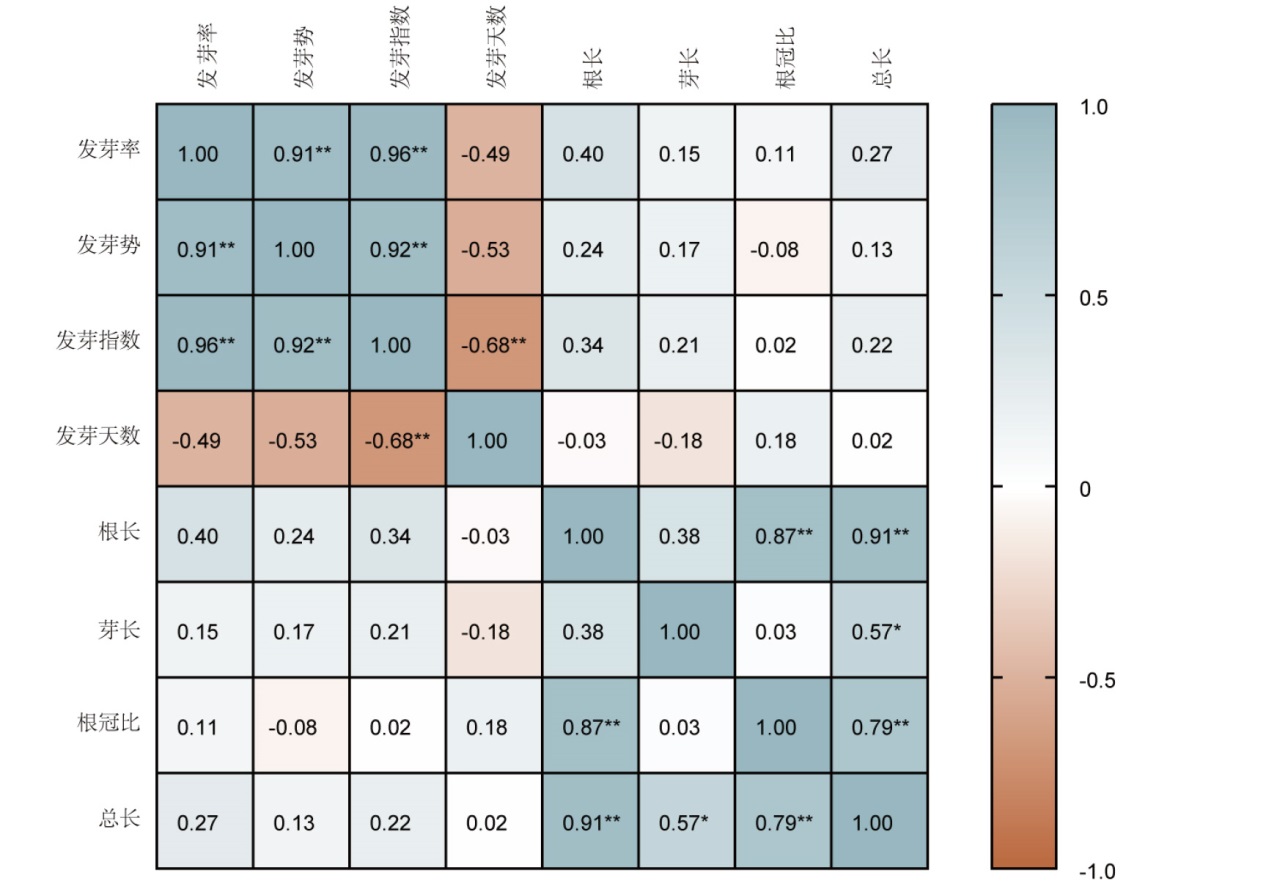
| 发芽率 | 0.88 | -0.35 | 0.21 | 根冠比 | 0.40 | 0.81 | 0.37 |
| 发芽势 | 0.80 | -0.49 | 0.11 | 总长 | 0.63 | 0.74 | -0.15 |
| 发芽指数 | 0.89 | -0.44 | 0.08 | 特征值 | 3.74 | 2.56 | 1.00 |
| 发芽天数 | -0.54 | 0.53 | 0.19 | 贡献率/% | 46.78% | 32.01% | 12.45% |
| 根长 | 0.71 | 0.67 | 0.11 | 累计贡献率/% | 46.78% | 78.79% | 91.24% |
| 芽长 | 0.44 | 0.24 | -0.85 | 权重 | 0.51 | 0.35 | 0.14 |
| 品种名称 | 综合指标值 | 隶属函数值 | D值 | 综合评价 | |||||
|---|---|---|---|---|---|---|---|---|---|
| CI1 | CI2 | CI3 | µ1 | µ2 | µ3 | ||||
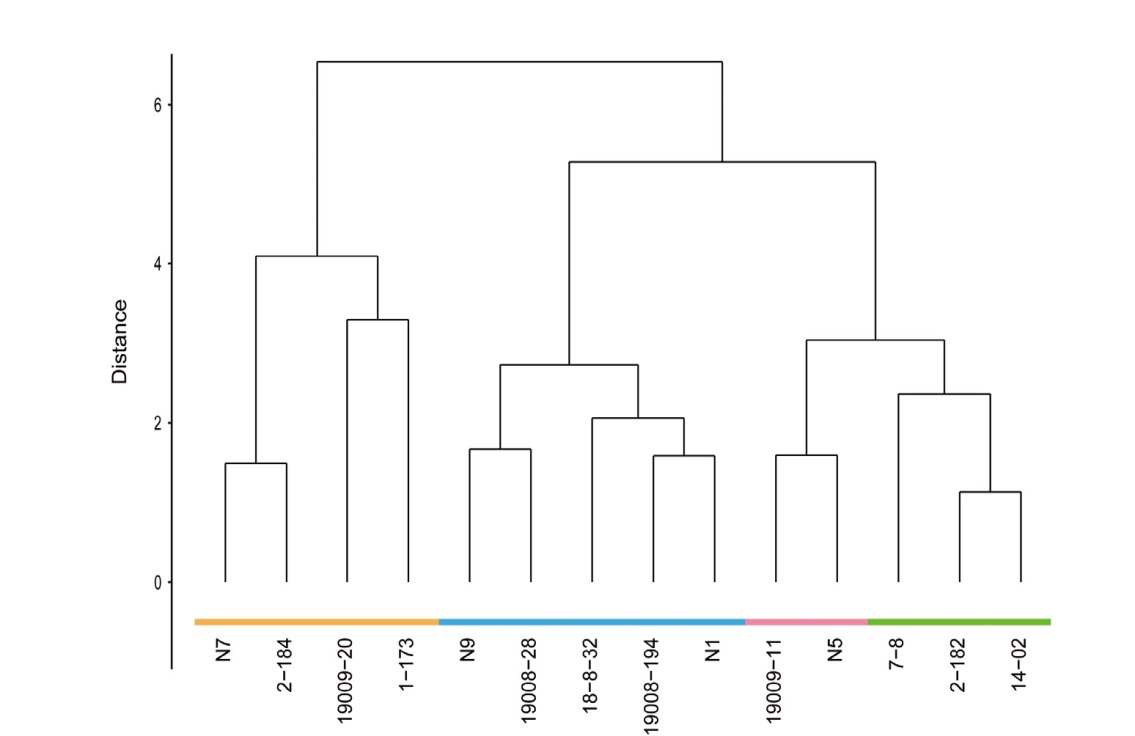
| N1 | -0.50 | 1.68 | 0.07 | 0.33 | 0.79 | 0.42 | 0.504820297 | 6 | |
| N5 | -0.61 | 2.27 | 1.74 | 0.31 | 0.91 | 0.99 | 0.615196247 | 4 | |
| N7 | -2.34 | -1.21 | -1.00 | 0.03 | 0.21 | 0.06 | 0.094929131 | 14 | |
| N9 | -1.12 | -0.97 | 1.33 | 0.23 | 0.25 | 0.85 | 0.322599103 | 10 | |
| 14-02 | 3.56 | -1.23 | 1.78 | 1.00 | 0.20 | 1.00 | 0.72038216 | 1 | |
| 7-8 | 1.48 | 1.60 | -0.37 | 0.66 | 0.78 | 0.27 | 0.645955097 | 3 | |
| 1-173 | 0.31 | -2.23 | -0.49 | 0.46 | 0.00 | 0.23 | 0.269221476 | 11 | |
| 2-182 | 3.26 | 0.22 | -1.17 | 0.95 | 0.50 | 0.00 | 0.661011711 | 2 | |
| 2-184 | -2.51 | -1.44 | 0.65 | 0.00 | 0.16 | 0.62 | 0.140283149 | 13 | |
| 19008-28 | -0.07 | -1.08 | -0.18 | 0.40 | 0.23 | 0.33 | 0.333621838 | 9 | |
| 19008-194 | 1.61 | -1.57 | -0.79 | 0.68 | 0.13 | 0.13 | 0.412656449 | 7 | |
| 19009-11 | 0.42 | 2.70 | -0.82 | 0.48 | 1.00 | 0.12 | 0.614854639 | 5 | |
| 19009-20 | -2.25 | 0.43 | -0.72 | 0.04 | 0.54 | 0.15 | 0.232402263 | 12 | |
| 18-8-32 | -1.24 | 0.83 | -0.02 | 0.21 | 0.62 | 0.39 | 0.377308977 | 8 | |
| [1] |
中国气象局气候变化中心. 中国气候变化蓝皮书(2024)[M]. 北京: 科学出版社, 2024.
|
| [2] |
|
| [3] |
doi: 10.1038/nature16467 |
| [4] |
doi: 10.1038/s43016-025-01158-3 pmid: 40251295 |
| [5] |
doi: 10.1016/j.jpba.2020.113859 URL |
| [6] |
陈柳, 段傲宜, 李宜静, 等. 枸杞多糖的生物活性及应用研究进展[J]. 食品工业科技, 2025, 46(19):455-467.
|
| [7] |
程汝阳, 宋蔚宁, 蒋鑫, 等. 枸杞子及其复方在中枢神经系统疾病中的应用研究进展[J]. 中国实验方剂学杂志, 2025, 31(22):273-281.
|
| [8] |
罗青, 张波, 曹有龙. 枸杞落花落果的原因探讨及对策[J]. 宁夏农林科技, 2011, 52(7):69-70.
|
| [9] |
赵琴, 潘静, 曹兵, 等. 气温升高与干旱胁迫对宁夏枸杞光合作用的影响[J]. 生态学报, 2015, 35(18):6016-6022.
|
| [10] |
杨君妍, 闫淼, 吴海波, 等. 高温对不同厚皮甜瓜品种种子萌发的影响及其耐热性综合评价[J]. 新疆农业科学, 2024, 61(6):1386-1396.
doi: 10.6048/j.issn.1001-4330.2024.06.011 |
| [11] |
沈丹婷, 刘晓嵩, 唐东梅, 等. 高温胁迫下菠菜种子萌发特性及耐热性[J]. 上海交通大学学报, 2012, 30(4):31-38.
|
| [12] |
姚佳睿, 吕金钊, 陈康, 等. 不同油麦菜品种萌发期耐热指标筛选及耐热性评价[J]. 西北农业学报, 2024, 33(3):511-520.
|
| [13] |
秦小雅, 秦贝贝, 尹自成, 等. 枸杞高温耐受性的初步分析[J]. 分子植物育种, 2025, 23(7):2372-2378.
|
| [14] |
宋松泉, 刘军, 徐恒恒, 等. 脱落酸代谢与信号传递及其调控种子休眠与萌发的分子机制[J]. 中国农业科学, 2020, 53(5):857-873.
doi: 10.3864/j.issn.0578-1752.2020.05.001 |
| [15] |
徐恒恒, 黎妮, 刘树君, 等. 种子萌发及其调控的研究进展[J]. 作物学报, 2014, 40(7):1141-1156.
|
| [16] |
doi: 10.1146/annurev-arplant-050718-095919 pmid: 30786235 |
| [17] |
江敏, 王广伦, 李明璐, 等. 基于模型的水稻高温热害风险评估与动态预警[J]. 中国水稻科学, 2025, 39(1):128-142.
doi: 10.16819/j.1001-7216.2025.240306 |
| [18] |
doi: 10.1016/j.xplc.2023.100629 URL |
| [19] |
doi: 10.1016/j.molp.2023.09.013 URL |
| [20] |
王丽婧, 曾涛, 高山. 宁夏中宁枸杞生长季光热资源对发育期的影响[J]. 陕西农业科学, 2023, 69(3):93-97.
|
| [21] |
吴红霏, 施招婉, 王瑞, 等. 瓜类作物响应高温逆境的研究进展[J]. 中国农学通报, 2025, 41(12):26-33.
doi: 10.11924/j.issn.1000-6850.casb2024-0608 |
| [22] |
朱亚迪, 王慧琴, 王洪章, 等. 不同夏玉米品种大喇叭口期耐热性评价和鉴定指标筛选[J]. 作物学报, 2022, 48(12):3130-3143.
doi: 10.3724/SP.J.1006.2022.13079 |
| [23] |
雷刚, 方荣, 周坤华, 等. 辣椒种质资源苗期耐热性综合评价体系的建立[J]. 中国农业科技导报, 2025, 27(3):60-70.
|
| [24] |
芦娟, 柴春山, 王子婷, 等. 黑果枸杞种子萌发及幼苗生长效应研究[J]. 甘肃林业科技, 2023, 48(4):39-44,51.
|
| [1] | GUO Jinhua, SUN Zongjiu, LI Peiying, ZHANG Yongjuan, REN Menglong. Comprehensive Evaluation of Biological Characteristics and Turf Performance of New Bermudagrass Lines in Xinjiang [J]. Chinese Agricultural Science Bulletin, 2026, 42(7): 77-84. |
| [2] | CHENG Fanyi, ZHOU Qixuan, LAN Lingkai, ZHANG Ruoxi, YIN Yidi, HOU Bohan, DUO Liangyu, GU Jiageng, YAO Yiduo, ZHANG Zishuo, LANG Xuping. Effects of Potassium Deficiency Stress on Growth and Antioxidant Characteristics in Lycium barbarum Seedlings [J]. Chinese Agricultural Science Bulletin, 2026, 42(7): 92-96. |
| [3] | GAO Qin, CHEN Huanhuan, ZHU Qifa, XIA Hao, YU Fei, SHEN Jia, JIANG Chaoqiang. Study on Relationship Between Chemical Composition and Sensory Quality of Tobacco Middle Leaves in Southern Anhui Tobacco Area [J]. Chinese Agricultural Science Bulletin, 2026, 42(7): 204-209. |
| [4] | YANG Xin, ZHANG Mingjin, LI Bin, ZHANG Yonghui, XIE Qiang, WANG Jian’an. Effect of Different Harvesting Methods with Stems on Curing Quality of Upper Leaves [J]. Chinese Agricultural Science Bulletin, 2026, 42(7): 210-218. |
| [5] | ZENG Pei, YU Honglei, LI Yuekang, LIU Boyi. Abrupt Change Characteristics of Meteorological Elements in Ganfupingyuan Irrigation Area Based on Pettitt Test and Its Correlation Study [J]. Chinese Agricultural Science Bulletin, 2026, 42(6): 164-170. |
| [6] | LI Shimeng, NAN Zhiqiang, BAIMA Yangzhen, WANG Jinxiong. Comprehensive Evaluation and Adaptability Analysis of Rapeseed Agronomic Traits in Xizang [J]. Chinese Agricultural Science Bulletin, 2026, 42(6): 31-40. |
| [7] | ZHENG Xiaoyuan, CHEN Jingyu, WANG Huicong, WANG Zhenjiang, WANG Dan. Fruit Quality Analysis and Comprehensive Evaluation of 38 Mulberry Germplasm Resources [J]. Chinese Agricultural Science Bulletin, 2026, 42(6): 72-84. |
| [8] | WANG Zhengfeng, ZHAO Feng, LIU Jing, BAO Qijun. Evaluation of Forage Barley Germplasm Resources Based on Multiple Traits [J]. Chinese Agricultural Science Bulletin, 2026, 42(5): 1-11. |
| [9] | SU Yan, ZHAO Xiaoying, CHENG Risheng, XUE Shuqin, ZHANG Yinghua. Characteristics and Comprehensive Evaluation of Major Soil Nutrient Changes in Sunite Desert Grassland [J]. Chinese Agricultural Science Bulletin, 2026, 42(5): 109-116. |
| [10] | GUAN Jiyuan, CHEN Zhe, ZHANG Qunying. Effect of Pollination Varieties on Fecundity and Fruit Quality of Blackberries ‘Freedom’ [J]. Chinese Agricultural Science Bulletin, 2026, 42(5): 77-82. |
| [11] | LIAO Yuanyuan, ZHENG Zhangyun, ZHANG Zitao, CHEN Li, XIA Chuanlin, REN Jiequn, TAN Lixin. Analysis of Phenotypic and Leaf Nutritional Traits of 42 Mulberry Germplasm Resources [J]. Chinese Agricultural Science Bulletin, 2026, 42(4): 105-116. |
| [12] | LUO Jing, DU Shanshan, YAO Qingqing, WANG Dongli, HE Zhongsheng, SUN Huijian, WANG Ruijun. Effect of NaCl and Na2SO4 Salt Stress on the Germination of Upland Cotton Seeds and Screening of Salt-tolerant Germplasm [J]. Chinese Agricultural Science Bulletin, 2026, 42(3): 48-56. |
| [13] | YANG Wei, ZHANG Chenxu, LIU Minjie, MA Guosheng, LIU Wenhui, BAO Gensheng, KONG Fanmei. Comprehensive Evaluation of Production Performance and Nutritional Quality of Different Oat Varieties in Alpine Region of Qinghai Province [J]. Chinese Agricultural Science Bulletin, 2026, 42(19): 154-162. |
| [14] | HUANG Mengdi, CHEN Yingmin, YAN Yun, NIU Jijuan, LI Lin, KANG Jiangfei, ZHANG Bao, ZAI Xiaoyu, FANG Shefa, GUO Jianqiu. Comprehensive Analysis of Varieties and Yield of Soybean Based on Grey Correlation Degree and GGE Biplot [J]. Chinese Agricultural Science Bulletin, 2026, 42(19): 17-22. |
| [15] | WU Junting, XU Xiangming, SUN Yangyue, SHI Chunhui, ZHOU Boqiang. Study on Evaluation of Climate Quality of Sand Pear in Jinshan, Shanghai Based on Meteorological Factors [J]. Chinese Agricultural Science Bulletin, 2026, 42(18): 111-116. |
| Viewed | ||||||
|
Full text |
|
|||||
|
Abstract |
|
|||||
