Welcome to Chinese Agricultural Science Bulletin,

Chinese Agricultural Science Bulletin ›› 2026, Vol. 42 ›› Issue (21): 81-87.doi: 10.11924/j.issn.1000-6850.casb2026-0172
Previous Articles Next Articles
YANG Qijuan( ), LU Shuchang(), GUO Liuming, CIDAN Sangji, ZHANG Zixuan, YAO Xinyu
Received:2026-02-28
Revised:2026-04-23
Online:2026-11-10
Published:2026-11-10
CLC Number:
YANG Qijuan, LU Shuchang, GUO Liuming, CIDAN Sangji, ZHANG Zixuan, YAO Xinyu. Effects of Soil Biostimulants and Nitrogen Reduction on Salt-resistant Physiological Traits and Nitrogen Nutrient Enhancement of Facilities Rapeseed[J]. Chinese Agricultural Science Bulletin, 2026, 42(21): 81-87.
Add to citation manager EndNote|Ris|BibTeX
URL: https://www.casb.org.cn/EN/10.11924/j.issn.1000-6850.casb2026-0172
| 处理 | 株高/cm | 叶色/SPAD | 净光合速率/ [µmol/(m·s)] | 叶面积/cm2 |
|---|---|---|---|---|
| T1 | 17.10±0.43ab | 50.63±0.81cd | 21.77±0.32a | 36.17±1.99c |
| T2 | 16.60±0.14b | 45.04±0.38e | 21.10±0.20c | 37.85±4.49c |
| T3 | 14.77±0.21c | 43.47±1.22e | 20.67±0.21d | 42.61±1.34b |
| T4 | 14.03±0.45c | 43.90±0.26e | 20.50±0.26d | 34.65±2.08cd |
| T5 | 17.17±0.31ab | 57.60±0.36a | 21.27±0.25bc | 57.42±0.38a |
| T6 | 17.10±0.57ab | 51.07±0.36cd | 21.30±0.10bc | 38.78±2.73bc |
| T7 | 16.53±0.86b | 51.67±1.17c | 21.53±0.21ab | 31.47±1.27de |
| T8 | 14.40±0.22c | 49.80±0.72d | 20.47±0.06d | 29.51±1.14e |
| 处理 | SOD/(U/g) | POD/(U/g) | CAT/(U/g) | MDA/(nmol/g) | DP/(mg/g) |
|---|---|---|---|---|---|
| T1 | 433.23±17.43cd | 1548.19±169.00ab | 113.79±18.41b | 88.31±3.32a | 31.40±1.58a |
| T2 | 236.55±20.22e | 1270.19±291.76b | 124.47±7.03b | 40.67±4.03bc | 25.59±1.56b |
| T3 | 454.94±2.25bc | 922.42±136.15b | 108.63±3.75b | 32.75±8.97c | 25.11±3.47b |
| T4 | 416.07±8.04cd | 1708.95±87.16ab | 169.38±27.35b | 37.35±5.87bc | 29.13±1.91ab |
| T5 | 402.78±39.44d | 1738.98±172.85ab | 120.62±15.84a | 64.13±19.59abc | 30.2±1.33ab |
| T6 | 519.66±27.75a | 1740.17±33.64ab | 112.62±5.97b | 68.59±5.32ab | 27.81±1.07ab |
| T7 | 516.05±23.65a | 2674.55±1281.33a | 112.83±7.29b | 85.38±33.34a | 28.03±4.66ab |
| T8 | 500.03±10.41ab | 1907.31±279.35ab | 120.38±8.24b | 47.90±0.60bc | 28.76±2.35ab |
| 处理 | 产量 | 干物质积累量 | 吸氮量 |
|---|---|---|---|
| T1 | 191.86±1.97ab | 57.56±0.59ab | 1.38±0.01ab |
| T2 | 187.23±2.04ab | 56.17±0.61ab | 1.40±0.02ab |
| T3 | 175.16±2.98bc | 52.55±0.90bc | 1.39±0.02ab |
| T4 | 163.50±2.12c | 49.05±0.64c | 1.32±0.02bc |
| T5 | 200.90±0.11a | 60.27±0.03a | 1.48±0.01a |
| T6 | 202.90±4.07a | 60.87±1.22a | 1.51±0.01a |
| T7 | 191.19±1.28ab | 57.36±0.38ab | 1.43±0.02abc |
| T8 | 162.78±0.43c | 48.83±0.13c | 1.25±0.02c |
| 处理 | 氮肥偏生产力/(g/g) | 氮肥农学效率/(g/g) | 产量氮素生产效率/(g/g) | 干物质氮素生产效率/(g/g) | 氮肥利用率/% |
|---|---|---|---|---|---|
| T1 | 436.05 | 64.45 | 138.89 | 41.67 | 12.96 |
| T2 | 492.71 | 62.45 | 133.33 | 40.00 | 21.02 |
| T3 | 583.87 | 38.37 | 125.79 | 37.74 | 22.72 |
| T4 | — | — | 123.46 | 37.04 | — |
| T5 | 456.58 | 84.99 | 136.05 | 40.82 | 34.60 |
| T6 | 533.95 | 103.68 | 134.42 | 40.33 | 48.70 |
| T7 | 637.28 | 92.28 | 133.33 | 40.00 | 36.51 |
| T8 | — | — | 130.72 | 39.22 | — |
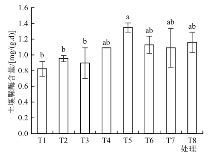
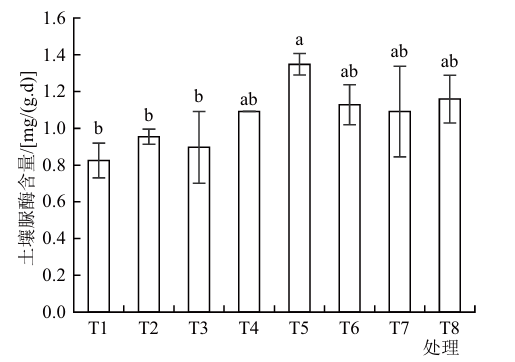
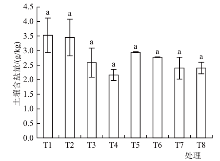
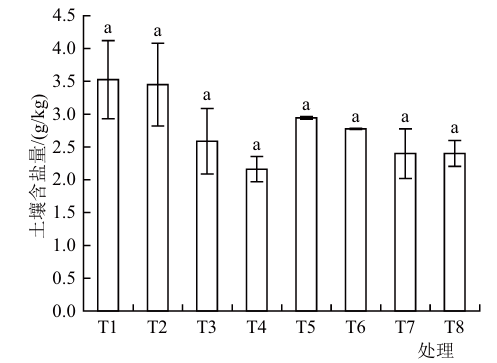
| [1] |
程同顺, 赫永超. 设施农业要注重发挥综合效益-以天津为例[J]. 辽宁农业科学, 2016(3):22-25.
|
| [2] |
葛桂利, 李爽, 左伟立, 等. 生物焖棚对盐渍化设施土壤理化性质与微生物群落结构的影响[J]. 中国农业大学学报, 2025(2):95-104.
|
| [3] |
黄梓翀. 不同土壤调理剂对次生盐渍化菜地蔬菜生长与氮磷淋溶阻控的研究[D]. 北京: 中国地质大学, 2022.
|
| [4] |
夏渝静. 减氮与微生物菌剂结合对设施土壤氮素吸收与形态转化影响研究[D]. 天津: 天津农学院, 2023.
|
| [5] |
刘兆普, 王兴起, 陈铭达. 盐胁迫对作物养分吸收与利用的影响及调控措施[J]. 土壤学报, 2010, 47(3):590-596.
|
| [6] |
宋海妹, 李振松, 张超一, 等. 不同生物刺激素在叶菜类蔬菜上的应用效果[J]. 精细与专用化学品, 2015(2):22-25.
|
| [7] |
doi: 10.3389/fpls.2017.01951 URL |
| [8] |
谢一夫, 许秋瑾, 夏青. 生物刺激素研究进展及其对解决中国农业面源污染问题的启示[J]. 环境科学研究, 2025(4):831-83.
|
| [9] |
王小静, 李淑婷, 王海旭, 等. 生物刺激素在蔬菜生产上的应用[J]. 现代园艺, 2026, 49(11):102-105.
|
| [10] |
王学奎, 黄见良. 植物生理生化实验原理和技术[M].第三版. 北京: 高等教育出版社, 2015.
|
| [11] |
郑飞雪, 魏民, 牟同水. NaCl胁迫对羽衣甘蓝生理生化指标的影响[J]. 北方园艺, 2010(17):42-44.
|
| [12] |
孟远夺, 赵英杰, 吴优, 等. 加强生物刺激素行业管理的借鉴与思考[J]. 中国农技推广, 2025, 41(4):1-5.
|
| [13] |
doi: 10.1007/s11104-014-2131-8 URL |
| [14] |
陈俊杰, 李艳梅, 杨俊刚, 等. 叶施生物刺激剂与减量灌溉对芹菜生长、产量及灌溉水利用效率的影响[J]. 节水灌溉, 2024(10):1-7.
doi: 10.12396/jsgg.2024141 |
| [15] |
高倩, 冯棣, 刘杰, 等. 外源物缓解植物盐分胁迫的作用机理及其分类[J]. 植物营养与肥料学报, 2021, 27(11):2030-2044.
|
| [16] |
毛培. 紫花苜蓿WRKY基因家族鉴定及MsWRKY100基因耐旱功能研究[D]. 兰州: 兰州大学, 2022.
|
| [17] |
谢远杰. STGC3基因低表达对NP69细胞的影响及机制研究[D]. 衡阳: 南华大学, 2015.
|
| [18] |
|
| [19] |
赵飞燕, 严文辉, 李明江, 等. 生物刺激素促进植物磷吸收的研究进展及其磷肥增效途径[J]. 江苏农业科学, 2025(53):10-22.
|
| [20] |
doi: 10.1007/s42729-023-01503-0 |
| [21] |
林家欣, 陆苑莹, 伏广农, 等. 不同生物刺激素对水培上海青产量及品质的影响[J]. 农业工程技术, 2023(6):11-15.
|
| [22] |
|
| [23] |
doi: 10.1007/s00344-020-10064-w |
| [24] |
高贤彪, 肖辉. 天津滨海盐渍土壤发展设施农业可行性分析[J]. 天津农业科学, 2020, 26(1):1-4.
|
| [25] |
艾京, 郭俊. 生物刺激素在辣椒生长促进中的应用效果评估[J]. 河北农业, 2025(4):95-96.
|
| [26] |
郭刘涛, 刘丙霞, 王仕琴, 等. 有机肥和生物炭基肥对微咸水灌溉盐渍农田土壤氮素和作物产量的影响[J]. 中国生态农业学报(中英文), 2026(1):1-13.
|
| [27] |
王晓丽, 南运有, 李越, 等. 减氮及施用生物炭对间作玉米光合特性及产量的影响[J]. 干旱地区农业研究, 2026(44):104-115.
|
| [28] |
陈林, 阿米娜·胡吉, 孙阳阳. 土壤盐渍化现状和快速检测方法研究[J]. 新疆有色金属, 2024(3):90-91.
|
| [29] |
周天阳. 不同肥水管理措施对水稻产量、氮素利用和土壤特性的影响[D]. 扬州: 扬州大学, 2025.
|
| [1] | SHANG Xiaolan, LI Dan, FANG Wenying, XU Zhu, WANG Qiang, CHEN Zhaoming. Effect of Machine-Transplanting Synchronized with Side-deep Fertilization on Rice Yield, Nitrogen Fertilizer Utilization and Soil Nitrogen Content [J]. Chinese Agricultural Science Bulletin, 2026, 42(7): 1-7. |
| [2] | QU Yuankai, PAN Dongyun, CHEN Hongjiang, SUN Hongzhu, LI Mingtan, XIE Jiali, SUN Liwei, CUI Xiutao. Application of Seaweed Extracts in Agriculture Production and Their Impact on Crop Stress Resistance [J]. Chinese Agricultural Science Bulletin, 2026, 42(14): 203-209. |
| [3] | ZHAO Xi, SU Cuicui, XIE Zhongqing. Effects of Nitrogen Reduction Combined with Biostimulants on Nitrogen Absorption and Glycoside Content in Stevia Rebaudiana [J]. Chinese Agricultural Science Bulletin, 2025, 41(11): 107-116. |
| [4] | SONG Ge, XU Zhiqiang, SUN Jingsi, ZHAO Xuening. Spectral and Thermogravimetric Analysis of Soil Humic Substances Under Different Cultivation Conditions [J]. Chinese Agricultural Science Bulletin, 2024, 40(27): 60-68. |
| [5] | MENG Yan, YANG Haiyan, ZHANG Fei, LEI Xiaoying, ZHAO Yinping, SUN Liping, LIU Tao, ZHAO Zengshou. Effects of Water and Nitrogen Coupling on Spring Tomato Growth and Soil Nitrate Nitrogen Accumulation in Greenhouse of Northern Weihe River Basin [J]. Chinese Agricultural Science Bulletin, 2024, 40(22): 103-109. |
| [6] | KAN Jianluan, SHI Lv, HAN Xiao, ZHOU Zhihong, SU Jianping, LIU Jian, XUE Yaguang. Effects of Nitrogen Reduction and Side Deep Application of Controlled-release Blend Fertilizer on Grain Yield, Quality and Nitrogen Absorption and Utilization of Japonica Rice ‘Nanjing 5055’ [J]. Chinese Agricultural Science Bulletin, 2024, 40(2): 91-96. |
| [7] | ZHANG Yang, XIA Bing, CAI Qi, XIE Huiya, CHEN Shunyao, HE Wei, HUANG Qionghui, WANG Xinyue, QUAN Keying, DENG Xiaohua. Effects of Nitrogen-reduction and Microbial Agents on Dry Matter, Nitrogen, Phosphorus and Potassium Accumulation of Tobacco [J]. Chinese Agricultural Science Bulletin, 2024, 40(16): 26-35. |
| [8] | LI Xia, LIU Chuanxin, XU Bin, DONG Rongshu, HUAN Hengfu, HUANG Chunqiong, YAN Linling, WANG Wenqiang, YANG Hubiao, YU Daogeng, WANG Zhiyong, LIU Yiming. Plant Salt-exclusion Mechanism: A Review [J]. Chinese Agricultural Science Bulletin, 2023, 39(27): 86-94. |
| [9] | Huang Keming, Tong Haotian, Han Yanlai, Li Peipei. Straw Returning and Nitrogen Reduction: Effects on Physicochemical Properties of Mortar Black Soil and Wheat Yield [J]. Chinese Agricultural Science Bulletin, 2020, 36(8): 21-26. |
| Viewed | ||||||
|
Full text |
|
|||||
|
Abstract |
|
|||||
