Welcome to Chinese Agricultural Science Bulletin,

Chinese Agricultural Science Bulletin ›› 2026, Vol. 42 ›› Issue (8): 95-103.doi: 10.11924/j.issn.1000-6850.casb2026-0093
Previous Articles Next Articles
LU Ping1( ), CHEN Yujia1, WANG Zhanfu2, ZHANG Yiming1, JIANG Hangfeng1, WANG Chaofan1, ZHANG Rong1(), QIU Hanying3()
Received:2026-01-28
Revised:2026-03-04
Online:2026-04-25
Published:2026-04-23
CLC Number:
LU Ping, CHEN Yujia, WANG Zhanfu, ZHANG Yiming, JIANG Hangfeng, WANG Chaofan, ZHANG Rong, QIU Hanying. Effects of One-time Basal Application of a Newly Formulated Controlled-release Blended Urea on Traits, Yield and Nitrogen Utilization of Rice (Oryza sativa L. 'Nanjing 46')[J]. Chinese Agricultural Science Bulletin, 2026, 42(8): 95-103.
Add to citation manager EndNote|Ris|BibTeX
URL: https://www.casb.org.cn/EN/10.11924/j.issn.1000-6850.casb2026-0093
| 处理 | 基肥 | 返青肥 | 分蘖 肥1 | 分蘖 肥2 | 穗肥 | 总施氮量(N) | 总施磷量(P2O5) | 总施钾量(K2O) | |||
|---|---|---|---|---|---|---|---|---|---|---|---|
| 控释掺混尿素(N) | 尿素(N) | 过磷酸钙(P2O5) | 氯化钾(K2O) | 尿素(N) | 复合肥(N-P2O5-K2O) | ||||||
| T1 | 267 | 22.5 | 22.5 | 22.5-22.5-22.5 | 289.5 | 45 | 45 | ||||
| T2 | 60 | 22.5 | 22.5 | 69 | 69 | 69 | 22.5-22.5-22.5 | 289.5 | 45 | 45 | |
| T3 | 45 | 45 | 45 | 45 | |||||||
| 处理 | 基肥 | 返青肥 | 分蘖 肥1 | 分蘖 肥2 | 穗肥 | 总施氮量(N) | 总施磷量(P2O5) | 总施钾量(K2O) | |||
|---|---|---|---|---|---|---|---|---|---|---|---|
| 控释掺混尿素(N) | 尿素(N) | 过磷酸钙(P2O5) | 氯化钾(K2O) | 尿素(N) | 复合肥(N-P2O5-K2O) | ||||||
| T1 | 267 | 22.5 | 22.5 | 22.5-22.5-22.5 | 289.5 | 45 | 45 | ||||
| T2 | 60 | 22.5 | 22.5 | 69 | 69 | 69 | 22.5-22.5-22.5 | 289.5 | 45 | 45 | |
| T3 | 45 | 45 | 45 | 45 | |||||||
| 处理 | 播种期 | 移栽期 | 孕穗期 | 抽穗期 | 齐穗期 | 成熟期 | 全生育期/d |
|---|---|---|---|---|---|---|---|
| T1 | 5月19日 | 6月9日 | 8月8日 | 9月9日 | 9月14日 | 10月24日 | 158 |
| T2 | 5月19日 | 6月9日 | 8月4日 | 9月5日 | 9月10日 | 10月21日 | 155 |
| T3 | 5月19日 | 6月9日 | 8月1日 | 9月2日 | 9月7日 | 10月18日 | 152 |
| 处理 | 播种期 | 移栽期 | 孕穗期 | 抽穗期 | 齐穗期 | 成熟期 | 全生育期/d |
|---|---|---|---|---|---|---|---|
| T1 | 5月19日 | 6月9日 | 8月8日 | 9月9日 | 9月14日 | 10月24日 | 158 |
| T2 | 5月19日 | 6月9日 | 8月4日 | 9月5日 | 9月10日 | 10月21日 | 155 |
| T3 | 5月19日 | 6月9日 | 8月1日 | 9月2日 | 9月7日 | 10月18日 | 152 |
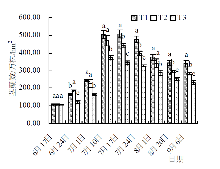
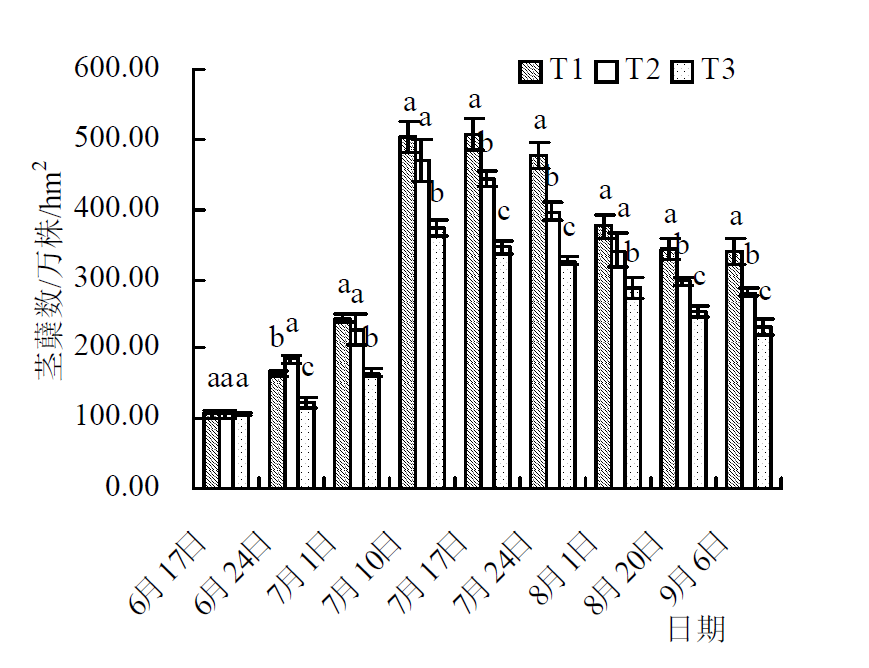
| 处理 | 分蘖盛期茎蘖数/(万株/hm2) | 抽穗期茎蘖数/(万株/hm2) | 成熟期有效穗数/(万株/hm2) | 茎蘖成穗率/% |
|---|---|---|---|---|
| T1 | 507.00±21.79 a | 339.17±19.11 a | 308.90±6.13 a | 60.97±1.64 a |
| T2 | 468.50±29.33 a | 281.10±6.62 b | 278.36±17.76 b | 59.43±1.73 a |
| T3 | 372.00±11.91 b | 231.00±12.28 c | 222.95±5.12 c | 59.94±0.59 a |
| 处理 | 分蘖盛期茎蘖数/(万株/hm2) | 抽穗期茎蘖数/(万株/hm2) | 成熟期有效穗数/(万株/hm2) | 茎蘖成穗率/% |
|---|---|---|---|---|
| T1 | 507.00±21.79 a | 339.17±19.11 a | 308.90±6.13 a | 60.97±1.64 a |
| T2 | 468.50±29.33 a | 281.10±6.62 b | 278.36±17.76 b | 59.43±1.73 a |
| T3 | 372.00±11.91 b | 231.00±12.28 c | 222.95±5.12 c | 59.94±0.59 a |
| 处理 | 叶片SPAD值(开花期) | 叶片SPAD值(乳熟期) | |||||
|---|---|---|---|---|---|---|---|
| 剑叶 | 倒一叶 | 倒二叶 | 剑叶 | 倒一叶 | 倒二叶 | ||
| T1 | 39.00±0.70 a | 39.37±1.00 a | 38.53±1.42 a | 40.53±2.63 a | 37.17±5.05 a | 40.13±4.56 a | |
| T2 | 37.67±0.95 b | 37.80±0.96 a | 37.40±1.23 ab | 34.97±4.05 b | 35.83±4.60ab | 32.60±2.65 ab | |
| T3 | 33.80±1.14 c | 33.43±0.70 b | 33.37±2.29 b | 28.13±1.30 c | 27.47±1.18 b | 27.20±1.01 b | |
| 处理 | 叶片SPAD值(开花期) | 叶片SPAD值(乳熟期) | |||||
|---|---|---|---|---|---|---|---|
| 剑叶 | 倒一叶 | 倒二叶 | 剑叶 | 倒一叶 | 倒二叶 | ||
| T1 | 39.00±0.70 a | 39.37±1.00 a | 38.53±1.42 a | 40.53±2.63 a | 37.17±5.05 a | 40.13±4.56 a | |
| T2 | 37.67±0.95 b | 37.80±0.96 a | 37.40±1.23 ab | 34.97±4.05 b | 35.83±4.60ab | 32.60±2.65 ab | |
| T3 | 33.80±1.14 c | 33.43±0.70 b | 33.37±2.29 b | 28.13±1.30 c | 27.47±1.18 b | 27.20±1.01 b | |
| 处理 | 有效穗数/(万穗/hm2) | 实粒数/(粒/穗) | 千粒重/g | 结实率/% | 产量/(t/hm2) |
|---|---|---|---|---|---|
| T1 | 308.90±6.13 a | 118.60±2.04 a | 25.92±0.68 ab | 86.09±1.92 a | 8.67±0.13 a |
| T2 | 278.36±17.76 b | 117.97±1.87 a | 25.72±0.31 b | 85.19±2.57 a | 8.45±0.10 b |
| T3 | 222.95±5.12 c | 91.37±3.61 b | 26.79±0.26 a | 87.81±1.88 a | 3.03±0.06 c |
| 处理 | 有效穗数/(万穗/hm2) | 实粒数/(粒/穗) | 千粒重/g | 结实率/% | 产量/(t/hm2) |
|---|---|---|---|---|---|
| T1 | 308.90±6.13 a | 118.60±2.04 a | 25.92±0.68 ab | 86.09±1.92 a | 8.67±0.13 a |
| T2 | 278.36±17.76 b | 117.97±1.87 a | 25.72±0.31 b | 85.19±2.57 a | 8.45±0.10 b |
| T3 | 222.95±5.12 c | 91.37±3.61 b | 26.79±0.26 a | 87.81±1.88 a | 3.03±0.06 c |
| 处理 | 籽粒氮素 积累量/(kg/hm2) | 茎秆氮素 积累量/(kg/hm2) | 地上部氮素 积累量/(kg/hm2) | 氮肥 利用率/% | 氮肥对产量 贡献率/% | 氮肥 农学效率/(kg/kg) | 氮肥 偏生产力/(kg/kg) |
|---|---|---|---|---|---|---|---|
| T1 | 114.41±1.70 a | 55.51±0.83 a | 169.92±2.53 a | 42.72±0.78 a | 64.99±0.64 a | 19.46±0.39 a | 29.94±0.45 a |
| T2 | 87.03±1.06 b | 55.33±0.67 a | 142.36±1.73 b | 33.19±0.65 b | 64.09±0.79 a | 18.71±0.39 b | 29.19±0.36 b |
| T3 | 32.47±3.95 c | 13.80±0.27 b | 46.26±0.90 c | - | - | - | - |
| 处理 | 籽粒氮素 积累量/(kg/hm2) | 茎秆氮素 积累量/(kg/hm2) | 地上部氮素 积累量/(kg/hm2) | 氮肥 利用率/% | 氮肥对产量 贡献率/% | 氮肥 农学效率/(kg/kg) | 氮肥 偏生产力/(kg/kg) |
|---|---|---|---|---|---|---|---|
| T1 | 114.41±1.70 a | 55.51±0.83 a | 169.92±2.53 a | 42.72±0.78 a | 64.99±0.64 a | 19.46±0.39 a | 29.94±0.45 a |
| T2 | 87.03±1.06 b | 55.33±0.67 a | 142.36±1.73 b | 33.19±0.65 b | 64.09±0.79 a | 18.71±0.39 b | 29.19±0.36 b |
| T3 | 32.47±3.95 c | 13.80±0.27 b | 46.26±0.90 c | - | - | - | - |
| 处理 | 产量/(t/hm2) | 总产值/(元/hm2) | 肥料成本/(元/hm2) | 施肥人工/(元/hm2) | 净效益/(元/hm2) |
|---|---|---|---|---|---|
| T1 | 8.67 | 23748.81 | 3007.50 | 750 | 19991.32 |
| T2 | 8.45 | 23151.22 | 2469.00 | 1875 | 18807.22 |
| T3 | 3.03 | 8335.90 | 675.00 | 375 | 7263.71 |
| 处理 | 产量/(t/hm2) | 总产值/(元/hm2) | 肥料成本/(元/hm2) | 施肥人工/(元/hm2) | 净效益/(元/hm2) |
|---|---|---|---|---|---|
| T1 | 8.67 | 23748.81 | 3007.50 | 750 | 19991.32 |
| T2 | 8.45 | 23151.22 | 2469.00 | 1875 | 18807.22 |
| T3 | 3.03 | 8335.90 | 675.00 | 375 | 7263.71 |
| [1] |
朱兆良, 金继运. 保障我国粮食安全的肥料问题[J]. 植物营养与肥料学报, 2013, 19(2):259-273.
|
| [2] |
陆萍, 张秋兴. 上海市嘉定区耕地地力与研究实践[M]. 上海: 上海科学技术出版社, 2019.
|
| [3] |
赵秉强. 传统化肥增效改性提升产品性能与功能[J]. 植物营养与肥料学报, 2016, 22(1):1-7.
|
| [4] |
于飞, 施卫明. 近10年中国大陆主要粮食作物氮肥利用率分析[J]. 土壤学报, 2015, 52(6):1311-1324.
|
| [5] |
吕慧丹, 王西亚, 潘昭隆, 等. 控释尿素的作物增产效应及其关键影响因子评价[J]. 中国土壤与肥料, 2024(6):70-78.
|
| [6] |
潘晨, 杨宇, 漆栋良, 等. 不同灌溉条件下氮肥配施模式对水稻干物质和产量的影响[J]. 灌溉排水学报, 2023, 42(2):73-78.
|
| [7] |
申朝阳, 高林广, 周浩露, 等. 普通尿素与控释尿素配施对谷子产量及氮素利用的影响[J]. 干旱地区农业研究, 2024, 42(5):63-70.
|
| [8] |
王翔云, 咸云宇, 赵灿, 等. 缓控释氮肥施用技术在水稻上应用研究进展与展望[J]. 中国稻米, 2023, 29(4):20-26.
|
| [9] |
樊小林, 刘芳, 廖照源, 等. 我国控释肥料研究的现状和展望[J]. 植物营养与肥料学报. 2009, 15(2):463-473.
|
| [10] |
王宝档, 王朝贤, 董作为, 等. 缓释氮肥与尿素配施对早稻产量和氮肥效率的影响[J]. 浙江农业科学, 2022, 63(2):265-267.
doi: 10.16178/j.issn.0528-9017.20212535 |
| [11] |
辛志远, 王昌全, 申亚珍, 等. 水基包衣控释掺混肥料一次性施用对单季稻氮素利用的影响[J]. 农业环境科学学报, 2016, 35(1):109-114.
|
| [12] |
doi: 10.1007/s11356-022-20890-y |
| [13] |
张木, 唐拴虎, 黄旭, 等. 一次性施肥对水稻产量基养分吸收的影响[J]. 中国农学通报, 2016, 32(3):1-7.
doi: 10.11924/j.issn.1000-6850.casb15080078 |
| [14] |
黄恒, 姜恒鑫, 刘光明, 等. 侧深施氮对水稻产量及氮素吸收利用的影响[J]. 作物学报, 2021, 47(11):2232-2249.
doi: 10.3724/SP.J.1006.2021.02086 |
| [15] |
蒋伟勤, 马中涛, 胡群, 等. 缓控释氮肥对水稻生长发育及氮素利用的影响[J]. 江苏农业学报, 2020, 36(3):777-784.
|
| [16] |
杨建昌, 张建华. 水稻高产节水灌溉[M]. 北京: 科学出版社, 2019.
|
| [17] |
易琼, 吴腾飞, 曾招兵, 等. 控释尿素配比对华南双季稻产量、氮素吸收累积及氮肥利用率的影响[J]. 南方农业学报, 2024, 55(5):1307-1316.
|
| [18] |
doi: 10.1016/j.fcr.2018.11.013 URL |
| [19] |
doi: 10.1016/j.jia.2023.10.007 URL |
| [20] |
国家统计局. 2022中国统计年鉴[M]. 北京: 中国统计出版社, 2023.
|
| [21] |
闫聪硕, 杨莉莉, 周奇, 等. 我国水稻不同产区施氮量与产量分析比较[J]. 农业科技与装备, 2023(1):17-19.
|
| [22] |
刘兆辉, 吴小宾, 谭德水, 等. 一次性施肥在我国主要粮食作物中的应用与环境效应[J]. 中国农业科学, 2018, 51(20):3827-3839.
doi: 10.3864/j.issn.0578-1752.2018.20.002 |
| [23] |
杨红竹, 黄艳艳, 刘海林, 等. 控释掺混肥料一次性基施对热带地区水稻产量及氮肥利用效率的影响[J]. 福建农业学报, 2024, 39(7):766-774.
|
| [24] |
韩锐锋, 牛堉锡, 王鑫悦, 等. 控释尿素和普通尿素混合基施对冬小麦氮素吸收利用和产量的影响[J]. 植物营养与肥料学报, 2023, 29(11):2024-2058.
|
| [25] |
袁嫚嫚, 叶舒娅, 李枫, 等. 树脂包膜尿素对水稻产量和氮肥利用率的影响[J]. 中国农业气象, 2011, 32(增刊1):83-87.
|
| [26] |
张敬昇, 李冰, 王昌全, 等. 控释掺混尿素对稻麦产量及氮素利用率的影响[J]. 中国水稻科学, 2017, 31(3)288-298.
doi: 10.16819/j.1001-7216.2017.6143 288 |
| [27] |
张金萍, 陈照明, 王强, 等. 缓释肥占基肥比例对单季晚稻分蘖和氮素吸收利用的影响[J]. 浙江农业学报, 2022, 34(10):2259-2267.
doi: 10.3969/j.issn.1004-1524.2022.10.20 |
| [28] |
王强, 姜丽娜, 潘建清, 等. 缓释氮肥一次性施肥对单季稻氮素吸收和产量的影响[J]. 中国农业科学, 2018, 51(20):3951-3960.
doi: 10.3864/j.issn.0578-1752.2018.20.013 |
| [29] |
汪洋. 氮素营养对水稻分蘖的产量异质性影响及调控[D]. 武汉: 华中农业大学, 2017.
|
| [30] |
田昌, 靳拓, 周旋, 等. 控释尿素对环洞庭湖区双季稻吸氮特征和产量的影响[J]. 作物学报, 2021, 47(4):691-700.
doi: 10.3724/SP.J.1006.2021.02038 |
| [31] |
胡丹丹, 范呈根, 洪欠欠, 等. 等养分条件下缓/控释肥料替代部分速效化肥对中稻生产效益的影响[J]. 中国稻米, 2018, 24(1):16-19.
doi: 10.3969/j.issn.1006-8082.2018.01.004 |
| [1] | ZHANG Jie, SHAO Wenqi, Ma Hongbo, CHEN Chuan, ZHANG Ankang, LI Chuanzhe. Effect of Slow-release Nitrogen Fertilizer on Rice Yield and Fertilizer Utilization Efficiency in Jiangsu Province [J]. Chinese Agricultural Science Bulletin, 2026, 42(8): 104-109. |
| [2] | YU Linchuang, CHEN Qingming, LU Yun, SHEN Guanwang, QI Yuliang, FU Ding, YU Xinchun, CHANG Xingyuan, SHEN Guanghui. Preliminary Molecular Characterization and Allelic Profiling of Blast Resistance Genes in 93 Core Parental Lines of Oryza sativa L [J]. Chinese Agricultural Science Bulletin, 2026, 42(8): 38-43. |
| [3] | SHANG Xiaolan, LI Dan, FANG Wenying, XU Zhu, WANG Qiang, CHEN Zhaoming. Effect of Machine-Transplanting Synchronized with Side-deep Fertilization on Rice Yield, Nitrogen Fertilizer Utilization and Soil Nitrogen Content [J]. Chinese Agricultural Science Bulletin, 2026, 42(7): 1-7. |
| [4] | WEN Jianchuan, LAI Zhengrong, WU Lyu, RUAN Lingli, WU Biliang, LIANG Ping. Meteorological Forecast of Rice Blast Risk Level in Qiandongnan Prefecture [J]. Chinese Agricultural Science Bulletin, 2026, 42(7): 171-175. |
| [5] | YE Pei, FENG Dehao, YANG Jun, LIU Kaiwen, CHEN Sicheng. Study on Vulnerability and Meteorological Disaster Thresholds of High-Temperature and Drought Combined Stress During Heading and Flowering Stage of Mid-season Rice [J]. Chinese Agricultural Science Bulletin, 2026, 42(6): 120-126. |
| [6] | ZHANG Qiming, GUO Shuilian, OUYANG Dongmei. Variation Analysis of Climate Condition for Double-cropping Rice in Yichun Based on GIS [J]. Chinese Agricultural Science Bulletin, 2026, 42(3): 133-143. |
| [7] | HUANG Wei, PAN Huixiao, WU Xuanke, HE Yan, TAN Mengxiang, LIU Yongyu. Analysis of Risk Zoning and Meteorological Factors of Double Cropping Rice Yield Disaster in Guangxi [J]. Chinese Agricultural Science Bulletin, 2026, 42(3): 144-154. |
| [8] | XU Junhui, CHEN Lini, HUANG Fang, LIAN Cong, MO Bocheng. Effects of Two Foliar Inhibitors on Absorption and Accumulation of Cd in Rice and Related Health Risk Assessment [J]. Chinese Agricultural Science Bulletin, 2026, 42(2): 113-119. |
| [9] | WANG Jingwen, YUAN Hangjie, LOU Ling, ZHANG Xiumei, YANG Wenye, WANG Zhong. Influence of Different Fallowing Methods on Soil Quality of Degraded Vegetable Fields [J]. Chinese Agricultural Science Bulletin, 2026, 42(2): 146-152. |
| [10] | LAN Bo, CHEN Ming, ZHOU Qina, LI Yunpeng, LI Baojia, DENG Xing, SUN Qinghua, YANG Ziyu, DUAN Lingtao, YIN Changfa, SHAO Jianyang, TU Xueqin, YANG Yingqing, ZHAO Zhizhen. Research Progress on Comprehensive Prevention and Control Techniques of Rice Bakanae Disease [J]. Chinese Agricultural Science Bulletin, 2026, 42(1): 176-183. |
| [11] | WANG Kexiu, TANG Mingxia, CHENG Mingjun, HU Jianjun, LI Bing, LIAO Feifei, LI Huapeng, YANG Wenting, GUO Zhan, CUI Kuoshu. Effects of Nitrogen Application Rate and Nitrogen Fertilizer Type on Growth and Development of Potato and Nitrogen Utilization [J]. Chinese Agricultural Science Bulletin, 2026, 42(1): 1-11. |
| [12] | LI Yangyang, CHEN Shuaimin, XU Minghong, CHI Chang, MA Wei, WANG Yinping, SONG Yan, FAN Zuowei, WU Haiyan. Effects of Microbial Product Coupling Urea on Straw Decomposition Rate and Yield of Rice [J]. Chinese Agricultural Science Bulletin, 2025, 41(9): 18-24. |
| [13] | CHEN Pengjun, ZHANG Jiao, HAN Jijun, MIAO Yuanqing, CUI Shiyou. Effects of Different Exogenous Silicon Fertilizers Application on Yield, Dry Matter and Nutrient Accumulation and Transport of Rice in Tidal Flat [J]. Chinese Agricultural Science Bulletin, 2025, 41(9): 8-17. |
| [14] | WANG Feng, ZHU Shijun, YING Hong, CHAI Weigang, DAI Yaolu, YUAN Qing, JIN Shuquan. Effect of Organic Amendment Combined with Moderate Deep Ploughing on Productivity Improvement of Hilly Reclaimed Rice Field [J]. Chinese Agricultural Science Bulletin, 2025, 41(9): 91-98. |
| [15] | DONG Linlin, YAN Kai, SHENG Xuewen, LU Changying, SHI Linlin, WANG Haihou, WU Zhenggui. Spectral Characteristics of Soil Water-soluble Organic Carbon Affected by Cultivation Methods During Rice Growth Period [J]. Chinese Agricultural Science Bulletin, 2025, 41(9): 99-106. |
| Viewed | ||||||
|
Full text |
|
|||||
|
Abstract |
|
|||||
