欢迎访问《中国农学通报》,

中国农学通报 ›› 2026, Vol. 42 ›› Issue (8): 211-218.doi: 10.11924/j.issn.1000-6850.casb2025-0636

• 水产/渔业 • 上一篇    

春季冷空气对小龙虾投苗成活率的影响及预测模型构建

黄永平1(), 杨青青1(), 邓艳君2, 叶佩1   

  1. 1 湖北省荆州农业气象试验站, 湖北荆州 434025
    2 湖北省荆州市气象局, 湖北荆州 434020
  • 收稿日期:2025-07-25 修回日期:2025-12-24 出版日期:2026-04-25 发布日期:2026-04-23
  • 通讯作者:
    杨青青,女,1991年出生,湖北荆州人,工程师,硕士,主要从事作物高产高效栽培方面的研究。通信地址:434025 湖北省荆州市九阳大道20号 气象局湖北省荆州农业气象试验站,Tel:0716-8080863,E-mail:
  • 作者简介:

    黄永平,男,1969年出生,湖北仙桃人,高级工程师,本科,主要从事生态与农业气象方向的研究。通信地址:434025 湖北省荆州市九阳大道20号 气象局湖北省荆州农业气象试验站,Tel:0716-8080863,E-mail:

  • 基金资助:
    湖北省气象局重点基金项目“湖北省主要水产品气象灾害预警预报关键技术研究”(2022Z03)

Effects of Spring Cold Air on Seedling Stocking Survival Rate of Crayfish and Prediction Model Construction

HUANG Yongping1(), YANG Qingqing1(), DENG Yanjun2, YE Pei1   

  1. 1 Jingzhou Agricultural Meteorological Experiment Station, Jingzhou, Hubei 434025
    2 Jingzhou Meteorological Bureau, Jingzhou, Hubei 434020
  • Received:2025-07-25 Revised:2025-12-24 Published:2026-04-25 Online:2026-04-23

摘要:

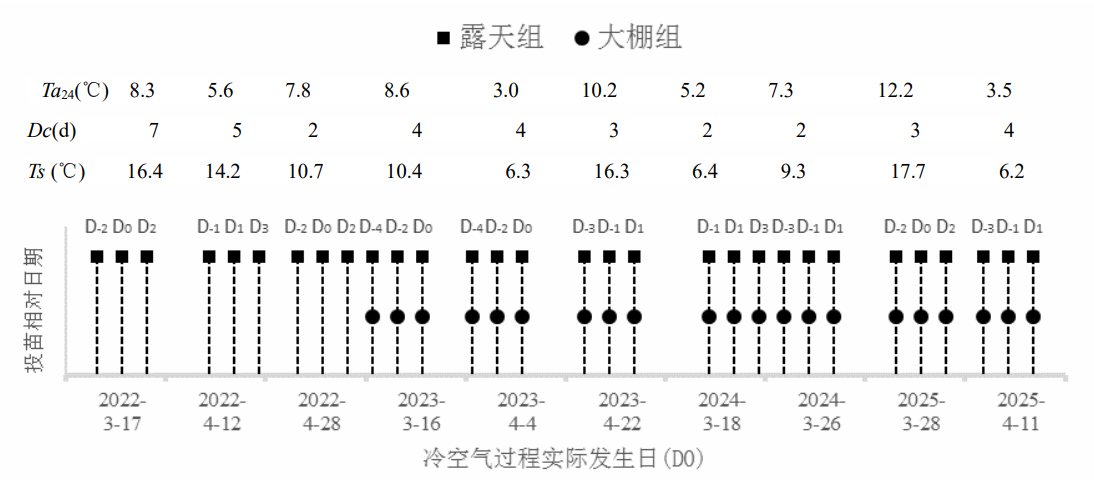
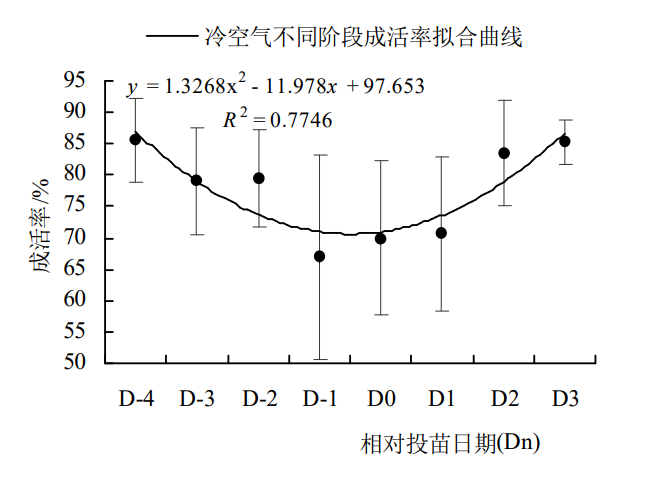
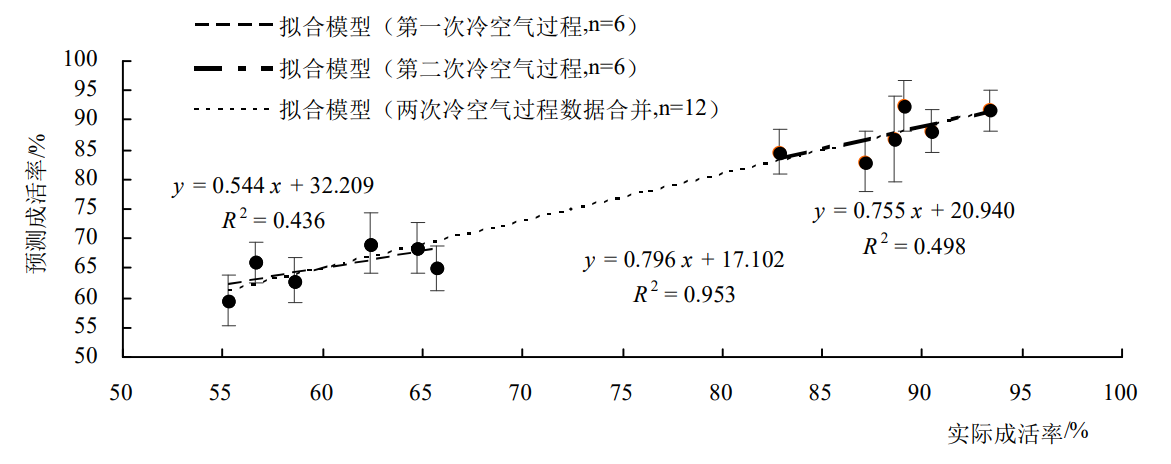
针对长江中下游稻虾共作区春季冷空气对小龙虾投苗成活率的显著威胁,本研究旨在探究冷空气不同阶段的影响模式,识别关键致灾因子,并构建高精度预测模型。基于2022—2024年荆州地区3—4月间的8次冷空气过程,开展了39组分期投苗控制试验(大棚组与露天组),系统分析了春季冷空气在不同强度、环境和阶段指标下对小龙虾投苗成活率的影响差异,筛选出关键气象灾害指标。在此基础上,利用多元回归建立了投苗15日成活率预测模型,并采用2025年的独立数据进行了模型性能验证。结果表明,(1)小龙虾成活率呈现明显的“前高—中低—后升”阶段性特征:冷空气来临前4 d(D-4)及结束后2~3 d(D2—D3)成活率最高(83.6%~85.6%),而在剧烈降温期(D-1—D1),成活率显著下降66.9%~70.8%(P<0.05)。(2)24 h最大水温降幅(ΔTw24)是核心胁迫因子,与成活率呈极显著负相关(R=-0.752, P<0.01),ΔTw24>7℃构成急性冷害的临界值(成活率57.5%)。(3)投苗后1~2 d水温波动(Vw)的负向影响(R= -0.639, P<0.01)是平均水温正面影响的2.6倍,表明温度稳定性相较于绝对温度值更为重要。(4)构建的集成预测模型(Ŷ=91.536-3.959X1+4.284 X2+1.237 X3, R2=0.858, SE=4.51%)经过独立数据集验证,合并数据后决定系数R2显著提升至0.95(MAPE=5.5%),证实多过程数据集成可显著提升模型的解释力与预测稳定性。本研究系统揭示了春季冷空气对小龙虾投苗成活率的动态影响机制,量化了温度波动特征与成灾阈值的关系,提出了基于多阶段气象—环境耦合指标的预测模型,为精准化养殖决策提供量化工具。该研究对长江中下游稻虾共作区气候适应性养殖策略的制定,以及极端天气下水产养殖的防灾减灾具有重要的理论价值与实践指导意义。

关键词: 小龙虾, 春季低温, 气象灾害指标, 投苗, 成活率, 冷空气过程, 预测模型

Abstract:

In response to the severe threat of spring cold air to the survival rate of crayfish seedlings in rice-crayfish co-culture areas of the middle and lower reaches of the Yangtze River, this study aims to investigate the impact patterns across different stages of cold air, identify core disaster-inducing factors, and construct a prediction model. Based on 39 controlled trials of staged seedling stocking (greenhouse vs. open-air groups) during 8 cold air events from March to April (2022-2024) in Jingzhou, we systematically analyzed differences in crayfish survival rates under varying cold air intensities, environmental indicators, and stages. Key meteorological disaster indicators were screened, and a multiple regression model for 15-day survival rate prediction was established. Independent data from 2025 were used to validate model performance. The results indicated: (1) Survival rates exhibited a "high-low-high" stage pattern. The survival rate was the highest (83.6% -85.6%) 4 days before the arrival of cold air ( D-4 ) and 2-3 days after the end of cold air ( D2-D3 ), but significantly decreased to 66.9%-70.8% during rapid cooling period (D-1 to D1) (P<0.05). (2) Maximum 24-h water temperature drop (ΔTw24) was the core stressor, showing the strongest negative correlation with survival rate (R=-0.752, P<0.01). ΔTw24>7°C was the critical threshold for acute cold damage (survival rate 57.5%). (3) Water temperature fluctuation (Vw) within 1-2 days post-stocking had a negative impact (R=-0.639, P<0.01), 2.6 times stronger than the positive effect of average temperature, indicating stability over absolute value.(4) The integrated prediction model (Ŷ=91.536-3.959X1+4.284 X2+1.237 X3, R2=0.858, SE=4.51%) was externally validated. After merging datasets, R2 increased to 0.95 (MAPE=5.5%), confirming that multi-process data integration significantly enhances model interpretability and stability. This study systematically reveals the dynamic impact mechanism of spring cold air on the survival rate of crayfish seedling stocking, clarifies the quantitative relationship between temperature fluctuation characteristics and disaster-causing thresholds, and proposes a prediction model based on multi-stage meteorological-environmental coupling indicators. It provides a quantitative tool for precise aquaculture decision-making and has important theoretical and practical significance for formulating climate-adaptive aquaculture strategies in the rice-crayfish co-culture areas of the middle and lower reaches of the Yangtze River and for disaster prevention and mitigation in aquaculture under extreme weather.

Key words: crayfish, spring low temperature, indicators of meteorological disasters, seedling stocking, survival rate, cold air process, prediction model

中图分类号: