欢迎访问《中国农学通报》,

中国农学通报 ›› 2026, Vol. 42 ›› Issue (13): 179-188.doi: 10.11924/j.issn.1000-6850.casb2025-0682
任雨嘉1( ), 冯健2, 高大伟1, 张小亮1, 闻玮玮1(), 姜晓辉3()
收稿日期:2025-08-12
修回日期:2026-04-08
出版日期:2026-07-15
发布日期:2026-07-09
通讯作者:
作者简介:任雨嘉,女,2000年出生,山东临沂人,硕士研究生,研究方向为茶树类黄酮糖基化的遗传调控。通信地址:430070 湖北武汉洪山区狮子山1号 华中农业大学果蔬园艺作物种质创新与利用全国重点实验室,Tel:027-87282010,E-mail:ryj0201@163.com。
基金资助:
REN Yujia1(), FENG Jian2, GAO Dawei1, ZHANG Xiaoliang1, WEN Weiwei1(), JIANG Xiaohui3()
Received:2025-08-12
Revised:2026-04-08
Published:2026-07-15
Online:2026-07-09
摘要:
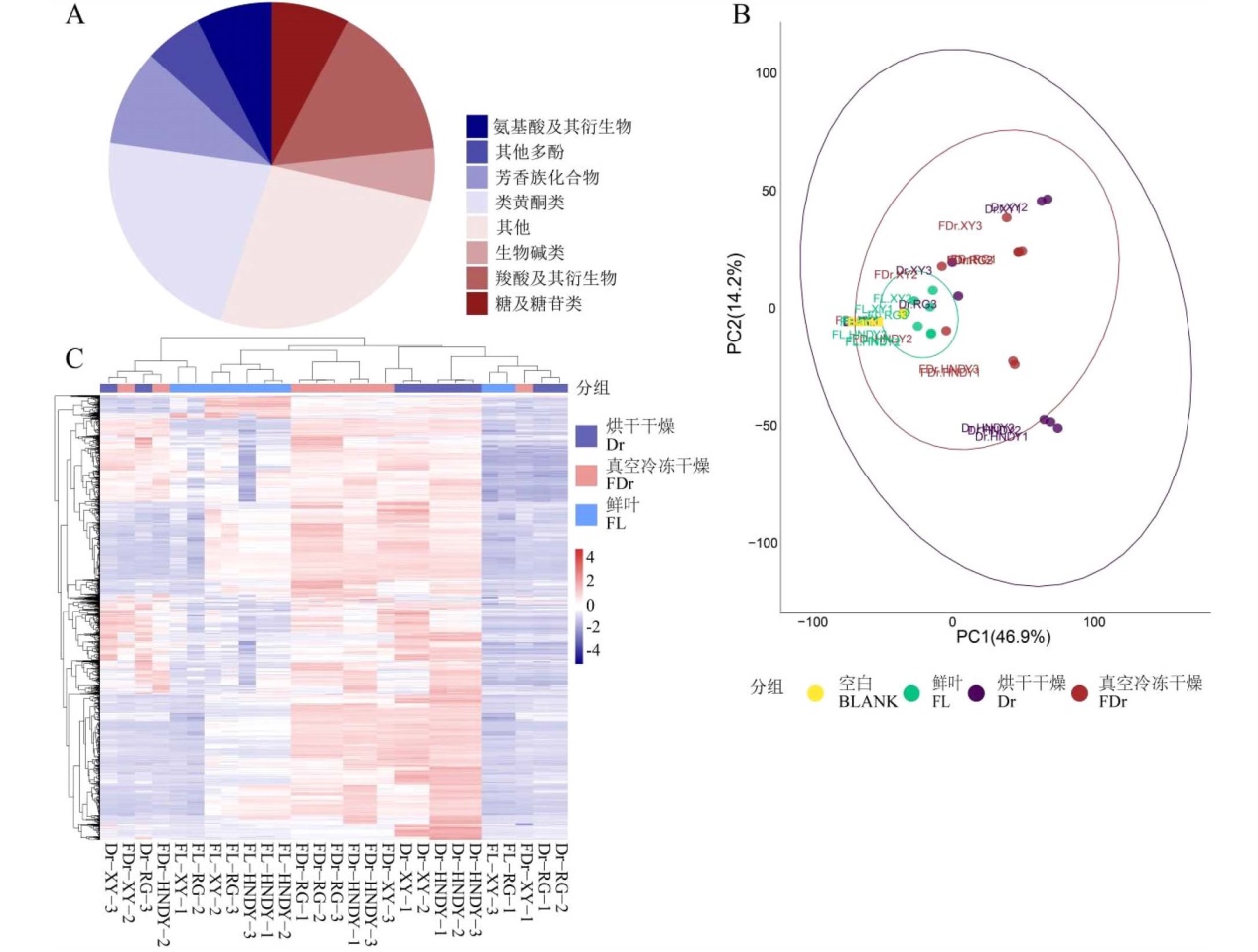
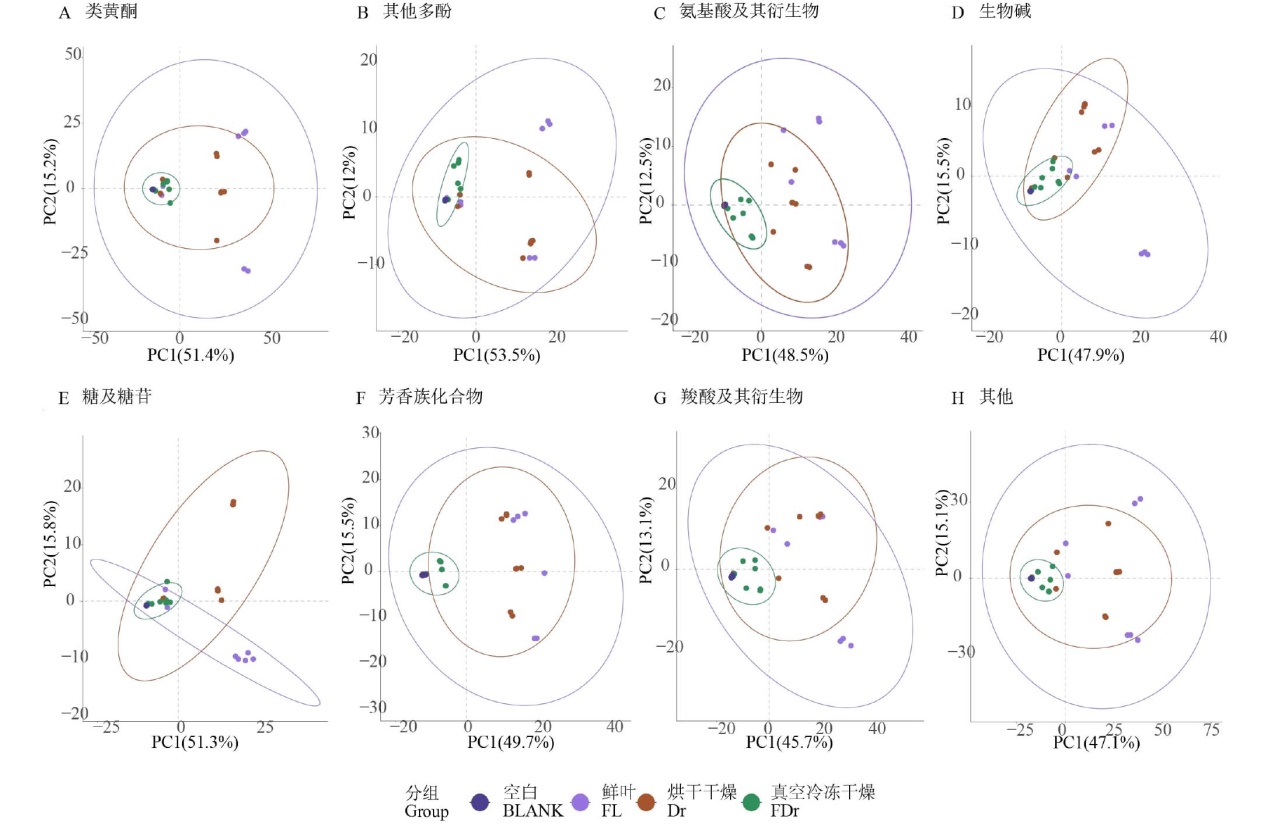
为筛选适宜茶叶非靶向代谢组学的高效干燥方法,以‘小叶1号’‘肉桂’‘海南大叶1号’3个茶树种质资源为材料,采用超高效液相色谱-质谱联用(ultra-high performance liquid chromatography-mass spectrometry,UHPLC-MS),比较真空冷冻干燥、烘干干燥对代谢物定性与定量的影响,分析不同类别代谢物与不同品种的稳定性差异。研究结果表明,在正负离子检测模式下,共检测到3327种代谢物的离子峰,分属8大类,这些代谢物主要为多酚、生物碱、氨基酸及其衍生物、羧酸及其衍生物、芳香族化合物、糖及糖苷等;不同的干燥方式对代谢物测定结果产生了显著影响。‘小叶1号’‘海南大叶1号’在真空冷冻干燥后的代谢物测定结果与鲜叶更为接近,而‘肉桂’在烘干处理后的代谢物测定结果与鲜叶更为接近;类黄酮、氨基酸及其衍生物、芳香族化合物这3类代谢物在不同干燥条件下的含量相对稳定,其他多酚、生物碱、糖及糖苷、羧酸及其衍生物受干燥方式影响显著。研究明确了茶叶代谢组学干燥方法选择依据,建议大批量样品优先选用烘干干燥,精准定量优先选用真空冷冻干燥,并根据目标代谢物与品种特性灵活选择。
中图分类号:
任雨嘉, 冯健, 高大伟, 张小亮, 闻玮玮, 姜晓辉. 干燥方式对茶叶代谢物检测效率的影响[J]. 中国农学通报, 2026, 42(13): 179-188.
REN Yujia, FENG Jian, GAO Dawei, ZHANG Xiaoliang, WEN Weiwei, JIANG Xiaohui. Effects of Drying Methods on Detection Efficiency of Tea Metabolites[J]. Chinese Agricultural Science Bulletin, 2026, 42(13): 179-188.
| [1] |
doi: 10.1021/acs.jafc.9b01356 URL |
| [2] |
|
| [3] |
符梅, 李桂花, 罗文龙, 等. 基于广泛靶向代谢组学的芋头代谢物和抗氧化酶活性的差异分析[J]. 中国农学通报, 2025, 41(6):118-125.
doi: 10.11924/j.issn.1000-6850.casb2024-0327 |
| [4] |
doi: 10.1038/s41438-021-00477-3 pmid: 33642595 |
| [5] |
doi: 10.1111/pbi.v22.4 URL |
| [6] |
doi: 10.1007/s44281-024-00030-x |
| [7] |
doi: 10.1021/acs.jafc.0c00434 pmid: 32302110 |
| [8] |
doi: S0039-9140(18)31039-7 pmid: 30609583 |
| [9] |
|
| [10] |
doi: 10.1038/s41467-020-17498-6 pmid: 32709943 |
| [11] |
马梦君, 胡新龙, 邱首哲, 等. 基于代谢组学的不同年份青砖茶主要品质成分分析[J]. 茶叶科学, 2025, 45(1):133-144.
|
| [12] |
doi: 10.1093/plphys/kiad511 URL |
| [13] |
doi: 10.1016/j.molp.2017.08.012 URL |
| [14] |
孔亚帅, 陈凌芝, 成恩, 等. 基于非靶向代谢组学的信阳毛尖茶加工过程非挥发物代谢轮廓分析[J]. 食品科学, 2024, 45(5):102-110.
|
| [15] |
岳文杰, 金心怡, 陈明杰, 等. 基于非靶向代谢组学分析白茶室内自然萎凋过程代谢物的变化规律[J]. 茶叶科学, 2021, 41(3):379-392.
|
| [16] |
doi: 10.1093/mp/sst080 pmid: 23702596 |
| [17] |
doi: 10.1016/j.molp.2021.09.003 URL |
| [18] |
doi: 10.1016/j.foodres.2022.112397 URL |
| [19] |
doi: 10.1016/j.foodchem.2014.10.092 URL |
| [20] |
doi: 10.3389/fchem.2022.981173 URL |
| [21] |
doi: S0963-9969(18)30077-2 pmid: 29580004 |
| [22] |
doi: S0963-9969(17)30040-6 pmid: 28290365 |
| [23] |
doi: 10.1016/j.canlet.2017.11.002 URL |
| [24] |
doi: S0168-9452(17)30390-4 pmid: 28969800 |
| [25] |
doi: 10.3389/fmicb.2022.992823 URL |
| [26] |
doi: 10.1016/j.foodchem.2017.04.079 URL |
| [27] |
doi: 10.1016/j.foodres.2020.109978 URL |
| [28] |
doi: 10.1016/j.foodchem.2020.127412 URL |
| [29] |
doi: 10.1016/j.fochx.2022.100270 URL |
| [30] |
doi: 10.1016/j.foodres.2019.108778 URL |
| [31] |
虞昕磊, 艾于杰, 曲凤凤, 等. 代谢组学在研究茶叶品质形成中的应用[J]. 茶叶科学, 2018, 38(1):20-32.
|
| [32] |
贾晓东, 李浩男, 郭昊岩, 等. 园艺作物代谢组学研究进展[J]. 中国农学通报, 2014, 30(25):75-83.
|
| [33] |
doi: 10.3390/molecules27041420 URL |
| [34] |
doi: 10.1038/s41598-021-02158-6 pmid: 34811431 |
| [35] |
doi: 10.1021/acs.jafc.0c07009 pmid: 33719437 |
| [36] |
施江, 王佳童, 彭群华, 等. 外源茉莉酸甲酯诱导茶树鲜叶及其采后乌龙茶加工关键工序中七种脂溶性色素变化[J]. 中国农业科学, 2021, 54(18):3984-3997.
doi: 10.3864/j.issn.0578-1752.2021.18.016 |
| [37] |
李鑫磊, 俞晓敏, 林军, 等. 基于非靶向代谢组学的白茶与绿茶、乌龙茶和红茶代谢产物特征比较[J]. 食品科学, 2020, 41(12):197-203.
doi: 10.7506/spkx1002-6630-20190128-358 |
| [38] |
doi: 10.1016/j.foodres.2020.109789 URL |
| [39] |
doi: 10.3389/fpls.2019.01397 URL |
| [40] |
doi: 10.3389/fpls.2021.746972 URL |
| [41] |
叶乃兴, 杨如兴, 杨广, 等. 真空冷冻干燥对乌龙茶香气品质的影响[J]. 茶叶科学, 2006(3):181-185.
|
| [42] |
doi: 10.3390/foods10040868 URL |
| [43] |
高静静, 冯作山. 白羽嘉. 真空冷冻和热风干燥对哈密瓜片品质的影响[J]. 保鲜与加工, 2020, 20(3):78-84.
|
| [44] |
刘飞, 王云, 李春华, 等. 茶叶干燥技术研究现状及展望[J]. 中国农学通报, 2015, 31(6):210-215.
doi: 10.11924/j.issn.1000-6850.casb14110098 |
| [45] |
doi: 10.1016/j.lwt.2022.114129 URL |
| [46] |
赵熙, 钟妮, 余鹏辉, 等. 不同干燥方式下黑毛茶风味品质的比较分析[J]. 茶叶通讯, 2022, 49(3):342-352.
|
| [47] |
doi: 10.1016/j.lwt.2018.09.036 URL |
| [48] |
doi: 10.1111/jfds.v85.10 URL |
| [49] |
doi: 10.1021/acs.jafc.3c04339 URL |
| [50] |
周晨阳, 金基强, 姚明哲, 等. 茶树等植物中嘌呤生物碱代谢研究进展[J]. 茶叶科学, 2011, 31(2):87-94.
|
| [51] |
李红建, 秦丹丹, 姜晓辉, 等. 广东苦茶资源嘌呤生物碱含量分析与评价[J]. 茶叶科学, 2021, 41(1):71-79.
|
| [52] |
doi: 10.1002/jsfa.2018.98.issue-9 URL |
| [53] |
|
| [54] |
doi: 10.1016/j.ultsonch.2020.105300 URL |
| [55] |
doi: 10.1016/j.foodchem.2022.133501 URL |
| [56] |
doi: 10.1016/j.foodchem.2020.127258 URL |
| [57] |
doi: 10.1016/j.foodchem.2018.11.148 URL |
| [58] |
doi: 10.1016/j.foodchem.2021.130131 URL |
| [59] |
doi: 10.1016/j.fochx.2022.100354 URL |
| [60] |
doi: 10.1016/j.heliyon.2023.e17305 URL |
| [61] |
doi: 10.1021/acs.jafc.2c05456 URL pmid: 36321848 |
| [62] |
doi: 10.3390/foods11152304 URL |
| [1] | 马德栗, 鞠英芹, 陈城. 基于AquaCrop作物模型的茶叶产量预报研究[J]. 中国农学通报, 2026, 42(9): 97-106. |
| [2] | 周波, 唐劲驰, 黎健龙, 陈义勇, 张曼, 崔莹莹, 黄秀鑫. 茶树叶片对干旱胁迫的生理响应[J]. 中国农学通报, 2025, 41(7): 67-74. |
| [3] | 吴文娟, 吕伯龙. 龙眼果皮和种子的非靶向代谢组学分析、抗氧化和α-葡萄糖苷酶抑制活性研究[J]. 中国农学通报, 2025, 41(25): 134-143. |
| [4] | 王东, 卢健, 朱建杰, 庞英华, 杜叶鑫, 施鸿鑫, 楼玲. 酶制剂施用对茶园土壤和茶叶重金属含量的影响[J]. 中国农学通报, 2023, 39(36): 48-51. |
| [5] | 邵雪花, 赖多, 肖维强, 贺涵, 刘传和, 匡石滋. 不同干燥方法对番石榴果实品质及抗氧化活性的影响[J]. 中国农学通报, 2022, 38(6): 134-140. |
| [6] | 荣华, 刘龙, 郭庆元. 茶叶活性成分对梨火疫病菌的抑制活性及稳定性研究[J]. 中国农学通报, 2022, 38(24): 118-123. |
| [7] | 赵东绪, 陈道印, 江丽, 苏晓玲, 李朵姣, 华启云. 不同蜂种授粉对‘金茶1号’茶叶籽传粉效率与果实品质的影响[J]. 中国农学通报, 2022, 38(20): 138-142. |
| [8] | 王金林, 闻禄, 陈平, 张德全, 田永, 曾婕, 杨峥. 长期不同施肥对茶园土壤pH、茶叶产量可持续性和品质的影响[J]. 中国农学通报, 2021, 37(8): 84-88. |
| [9] | 陈检锋, 刘俊, 何正海, 陈华, 尹梅, 王志远, 王伟, 付利波. 滇南茶园适产养分临界值施肥体系研究[J]. 中国农学通报, 2021, 37(8): 79-83. |
| [10] | 刘文静, 林晶, 傅建炜, 吴建鸿. 超高效液相-串联质谱法测定茶叶中草甘膦、草铵膦、氨甲基膦酸残留[J]. 中国农学通报, 2020, 36(25): 129-136. |
| [11] | 刘 晓,张 厅,王 云,唐晓波,李春华,李兰英,龚雪蛟. 近红外光谱技术在茶叶中的应用研究进展[J]. 中国农学通报, 2019, 35(29): 80-84. |
| [12] | 李嘉慧. 基于文献计量学的国内外茶叶农药残留研究综述[J]. 中国农学通报, 2019, 35(10): 148-157. |
| [13] | 沈明丽,许丽梅,字肖萌,李季芳,张薇,孟霞. 电感耦合等离子体发射光谱法测定茶叶中的微量元素[J]. 中国农学通报, 2018, 34(31): 72-75. |
| [14] | 林玲,龚志华,袁冬寅,周阳,彭影琦,肖文军. 相同加工原料下的六大茶类体外抗氧化性能比较[J]. 中国农学通报, 2018, 34(2): 107-112. |
| [15] | 刘春涛,李华,宋超,孙少华,李庆宝. 青岛崂山茶叶产量年景预报方法研究[J]. 中国农学通报, 2018, 34(13): 131-136. |
| 阅读次数 | ||||||
|
全文 |
|
|||||
|
摘要 |
|
|||||
