欢迎访问《中国农学通报》,

中国农学通报 ›› 2026, Vol. 42 ›› Issue (21): 46-53.doi: 10.11924/j.issn.1000-6850.casb2026-0069

• 农业微生物组与绿色发展专题 • 上一篇    下一篇

桃果肉褐斑症田间发生规律及影响因子调查分析

曾少敏1(), 黄保平2, 黄新忠1, 吴景栋2, 吕科良1, 王桂花2, 张振威2, 姜翠翠1()   

  1. 1 福建省农业科学院果树研究所/福建省落叶果树工程技术研究中心, 福州 350013
    2 建宁县农业农村局, 福建建宁 354500
  • 收稿日期:2026-01-23 修回日期:2026-07-28 出版日期:2026-11-10 发布日期:2026-11-10
  • 通讯作者:
    姜翠翠,女,1982年出生,山西襄垣人,副研究员,博士,研究方向:落叶果树栽培生理和品质生物学。通信地址:350013 福建福州晋安区新店镇埔垱104号 福建省农科院果树所915,E-mail:。
  • 作者简介:

    曾少敏,男,1987年出生,湖北天门人,助理研究员,硕士,研究方向:落叶果树育种与栽培技术。通信地址:350013 福建福州晋安区新店镇埔垱104号 福建省农科院果树所915,E-mail:。

  • 基金资助:
    福建省农业科学院“建宁县特色产业(稻梨莲)全产业链科技集成创新与示范”(2026KTP03)

Investigation and Analysis of Field Occurrence Pattern and Influencing Factors of Brown Spot of Peach Pulp

ZENG Shaomin1(), HUANG Baoping2, Huang Xinzhong1, WU Jingdong2, LYU Keliang1, WANG Guihua2, ZHANG Zhenwei2, JIANG Cuicui1()   

  1. 1 Fruit Research Institute, Fujian Academy of Agricultural Sciences/ Research Centre for Engineering Technology of Fujian Deciduous Fruits, Fuzhou 350013
    2 Bureau of Agriculture and Rural Affairs of Jianning County, Jianning, Fujian 354500
  • Received:2026-01-23 Revised:2026-07-28 Published:2026-11-10 Online:2026-11-10

摘要:

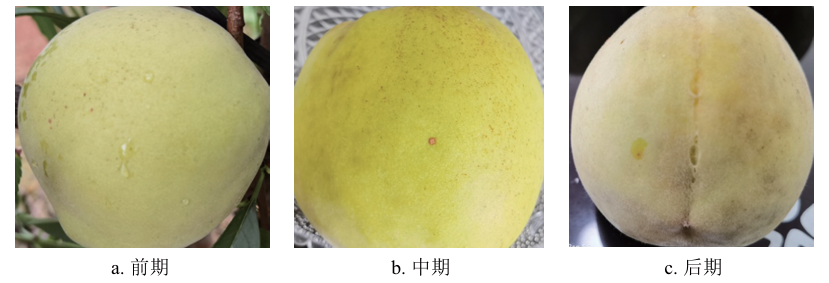
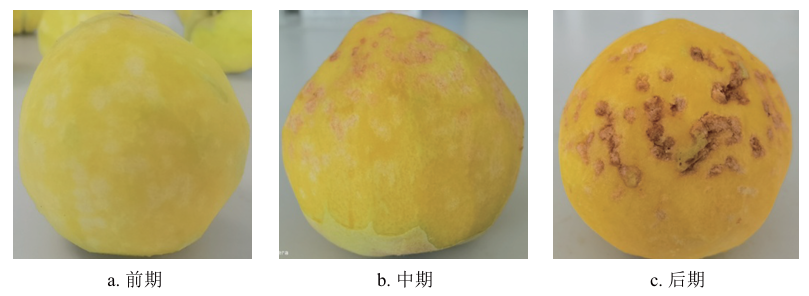
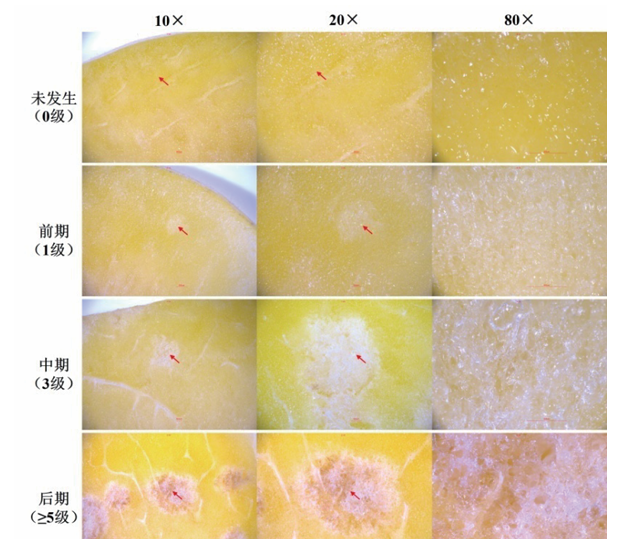
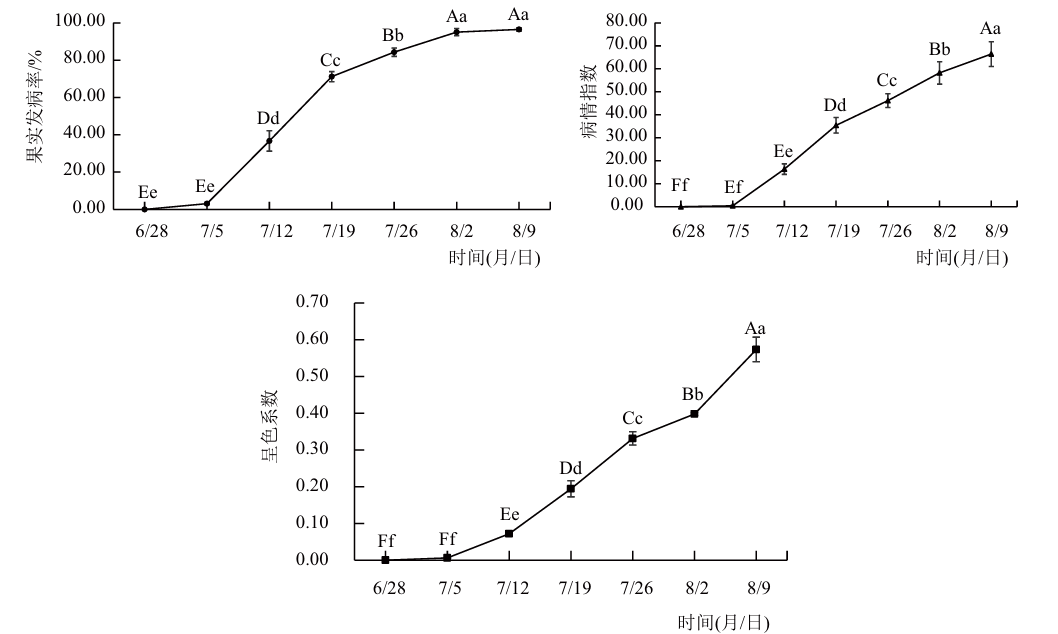
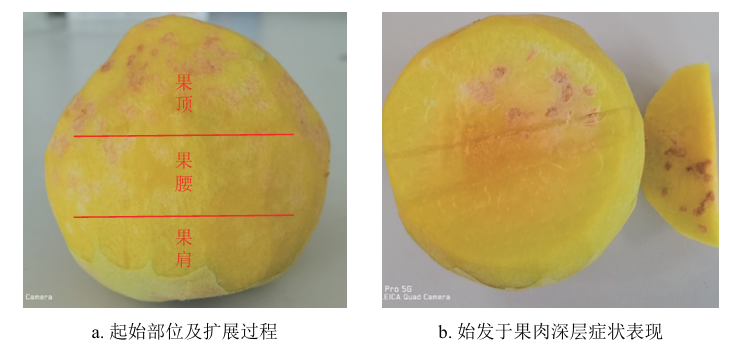
为实现桃果肉褐斑症的高效防控,本研究对其田间发生规律及主要影响因子进行调查分析。以‘锦绣’黄桃、‘鹰嘴桃’等品种为研究对象,通过采集不同类型桃园的果实样品,观测症状表现、发生时间和部位,并比较果实发病率、病情指数和呈色系数,分析品种、年际、土壤、树龄、坡段及朝向等因素对褐斑症发生的影响。结果表明,果肉褐斑症在初期阶段果皮无明显异常,至中后期,病斑对应区域的果皮呈暗绿色并凹陷;独立病斑近圆形,直径3~6 mm,颜色由白渐褐,中后期,凹陷部位呈现蜂窝状。褐斑症的发生进程可划分为始发期(成熟前约25 d)、快发期(成熟前约18 d)、盛发期(成熟前约11 d)和重症期(成熟前约3 d),病斑通常从果顶向果肩方向扩展,由果肉浅层到果核发展。该症状主要发生于7月中旬及以后成熟的中晚熟、硬溶质或不溶质品种;树龄1~3 a植株不发生或发生轻,第4年后逐年加重;土壤类型以梯田壤土发生程度最轻、山地砂包土最重;不同坡段发生程度排序为:上坡段>中坡段>下坡段>坡底平地;朝向以西向较重。综上,桃果肉褐斑症的发生与品种、树龄、土壤、坡段、朝向密切相关,通过科学合理的建园规划,可有效控制其发生;褐斑症呈逐年加重趋势,提示可能存在某一主导诱因,需进一步探究。

关键词: 桃, 果肉, 褐斑症, 发生规律, 影响因子

Abstract:

To enable efficient prevention and control of brown spot of peach pulp, this study investigated its field occurrence patterns and key influencing factors. Using varieties such as ‘Jinxiu’ yellow peach and ‘Olecranon’ peach as subjects, fruit samples were collected from various types of peach orchards. Observations were conducted on symptom manifestation, time of occurrence, and disease location. By comparing the fruit incidence rate, disease index, and coloration coefficient, the effects of factors including cultivar, inter-annual variation, soil type, tree age, slope position, and aspect on the occurrence of brown spot were analyzed. The results indicated that: in the initial stage of brown spot of peach pulp, the fruit epidermis showed no abnormalities; in the mid-to-late stages, it appeared dark green and sunken. Independent lesions were nearly circular, with a diameter of 3 mm to 6 mm; the color progressed from white to brown, and in the mid-to-late stages, the sunken areas presented a honeycomb-like appearance. The occurrence process was divided into the initial stage (25 days before maturity), the rapid stage (18 days before maturity), the peak stage (11 days before maturity), and the severe stage (3 days before maturity). The disease location developed from the fruit apex towards the fruit shoulder, and from the shallow flesh to the stone. This symptom primarily occurred in mid-to-late ripening, hard-melting or non-melting varieties maturing from mid-July onward; it did not occur or occurred lightly in trees aged 1 to 3 years, but intensified year by year after the 4th year. Regarding soil types, the severity was lightest in terraced loam soil and most severe in mountainous sandy soil; the order of severity by slope segment was: upper slope segment>middle slope segment>lower slope segment>flat ground at the slope bottom; regarding aspect, west-facing slopes were more severely affected. In conclusion, brown spot of peach pulp is closely related to variety, tree age, soil type, slope segment, and aspect, and can be effectively controlled through rational orchard establishment; and its trend of annual aggravation suggests the potential existence of a dominant inducing factor, which requires further investigation.

Key words: peach, pulp, brown spot, occurrence pattern, influencing factors

中图分类号: