欢迎访问《中国农学通报》,

中国农学通报 ›› 2026, Vol. 42 ›› Issue (1): 110-115.doi: 10.11924/j.issn.1000-6850.casb2025-0314

• 林学·园艺·园林 • 上一篇    下一篇

育苗基质对昭参种子育苗及种苗生长的影响

权申春(), 马永鹏, 龙云星, 王茜, 高朝文, 岳凯, 潘曾荣, 邓琦炜, 刘元剑()   

  1. 昭通市农业科学院,云南昭通 657000
  • 收稿日期:2025-04-21 修回日期:2025-09-26 出版日期:2026-01-15 发布日期:2026-01-15
  • 通讯作者:
    刘元剑,男,1986年出生,高级农艺师,硕士,主要从事中药材资源开发利用与中药材栽培技术研究。E-mail:
  • 作者简介:

    权申春,女,1989年出生,农艺师,硕士,主要从事药用植物资源评价与利用研究。E-mail:

  • 基金资助:
    云南省生物多样性基金资助项目“昭通道地优势及濒危药用植物种质资源收集与繁育保护”(2025)

Effects of Different Seedling-raising Substrates on Seed Germination and Seedling Growth of Panax japonicus

QUAN Shenchun(), MA Yongpeng, LONG Yunxing, WANG Xi, GAO Chaowen, YUE Kai, PAN Zengrong, DENG Qiwei, LIU Yuanjian()   

  1. Zhaotong Academy of Agricultural Sciences, Zhaotong, Yunnan 657000
  • Received:2025-04-21 Revised:2025-09-26 Published:2026-01-15 Online:2026-01-15

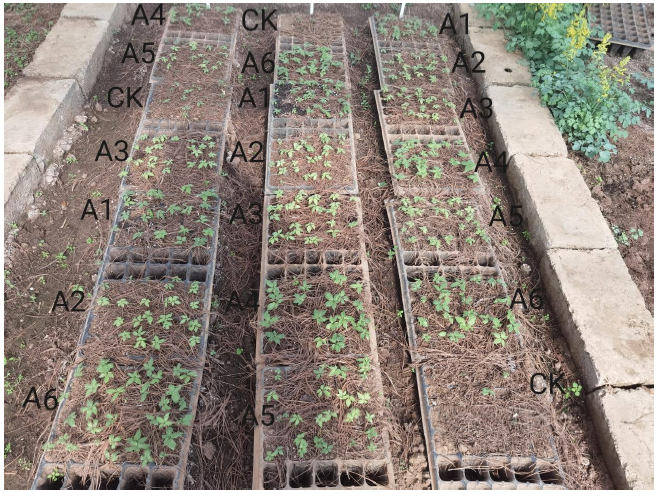
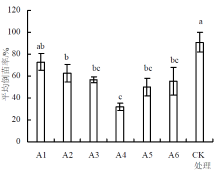
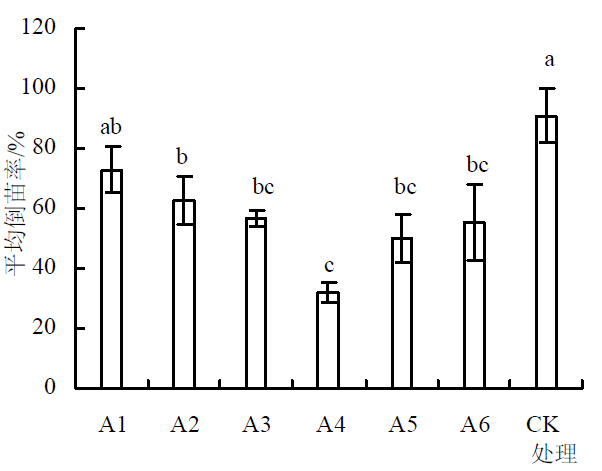
摘要: 探索基质对昭参种子育苗及种苗生长的影响,筛选出适宜昭参种子的育苗基质,为昭参规模化种苗繁育提供理论和技术支撑。本研究以昭参种子为试验材料,采用单因素随机区组试验,以田土为对照(CK),按体积比配制不同育苗基质,分别为丽江神土基质(A1)、椰糠:药渣:田土=1:3:5(A2)、椰糠:药渣=5:5(A3)、椰糠:田土=5:5(A4)、药渣:田土=5:5(A5)、椰糠:药渣:田土=3:1:5(A6),开展不同育苗基质对昭参种子出苗率及幼苗生长的影响。结果表明,不同育苗基质均可显著提高昭参种子的出苗率(P<0.05),出苗率为A2>A6>A3>A5>A1>A4>CK;不同基质对幼苗生长指标的影响不尽相同,其中A4处理根系、根茎直径、根茎长和种苗鲜重相较CK分别提高了88.17%、41.26%、31.36%和94.3%,A4处理的倒苗率相较CK降低了65.09%,各处理隶属函数综合排名为A4(0.810)> A6(0.735)> A1(0.699)> A2(0.607)> A3(0.541)> CK(0.033)。研究认为,基质育苗是昭参种子繁育的有效途径,其中椰糠基质比药渣基质更适合昭参种子育苗,以椰糠:田土=5:5、椰糠:药渣:田土=3:1:5综合表现最佳,既能保障种子萌发所需的通气与持水条件,又能促进种苗地上部健壮生长及地下根茎发育,可作为昭参种子育苗的优选基质在生产中推广应用。

关键词: 昭参, 种子育苗, 育苗基质, 出苗率, 生长指标, 隶属函数法, 综合评价

Abstract:

This study aimed to investigate the effects of different growth substrates on seed germination and seedling development of Panax japonicus, identifying optimal substrate formulations to support its nursery cultivation. A single-factor randomized block design was adopted using field soil as control (CK), and six substrate mixtures (by volume) were set up, including Lijiang Shentu substrate (A1), coir dust: herbal residue: field soil= 1:3:5 (A2), coir dust: herbal residue= 5:5 (A3), coir dust: field soil= 5:5 (A4), herbal residue: field soil= 5:5 (A5), and coir dust: herbal residue: field soil= 3:1:5 (A6). Germination rate and seedling growth parameters were systematically evaluated. All substrates significantly enhanced germination rates (P<0.05), which ranked as A2>A6>A3>A5>A1>A4>CK. Substrate A4 exhibited the most pronounced growth promotion, increasing root biomass, rhizome diameter, rhizome length, and seedling fresh weight by 88.17%, 41.26%, 31.36%, and 94.3% respectively versus CK, while reducing seedling mortality by 65.09%. The comprehensive evaluation via membership function ranked treatments as A4(0.810)> A6(0.735)> A1(0.699)> A2(0.607)> A3(0.541)> CK(0.033). Substrate cultivation is recognized as an effective approach for enhancing seed propagation of P. japonicus. Among various substrate formulations, those based on coconut coir demonstrated superior performance compared to those incorporating medicinal herb residues. In particular, the mixture of coconut coir and field soil in a ratio of 5:5 and mixture of coconut coir, herbal residue, and field soil in a ratio of 3:1:5 achieved the best overall evaluation, showing significant synergistic promotion in both aerial and underground growth of seedlings. It can be used as the preferred substrate for P. japonicus seed propagation in production.

Key words: Panax japonicus, seed propagation, seedling substrate, germination rate, growth index, membership function method, comprehensive evaluation