Welcome to Chinese Agricultural Science Bulletin,

Chinese Agricultural Science Bulletin ›› 2026, Vol. 42 ›› Issue (21): 112-119.doi: 10.11924/j.issn.1000-6850.casb2026-0477
Previous Articles Next Articles
MA Xiaomei( ), LI Baocheng, LI Yawen, ZHOU Xiaofeng, WANG Xin, TIAN Qin, DONG Chengguang()
Received:2026-06-12
Revised:2026-09-16
Online:2026-11-10
Published:2026-11-10
CLC Number:
MA Xiaomei, LI Baocheng, LI Yawen, ZHOU Xiaofeng, WANG Xin, TIAN Qin, DONG Chengguang. Comprehensive Evaluation of Main Agronomic Traits and Analysis of Productivity and Yield Stability of Nationally Approved Cotton Variety ‘Xinken M219’[J]. Chinese Agricultural Science Bulletin, 2026, 42(21): 112-119.
Add to citation manager EndNote|Ris|BibTeX
URL: https://www.casb.org.cn/EN/10.11924/j.issn.1000-6850.casb2026-0477
| 试验组别 | 年度 | 品种名称 | 皮棉产量/(kg/hm2) | 比CK增产/% | 皮棉产量位次 | 年度试验达到的显著水平 | 试点最高皮棉产量/(kg/hm2 ) | |
|---|---|---|---|---|---|---|---|---|
| 5% | 1% | |||||||
| 区域试验 | 2021年 | 新垦M219 | 2485.5 | 9.1 | 3 | ab | AB | 2835 |
| 新陆早61号 | 2277 | — | 8 | d | D | 2664 | ||
| 2022年 | 新垦M219 | 2844 | 9.8 | 2 | a | A | 3300 | |
| 新陆早61号 | 2589 | — | 9 | c | C | 3141 | ||
| 生产试验 | 2023年 | 新垦M219 | 2524.5 | 9.4 | 3 | a | A | 3046.5 |
| 新陆早61号 | 2308.5 | — | 5 | c | C | 2811 | ||
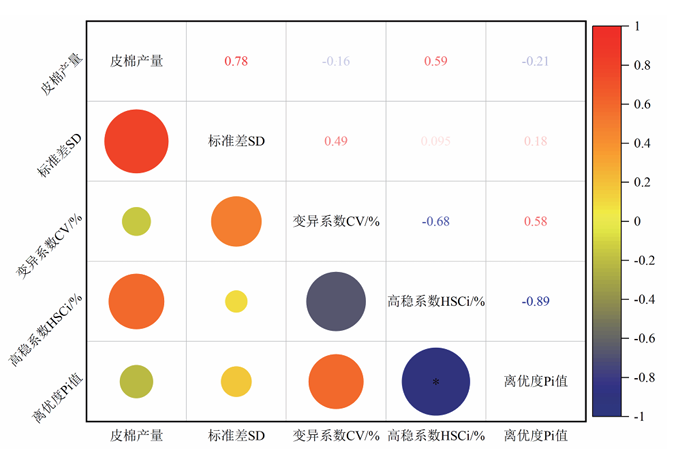
| 试验组别 | 年度 | 品种 | 标准差 | 变异系数/% | 高稳系数(HSCi) | 增产点率/% | 离优度(Pi) | ||
|---|---|---|---|---|---|---|---|---|---|
| 数值/% | 年度试验位次 | 数值/% | 年度试验位次 | ||||||
| 区域试验 | 2021年 | 新垦M219 | 18.89 | 11.40 | 96.71 | 2 | 100.0 | 10.934 | 3 |
| 新陆早61号 | 20.14 | 13.27 | 86.73 | 8 | — | 22.570 | 8 | ||
| 2022年 | 新垦M219 | 24.11 | 12.71 | 95.88 | 2 | 80.0 | 15.724 | 3 | |
| 新陆早61号 | 23.15 | 13.41 | 86.59 | 9 | — | 30.305 | 9 | ||
| 生产试验 | 2023年 | 新垦M219 | 22.30 | 13.25 | 94.89 | 3 | 100.0 | 9.780 | 2 |
| 新陆早61号 | 20.22 | 13.14 | 86.86 | 5 | — | 22.546 | 5 | ||
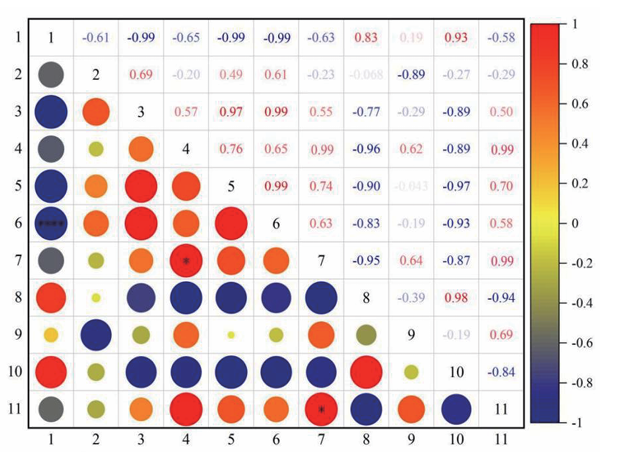
| 性状 | 果枝始 节位/节 | 株高/cm | 果枝数/台 | 单株结铃/(个/株) | 霜前花率/% | 单铃重/g | 衣分/% | 出苗— 开花/d | 开花— 吐絮/d | 生育期/d | 皮棉产量/ (kg/hm2) |
|---|---|---|---|---|---|---|---|---|---|---|---|
| 平均值 | 5.43 | 79.37 | 8.77 | 6.60 | 98.87 | 5.40 | 42.63 | 56.67 | 59.67 | 116.67 | 2617.95 |
| 标准偏差 | 0.40 | 1.51 | 0.49 | 0.26 | 1.02 | 0.20 | 0.32 | 4.51 | 1.53 | 4.04 | 13.11 |
| 变异系数/% | 7.44 | 1.91 | 5.63 | 4.01 | 1.03 | 3.70 | 0.75 | 7.96 | 2.56 | 3.46 | 7.51 |
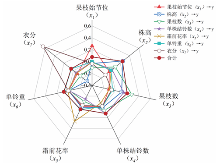
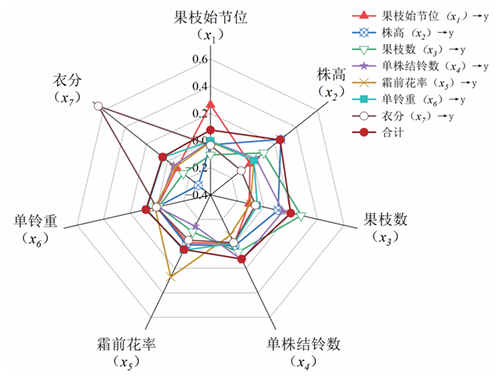
| 自变量 | 直接通径系数 | 间接通径系数 | 合计 | ||||||
|---|---|---|---|---|---|---|---|---|---|
| x1→y | x2→y | x3→y | x4→y | x5→y | x6→y | x7→y | |||
| 果枝始节位(x1) | 0.264 | — | -0.031 | -0.105 | -0.003 | -0.010 | -0.002 | -0.035 | 0.078 |
| 株高(x2) | 0.257 | -0.030 | — | 0.097 | 0.026 | 0.008 | 0.005 | -0.113 | 0.25 |
| 果枝数(x3) | 0.279 | -0.111 | 0.106 | — | 0.142 | -0.103 | -0.049 | -0.063 | 0.201 |
| 单株结铃数(x4) | 0.131 | -0.002 | 0.013 | 0.067 | — | -0.070 | -0.005 | -0.011 | 0.123 |
| 霜前花率(x5) | 0.269 | -0.010 | 0.008 | -0.099 | -0.144 | — | 0.051 | -0.030 | 0.045 |
| 单铃重(x6) | 0.080 | -0.0005 | 0.0015 | -0.014 | -0.003 | 0.015 | — | 0.005 | 0.084 |
| 衣分(x7) | 0.649 | -0.086 | -0.286 | -0.146 | -0.055 | -0.072 | 0.043 | — | 0.047 |
| [1] |
周娟, 王胜利, 杜召海, 等. 适宜轻简化机械化植棉的鲁棉378的选育及其栽培技术[J]. 中国棉花, 2022, 49(2):24-25.
doi: 10.11963/cc20210165 |
| [2] |
张泓, 吐尔逊江·买买提, 张少民, 等. 近30 a全国棉花生产区域时空变化及区域优势分析[J]. 新疆农业科学, 2023, 60(4):1028-1040.
doi: 10.6048/j.issn.1001-4330.2023.04.029 |
| [3] |
毛树春, 程思贤, 王树林, 等. 2019—2021年全国棉花生产表观成本、产值和收益监测报告[J]. 中国棉花, 2022, 49(9):6-20.
doi: 10.11963/cc20220092 |
| [4] |
袁有禄, 魏晓文, 毛树春, 等. 棉花育种行业创新与进展[J]. 植物遗传资源学报, 2018, 19(3):455-463.
|
| [5] |
王红梅, 赵云雷, 陈伟, 等. 黄河流域棉区棉花生产现状及发展建议[J]. 中国棉花, 2018, 45(2):4-7.
doi: 10.11963/1000-632X.whmwhm.20180227 |
| [6] |
付小琼, 彭军. 国家棉花区域试验工作十年回顾与展望[J]. 棉花学报, 2017, 29(增刊):113-117.
doi: 10.11963/1002-7807.fxqpj.20170825 |
| [7] |
喻树迅, 范术丽, 王寒涛, 等. 中国棉花高产育种研究进展[J]. 中国农业科学, 2016, 49(18):3465-3476.
doi: 10.3864/j.issn.0578-1752.2016.18.001 |
| [8] |
闻小霞, 商娜, 李庆恩, 等. 早中熟棉花品种聊棉19号选育及轻简化栽培技术[J]. 中国棉花, 2024, 51(3):26-28.
doi: 10.11963/cc20230110 |
| [9] |
吴晓东, 李海燕, 王天硕, 等. GGE双标图法评价辽棉50的丰产性稳产性及适应性[J]. 中国棉花, 2024, 51(7):33-37.
doi: 10.11963/cc20230201 |
| [10] |
赵树琪, 张华崇, 闫振华, 等. 强优势杂交棉新品种‘冈0996’丰产性、稳产性及适应性分析[J]. 农学学报, 2023, 13(4):32-38.
doi: 10.11923/j.issn.2095-4050.cjas2022-0043 |
| [11] |
商娜, 李庆恩, 李晓宇, 等. 国审棉花新品种“聊棉15号”丰产稳产适应性及产量构成因素分析[J]. 中国农学通报, 2024, 40(33):48-52.
doi: 10.11924/j.issn.1000-6850.casb2023-0751 |
| [12] |
闻小霞, 李晓宇, 李庆恩, 等. 棉花新品种“聊棉21号”丰产稳产性和相关性状分析[J]. 农学学报, 2025, 15(9):1-5.
doi: 10.11923/j.issn.2095-4050.casb2024-0056 |
| [13] |
闫振华, 赵树琪, 张华崇, 等. 冈杂棉10号丰产性和适应性以及产量构成要素分析[J]. 中国棉花, 2023, 50(2):17-23.
doi: 10.11963/cc20220125 |
| [14] |
|
| [15] |
任洪雷, 李春霞, 龚士琛, 等. 利用SPSS实现玉米杂交种主要农艺性状与产量的相关和通径分析[J]. 作物杂志, 2019(3):86-90.
|
| [16] |
齐海坤, 左彦利, 张伯谦, 等. 黄河流域黑龙港植棉区棉花主要产量决策性状分析[J]. 棉花学报, 2020, 32(6):483-490.
doi: 10.11963/1002-7807.qhkxdy.20200713 |
| [17] |
闫振华, 黄晓莉, 赵树琪, 等. 2006-2019年湖北省审定转基因抗虫杂交棉品种产量、品质及相关性状分析[J]. 中国棉花, 2022, 49 (11):17-24.
doi: 10.11963/cc20220054 |
| [18] |
孙绘健, 罗静, 杜珊珊, 等. 棉花品种新陆中121的选育及栽培技术[J]. 中国棉花, 2025, 52(9):25-27.
|
| [19] |
doi: 10.1016/j.fcr.2026.110484 URL |
| [20] |
张旺锋, 王振林, 余松烈, 等. 膜下滴灌对新疆高产棉花群体光合作用冠层结构和产量形成的影响[J]. 中国农业科学, 2002, 35(6):632-637.
|
| [21] |
doi: 10.1016/j.indcrop.2024.118593 URL |
| [22] |
詹有俊, 杨涛, 孙建船, 等. 特早熟陆地棉熟性产量品质的遗传相关分析[J]. 农业现代化研究, 2013, 34(1):118-121.
|
| [23] |
许乃银, 赵素琴, 张芳, 等. 基于GYT双标图对西北内陆棉区国审棉花品种的分类评价[J]. 作物学报, 2021, 474(4):660-671.
|
| [24] |
唐中杰, 谢德意, 于跃波, 等. 内地棉区优势棉花资源评价及其在新疆棉花育种中的应用[J]. 河南农业科学, 2024, 53(2):37-45.
|
| [25] |
韩婉瑞, 雷亚平, 李亚兵, 等. 气候变暖背景下中国三大棉区水热时空变化[J]. 中国生态农业学报(中英文), 2021, 29(8):1430-1441.
|
| [26] |
张志刚, 曾潜, 杨晓萍, 等. 不同生态点对棉株产量构成因素综合评价的研究[J]. 分子植物育种, 2003, 1(5):697-700.
|
| [27] |
张艳军, 代建龙, 董合忠. 论棉花多目标协同栽培[J]. 中国农业科学, 2025, 58(10):1908-1916.
doi: 10.3864/j.issn.0578-1752.2025.10.004 |
| [1] | XU Yudong, LI Haiyang, YANG Jianming, WANG Guifang, WEI Gaigai. Experimental Study on Yield Impact of Potato Planting Density Under Double Ridge Full Film Furrow Sowing in Arid Area of Ningxia [J]. Chinese Agricultural Science Bulletin, 2026, 42(8): 11-16. |
| [2] | CHENG Fanyi, ZHOU Qixuan, LAN Lingkai, ZHANG Ruoxi, YIN Yidi, HOU Bohan, DUO Liangyu, GU Jiageng, YAO Yiduo, ZHANG Zishuo, LANG Xuping. Effects of Potassium Deficiency Stress on Growth and Antioxidant Characteristics in Lycium barbarum Seedlings [J]. Chinese Agricultural Science Bulletin, 2026, 42(7): 92-96. |
| [3] | WANG Shuo, YANG Hetuan, WANG Fang, ZHANG Lichun, YANG Run, MA Yulian, LI Shanshan, YANG Nan, HU Qianqian, FU Changhao, LI Mingyu, LIANG Yanli. Screening of Dominant Germplasm of Dipsacus asperoides and Comparison of Agronomic Traits of Plants with Different Colored Anthers [J]. Chinese Agricultural Science Bulletin, 2026, 42(7): 113-120. |
| [4] | GAO Qin, CHEN Huanhuan, ZHU Qifa, XIA Hao, YU Fei, SHEN Jia, JIANG Chaoqiang. Study on Relationship Between Chemical Composition and Sensory Quality of Tobacco Middle Leaves in Southern Anhui Tobacco Area [J]. Chinese Agricultural Science Bulletin, 2026, 42(7): 204-209. |
| [5] | YANG Xin, ZHANG Mingjin, LI Bin, ZHANG Yonghui, XIE Qiang, WANG Jian’an. Effect of Different Harvesting Methods with Stems on Curing Quality of Upper Leaves [J]. Chinese Agricultural Science Bulletin, 2026, 42(7): 210-218. |
| [6] | ZENG Pei, YU Honglei, LI Yuekang, LIU Boyi. Abrupt Change Characteristics of Meteorological Elements in Ganfupingyuan Irrigation Area Based on Pettitt Test and Its Correlation Study [J]. Chinese Agricultural Science Bulletin, 2026, 42(6): 164-170. |
| [7] | LI Shimeng, NAN Zhiqiang, BAIMA Yangzhen, WANG Jinxiong. Comprehensive Evaluation and Adaptability Analysis of Rapeseed Agronomic Traits in Xizang [J]. Chinese Agricultural Science Bulletin, 2026, 42(6): 31-40. |
| [8] | ZHENG Xiaoyuan, CHEN Jingyu, WANG Huicong, WANG Zhenjiang, WANG Dan. Fruit Quality Analysis and Comprehensive Evaluation of 38 Mulberry Germplasm Resources [J]. Chinese Agricultural Science Bulletin, 2026, 42(6): 72-84. |
| [9] | ZHAO Hui, HE Xuemei, LI Biao, Feng Hui, DENG Li, SUN Chuanqi, MA Jie, FU Liang. Agronomic Traits and Nutritional Components Analysis of Lepista sordida E70 Cultivated with Different Raw Materials [J]. Chinese Agricultural Science Bulletin, 2026, 42(5): 83-91. |
| [10] | LIAO Yuanyuan, ZHENG Zhangyun, ZHANG Zitao, CHEN Li, XIA Chuanlin, REN Jiequn, TAN Lixin. Analysis of Phenotypic and Leaf Nutritional Traits of 42 Mulberry Germplasm Resources [J]. Chinese Agricultural Science Bulletin, 2026, 42(4): 105-116. |
| [11] | FAN Yongxin, SONG Yuyang, LI Ruirui, FAN Shaopeng, ZOU Xiaoxia, FAN Yijie, YU Xiaona, ZHANG Xiaojun, SI Tong, NI Yu. Study on Optimal Sowing Dates for Rapeseed in Saline-alkali Soil of Yellow River Delta and Effects of Wood Vinegar in Alleviating Salt Stress [J]. Chinese Agricultural Science Bulletin, 2026, 42(4): 27-33. |
| [12] | FU Kairui, SHI Haoliang, ZHOU Shunbao, WANG Zhongyuan, ZHOU Hongxia, LI Wenting, YANG Yunli, LI Guangyang, TIAN Minghui, FU Limei, YU Lei, HUANG Feiyan, ZHOU Houfa. Effects of Different Cultivation Measures on Growth and Quality of ‘Yunyan 116’ in Shuangjiang of Yunnan [J]. Chinese Agricultural Science Bulletin, 2026, 42(4): 34-45. |
| [13] | LI Xinjian, LEI Ting, WEI Xingqi, YOU Andi, ZHOU Yangheng, LUO Mingquan, MO Zegang, LIU Xiaoang, ZHU Yinghua, TANG Xinggui. Influence of Leaf Pruning on Key Indicators of Cellar Transplanting Tobacco Seedlings [J]. Chinese Agricultural Science Bulletin, 2026, 42(4): 46-51. |
| [14] | WANG Ping, WANG Lei, XIE Chengjun, SUN Zhenrong, CHEN Juan. Comprehensive Evaluation of Drought Resistance of Potato Varieties in Longzhong Region [J]. Chinese Agricultural Science Bulletin, 2026, 42(4): 8-16. |
| [15] | LUO Jing, DU Shanshan, YAO Qingqing, WANG Dongli, HE Zhongsheng, SUN Huijian, WANG Ruijun. Effect of NaCl and Na2SO4 Salt Stress on the Germination of Upland Cotton Seeds and Screening of Salt-tolerant Germplasm [J]. Chinese Agricultural Science Bulletin, 2026, 42(3): 48-56. |
| Viewed | ||||||
|
Full text |
|
|||||
|
Abstract |
|
|||||
