Welcome to Chinese Agricultural Science Bulletin,

Chinese Agricultural Science Bulletin ›› 2026, Vol. 42 ›› Issue (21): 132-140.doi: 10.11924/j.issn.1000-6850.casb2025-0822
Previous Articles Next Articles
DAI Hongfen1( ), WU Xiaming1, ZHOU Chenping1, YANG Junxian2, YANG Min1, YANG Meizhen2, KUANG Ruibin1, WEI Yuerong1()
Received:2025-09-29
Revised:2026-08-15
Online:2026-11-10
Published:2026-11-10
CLC Number:
DAI Hongfen, WU Xiaming, ZHOU Chenping, YANG Junxian, YANG Min, YANG Meizhen, KUANG Ruibin, WEI Yuerong. Study on Models of Plant Growth and Fruit Development of Papaya[J]. Chinese Agricultural Science Bulletin, 2026, 42(21): 132-140.
Add to citation manager EndNote|Ris|BibTeX
URL: https://www.casb.org.cn/EN/10.11924/j.issn.1000-6850.casb2025-0822
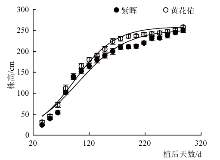
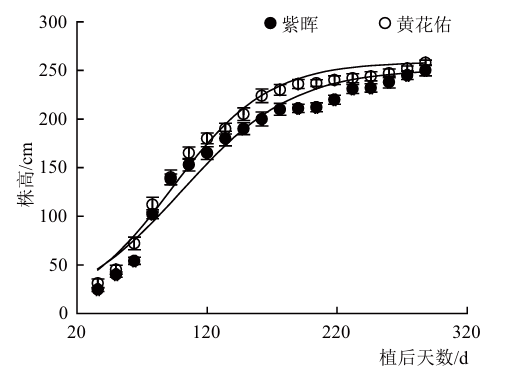
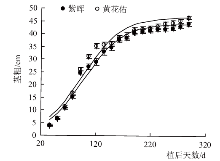
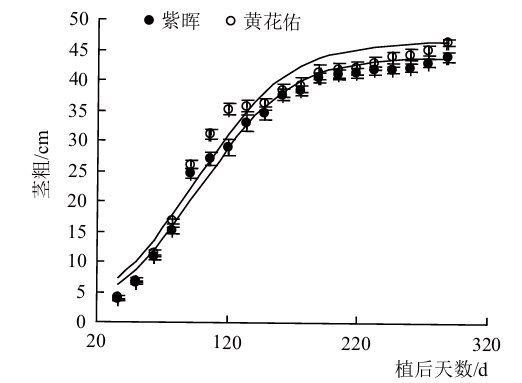
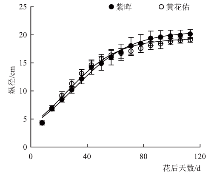
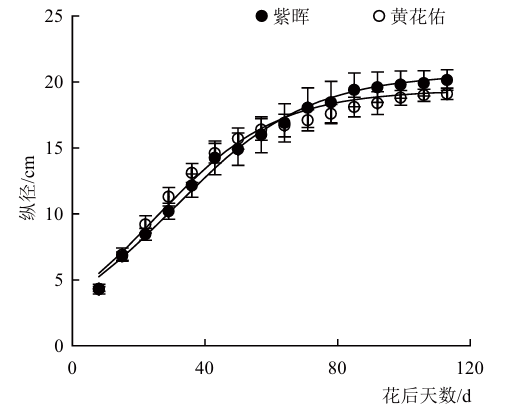
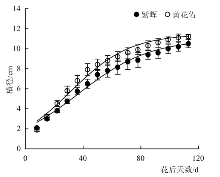
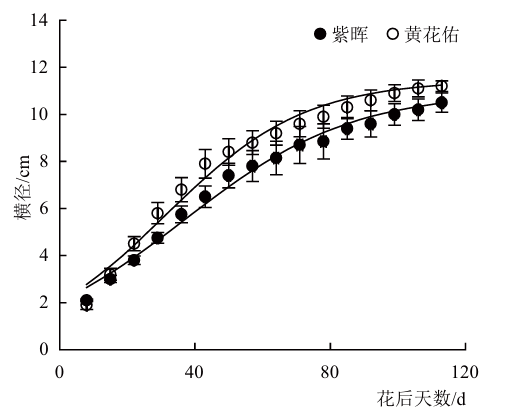
| 变量 | 品种 | Logistic生长曲线方程 | $R_{1}^{2}$ | r1 | 生长速率方程 |
|---|---|---|---|---|---|
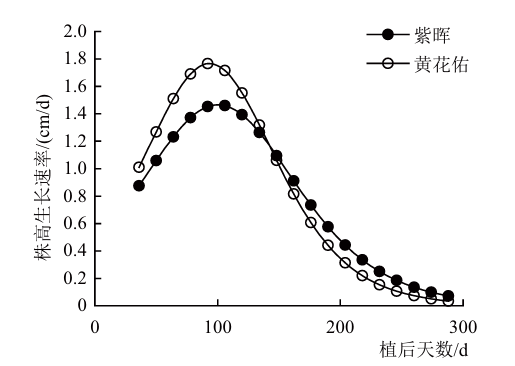
| 株高 | 紫晖 | $y=\frac{251.808}{1+\mathrm{e}^{2.339-0.023 x_{1}}}$ | 0.962 | 0.982 | $y^{\prime}=\frac{60.859 \mathrm{e}^{-0.023 x_{1}}}{\left(1+10.373 \mathrm{e}^{-0.023 x_{1}}\right)^{2}}$ |
| 黄花佑 | $y=\frac{258.850}{1+\mathrm{e}^{2.549-0.027 x_{1}}}$ | 0.984 | 0.993 | $y^{\prime}=\frac{90.439 \mathrm{e}^{-0.027 x_{1}}}{\left(1+12.798 \mathrm{e}^{-0.027 x_{1}}\right)^{2}}$ | |
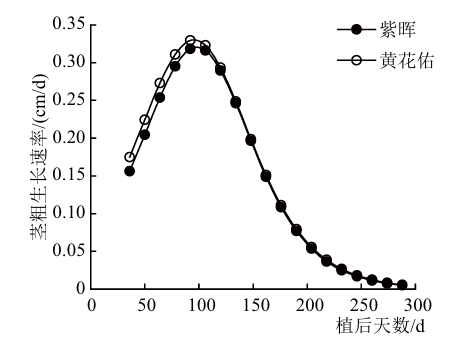
| 茎粗 | 紫晖 | $y=\frac{44.078}{1+\mathrm{e}^{2.848-0.029 x_{1}}}$ | 0.983 | 0.993 | $y^{\prime}=\frac{22.135 \mathrm{e}^{-0.029 x_{1}}}{\left(1+17.257 \mathrm{e}^{-0.029 x_{1}}\right)^{2}}$ |
| 黄花佑 | $y=\frac{46.681}{1+\mathrm{e}^{2.700-0.028 x_{1}}}$ | 0.959 | 0.983 | $y^{\prime}=\frac{19.655 \mathrm{e}^{-0.028 x_{1}}}{\left(1+14.878 \mathrm{e}^{-0.028 x_{1}}\right)^{2}}$ | |
| 果实纵径 | 紫晖 | $y=\frac{20.633}{1+\mathrm{e}^{1.464-0.049 x_{1}}}$ | 0.994 | 0.997 | $y^{\prime}=\frac{4.343 \mathrm{e}^{-0.049 x_{1}}}{\left(1+4.322 \mathrm{e}^{-0.049 x_{1}}\right)^{2}}$ |
| 黄花佑 | $y=\frac{19.370}{1+\mathrm{e}^{1.356-0.054 x_{1}}}$ | 0.985 | 0.993 | $y^{\prime}=\frac{4.083 \mathrm{e}^{-0.054 x_{1}}}{\left(1+3.882 \mathrm{e}^{-0.054 x_{1}}\right)^{2}}$ | |
| 果实横径 | 紫晖 | $y=\frac{10.974}{1+\mathrm{e}^{1.473-0.040 x_{1}}}$ | 0.989 | 0.995 | $y^{\prime}=\frac{1.924 \mathrm{e}^{-0.040 x_{1}}}{\left(1+4.361 \mathrm{e}^{-0.040 x_{1}}\right)^{2}}$ |
| 黄花佑 | $y=\frac{11.457}{1+\mathrm{e}^{1.527-0.049 x_{1}}}$ | 0.981 | 0.990 | $y^{\prime}=\frac{2.564 \mathrm{e}^{-0.049 x_{1}}}{\left(1+4.604 \mathrm{e}^{-0.049 x_{1}}\right)^{2}}$ |
| 变量 | 品种 | a | vm/(cm/d) | Δt/d | tm | t1 | t2 | |||||
|---|---|---|---|---|---|---|---|---|---|---|---|---|
| 时间/d | 日期(年-月-日) | 时间/d | 日期(年-月-日) | 时间/d | 日期(年-月-日) | |||||||
| 株高 | 紫晖 | 251.81 | 1.47 | 113.05 | 100.39 | 2023-06-30 | 43.87 | 2023-05-04 | 156.92 | 2023-08-25 | ||
| 黄花佑 | 258.85 | 1.77 | 96.48 | 93.38 | 2023-06-23 | 45.14 | 2023-05-06 | 141.62 | 2023-08-10 | |||
| 茎粗 | 紫晖 | 44.08 | 0.32 | 90.51 | 97.88 | 2023-06-27 | 52.62 | 2023-05-13 | 143.13 | 2023-08-12 | ||
| 黄花佑 | 46.68 | 0.33 | 93.07 | 95.40 | 2023-06-25 | 48.87 | 2023-05-09 | 141.94 | 2023-08-10 | |||
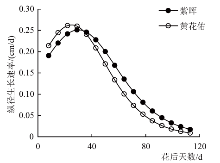
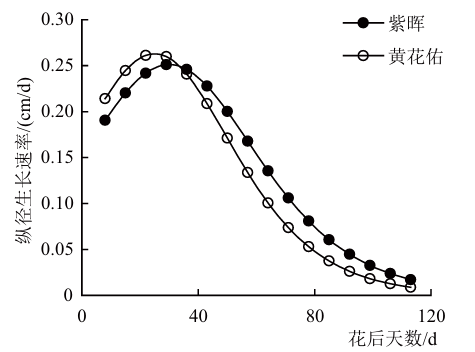
| 纵径 | 紫晖 | 20.63 | 0.25 | 54.09 | 30.06 | 2023-07-07 | 3.01 | 2023-06-10 | 57.10 | 2023-08-03 | ||
| 黄花佑 | 19.37 | 0.26 | 48.51 | 24.98 | 2023-07-02 | 0.73 | 2023-06-08 | 49.23 | 2023-07-26 | |||
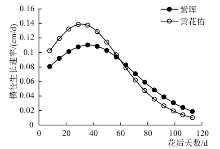
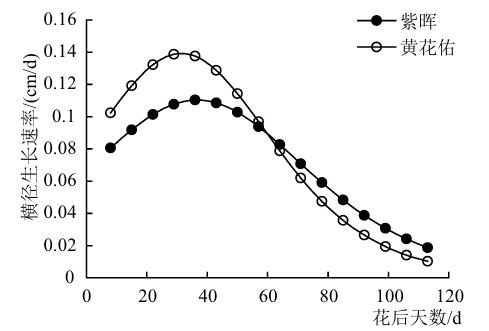
| 横径 | 紫晖 | 10.97 | 0.11 | 65.52 | 36.64 | 2023-07-13 | 3.88 | 2023-06-10 | 69.40 | 2023-08-15 | ||
| 黄花佑 | 11.46 | 0.14 | 54.20 | 31.42 | 2023-07-09 | 4.32 | 2023-06-11 | 58.52 | 2023-08-04 | |||
| 变量 | 品种 | 生长时间 | 有效积温 | 日照时数积累值 | 相对湿度积累值 |
|---|---|---|---|---|---|
| 株高 | 紫晖 | -0.716** | -0.699** | 0.881** | -0.019 |
| 黄花佑 | -0.881** | -0.827** | 0.948** | 0.094 | |
| 茎粗 | 紫晖 | -0.821** | -0.715** | 0.923** | -0.009 |
| 黄花佑 | -0.740** | -0.715** | 0.888** | -0.001 | |
| 果实纵径 | 紫晖 | -0.379 | -0.453 | 0.946** | -0.215 |
| 黄花佑 | -0.008 | -0.671* | 0.934** | -0.405 | |
| 果实横径 | 紫晖 | 0.102 | -0.644* | 0.929** | -0.520 |
| 黄花佑 | -0.060 | -0.677* | 0.943** | -0.394 |
| 变量 | 品种 | 多因子生长模型 | $R_{2}{ }^{2}$ | r2 |
|---|---|---|---|---|
| 株高 | 紫晖 | $y=\frac{251.808}{1+\mathrm{e}^{4.915+0.157 x_{1}+0.009 x_{2}-0.027 x_{3}}}$ | 0.994 | 0.996 |
| 黄花佑 | $y=\frac{258.850}{1+\mathrm{e}^{3.930+0.130 x_{1}+0.006 x_{2}-0.020 x_{3}}}$ | 0.996 | 0.998 | |
| 茎粗 | 紫晖 | $y=\frac{44.078}{1+\mathrm{e}^{4.499+0.127 x_{1}+0.007 x_{2}-0.021 x_{3}}}$ | 0.994 | 0.997 |
| 黄花佑 | $y=\frac{46.681}{1+\mathrm{e}^{5.746+0.214 x_{1}+0.012 x_{2}-0.035 x_{3}}}$ | 0.994 | 0.997 | |
| 果实纵径 | 紫晖 | $y=\frac{20.633}{1+\mathrm{e}^{1.767+0.014 x_{1}+0.013 x_{2}-0.023 x_{3}}}$ | 0.998 | 0.999 |
| 黄花佑 | $y=\frac{19.370}{1+\mathrm{e}^{1.810-0.581 x_{1}+0.043 x_{2}-0.054 x_{3}+0.005 x_{4}}}$ | 0.998 | 0.999 | |
| 横径 | 紫晖 | $y=\frac{10.974}{1+\mathrm{e}^{1.868-0.447 x_{1}+0.028 x_{2}-0.035 x_{3}+0.004 x_{4}}}$ | 0.998 | 0.999 |
| 黄花佑 | $y=\frac{11.457}{1+\mathrm{e}^{2.197-0.415 x_{1}+0.041 x_{2}-0.056 x_{3}+0.004 x_{4}}}$ | 0.999 | 0.998 |
| [1] |
吴红丽, 刘惠民. 施肥对新平县引进番木瓜生长的影响[J]. 西南林学院学报, 2006(2):59-61.
|
| [2] |
魏岳荣, 杨护, 周陈平, 等. 优质丰产番木瓜新品种紫晖的选育[J]. 果树学报, 2022, 39(6):1129-1132.
|
| [3] |
吴夏明, 林伟, 杨敏, 等. 非转基因番木瓜新品种比较试验[J]. 中国农学通报, 2024, 40(16):63-71.
doi: 10.11924/j.issn.1000-6850.casb2023-0511 |
| [4] |
吴夏明, 周陈平, 杨敏, 等. 小果型非转基因番木瓜新品种黄花佑的选育[J]. 果树学报, 2024, 41(1):193-196.
|
| [5] |
尤海磊, 胡希远, 高金锋, 等. 不同荞麦品种生长模型和生长特性的比较研究[J]. 干旱地区农业研究, 2010, 28(2):53-58.
|
| [6] |
朱雨晴, 薛晓萍. 基于不同驱动因子的番茄生长模型比较[J]. 应用气象学报, 2024, 35(6):747-758.
|
| [7] |
doi: 10.1016/s0025-5564(02)00096-2 pmid: 12047920 |
| [8] |
doi: 10.1038/35098076 |
| [9] |
doi: 10.1016/j.ecolmodel.2013.06.025 URL |
| [10] |
pmid: 12242474 |
| [11] |
王莹, 王良桂, 黄成名, 等. 露地栽培条件下百合的生长规律及种球繁殖技术[J]. 中国农业科学, 2014, 47(8):1558-1566.
doi: 10.3864/j.issn.0578-1752.2014.08.012 |
| [12] |
张彩琴, 杨持. 内蒙古典型草原生长季内不同植物生长动态的模拟[J]. 生态学报, 2007, 27(9):3618-3629.
|
| [13] |
金海湘, 龚雪, 朱报著. 大腹异木棉Ceiba insignis实生苗年生长节律研究[J]. 广东园林, 2020, 42(3):49-54.
|
| [14] |
韩树全, 罗立娜, 卢加举, 等. 贵州澳洲坚果果实发育动态及模型建立[J]. 种子, 2023, 42(4):79-85.
|
| [15] |
朱海军, 生静雅, 刘广勤, 等. 基于Logistic模型的薄壳山核桃果实生长发育研究[J]. 西南农业学报, 2015, 28(3):1231-1235.
|
| [16] |
徐回林, 陈金印, 辜青青, 等. 基于Logistic模型研究南丰蜜橘(Citrus reticulata Blanco)果实的生长动态[J]. 江西农业大学学报, 2010, 32(6):1131-1135.
|
| [17] |
黄丽云, 刘立云, 齐兰, 等. 基于Logistic模型的槟榔果实生长发育研究[J]. 热带农业科学, 2018, 38(8):105-108.
|
| [18] |
乔嘉, 朱金城, 赵姣, 等. 基于Logistic模型的玉米干物质积累过程对产量影响研究[J]. 中国农业大学学报, 2011, 16(5):32-38.
|
| [19] |
程艳, 魏尊苗, 刘佳遥, 等. 基于Logistic方程的油莎豆生长指标拟合与分析[J]. 东北农业科学, 2024, 49(4):47-51.
|
| [20] |
胡波, 李国元, 谢志兵, 等. 冬枣果实生长规律Logistic模型研究[J]. 湖北农业科学, 2015, 54(5):1114-1116.
|
| [21] |
邱宏业, 朱建华, 徐炯志, 等. 大乌圆龙眼果实发育动态及其模型的建立[J]. 西南农业学报, 2018, 31(1):149-153.
|
| [22] |
彭杰椿, 潘介春, 吴玉, 等. 桂丰早龙眼开花习性和果实生长模型研究[J]. 果树学报, 2021, 38(6):947-956.
|
| [23] |
王璐瑶, 闫锦涛, 刘涛, 等. 桃果实品质动态变化及其对气象因子的响应[J]. 农学学报, 2023, 13(11):49-54.
doi: 10.11923/j.issn.2095-4050.cjas2022-0165 |
| [24] |
杨丽丽, 王一鸣, 康孟珍, 等. 基于修正Logistic模型的番茄单个果实生长规律模拟[J]. 农业机械学报, 2008, 39(11):81-84.
|
| [25] |
李建明, 邹志荣, 刘迎春, 等. 温度与水分驱动的甜瓜幼苗生长形态模拟模型研究[J]. 农业工程学报, 2006, 22(11):203-208.
|
| [26] |
华南农业大学, 广州市果树科学研究所, 农业部科技发展中心. NY/T2519-2013,植物新品种特异性、一致性和稳定性测试指南番木瓜[S]. 北京: 中国农业出版社,2013:2.
|
| [27] |
戴宏芬, 李俊成, 孙艺洪, 等. 大红火龙果正造果与反季节果生长发育的比较研究[J]. 广东农业科学, 2022, 49(8):46-53.
|
| [28] |
李春喜. 生物统计学(第四版)[M]. 北京: 科学出版社,2008:151,225.
|
| [29] |
马鹏里, 蒲金涌, 赵春雨, 等. 光温因子对大田冬小麦累积生物量的影响[J]. 应用生态学报, 2010, 21(5):1270-1276.
|
| [30] |
王健, 郑维, 喻树龙. 红花光温指数对其生育期及产量的影响研究[J]. 中国生态农业学报, 2003, 11(4):12-14.
|
| [31] |
陈青君, 林成, 秦勇, 等. 温光条件对冬茬黄瓜生长发育及产量形成的影响[J]. 中国蔬菜, 1996(5):6-9.
|
| [32] |
曹广才, 吴东兵, 张成琦, 等. 我国地理条件下日长与温度之间的相关性及其对小麦生育的影响[J]. 西南农业学报, 1990, 3(4):47-55.
|
| [33] |
杜军. 气候因子对青稞千粒重影响的研究[J]. 生态农业研究, 1998, 6(4):47-49.
|
| [34] |
郭荣荣, 成果, 陆正义, 等. 有效积温和光照时数对桂南一年两收栽培模式下巨峰和夏黑葡萄物候期的影响[J]. 南方园艺, 2016, 27(6): 18-20.
|
| [35] |
doi: 10.3390/agronomy9120873 URL |
| [36] |
|
| [37] |
|
| [38] |
张京伟, 孙纪霞, 郭文姣, 等. 蝴蝶兰叶片生长曲线与环境积温的关系研究[J]. 中国农学通报, 2016, 32(1):113-117.
doi: 10.11924/j.issn.1000-6850.casb15070054 |
| [39] |
doi: 10.1016/j.agwat.2016.10.024 URL |
| [40] |
doi: 10.1007/s00271-016-0520-x URL |
| [1] | LI Ke, CHEN Geng, JIA Hong, SUN Xue. Characteristics of Grain Filling in Winter Wheat at Different Sowing Dates and Their Relationship with Meteorological Factors [J]. Chinese Agricultural Science Bulletin, 2026, 42(8): 165-173. |
| [2] | WU Guifen, LI Hailu, LI Wenzhao, YUAN Fang, WEI Fuhao, ZHANG Wei, LI Jiayi, ZHU Jingyu. Optimization of Isolation and Cultivation Conditions for a Wild Sanghuangporus sp. [J]. Chinese Agricultural Science Bulletin, 2026, 42(18): 159-165. |
| [3] | LIANG Wenhui, HUANG Xiaolu, WU Siyu, CEN Shaorong, SU Chaobao, CHEN Ting, LU Rongmin. Analysis of Growth Law of Malania oleifera Seedling with Different Host Plants [J]. Chinese Agricultural Science Bulletin, 2026, 42(16): 86-93. |
| [4] | LIU Chaoxiong, WANG Haiyan, MA Fengli, XU Xingyu, LI Yajiao, SUN Guoqin, FENG Tingting, GUO Jiufeng. Mutagenesis and Domestication of Wild Pholiota nameko by High-voltage Corona Electric Field Protoplasts [J]. Chinese Agricultural Science Bulletin, 2026, 42(11): 65-73. |
| [5] | ZHAO Zhenbang, YIN Maozhu, ZHANG Yanan, WANG Yueying. Demonstration and Research of Soybean Varieties in Anhui Province in 2023 [J]. Chinese Agricultural Science Bulletin, 2025, 41(30): 18-27. |
| [6] | WEN Junli, CHEN Qin, GUO Yuanyuan, ZHANG Li, LI Yang, KANG Dexian, SONG Huanzhong, CHEN Zhendong. Effects of Cultivation Methods on Growth and Quality of Water Spinach [J]. Chinese Agricultural Science Bulletin, 2025, 41(18): 65-74. |
| [7] | YANG Min, ZHOU Chenping, LI Qingmeng, KUANG Ruibin, WU Xiaming, WEI Yuerong. ‘Huanghy’ and ‘Jinchui’ Papaya’s Fruits: Storage Quality & Characteristics and Transcriptome Analysis [J]. Chinese Agricultural Science Bulletin, 2024, 40(6): 57-66. |
| [8] | XIAO Changchun, WEI Xinyu, ZENG Yuehui, HUANG Jianhong, XU Xuming. Effect of Sowing Date on Grain Filling Characteristics and Yield Composition of Black Rice [J]. Chinese Agricultural Science Bulletin, 2024, 40(36): 1-8. |
| [9] | HU Jia, CHEN Xin. Effect of High Temperature Weather Factors on Different Growth Stages of Pleurotus eryngii [J]. Chinese Agricultural Science Bulletin, 2024, 40(36): 57-62. |
| [10] | LIU Yongshi, XU Jiabo, SHI Yonghai, LIU Jianzhong, JIA Chuipan, WANG Jianjun. Overwintering Culture Experiment of Leiocassis longirostris in Greenhouse Ponds [J]. Chinese Agricultural Science Bulletin, 2024, 40(27): 152-158. |
| [11] | LI Meixia, WANG Xiaofei, CHEN Yali, QIAN Xin, ZHOU Changyong, FU Yousheng, CAO Kaige, LIU Weizhong. Leaf Neoplasia Pathogen on Euryale ferox: Biological Characteristics and Fungicide Screening [J]. Chinese Agricultural Science Bulletin, 2024, 40(23): 135-142. |
| [12] | WU Xiaming, LIN Wei, YANG Min, ZHOU Chenping, KUANG Ruibin, DAI Hongfen, WEI Yuerong. Comparative Experiment of Non-transgenic New Papaya Varieties [J]. Chinese Agricultural Science Bulletin, 2024, 40(16): 63-71. |
| [13] | ZHOU Chenping, LIN Wei, YANG Min, KUANG Ruibin, WU Xiaming, GUO Jinju, HUANG Bingxiong, WEI Yuerong. Effects of Water and Fertilizer Coupling on Growth of Banana and Papaya Seedlings [J]. Chinese Agricultural Science Bulletin, 2024, 40(10): 68-75. |
| [14] | WU Fei, LI Peng, WANG Wei, CUI Yulian, XU Yuqing, LU Shanshan, ZHAO Baolin. A Study on Heat Tolerance of Six Fern Species from Northern China [J]. Chinese Agricultural Science Bulletin, 2023, 39(34): 92-97. |
| [15] | ZHANG Mingfa, ZHANG Sheng, CHAO Jin, TIAN Maocheng, TIAN Yongmei, MA Lin, QIN Lang, LU Kuidong, PENG Yu, KONG Fanyu. Effects of Meteorological Factors on Tobacco Growth Period and Bacterial Wilt in Mountainous Tobacco Areas [J]. Chinese Agricultural Science Bulletin, 2023, 39(16): 88-95. |
| Viewed | ||||||
|
Full text |
|
|||||
|
Abstract |
|
|||||
