Welcome to Chinese Agricultural Science Bulletin,

Chinese Agricultural Science Bulletin ›› 2026, Vol. 42 ›› Issue (19): 187-199.doi: 10.11924/j.issn.1000-6850.casb2026-0088
Previous Articles Next Articles
LIU Shiyu( ), XIAO Xinyu, DU Yuhan, LEI Shanshan, YI Chengjing, FANG Weirui, LI Hongchen, CHEN Mingrui, LIU Yaowen()
Received:2026-01-23
Revised:2026-08-25
Online:2026-10-15
Published:2026-10-15
CLC Number:
LIU Shiyu, XIAO Xinyu, DU Yuhan, LEI Shanshan, YI Chengjing, FANG Weirui, LI Hongchen, CHEN Mingrui, LIU Yaowen. Study on Storage Rules and Quality Comparison of Different Varieties of Tomatoes in Panzhihua[J]. Chinese Agricultural Science Bulletin, 2026, 42(19): 187-199.
Add to citation manager EndNote|Ris|BibTeX
URL: https://www.casb.org.cn/EN/10.11924/j.issn.1000-6850.casb2026-0088
| 品质指标 | 第1主成分 | 第2主成分 |
|---|---|---|
| 丙二醛 | 0.997 | 0.074 |
| 抗坏血酸 | 0.993 | 0.121 |
| 可溶性固形物 | 0.993 | 0.121 |
| 番茄红素 | -0.993 | -0.121 |
| 可滴定酸 | 0.993 | 0.121 |
| 总酚 | 0.991 | 0.133 |
| 类黄酮 | 0.972 | 0.234 |
| L* | -0.876 | 0.483 |
| 单果重量 | -0.735 | 0.678 |
| a*/b* | -0.069 | -0.998 |
| 可溶性蛋白质 | 0.477 | 0.879 |
| 硬度 | -0.601 | 0.799 |
| 硬度 | 可溶性固形物 | 可滴定酸 | 番茄红素 | 抗坏血酸 | 可溶性蛋白质 | 丙二醛 | 总酚 | 类黄酮 | 失重率 | L* | a*/b* | |
|---|---|---|---|---|---|---|---|---|---|---|---|---|
| 硬度 | 1 | |||||||||||
| 可溶性固形物 | 0.631 | 1 | ||||||||||
| 可滴定酸 | 0.912** | 0.860* | 1 | |||||||||
| 番茄红素 | -0.990** | -0.696 | -0.923** | 1 | ||||||||
| 抗坏血酸 | 0.959** | 0.802* | 0.960** | -0.982** | 1 | |||||||
| 可溶性蛋白质 | 0.961** | 0.788* | 0.982** | -0.969** | 0.987** | 1 | ||||||
| 丙二醛 | -0.977** | -0.561 | -0.833* | 0.969** | -0.914** | -0.895** | 1 | |||||
| 总酚 | 0.058 | 0.512 | 0.416 | -0.045 | 0.161 | 0.272 | 0.103 | 1 | ||||
| 类黄酮 | 0.048 | 0.514 | 0.411 | -0.041 | 0.153 | 0.261 | 0.114 | 0.995** | 1 | |||
| 失重率 | -0.993** | -0.594 | -0.873* | 0.990** | -0.948** | -0.935** | 0.989** | 0.048 | 0.056 | 1 | ||
| L* | 0.993** | 0.708 | 0.935** | -0.994** | 0.977** | 0.972** | -0.974** | 0.096 | 0.084 | -0.985** | 1 | |
| a*/b* | -0.996** | -0.687 | -0.934** | 0.996** | -0.979** | -0.975** | 0.966** | -0.086 | -0.078 | 0.988** | -0.995** | 1 |
| 硬度 | 可溶性固形物 | 可滴定酸 | 番茄红素 | 抗坏血酸 | 可溶性蛋白质 | 丙二醛 | 总酚 | 类黄酮 | 失重率 | L* | a*/b* | |
|---|---|---|---|---|---|---|---|---|---|---|---|---|
| 硬度 | 1 | |||||||||||
| 可溶性固形物 | 0.290 | 1 | ||||||||||
| 可滴定酸 | 0.857* | 0.711 | 1 | |||||||||
| 番茄红素 | -0.923** | 0.000 | -0.679 | 1 | ||||||||
| 抗坏血酸 | 0.890** | 0.549 | 0.915** | -0.786* | 1 | |||||||
| 可溶性蛋白质 | 0.941** | 0.525 | 0.932** | -0.759* | 0.890** | 1 | ||||||
| 丙二醛 | -0.926** | -0.012 | -0.663 | 0.924** | -0.717 | -0.766* | 1 | |||||
| 总酚 | -0.432 | 0.489 | -0.145 | 0.701 | -0.228 | -0.147 | 0.649 | 1 | ||||
| 类黄酮 | -0.383 | 0.483 | -0.127 | 0.684 | -0.234 | -0.114 | 0.549 | 0.974** | 1 | |||
| 失重率 | -0.994** | -0.217 | -0.823* | 0.953** | -0.872* | -0.900** | 0.954** | 0.526 | 0.473 | 1 | ||
| L* | 0.984** | 0.385 | 0.883** | -0.868* | 0.939** | 0.954** | -0.878** | -0.320 | -0.274 | -0.968** | 1 | |
| a*/b* | -0.996** | -0.224 | -0.821* | 0.935** | -0.874* | -0.917** | 0.947** | 0.477 | 0.422 | 0.997** | -0.979** | 1 |
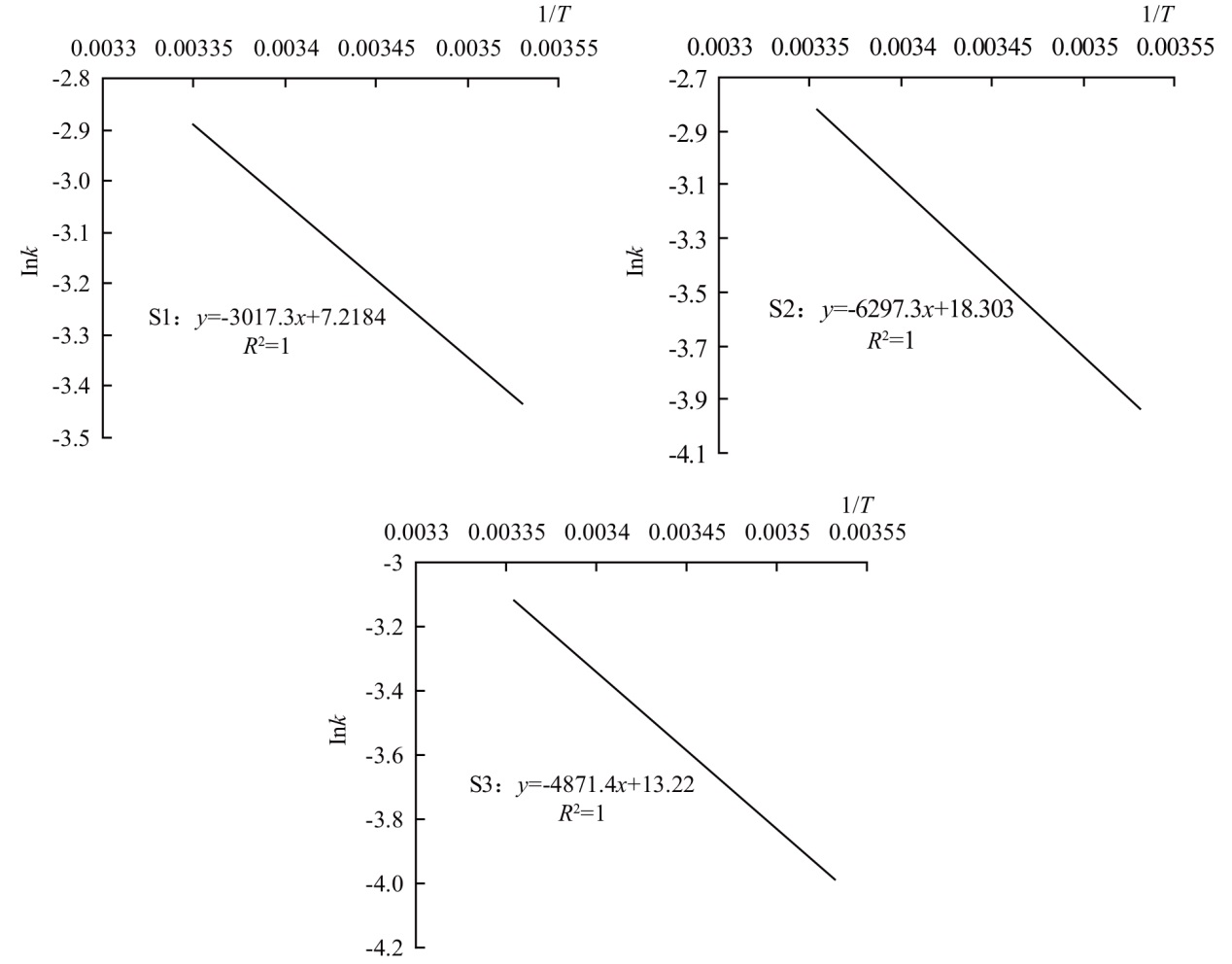
| 品种 | 贮藏温度/ ℃ | 回归方程 | 回归系数 (R2) | 反应速率常数 (k) |
|---|---|---|---|---|
| S1 | 25 | y=-0.0556x+3.9833 | 0.9651 | 0.0556 |
| 10 | y=-0.0323x+3.952 | 0.983 | 0.0323 | |
| S2 | 25 | y=-0.0597x+3.5148 | 0.8959 | 0.0597 |
| 10 | y=-0.0195x+3.4483 | 0.9148 | 0.0195 | |
| S3 | 25 | y=-0.0442x+4.3033 | 0.987 | 0.0442 |
| 10 | y=-0.0186x+4.2658 | 0.9879 | 0.0186 |
| [1] |
王仁杰, 蔡红明, 丁发强, 等. 5种口感番茄的风味物质分析与感官评价[J]. 中国蔬菜, 2025(6):146-156.
|
| [2] |
doi: 10.1016/j.postharvbio.2025.113845 URL |
| [3] |
doi: 10.1007/s00216-018-0854-8 pmid: 29350256 |
| [4] |
李景富, 何艳龙, 尚娜, 等. 番茄果实硬度与多个性状间相关分析及通径分析[J]. 东北农业大学学报, 2016, 47(5):1-8.
|
| [5] |
doi: 10.1186/s42506-021-00095-w |
| [6] |
doi: 10.1016/j.molliq.2023.122407 URL |
| [7] |
柯旭波, 潘凌洁, 张路, 等. 11个番茄品种的品质比较[J]. 湖北农业科学, 2015, 54(15):3692-3695.
|
| [8] |
程远, 万红建, 刘超超, 等. 十六个樱桃番茄品种果实风味品质相关指标比较分析[J]. 浙江农业学报, 2018, 30(11):1859-1869.
doi: 10.3969/j.issn.1004-1524.2018.11.08 |
| [9] |
庞胜群, 赵飏, 李格, 等. 灰色关联分析法综合评价不同品种加工番茄的品质[J]. 石河子大学学报(自然科学版), 2006(6):682-684.
|
| [10] |
曹建康. 果蔬采后生理生化指导[M]. 北京: 中国轻工业出版社,2022:29-49,70-72.
|
| [11] |
曾凡凡. MA包装结合1-MCP对樱桃番茄贮藏保鲜效果的影响[J]. 农业与技术, 2026, 46(7):34-39.
|
| [12] |
李爱玲. 油菜素内酯介导SlSAM3调控番茄果实色泽的分子机制[D]. 兰州: 甘肃农业大学, 2025.
|
| [13] |
doi: 10.1016/j.nbt.2021.02.002 URL |
| [14] |
刘秀云, 曹碧婷, 岳钉伊, 等. 西瓜种质资源番茄红素含量鉴定与评价[J]. 中国瓜菜, 2025, 38(2):25-31.
|
| [15] |
梁结桦, 冯瑞, 田柬昕, 等. 不同贮藏温度对即食花胶品质的影响及其保质期预测模型的建立[J]. 农产品加工, 2026(10):70-74.
|
| [16] |
裴娇艳. 番茄果实采后品质特性变化及预测模型研究[D]. 南京: 南京农业大学, 2010.
|
| [17] |
刘晶玉, 等. 赛菲娅·斯拉衣丁,阿迪娜·赛提汗, 臭氧处理对番茄果实贮藏期品质及活性氧代谢的影响[J]. 保鲜与加工, 2025, 25(9):31-39.
|
| [18] |
张珮, 刘妍, 潘转, 等. 低温贮藏的桃果实品质近红外光谱预测模型比较[J]. 中国食品学报, 2025, 25(10):386-396.
|
| [19] |
张翼斐, 鲁丁强, 刘玉姣, 等. 温度对采后番茄代谢通量的影响研究[J]. 保鲜与加工, 2025, 25(10):36-45.
|
| [20] |
|
| [21] |
张晓英, 毛咪, 靳雨婷, 等. 不同药剂处理对番茄果实转色及品质的影响[J]. 植物科学学报, 2026, 44(3):379-390.
|
| [22] |
黄鑫燕, 匡家灵, 陈月舞, 等. 磷酸二氢钾与硼酸配施对番茄生长、果实品质与转色的影响[J]. 作物杂志, 2026.
|
| [23] |
黄玉波, 梁路, 庄秋丽, 等. 蚯蚓营养液促进番茄生长并改善其果实品质[J]. 北方园艺, 2025(1):44-51.
|
| [24] |
屈乃聃, 曹玲玲, 王惠玉, 等. 蔬菜抗坏血酸合成代谢及影响因素研究进展[J]. 蔬菜, 2025(5):17-26.
|
| [25] |
李蕾. Sly-miR167a调控番茄果实采后低温耐受能力的表观遗传学机制研究[D]. 海口: 海南大学, 2024.
|
| [26] |
戴露. 几种微生物菌剂对盐渍环境下番茄的促生效果及果实品质的影响研究[D]. 烟台: 鲁东大学, 2025.
|
| [27] |
doi: 10.1016/j.jspr.2025.102643 URL |
| [1] | YI Yong, LI Minhua. Evaluation Method and Classification of Climate Quality of Myrica rubra [J]. Chinese Agricultural Science Bulletin, 2026, 42(9): 130-137. |
| [2] | WANG Yi, LIU Tingting, JIN Fengwei, MA Xiaowei, DONG Yun. Effects of Several Stem and Leaf Herbicides on Yield and Quality in Spring Rapeseed of Brassica napus L. [J]. Chinese Agricultural Science Bulletin, 2026, 42(9): 190-196. |
| [3] | ZHANG Yulong, ZHOU Lijuan, GUO Song, CHEN Jing, LIN Caixia, WAN Macao. Study on Planting Performance of Eight Highland Barley Varieties in High-altitude Environments [J]. Chinese Agricultural Science Bulletin, 2026, 42(9): 9-15. |
| [4] | HUANG Yongping, YANG Qingqing, DENG Yanjun, YE Pei. Effects of Spring Cold Air on Seedling Stocking Survival Rate of Crayfish and Prediction Model Construction [J]. Chinese Agricultural Science Bulletin, 2026, 42(8): 211-218. |
| [5] | MA Yongpeng, LIU Yuanjian, LONG Yunxing, QUAN Shenchun, YUE Kai, GAO Chaowen, PAN Zengrong, WANG Xi. Study on Responses of Yield and Quality of Angelica sinensis In Yunnan Province to Altitude and Climatic Factors [J]. Chinese Agricultural Science Bulletin, 2026, 42(8): 30-37. |
| [6] | BI Yanliang, QI Shihan, LI Qiongwei, ZOU Xiaoxia, SI Tong. Physiological Mechanism of Seed Coating Agent in Promoting Peanut Seed Germination and Seedling Growth Under Low Temperature [J]. Chinese Agricultural Science Bulletin, 2026, 42(8): 44-52. |
| [7] | HUANG Jian, JING Jiyue, LIN Haohan. Research Progress on Application of Different Types of Fertilizers in Tea [J]. Chinese Agricultural Science Bulletin, 2026, 42(7): 97-104. |
| [8] | ZHOU Liyao, LIU Juan, LIU Haijiao, CUI Yanan, LIU Bing, LUO Yilong, YU Longcheng, CHEN Yafei, XU Risheng, MA Tengfei. Research Progress on Application of Biochar in Peanut Cultivation [J]. Chinese Agricultural Science Bulletin, 2026, 42(7): 15-21. |
| [9] | GAO Qin, CHEN Huanhuan, ZHU Qifa, XIA Hao, YU Fei, SHEN Jia, JIANG Chaoqiang. Study on Relationship Between Chemical Composition and Sensory Quality of Tobacco Middle Leaves in Southern Anhui Tobacco Area [J]. Chinese Agricultural Science Bulletin, 2026, 42(7): 204-209. |
| [10] | YANG Xin, ZHANG Mingjin, LI Bin, ZHANG Yonghui, XIE Qiang, WANG Jian’an. Effect of Different Harvesting Methods with Stems on Curing Quality of Upper Leaves [J]. Chinese Agricultural Science Bulletin, 2026, 42(7): 210-218. |
| [11] | ZHANG Guizhi, ZHAO Hongjun, WANG Wenliang, CHEN Lan, ZHANG Xiaojie, LIU Guodong. Effects of Defoliation and Ripening Agent on Yield and Fiber Quality of Cotton Cultivars in Light and Simplified Regional Trials [J]. Chinese Agricultural Science Bulletin, 2026, 42(7): 22-29. |
| [12] | ZHAO Chengkun, CHEN Liang, SHI Xiangdong, LI Mengxu, LYU Shangju, CAO Chanhua, DING Songshuang, YANG Zhanwei. Effects of Nitrogen Fertilizer Application Rates on Growth and Development of Cigar Wrapper Tobacco and Quality of Tobacco Leaves in Greenhouse Cultivation [J]. Chinese Agricultural Science Bulletin, 2026, 42(7): 48-54. |
| [13] | DING Lihua, TONG Jianping, WU Qun, WANG Tongliang, GU Zhenhai. Construction and Grading Evaluation of Climate Quality Model for Huyou [J]. Chinese Agricultural Science Bulletin, 2026, 42(6): 127-132. |
| [14] | LIU Wei, DUAN Xiaofeng, WU Guozhou, BAO Jiajing, LI Shuqi. Sunflower Seed Quality Zoning in Hetao Irrigation District Based on Meteorological Conditions [J]. Chinese Agricultural Science Bulletin, 2026, 42(6): 133-140. |
| [15] | KAIDIRIYE Kerimu, WANG Xuejiao, WANG Sen, KERIMU Abasi, GUO Yanyun, HUO Xunguo, ZHANG Lizhen, HUANG Binxiang. Agroclimatic Conditions Leading to Freezing Injury in Walnut Flowering-stage and Its Causes Analysis: A Case Study of Yecheng County, Xinjiang [J]. Chinese Agricultural Science Bulletin, 2026, 42(6): 141-149. |
| Viewed | ||||||
|
Full text |
|
|||||
|
Abstract |
|
|||||
