欢迎访问《中国农学通报》,

中国农学通报 ›› 2026, Vol. 42 ›› Issue (12): 29-37.doi: 10.11924/j.issn.1000-6850.casb2025-0477

• 农学·农业基础科学 • 上一篇    下一篇

耕作和候芽调控对杂草油菜发生、菜籽产量和品质的影响

杨泽鹏(), 敖玉琴, 万柯均, 郑盛华, 马明坤, 杨继刚, 杨昊, 万学, 陈尚洪, 刘定辉, 陈红琳()   

  1. 四川省农业科学院农业资源与环境研究所/农业农村部西南山地农业环境重点实验室, 成都 610066
  • 收稿日期:2025-06-21 修回日期:2025-10-11 出版日期:2026-06-25 发布日期:2026-06-23
  • 通讯作者:
    陈红琳,女,1984年出生,四川大英人,研究员,硕士,主要从事油菜高产栽培生理生化研究。通信地址:610066 四川省成都市锦江区静平路666号 四川省农业科学院农业资源与环境研究所,Tel:028-84504285,E-mail:
  • 作者简介:

    杨泽鹏,男,1995年出生,山西芮城人,助理研究员,硕士,主要从事作物养分资源管理与绿色种植技术研究。通信地址:610066 四川省成都市锦江区静平路666号 四川省农业科学院农业资源与环境研究所,Tel:028-84504285,E-mail:

  • 基金资助:
    国家重点研发计划项目“西南地区油菜-水稻大面积单产提升技术模式集成示范”(2024YFD2300400); 国家现代农业产业技术体系四川油菜创新团队项目“油菜高产耕地培育及关键技术岗位”(sccxtd-2025-03); 四川省“十四五”生物育种重大科技专项“绿色高效油菜重大新品种培育”(2022ZDZX0015); 四川省农业科学院“1+9揭榜挂帅”科技攻关项目“耕地质量提升及环境治理重大技术”(1+9 KJGG005)

Effects of Tillage and Budding Regulation on Weedy Rapeseed Occurrence, Rapeseed Yield, and Quality

YANG Zepeng(), AO Yuqin, WAN Kejun, ZHENG Shenghua, MA Mingkun, Yang Jigang, Yang Hao, WAN Xue, CHEN Shanghong, LIU Dinghui, CHEN Honglin()   

  1. Institute of Agricultural Resources and Environment, Sichuan Academy of Agricultural Sciences / Key Laboratory of Agricultural Environment in Mountainous Regions of Southwest China, Ministry of Agriculture and Rural Affairs, Chengdu 610066
  • Received:2025-06-21 Revised:2025-10-11 Published:2026-06-25 Online:2026-06-23

摘要:

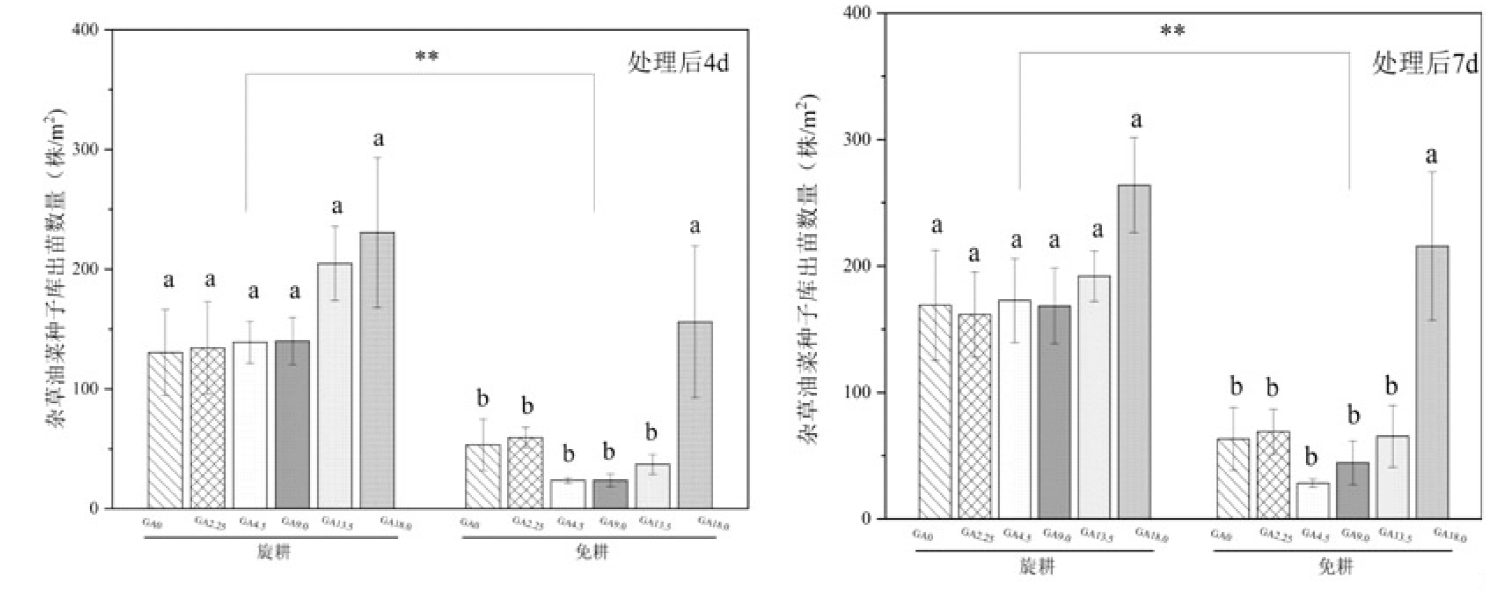
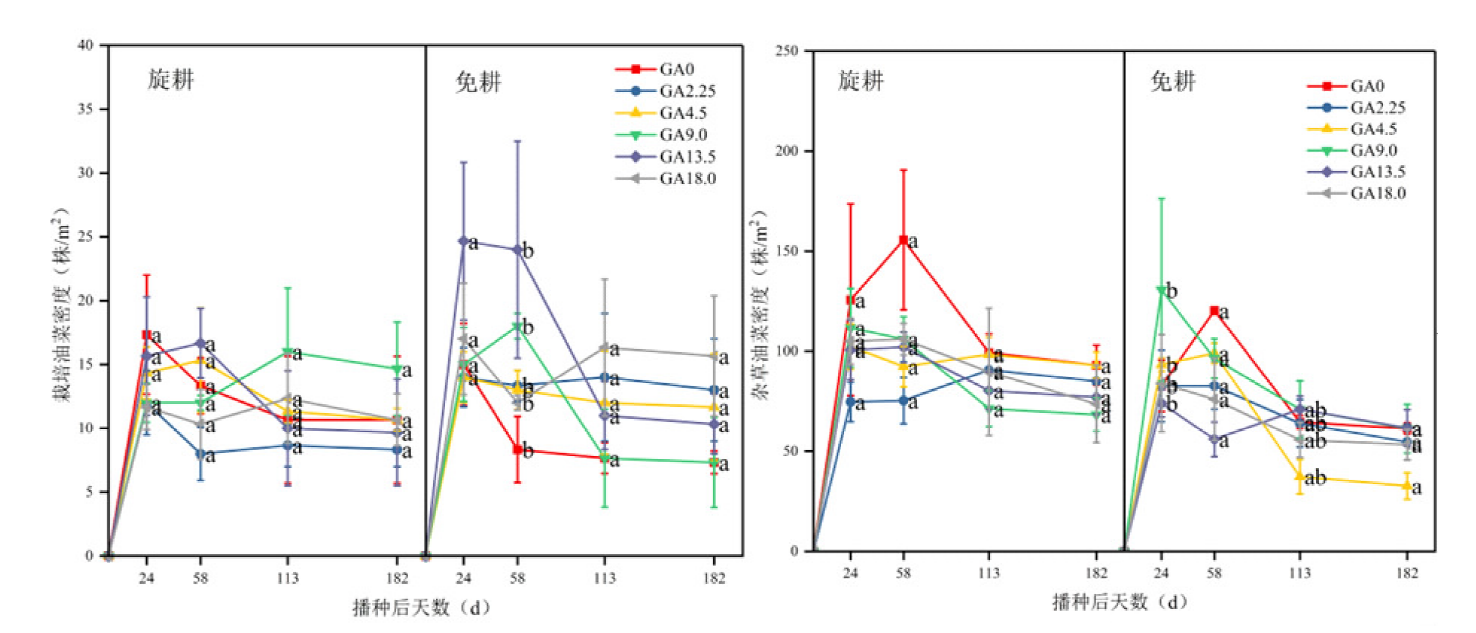
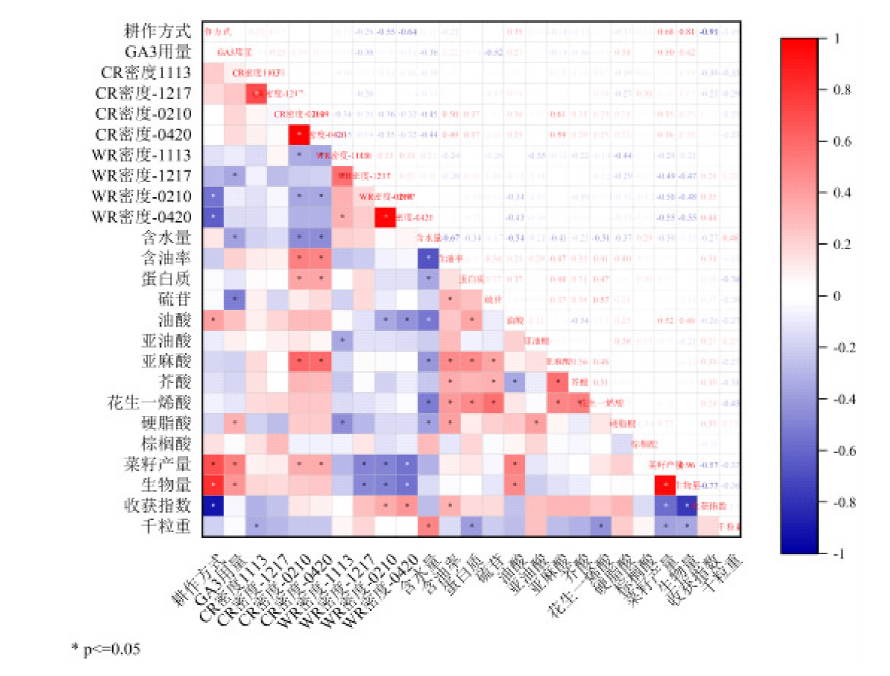
稻油轮作直播区杂草油菜(自生苗)发生严重,与栽培油菜激烈竞争并降低产量品质,现有防控技术难以适配机械化生产。为明确耕作方式与赤霉素(GA3)候芽调控对稻油轮作田块杂草油菜发生、栽培油菜产量与品质的影响,构建绿色防控技术模式,以长期稻油轮作直播田为对象,采用旋耕、免耕2种耕作方式,设置0、2.25、4.5、9.0、13.5、18.0 L/hm2 6个GA3播前调控处理,测定杂草油菜出苗密度、群体动态及栽培油菜产量及品质指标。结果表明:杂草油菜密度显著高于栽培油菜,旋耕与免耕条件下分别为其7.6~8.1倍和5.0~6.1倍。出苗调查表明,旋耕处理较免耕出苗量分别提高176.9%和131.7%;免耕条件下GA18.0处理出苗量较GA0显著增加192.3%~240.3%。产量方面,各处理栽培油菜产量均低于杂草油菜,旋耕与免耕下分别仅为杂草油菜的48.61%和60.23%。品质上,栽培油菜含油率(均值43.14%)较杂草油菜高16.5%,硫苷含量较杂草油菜低34.45%。高浓度GA3(如GA18.0)在免耕条件下可显著提高栽培油菜产量(最高达1171.03 kg/hm2),并一定程度降低籽粒硫苷含量。研究表明,耕作结合GA3前期诱芽调控可有效激活杂草油菜种子库、降低田间群体优势,配合灌水诱芽与轮作,可实现杂草油菜可持续防控。未来可进一步开展不同土层休眠种子激活机制与农机农艺融合防控技术研究,为西南稻油轮作区油菜绿色高产高效生产提供支撑。

关键词: 油菜, 稻油轮作, 杂草油菜, 耕作方式, 候芽调控, 赤霉素GA3, 种子休眠, 产量, 品质

Abstract:

The weedy rapeseed (volunteer rapeseed) in the direct seeding area of rice-rape rotation is serious, which competes fiercely with cultivated rapeseed and reduces the yield and quality. The existing prevention and control technology is difficult to adapt to mechanized production. To elucidate the effects of tillage practices and pre-germination gibberellic acid (GA3) application on the occurrence of volunteer rapeseed and the yield and quality of cultivated rapeseed in rice- rapeseed rotation fields, thereby providing a basis for developing effective control strategies, the study was conducted in a long-term rice-rapeseed rotation field. Employing two tillage methods(rotary tillage and no-tillage) combined with varying rates of pre-emergence GA3 application (0, 2.25, 4.5, 9.0, 13.5, and 18.0 L/hm2), density of volunteer rapeseed, the yield and quality parameters of cultivated rapeseed, were measured. Results showed that volunteer rapeseed density significantly exceeded that of the cultivated crop, being 7.6-8.1 times and 5.0-6.1 times higher under tillage and no-tillage conditions, respectively. Emergence surveys indicated that tillage increased volunteer emergence by 176.9% and 131.7% compared to no-tillage. Under no-tillage, the GA3 treatment at 18.0 L/hm2 increased volunteer emergence by 192.3%-240.3% relative to the control (0 L/hm2). Regarding yield, cultivated rapeseed yields under all treatments were lower than those of volunteer plants, reaching only 48.61% and 60.23% of volunteer rape yields under tillage and no-tillage, respectively. In terms of quality, cultivated rapeseed exhibited an oil content (mean 43.14%) that was 16.5% higher than that of volunteer rape, while its glucosinolate content was 34.45% lower. High-concentration GA3 (e.g., 18.0 L/hm2) significantly increased cultivated rapeseed yield under no-tillage conditions (up to 1171.03 kg/hm2) and moderately reduced seed glucosinolate content. Combining tillage with pre-germination gibberellic acid regulation effectively suppresses volunteer rapeseed occurrence while enhancing the yield, oil content, and fatty acid composition of the cultivated crop. When integrated with irrigation-induced germination and crop rotation measures, this approach enables sustainable pest management in rapeseed production. In the future, the research on the activation mechanism of dormant seeds in different soil layers and the integrated prevention and control technology of agricultural machinery and agronomy can be further carried out to provide support for the green, high-yield and high-efficiency production of rapeseed in the rice-rape rotation area of Southwest China.

Key words: rapeseed, rice-rape rotation, weedy rapeseed, tillage practices, pre-sowing germination regulation, gibberellic acid (GA3), seed dormancy, yield, quality

中图分类号: