欢迎访问《中国农学通报》,

中国农学通报 ›› 2026, Vol. 42 ›› Issue (4): 193-203.doi: 10.11924/j.issn.1000-6850.casb2025-0648

• 食品·营养·检测·安全 • 上一篇    下一篇

密封降氧和夏季仓间控温对片烟醇化过程关键化学成分的影响

袁艳花1(), 蓝军1, 杨萌萌2, 刘英杰3, 阳小栋1, 赵莉1, 张家升1, 杨妍4, 周锦涛4, 肖鹭4, 齐亮4, 黄磊1(), 王建伟2()   

  1. 1 广东中烟工业有限责任公司, 广州 510145
    2 中国烟草总公司郑州烟草研究院, 郑州 450001
    3 中国烟草总公司职工进修学院, 郑州 450008
    4 华南理工大学食品科学与工程学院, 广州 510640
  • 收稿日期:2025-08-05 修回日期:2026-01-15 出版日期:2026-02-27 发布日期:2026-02-27
  • 通讯作者:
    黄磊,男,1986年出生,湖南浏阳人,高级农艺师,本科,从事烟草醇化和烟叶质量评价研究。通信地址:510145 广州市海珠区赤岗路62号 广东中烟工业有限责任公司,Tel:020-84216053,E-mail:
    王建伟,男,1981年出生,山东泰安人,高级农艺师,硕士,从事烟草原料研究。通信地址:450001 河南省郑州市高新区枫杨街2号,Tel:037-167672326,E-mail:
  • 作者简介:

    袁艳花,女,1980年出生,陕西铜川人,助理农艺师,本科,从事烟叶仓储工作。通信地址:510145 广州市海珠区赤岗路62号 广东中烟工业有限责任公司,Tel:020-84216062,E-mail:

  • 基金资助:
    “广东韶关仓库片烟醇化调控技术研究”(粤烟工[2021]科字第005号); “广东地区片烟快速醇化工艺研究”(粤烟工[2023]科字第034号)

Effects of Sealed Hypoxia and Summer Temperature Control in Warehouse on Key Chemical Components During Tobacco Lamina Aging

YUAN Yanhua1(), LAN Jun1, YANG Mengmeng2, LIU Yingjie3, YANG Xiaodong1, ZHAO Li1, ZHANG Jiasheng1, YANG Yan4, ZHOU Jintao4, XIAO Lu4, QI Liang4, HUANG Lei1(), WANG Jianwei2()   

  1. 1 China Tobacco Guangdong Industrial Co., Ltd., Guangzhou 510145
    2 Zhengzhou Tobacco Research Institute of China National Tobacco Corporation (CNTC), Zhengzhou 450001
    3 CNTC Staff Training College, Zhengzhou 450008
    4 School of Food Science and Engineering, South China University of Technology, Guangzhou 510640
  • Received:2025-08-05 Revised:2026-01-15 Published:2026-02-27 Online:2026-02-27

摘要:

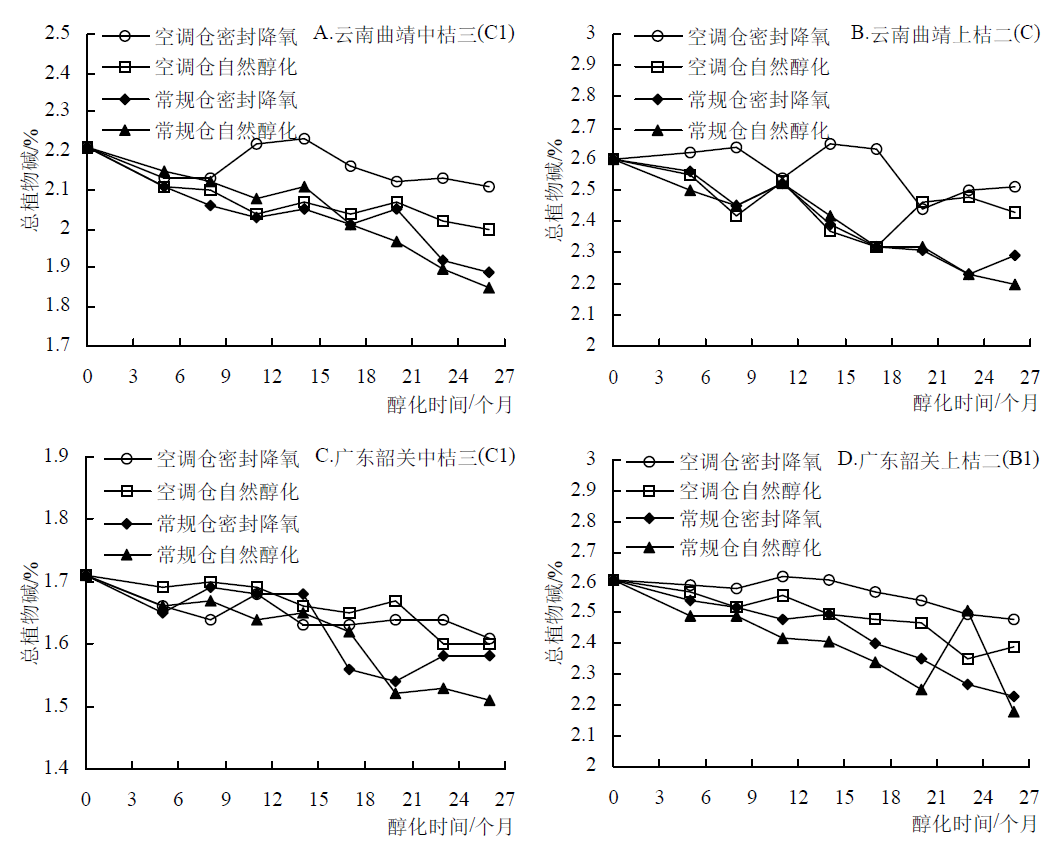
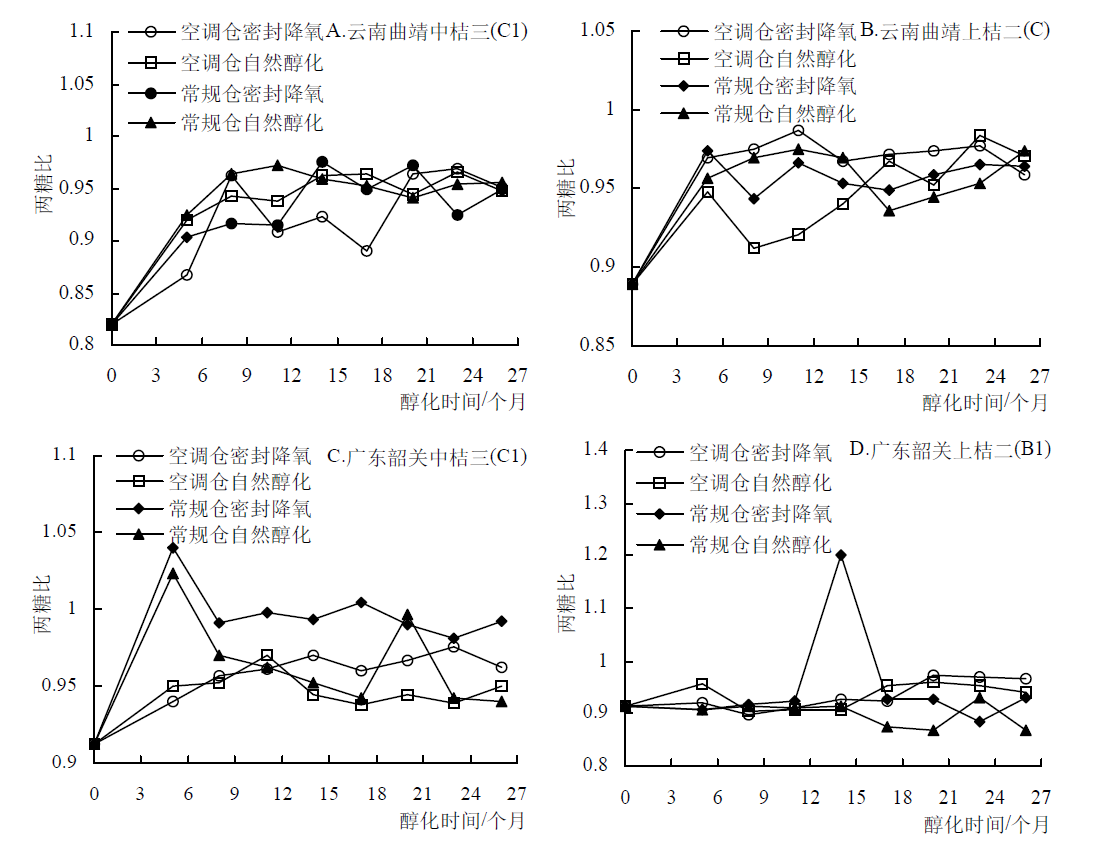
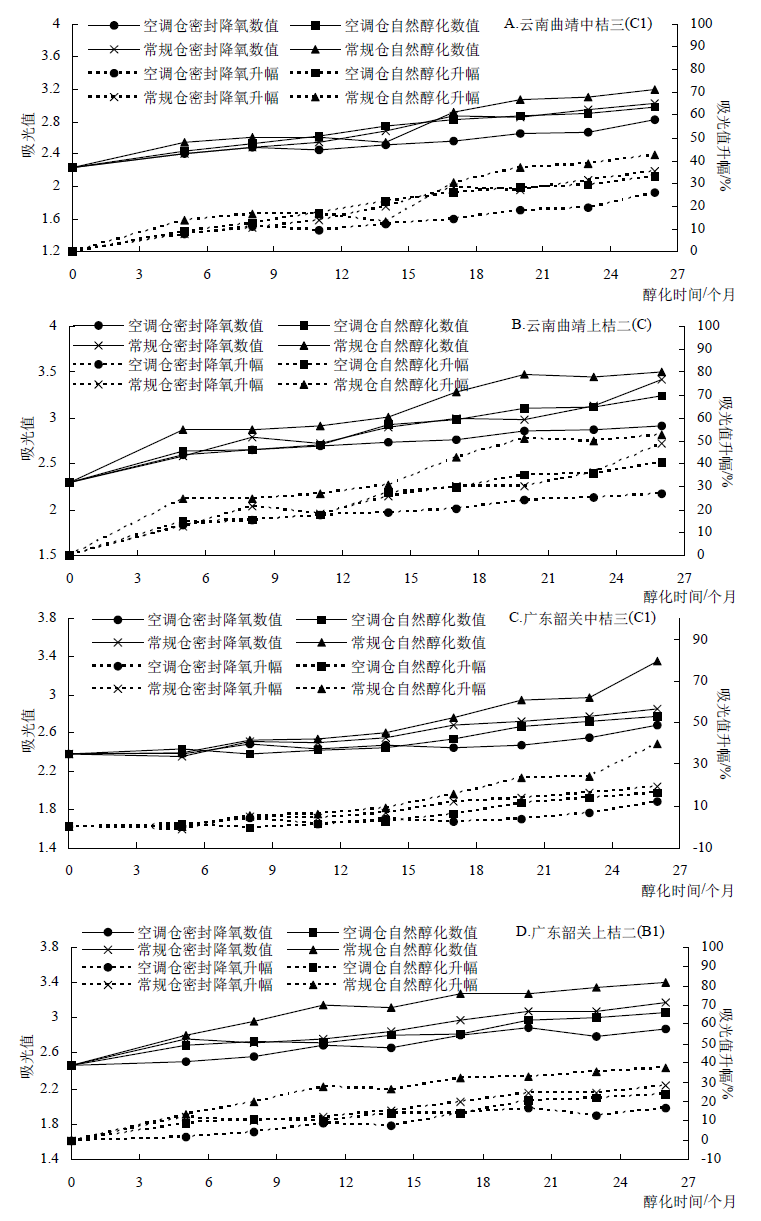
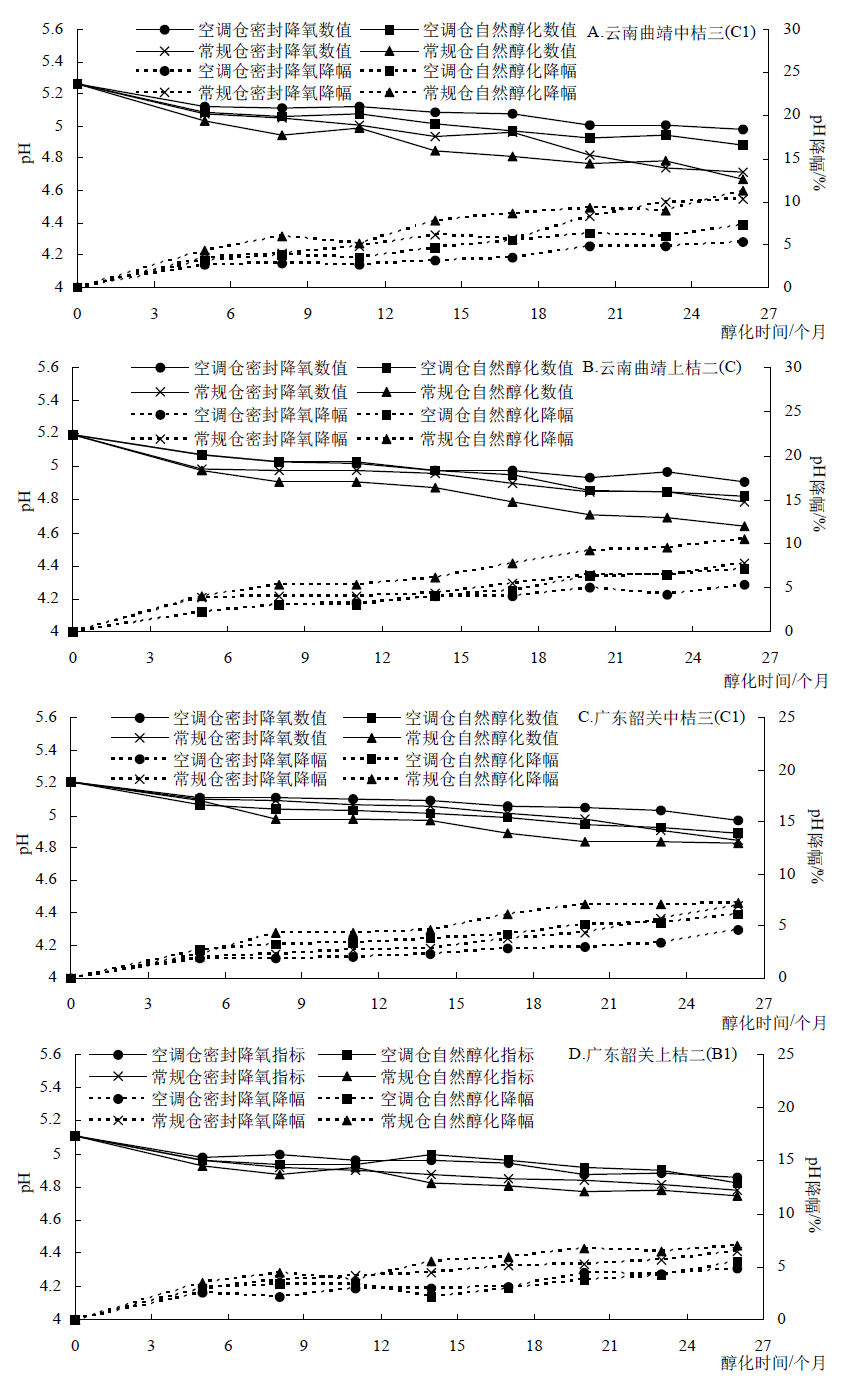
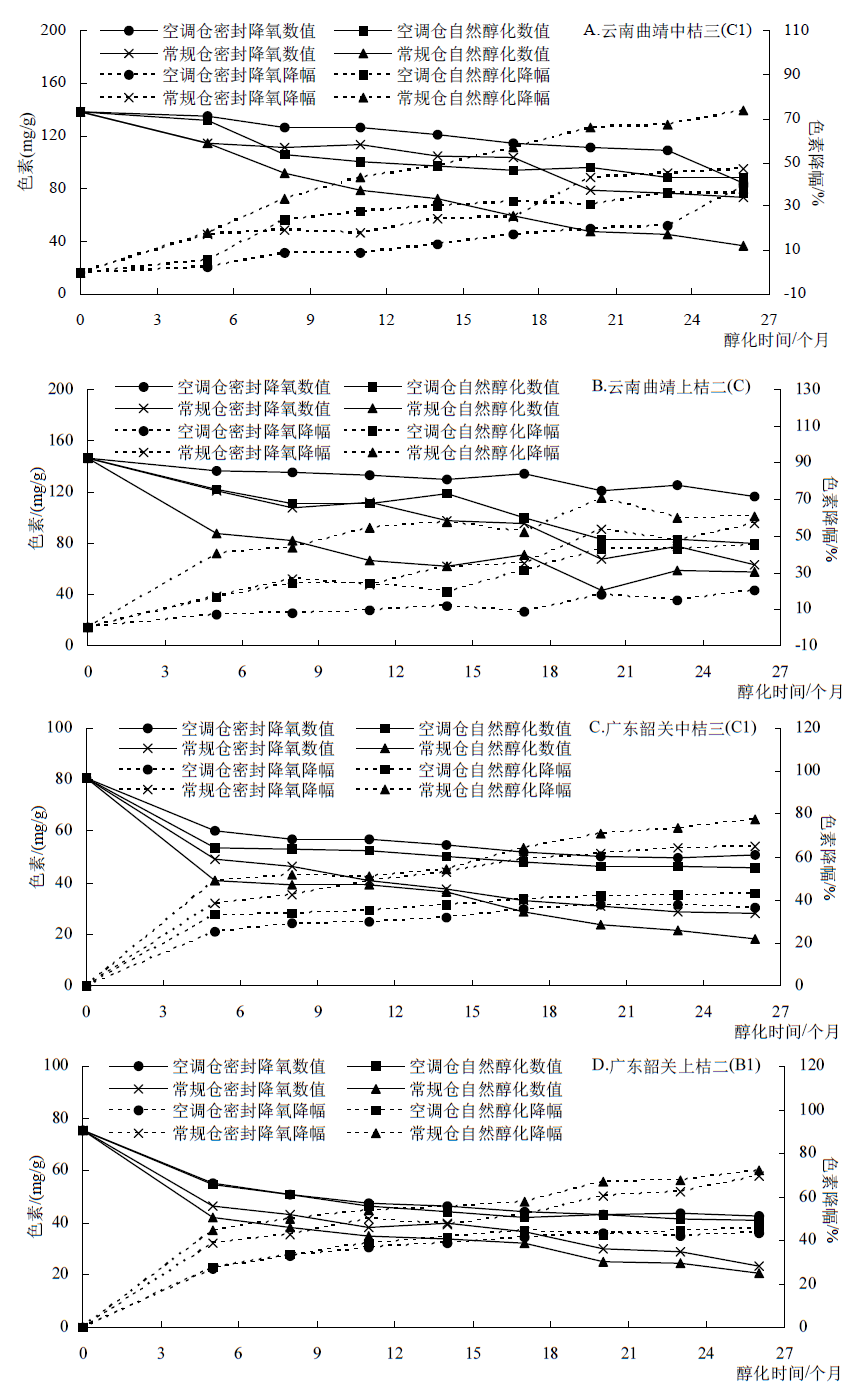
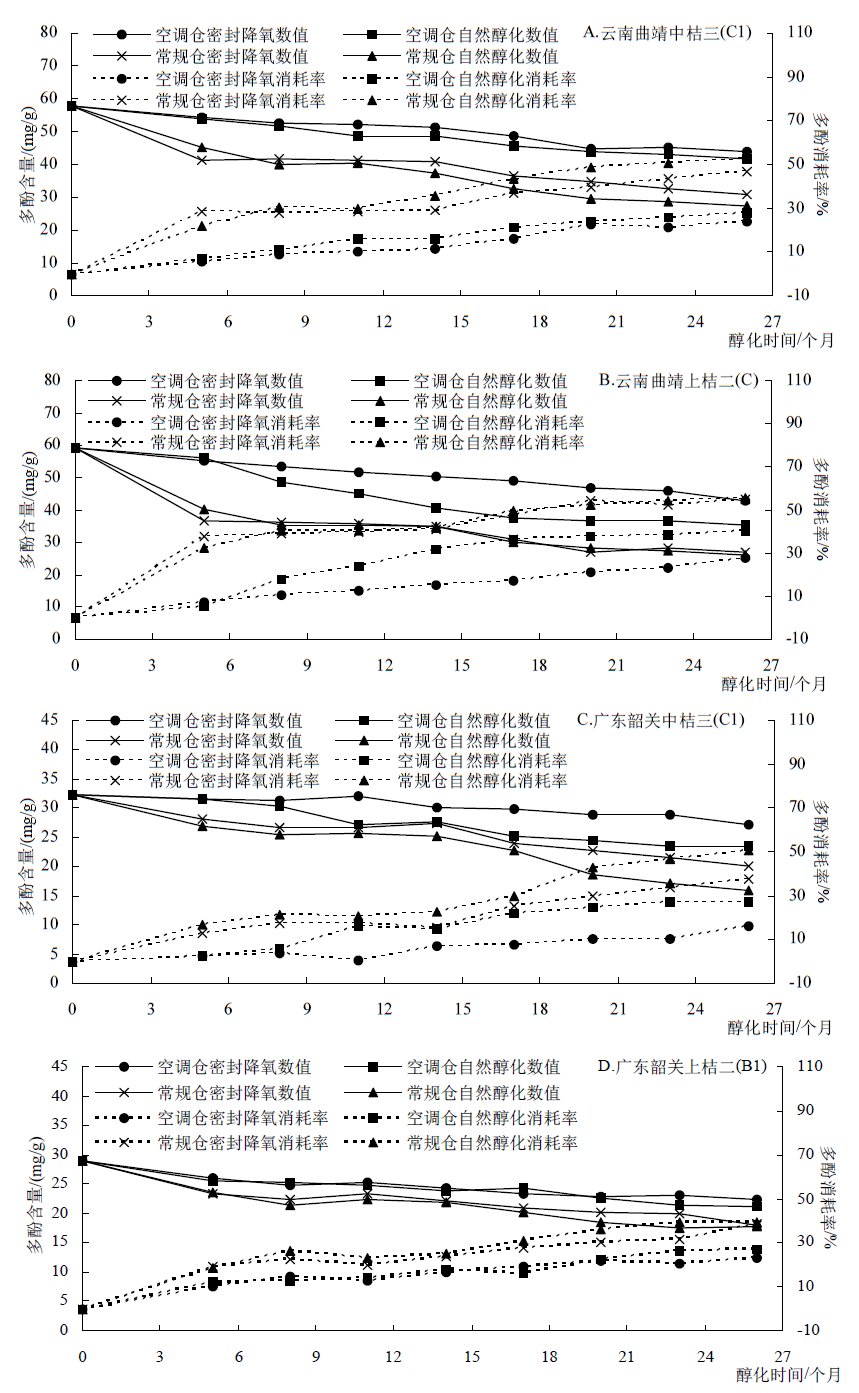
为探究密封降氧与自然供氧2种方式下,夏季仓间控温与否对烟叶化学成分的影响,以广东韶关和云南曲靖产的中部、上部片烟为材料,采用空调库密封降氧、空调库自然醇化、常规库密封降氧、常规库自然醇化4种养护模式,分析贮存条件对烟叶醇化过程中化学成分的影响。结果表明,与非控温常规库相比,控温空调库环境可显著延缓烟叶化学成分的变化速率,表现为各指标(总植物碱、多酚、色素、pH)变化幅度更平缓,而常规库环境可加速pH下降和多酚氧化进程。在相同温控条件下,密封降氧模式相比自然醇化模式能更有效地减缓化学成分变化。产地差异显示,云南曲靖烟叶初始多酚含量(59.35 mg/g)及化学成分变化幅度显著大于广东韶关烟叶(29.06 mg/g),前者在醇化初期呈现快速降解后趋于稳定。研究认为,控温是延缓烟叶醇化劣变、保持化学成分稳定的有效手段,尤其与密封降氧结合效果更佳。基于此,建议广东产区优先采用空调库密封降氧模式;云南产区烟叶因初始成分特性,适合在控温环境下适当延长醇化周期,以利于香气前体物质的保留与转化;形成“广东控温降氧优先、云南渐进醇化主导”的差异化仓储策略。

关键词: 片烟醇化, 烟叶仓储, 控温调控, 降氧醇化, 自然醇化, 化学成分, 产地差异

Abstract:

The paper aims to investigate the effects of sealed hypoxia versus natural oxygen supply, with or without summer temperature control, on the chemical components of tobacco leaves. Using tobacco lamina from Shaoguan (Guangdong) and Qujing (Yunnan) as the materials, four maintenance modes were applied: air-conditioned warehouse with sealed hypoxia, air-conditioned warehouse with natural aging, conventional warehouse with sealed hypoxia, and conventional warehouse with natural aging. The impact of storage conditions on chemical components during aging was analyzed. Compared to non-temperature-controlled conventional warehouses, temperature-controlled air-conditioned warehouses significantly slowed the rate of chemical changes in tobacco leaves, evidenced by gentler variation amplitudes in total alkaloids, polyphenols, pigments, and pH. Conventional warehouses notably accelerated pH decline and polyphenol oxidation. Under identical temperature control, sealed hypoxia more effectively retarded chemical changes than natural aging. Regional differences revealed that Qujing tobacco had higher initial polyphenol content (59.35 mg/g) and greater chemical variation than Shaoguan tobacco (29.06 mg/g), with rapid early-stage degradation stabilizing later. Temperature control is effective in delaying aging deterioration and stabilizing chemical components, particularly when combined with sealed hypoxia. For Guangdong-origin tobacco, the air-conditioned sealed hypoxia mode is recommended; for Yunnan tobacco, extended aging in temperature-controlled environments facilitates retention and conversion of aroma precursors. A differentiated storage strategy is proposed: ‘priority on temperature-controlled hypoxia for Guangdong, gradual aging dominance for Yunnan’.

Key words: tobacco strip aging, tobacco leaf storage, temperature control regulation, oxygen reduction aging, natural aging, chemical components, producing area differences