欢迎访问《中国农学通报》,

中国农学通报 ›› 2026, Vol. 42 ›› Issue (7): 85-91.doi: 10.11924/j.issn.1000-6850.casb2025-0386

• 林学·园艺·园林 • 上一篇    下一篇

芦竹基质替代对草菇生长特性及营养积累的影响

王剑豪1(), 彭洋洋1, 王思思1,2, 刘海军3, 潘梓恒3, 李欣阳1,2, 何焕清1, 徐江1, 肖自添1, 廖楠1, 刘明1()   

  1. 1 广东省农业科学院蔬菜研究所/广东省蔬菜新技术研究重点实验室, 广州 510640
    2 长江大学园艺园林学院, 湖北荆州 434025
    3 肇庆市国有大水口林场, 广东肇庆 526532
  • 收稿日期:2025-05-14 修回日期:2026-03-15 出版日期:2026-04-15 发布日期:2026-04-15
  • 通讯作者:
    刘明,男,1984年出生,湖北荆州人,副研究员,博士,主要从事食药用菌遗传育种与栽培。通信地址:510640 广州市天河区金颖路66号,Tel:020-38469598,E-mail:
  • 作者简介:

    王剑豪,男,1991年出生,河南新乡人,助理研究员,博士,研究方向为食药用菌遗传育种。通信地址:510640 广州市天河区金颖路66号,Tel:020-38469598,E-mail:

  • 基金资助:
    广东省林业科技创新项目“应用芦竹栽培灵芝等食用菌研究与示范”(2025KJCX018)

Effects of Arundo donax-based Substrate Substitution on Growth Characteristics and Nutrient Accumulation of Volvariella volvacea

WANG Jianhao1(), PENG Yangyang1, WANG Sisi1,2, LIU Haijun3, PAN Ziheng3, LI Xinyang1,2, HE Huanqing1, XU Jiang1, XIAO Zitian1, LIAO Nan1, LIU Ming1()   

  1. 1 Vegetables Research Institute, Guangdong Academy of Agricultural Sciences/Key Laboratory of Guangdong Vegetables Newly Technology, Guangzhou 510640
    2 College of Horticulture and Gardening, Yangtze University, Jingzhou, Hubei 434025
    3 State-owned Dashuikou Forest Farm, Zhaoqing, Guangdong 526532
  • Received:2025-05-14 Revised:2026-03-15 Published:2026-04-15 Online:2026-04-15

摘要:

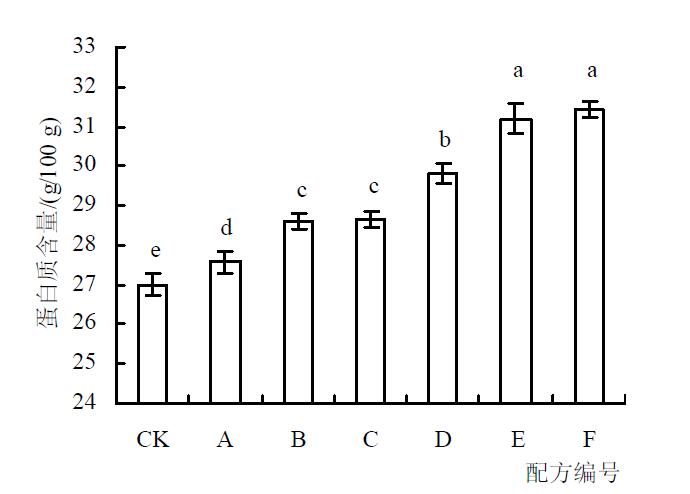
草菇传统栽培基质(棉籽壳、稻草)存在供应紧张、成本攀升的问题。为拓展廉价优质基质来源、推动农业废弃物循环利用,以芦竹为替代原料,设置0%(CK)、20%、40%、50%、60%、80%、99%不同芦竹添加质量比例梯度开展草菇栽培试验,分析不同配方对草菇生长特性、商品性状、产量及营养成分的影响。结果表明:(1)芦竹含量≤60%时,草菇菌丝生长速度(2.40~2.42 cm/d)、出菇周期(18~23 d)、商品性状(菇长4.33~4.83 cm、单菇重8.79~10.21 g)、鲜菇产量(535.16~550.42 g/框)及生物转化率(7.64%~7.86%)与CK处理无显著差异;芦竹含量≥80%时,各项指标显著下降。(2)60%芦竹配方的营养品质最优,蛋白质(29.83 g/100 g)、必需氨基酸(9.43 g/100 g)、呈味氨基酸(12.46 g/100 g)、灰分(9.00 g/100 g)及粗纤维(5.5 g/100 g)含量均显著高于CK,脂肪含量(1.3 g/100 g)低于CK。研究认为,芦竹可作为草菇栽培基质的优质替代原料,60%芦竹+39%棉籽壳+1%石膏为最优配方,该配方兼顾了草菇生长、产量与营养品质,可实现资源高效利用与成本降低的双重目标。

关键词: 草菇, 芦竹, 栽培, 基质, 替代配方, 生长, 营养成分

Abstract:

This study aims to identify low-cost and high-quality alternative materials to replace traditional substrates for straw mushroom (Volvariella volvacea) cultivation, thereby improving resource utilization efficiency, reducing cultivation costs, and increasing farmers’ income. Using Arundo donax as the experimental material, cultivation trials were conducted by incorporating it into the substrate at different mass ratios (0%, 20%, 40%, 50%, 60%, 80%, and 99%). The suitability of A. donax as a substrate alternative was evaluated through analyses of straw mushroom growth, economic traits, and nutritional composition. The results demonstrated that a substrate containing 60% A. donax was the most suitable alternative formulation. Under this treatment, mycelial growth (2.40-2.42 cm/d), cropping cycle (18-23 d), commercial traits (mushroom length 4.33-4.83 cm, single mushroom weight 8.79-10.21 g), fresh mushroom yield (535.16-550.42 g/tray), and biological conversion rate (7.64%-7.86%) did not differ significantly from those of the control. When the content of A. donax≥80%, the indexes decreased significantly. Meanwhile, the nutritional quality of straw mushrooms cultivated with this formulation was significantly improved. The protein content reached 29.83 g/100 g, while the contents of essential amino acids, umami amino acids, ash, and crude fiber were 9.43, 12.46, 9.00 and 5.5 g/100 g, respectively, all of which were significantly higher than those of the control, and the fat content (1.3 g/100 g) was lower than that of CK. It is concluded that A. donax could be used as a high-quality alternative raw material for V. volvacea cultivation matrix, and 60% A. donax+ 39% cottonseed hull+ 1% gypsum is the optimal formula. This formula takes into account the growth, yield and nutritional quality of V. volvacea, and could achieve the dual goals of efficient utilization of resources and cost reduction.

Key words: Volvariella volvacea, Arundo donax, cultivation, substrate, alternative formulation, growth, nutritional composition