Welcome to Chinese Agricultural Science Bulletin,

Chinese Agricultural Science Bulletin ›› 2026, Vol. 42 ›› Issue (13): 1-5.doi: 10.11924/j.issn.1000-6850.casb2025-0652

    Next Articles

A Comparative Study on Flag Leaf Photosynthetic Characteristics, Yield and Quality of High-quality Japonica Rice Between China and Japan

SUN Jianquan(), YIN Chunyuan(), HUANG Jinhua, LIU Hemei, HU Xiuming, WANG Hele, ZHANG Jinxia, ZHANG Qianqian, TIAN Fanghui, WANG Shuyu   

  1. Xinxiang Academy of Agricultural Sciences, Xinxiang, Henan 453002
  • Received:2025-08-05 Revised:2026-01-17 Online:2026-07-15 Published:2026-07-09

Abstract:

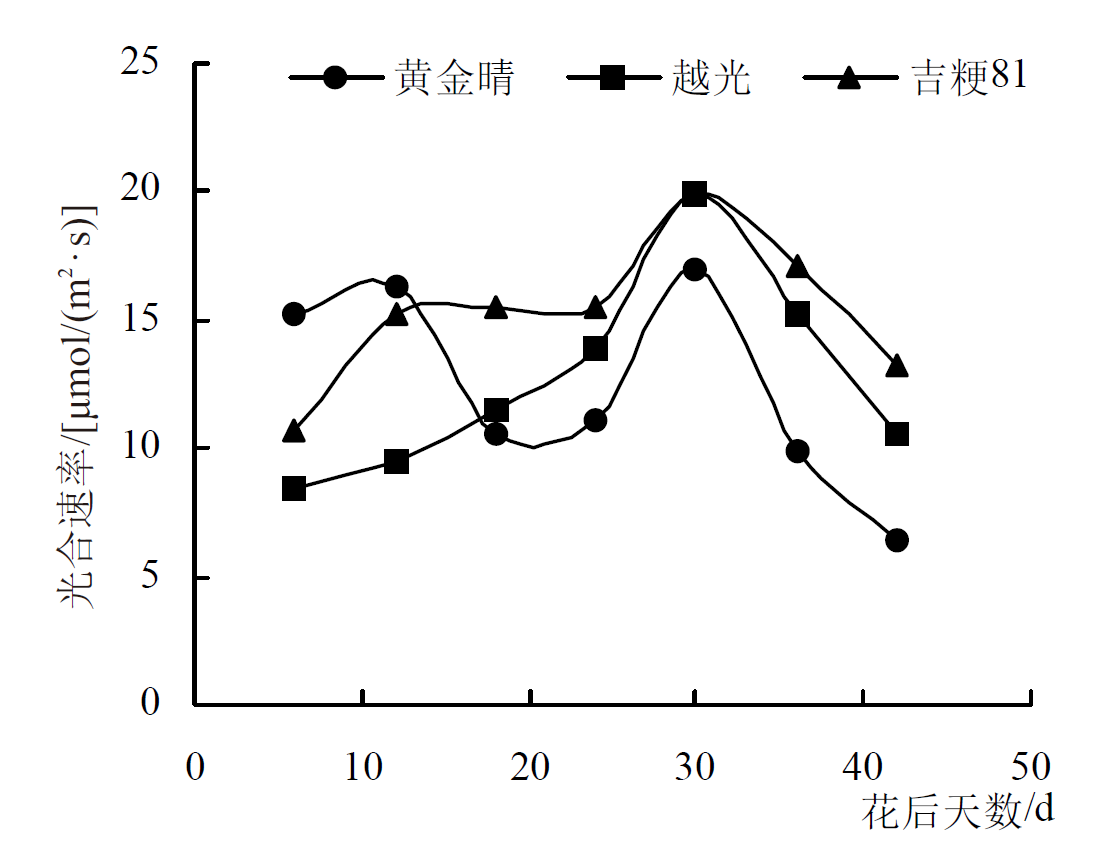
To clarify the differences in yield and quality of high-quality japonica rice varieties cultivated in three distinct ecological zones, namely Northeast China, the Yellow River Basin of China, and Japan, this study used three representative varieties ‘Jijing 81’, ‘Huangjinqing’ and ‘Yueguang’ as experimental materials. Under the conditions of unified water and fertilizer management for high-yield cultivation in the field of Xinxiang, Henan, we systematically investigated the dynamic changes in flag leaf photosynthetic rate during the growth period, as well as the yield and quality characteristics of the test varieties. The results showed that ‘Jijing 81’ achieved the highest yield of 9.50 t/hm2, followed by ‘Yueguang’ (7.83 t/hm2), while ‘Huangjinqing’ had the lowest yield (6.50 t/hm2). The yield advantage of ‘Yueguang’ was attributed to the increase of effective panicle number, with the maximum effective panicle number reaching 414400 panicles/hm2 and the minimum number of 300000 panicles/hm2. This was significantly higher than that of conventional varieties (200000 panicles/hm2) in production, indicating that all three varieties had strong tillering potential. A comprehensive analysis of appearance, processing and eating quality indicators showed that, compared with the other two varieties, ‘Yueguang’ exhibited distinct advantages. It had a low length-width ratio of only 1.77, a chalky grain rate of 14.00%, a chalkiness degree of 5.22% and an amylose content of 14.6%, with all indicators at low levels, demonstrating that this variety had excellent and stable quality. The comparison of flag leaf photosynthetic rate indicated that during the whole grain filling period, the average photosynthetic rate of the three varieties was ranked as ‘Jijing 81’[19.96 μmol/(m2·s)]> ‘Yueguang’ [19.88 μmol/(m2·s)]> ‘Huangjinqing’ [16.95 μmol/(m2·s)], which was completely consistent with the yield ranking. This confirmed that the improvement of rice yield mainly depended on the increase of flag leaf photosynthetic rate, indicating a good coordination between flag leaf photosynthetic rate and yield, and no synergistic relationship was observed between quality and yield. In conclusion, flag leaf photosynthetic rate can be used as a core reference index for high-yield japonica rice breeding. For high-quality japonica rice breeding, the criterion of low chalkiness, low amylose content, and high head rice rate and high eating quality value should be taken as the key breeding direction.

Key words: japonica rice, yield, quality, Northeast japonica rice, Yellow River japonica rice, Japanese japonica rice

CLC Number: