Welcome to Chinese Agricultural Science Bulletin,

Chinese Agricultural Science Bulletin ›› 2026, Vol. 42 ›› Issue (17): 131-140.doi: 10.11924/j.issn.1000-6850.casb2026-0284
Previous Articles Next Articles
REN Qingfeng( ), ZHANG Dongping, WANG Jie, WANG Hongbin, HUANG Fulin, XIONG Xinyi, MA Lei
Received:2026-04-07
Revised:2026-07-08
Online:2026-09-15
Published:2026-09-09
CLC Number:
REN Qingfeng, ZHANG Dongping, WANG Jie, WANG Hongbin, HUANG Fulin, XIONG Xinyi, MA Lei. Uncertainty Characteristics of Climatic Potential Productivity in Guizhou Based on Normal Cloud Model[J]. Chinese Agricultural Science Bulletin, 2026, 42(17): 131-140.
Add to citation manager EndNote|Ris|BibTeX
URL: https://www.casb.org.cn/EN/10.11924/j.issn.1000-6850.casb2026-0284
| H值 | 持性续强度 | H值 | 反持续性强度 |
|---|---|---|---|
| 0.80<H≤1.00 | 很强 | 0≤H<0.20 | 很强 |
| 0.75<H≤0.80 | 强 | 0.20≤H<0.25 | 强 |
| 0.65<H≤0.75 | 较强 | 0.25≤H<0.35 | 较强 |
| 0.55<H≤0.65 | 较弱 | 0.35≤H<0.45 | 较弱 |
| 0.50<H≤0.55 | 很弱 | 0.45≤H<0.50 | 很弱 |
| H值 | 持性续强度 | H值 | 反持续性强度 |
|---|---|---|---|
| 0.80<H≤1.00 | 很强 | 0≤H<0.20 | 很强 |
| 0.75<H≤0.80 | 强 | 0.20≤H<0.25 | 强 |
| 0.65<H≤0.75 | 较强 | 0.25≤H<0.35 | 较强 |
| 0.55<H≤0.65 | 较弱 | 0.35≤H<0.45 | 较弱 |
| 0.50<H≤0.55 | 很弱 | 0.45≤H<0.50 | 很弱 |
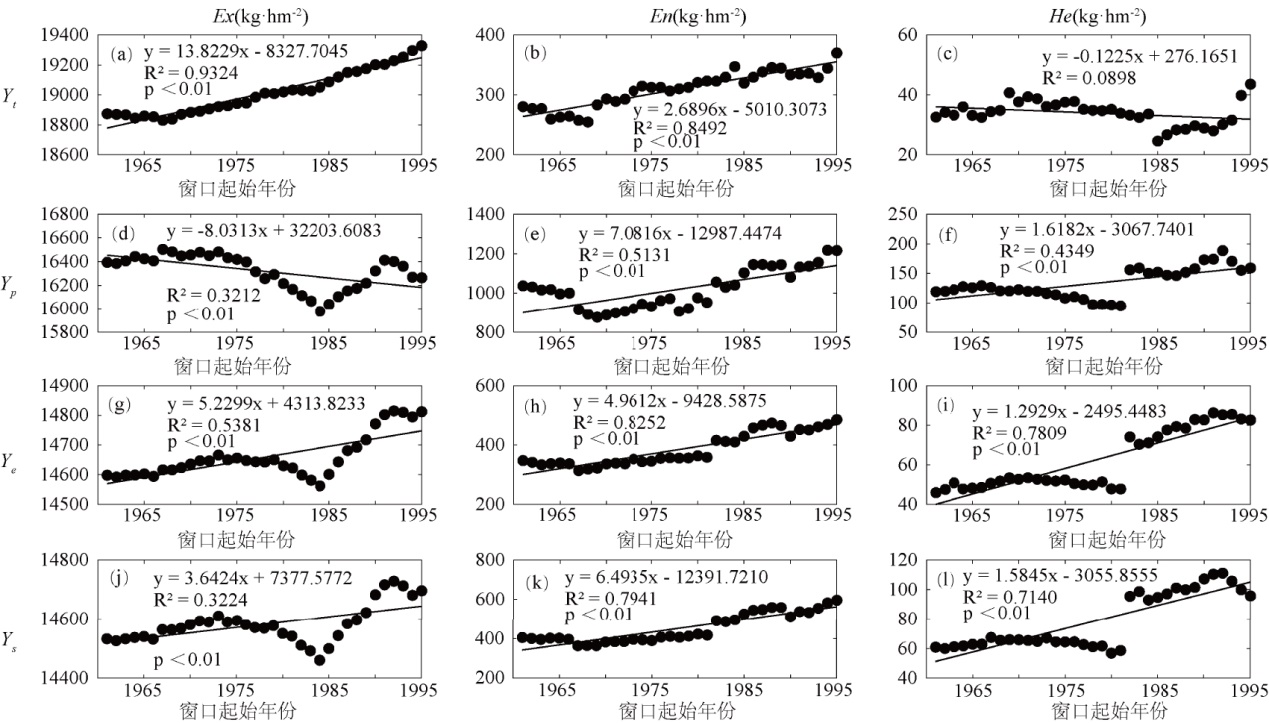
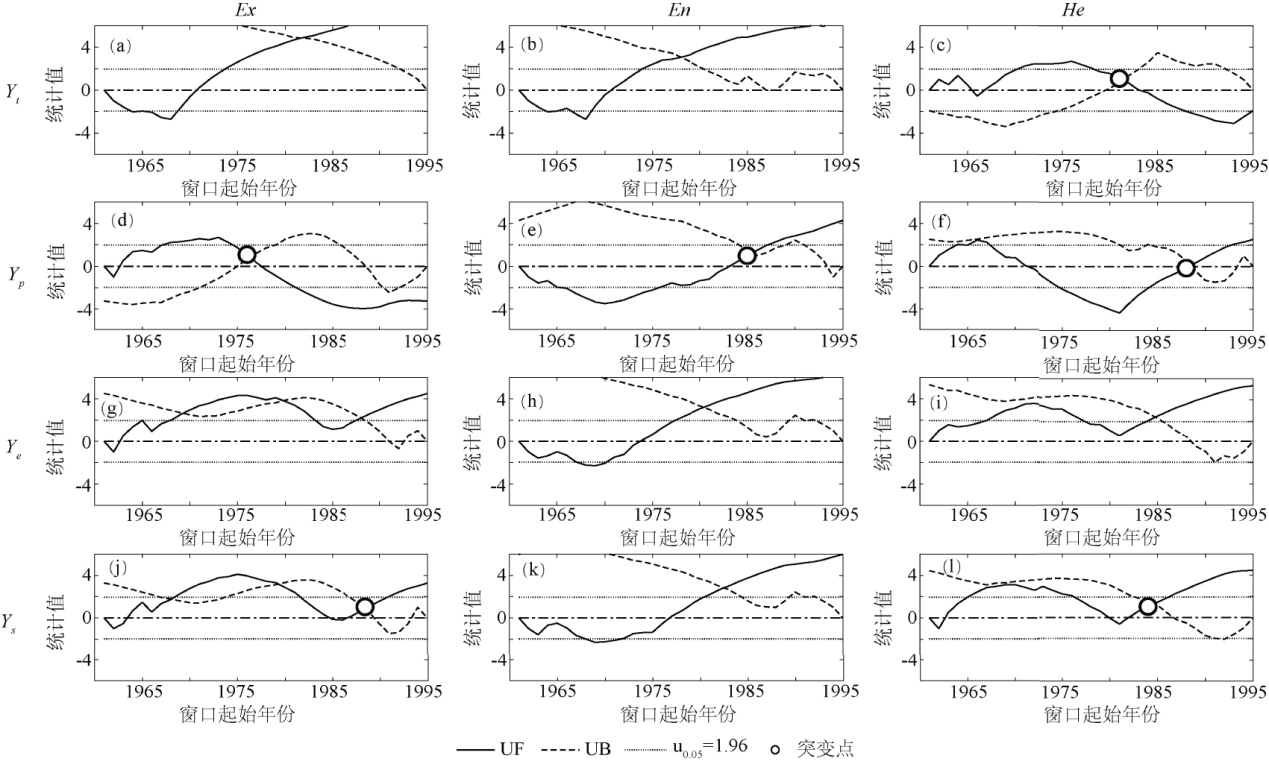
| Ex | En | He | |||||||||
|---|---|---|---|---|---|---|---|---|---|---|---|
| H值 | 持续(反持续)时间/a | 持续(反持续)强度 | H值 | 持续(反持续)时间/a | 持续(反持续)强度 | H值 | 持续(反持续)时间/a | 持续(反持续)强度 | |||
| Yt | 0.82 | 6 | 很强 | 0.60 | 9 | 较弱 | 0.83 | 8 | 很强 | ||
| Yp | 0.76 | 8 | 强 | 0.62 | 6 | 较弱 | 0.61 | 7 | 较弱 | ||
| Ye | 0.50 | - | 无 | 0.51 | 7 | 很弱 | 0.42 | 6 | 较弱 | ||
| Ys | 0.65 | 7 | 较弱 | 0.59 | 7 | 较弱 | 0.81 | 11 | 很强 | ||
| Ex | En | He | |||||||||
|---|---|---|---|---|---|---|---|---|---|---|---|
| H值 | 持续(反持续)时间/a | 持续(反持续)强度 | H值 | 持续(反持续)时间/a | 持续(反持续)强度 | H值 | 持续(反持续)时间/a | 持续(反持续)强度 | |||
| Yt | 0.82 | 6 | 很强 | 0.60 | 9 | 较弱 | 0.83 | 8 | 很强 | ||
| Yp | 0.76 | 8 | 强 | 0.62 | 6 | 较弱 | 0.61 | 7 | 较弱 | ||
| Ye | 0.50 | - | 无 | 0.51 | 7 | 很弱 | 0.42 | 6 | 较弱 | ||
| Ys | 0.65 | 7 | 较弱 | 0.59 | 7 | 较弱 | 0.81 | 11 | 很强 | ||
| Ex | En | He | |||||||||
|---|---|---|---|---|---|---|---|---|---|---|---|
| 第一模态 | 第二模态 | 前两个模态 | 第一模态 | 第二模态 | 前两个模态 | 第一模态 | 第二模态 | 前两个模态 | |||
| Yt | 96.34 | 2.54 | 98.88 | 77.33 | 13.07 | 90.39 | 46.95 | 23.67 | 70.63 | ||
| Yp | 61.25 | 24.19 | 85.44 | 64.98 | 16.55 | 81.53 | 72.64 | 8.76 | 81.40 | ||
| Ye | 76.94 | 11.19 | 88.12 | 83.22 | 6.57 | 89.79 | 85.05 | 6.16 | 91.21 | ||
| Ys | 62.94 | 20.43 | 83.38 | 83.12 | 6.54 | 89.66 | 79.43 | 6.98 | 86.40 | ||
| Ex | En | He | |||||||||
|---|---|---|---|---|---|---|---|---|---|---|---|
| 第一模态 | 第二模态 | 前两个模态 | 第一模态 | 第二模态 | 前两个模态 | 第一模态 | 第二模态 | 前两个模态 | |||
| Yt | 96.34 | 2.54 | 98.88 | 77.33 | 13.07 | 90.39 | 46.95 | 23.67 | 70.63 | ||
| Yp | 61.25 | 24.19 | 85.44 | 64.98 | 16.55 | 81.53 | 72.64 | 8.76 | 81.40 | ||
| Ye | 76.94 | 11.19 | 88.12 | 83.22 | 6.57 | 89.79 | 85.05 | 6.16 | 91.21 | ||
| Ys | 62.94 | 20.43 | 83.38 | 83.12 | 6.54 | 89.66 | 79.43 | 6.98 | 86.40 | ||
| [1] |
李涛辉, 张文翔, 吕爱锋, 等. 1978-2019年云南省气候生产潜力的时空演变及粮食产量响应[J]. 中国农学通报, 2023, 39(17):55-63.
doi: 10.11924/j.issn.1000-6850.casb2022-0441 |
| [2] |
李军, 周发元, 焦亮, 等. 1960-2022年河西走廊主要气候要素特征及气候生产潜力[J]. 中国沙漠, 2024, 44(6):14-25.
doi: 10.7522/j.issn.1000-694X.2024.00022 |
| [3] |
匡舒雅, 周泽宇, 梁媚聪, 等. IPCC第六次评估报告第二工作组报告解读[J]. 环境保护, 2022, 50(9):71-75.
|
| [4] |
doi: 10.1038/s41586-023-06474-x |
| [5] |
IPCC. Climate change 2021: the physical science basis[R]. Cambridge and New York: Cambridge University Press, 2021.
|
| [6] |
潘虹, 邱新法, 廖留峰, 等. 近50年贵州省气候生产潜力时空变化特征[J]. 干旱区资源与环境, 2014, 28(11):158-163.
|
| [7] |
张志高, 尹纪媛, 郭超凡, 等. 近61年河南省气候生产潜力估算及时空变化特征[J]. 西北农林科技大学学报(自然科学版), 2022, 50(6):53-62.
|
| [8] |
王宏, 杨东, 蓝小玉, 等. 基于SSPs路径下植被气候生产潜力的预测:以陕甘宁为例[J]. 高原气象, 2023, 42(1):233-243.
doi: 10.7522/j.issn.1000-0534.2022.00033 |
| [9] |
任青峰, 张正强, 梅可远, 等. 基于REOF分析的贵州省降水模式识别及变化趋势预测[J]. 山地气象学报, 2024, 48(5):87-93.
|
| [10] |
许丹, 龙俐, 张东海, 等. 基于MCI干旱综合指数的贵州省干旱时空分布及灾情变化特征[J]. 干旱气象, 2023, 41(6):897-909.
|
| [11] |
doi: 10.1007/s11442-019-1637-7 |
| [12] |
|
| [13] |
张艳梅, 谷小平, 顾天红, 等. 近54年贵州省洪涝灾害时空特征及成因分析[J]. 湖北农业科学, 2022, 61(14):31-36.
|
| [14] |
张波, 谷晓平, 古书鸿. 1961-2015年贵州省气候生产潜力估算及趋势分析[J]. 中国农业资源与区划, 2018, 39(2):114-122.
|
| [15] |
任青峰, 翁玲, 古堃, 等. 贵州省气候生产潜力时空变化特征[J]. 中国农业气象, 2025, 46(6):872-882.
|
| [16] |
李焱, 靳甜甜, 高秉丽, 等. 1901-2017年藏西南高原气候及其生产潜力时空变化[J]. 自然资源学报, 2022, 37(77):1918-1934.
|
| [17] |
吕佳佳, 刘松, 李宇光, 等. 黑土区马铃薯气候生产潜力对气候变化的响应及优势产区增产空间研究[J]. 中国农学通报, 2023, 39(11):88-97.
doi: 10.11924/j.issn.1000-6850.casb2022-0799 |
| [18] |
doi: 10.2480/agrmet.40.343 URL |
| [19] |
王萍, 朱海霞, 王晾晾, 等. 黑龙江省典型日光温室气候生产潜力估算及分析[J]. 中国农学通报, 2021, 37(28):81-87.
doi: 10.11924/j.issn.1000-6850.casb2021-0508 |
| [20] |
周广胜, 张新时. 全球气候变化的中国自然植被的净第一性生产力研究[J]. 植物生态学报, 1996, 20(1):11-19.
|
| [21] |
刘思华, 李晶, 黄晚华, 等. 湖南省春玉米光温生产潜力和产量差特征及限制因子分析[J]. 中国农业气象, 2020, 41(2):94-101.
|
| [22] |
蒋元华, 郭凌曜. 气候变化背景下湖南普通油茶气象灾害风险时空变化[J]. 中国农业气象, 2024, 45(6):643-656.
|
| [23] |
|
| [24] |
杨洁, 王国胤, 刘群, 等. 正态云模型研究回顾与展望[J]. 计算机学报, 2018, 41(3):724-744.
|
| [25] |
李德毅, 刘常昱. 论正态云模型的普适性[J]. 中国工程科学, 2004, 6(8):28-34.
|
| [26] |
doi: 10.3390/app13053336 URL |
| [27] |
doi: 10.1016/j.jclepro.2022.135562 URL |
| [28] |
doi: 10.1016/j.jhydrol.2021.126379 URL |
| [29] |
doi: 10.1016/j.atmosres.2018.01.006 URL |
| [30] |
罗爽, 许有鹏, 王强, 等. 城市化背景下年最大日径流演变及影响因素研究:以长江下游秦淮河流域为例[J]. 湖泊科学, 2023, 35(6):2123-2132.
|
| [31] |
刘赛艳, 张永江, 解阳阳, 等. 基于CAMarkov模型的淮河流域土地利用变化研究[J]. 灌溉排水学报, 2024, 43(1):52-59,96.
|
| [32] |
高峥, 张永江, 解阳阳, 等. 不同季节潜在蒸散发变化的不确定性特征[J]. 地理学报, 2025, 80(7):1757-1770.
doi: 10.11821/dlxb202507003 |
| [33] |
张锐. 甘青新 1959-2008年草地气候生产潜力的变化特征与预测研究[D]. 兰州: 西北师范大学, 2011.
|
| [34] |
徐雨晴, 於琍, 周波涛, 等. 气候变化背景下未来中国气候生产潜力时空动态格局[J]. 干旱区资源与环境, 2019, 33(9):72-80.
|
| [35] |
蔡玉琴, 李海凤, 王烈福, 等. 长江源地区气候变化对草地生产潜力的影响[J]. 青海农林科技, 2021, 123(3):34-37.
|
| [36] |
doi: 10.1016/j.jclepro.2022.130695 URL |
| [37] |
郑永放. 蒸发的时空变化特征及影响因子研究[D]. 哈尔滨: 黑龙江大学, 2024.
|
| [38] |
魏凤英. 现代气候统计诊断与预测技术[M]. 北京: 气象出版社, 2007.
|
| [39] |
徐建华. 现代地理学中的数学方法[M]. 北京: 高等教育出版社, 2002.
|
| [40] |
程梦琦, 左志燕, 蔺邹兴, 等. 全球陆地饱和水汽压差的年代际突变[J]. 中国科学:地球科学, 2023, 53(7):1536-1549.
|
| [41] |
宁梓妤, 徐宪立, 杨东, 等. 中国西南地区饱和水汽压差的年际变化及其影响因素[J]. 农业现代化研究, 2022, 43(1):172-179.
|
| [1] | ZHANG Lanbiao, ZHANG Lanjing, LI Dan, LI Bin, SHEN Xingzhi. Spatiotemporal Evolution Characteristics of Forest Net Primary Productivity in Greater Khingan Mountains of Inner Mongolia and Its Response to Climate Factors [J]. Chinese Agricultural Science Bulletin, 2026, 42(13): 152-160. |
| [2] | WANG Ping, ZHOU Baocai, HAN Junjie, XU Yongqing, JI Yanghui, LI Xiufen, JIANG Lixia, NA Rongbo. Analysis of Rice Yield Increase Potential in Southeast Heilongjiang Province Under the Background of Climate Change [J]. Chinese Agricultural Science Bulletin, 2024, 40(17): 106-113. |
| [3] | WANG Qingqing, ZHAO Mengwei, LUO Jingjing, LIU Weiwei. Analysis of Spatial and Temporal Variation of Agricultural Carbon Emissions and Influencing Factors in Anhui Province [J]. Chinese Agricultural Science Bulletin, 2024, 40(16): 104-111. |
| [4] | LI Taohui, ZHANG Wenxiang, LV Aifeng, LIU Yonghao. Temporal and Spatial Evolution of Climatic Potential Productivity and Response Characteristics of Grain Yield in Yunnan Province from 1978 to 2019 [J]. Chinese Agricultural Science Bulletin, 2023, 39(17): 55-63. |
| [5] | LV Jiajia, LIU Song, LI Yuguang, GU Ping, HAN Junjie, GONG Lijuan, WANG Ping, LI Xiufen. Response of Potato Climatic Potential Productivity to Climate Change in Black Soil Region and Yield Increase Potential in Dominant Production Areas [J]. Chinese Agricultural Science Bulletin, 2023, 39(11): 88-97. |
| [6] | ZHU Xiaocong. Spatial and Temporal Variation Characteristics of Vegetation Productivity in Fen River Basin [J]. Chinese Agricultural Science Bulletin, 2022, 38(5): 86-93. |
| [7] | Wang Ping, Zhu Haixia, Wang Liangliang, Wang Xiaoming, Jiang Lanqi, Li Xiufen, Jiang Lixia, Yan Ping. Calculation and Analysis of Climatic Potential Productivity of Typical Solar Greenhouse in Heilongjiang Province [J]. Chinese Agricultural Science Bulletin, 2021, 37(28): 81-87. |
| [8] | Ren Jingquan, Liu Yuxi, Wang Liwei, Wang Liang, Wang Dongni, Guo Chunming, Cao Tiehua. Spatiotemporal Variation of Surface Temperature in Jilin Province and Its Influencing Factors [J]. Chinese Agricultural Science Bulletin, 2020, 36(5): 103-109. |
| [9] | Zhou Kanshe, Deng Wei, Cui Yuanliang, Hong Jianchang, Cuo Mu, Luo Zhen. Highland Barley Production Area of Tibetan Plateau from 1961 to 2018: Spatio-temporal Variation Characteristics of Climatic Potential Productivity [J]. Chinese Agricultural Science Bulletin, 2020, 36(23): 88-98. |
| [10] | . Estimation of Climatic Potential Productivity of Rice and Wheat in Taicang [J]. Chinese Agricultural Science Bulletin, 2019, 35(35): 1-10. |
| [11] | . Research Status of Planting and Physiology of Adzuki Bean in China [J]. Chinese Agricultural Science Bulletin, 2018, 34(21): 23-28. |
| [12] | 郭小芹,赵瑾 and 刘绪珍. The Study on Evaluation Method of Satisfaction of Agrometeorological Service [J]. Chinese Agricultural Science Bulletin, 2016, 32(11): 177-183. |
| [13] | . Spatiotemporal Characteristics and Climatic Forecast of the Cold Dew Wind First Day in Anhui Province [J]. Chinese Agricultural Science Bulletin, 2014, 30(32): 276-281. |
| [14] | . Spatiotemporal Variation and the Influences of Water and Heat Resource During the Growth Period of Winter Wheat in the Huaihe Basin [J]. Chinese Agricultural Science Bulletin, 2014, 30(18): 177-184. |
| [15] | . A Research Review about the Intensive Land Use [J]. Chinese Agricultural Science Bulletin, 2011, 27(29): 182-186. |
| Viewed | ||||||
|
Full text |
|
|||||
|
Abstract |
|
|||||
