Welcome to Chinese Agricultural Science Bulletin,

Chinese Agricultural Science Bulletin ›› 2026, Vol. 42 ›› Issue (2): 113-119.doi: 10.11924/j.issn.1000-6850.casb2025-0160
Special Issue: 生物技术; 土壤重金属污染; 水稻
Previous Articles Next Articles
XU Junhui1( ), CHEN Lini1, HUANG Fang2, LIAN Cong2, MO Bocheng3()
Received:2025-03-05
Revised:2025-06-15
Online:2026-01-25
Published:2026-01-22
XU Junhui, CHEN Lini, HUANG Fang, LIAN Cong, MO Bocheng. Effects of Two Foliar Inhibitors on Absorption and Accumulation of Cd in Rice and Related Health Risk Assessment[J]. Chinese Agricultural Science Bulletin, 2026, 42(2): 113-119.
Add to citation manager EndNote|Ris|BibTeX
URL: https://www.casb.org.cn/EN/10.11924/j.issn.1000-6850.casb2025-0160
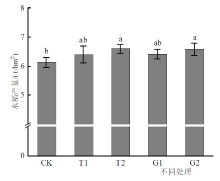
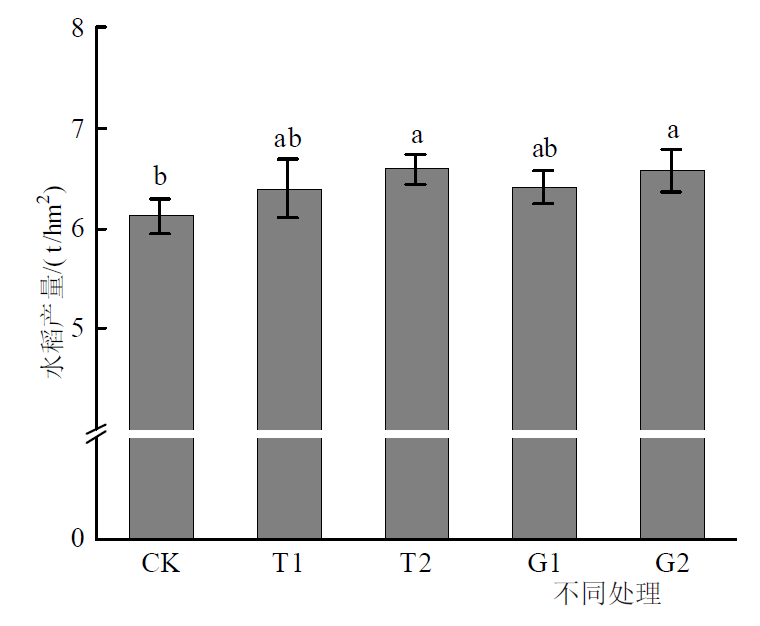
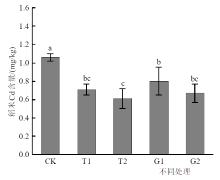
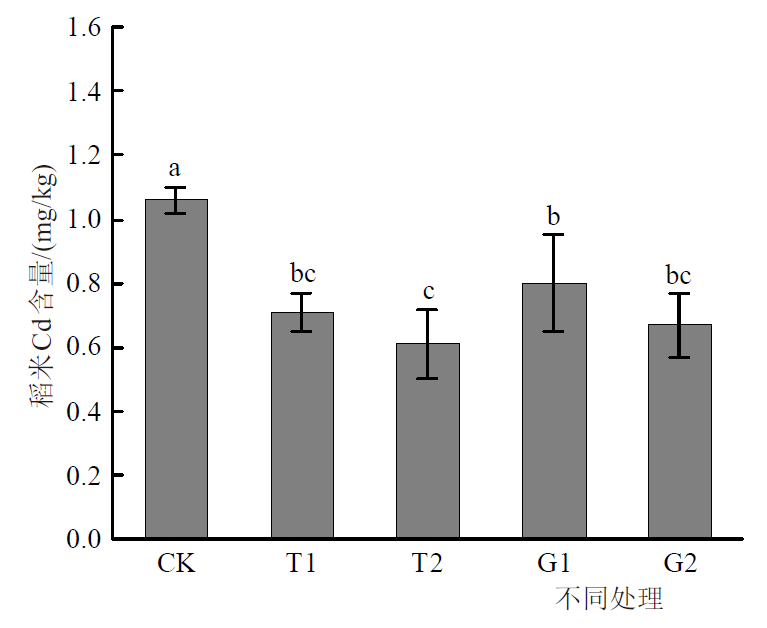
| 序号 | 名称 | 用量 |
|---|---|---|
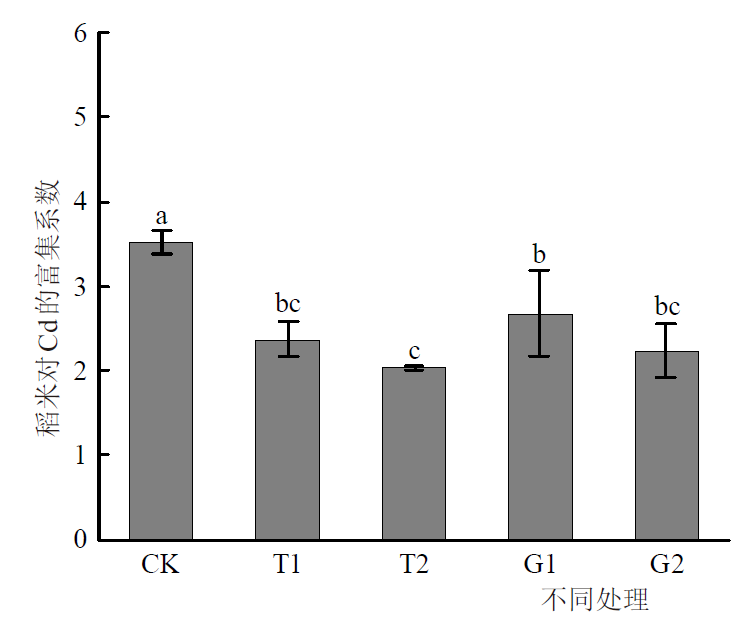
| 1 | 对照(CK) | 不施用叶面阻控剂 |
| 2 | T1 | 施用贝尔壳叶面阻控剂3 L/hm2,于水稻破口期与齐穗期各喷施一次,每次喷施量为1.5 L/hm2 |
| 3 | T2 | 施用贝尔壳叶面阻控剂6 L/hm2,于水稻破口期与齐穗期各喷施一次,每次喷施量为3 L/hm2 |
| 4 | G1 | 施用硅利丰叶面阻控剂3 L/hm2,于水稻破口期与齐穗期各喷施一次,每次喷施量为1.5 L/hm2 |
| 5 | G2 | 施用硅利丰叶面阻控剂6 L/hm2,于水稻破口期与齐穗期各喷施一次,每次喷施量为3 L/hm2 |
| 序号 | 名称 | 用量 |
|---|---|---|
| 1 | 对照(CK) | 不施用叶面阻控剂 |
| 2 | T1 | 施用贝尔壳叶面阻控剂3 L/hm2,于水稻破口期与齐穗期各喷施一次,每次喷施量为1.5 L/hm2 |
| 3 | T2 | 施用贝尔壳叶面阻控剂6 L/hm2,于水稻破口期与齐穗期各喷施一次,每次喷施量为3 L/hm2 |
| 4 | G1 | 施用硅利丰叶面阻控剂3 L/hm2,于水稻破口期与齐穗期各喷施一次,每次喷施量为1.5 L/hm2 |
| 5 | G2 | 施用硅利丰叶面阻控剂6 L/hm2,于水稻破口期与齐穗期各喷施一次,每次喷施量为3 L/hm2 |
| [1] |
中国生态环境部. 2022年中国生态环境状况公报[R]. 北京: 中国生态环境部, 2023.
|
| [2] |
doi: 10.1016/j.jhazmat.2024.134531 URL |
| [3] |
付凌晖, 叶礼奇. 中国统计年鉴2023[M]. 北京: 中国统计出版社,2023:4-5.
|
| [4] |
doi: 10.1038/s41598-022-13140-1 pmid: 35654920 |
| [5] |
周雪萍, 简桂宏, 程细江, 等. 珠三角典型重金属污染农田土壤调理剂筛选田间试验研究[J]. 农业环境科学学报, 2024, 43(9):1969-1978.
|
| [6] |
邓思涵, 龙九妹, 陈聪颖, 等. 叶面肥阻控水稻富集镉的研究进展[J]. 中国农学通报, 2020, 36(1):1-5.
doi: 10.11924/j.issn.1000-6850.casb18080003 |
| [7] |
任利娟, 卢维宏, 李嘉琦, 等. 叶面阻控剂在重金属污染耕地土壤安全利用中的应用[J]. 中国土壤与肥料, 2022(11):230-236.
|
| [8] |
向焱赟, 伍湘, 张小毅, 等. 叶面阻控剂对水稻吸收和转运镉的影响研究进展[J]. 作物研究, 2020, 34(3):93-99.
|
| [9] |
隆志方, 黄蕊, 王继红, 等. 植保无人机喷施锌锰型水稻降Cd叶面阻控剂的飞行参数研究[J]. 农业环境科学学报, 2021, 40(9):1869-1876.
|
| [10] |
林小兵, 张秋梅, 武琳, 等. 南方镉污染水稻产区土壤调理剂,叶面阻控剂产品调查与分析[J]. 环境生态学, 2021, 3(9):56-64.
|
| [11] |
魏宾纭, 周航, 刘佳炜, 等. 不同水分管理模式联合叶面喷施硅肥对水稻Cd累积的影响[J]. 环境科学, 2020, 41(8):3855-3861.
|
| [12] |
doi: 10.1016/j.scitotenv.2024.171245 URL |
| [13] |
doi: 10.1038/s41598-024-66204-9 pmid: 38961133 |
| [14] |
doi: 10.1016/S1002-0160(21)60052-8 URL |
| [15] |
doi: 10.3390/plants10061070 URL |
| [16] |
文耀林, 丁华, 谢沙, 等. 秸秆离田对水稻Cd吸收累积的影响与摄入健康风险评估[J]. 环境科学学报, 2024, 44(2):413-422.
|
| [17] |
国务院办公厅. 中国食物与营养发展纲要(2014—2020年)[EB/OL].(2014-01-28).https://www.gov.cn/gongbao/content/2014/content_2600055.htm2014.
|
| [18] |
USEPA. National Center for Environmental Assessment, Washington DC, Immediate Office. Exposure Factors Handbook[M]. 2011.
|
| [19] |
何嫱. 米饭中污染物镉的生物可给性及生物有效性研究[D]. 长沙: 中南林业科技大学, 2019.
|
| [20] |
徐明岗, 于荣, 王伯仁. 土壤活性有机质的研究进展[J]. 土壤肥料, 2000(6):3-7.
|
| [21] |
唐金梦. ICP-AES法测定土壤中的重金属元素[J]. 世界有色金属, 2019(21):283-284.
|
| [22] |
doi: 10.1007/s11356-016-6436-4 URL |
| [23] |
doi: 10.1007/s11356-023-25983-w |
| [24] |
doi: 10.1016/j.ecoenv.2015.05.011 URL |
| [25] |
宋平原, 刘君权, 杨健, 等. 不同镉胁迫下施用纳米硅和活性硅对水稻的降镉效应[J]. 中国稻米, 2024, 30(6):49-54.
doi: 10.3969/j.issn.1006-8082.2024.06.008 |
| [26] |
林小兵, 张秋梅, 周利军, 等. 南方红壤区喷施叶面硅肥对水稻Cd累积的影响[J]. 土壤与作物, 2022, 11(4):428-436.
|
| [27] |
doi: 10.1016/j.stress.2023.100237 URL |
| [28] |
黄崇玲, 雷静, 顾明华, 等. 土施和喷施硅肥对镉污染农田水稻不同部位镉含量及富集的影响[J]. 西南农业学报, 2013, 26(4):1532-1535.
|
| [29] |
师展, 王科积, 刘涛, 等. 叶面喷施纳米硅提高水稻叶片镉固持量的机理[J]. 植物营养与肥料学报, 2024, 30(12):2366-2379.
|
| [30] |
罗玲, 吴小华, 廖紫君, 等. 叶面喷施锌、硅对莴笋镉累积的影响[J]. 生态与农村环境学报, 2023, 39(6):788-794.
|
| [31] |
魏岚, 邱超才, 黄连喜, 等. 4种炭基复合改良剂可不同程度地降低糙米Cd富集[J]. 中国农学通报, 2023, 39(12):146-153.
doi: 10.11924/j.issn.1000-6850.casb2022-0497 |
| [32] |
|
| [33] |
doi: 10.1016/j.envpol.2020.114681 URL |
| [34] |
doi: 10.1016/j.scitotenv.2020.137453 URL |
| [1] | ZHANG Qiming, GUO Shuilian, OUYANG Dongmei. Variation Analysis of Climate Condition for Double-cropping Rice in Yichun Based on GIS [J]. Chinese Agricultural Science Bulletin, 2026, 42(3): 133-143. |
| [2] | HUANG Wei, PAN Huixiao, WU Xuanke, HE Yan, TAN Mengxiang, LIU Yongyu. Analysis of Risk Zoning and Meteorological Factors of Double Cropping Rice Yield Disaster in Guangxi [J]. Chinese Agricultural Science Bulletin, 2026, 42(3): 144-154. |
| [3] | WANG Jingwen, YUAN Hangjie, LOU Ling, ZHANG Xiumei, YANG Wenye, WANG Zhong. Influence of Different Fallowing Methods on Soil Quality of Degraded Vegetable Fields [J]. Chinese Agricultural Science Bulletin, 2026, 42(2): 146-152. |
| [4] | LAN Bo, CHEN Ming, ZHOU Qina, LI Yunpeng, LI Baojia, DENG Xing, SUN Qinghua, YANG Ziyu, DUAN Lingtao, YIN Changfa, SHAO Jianyang, TU Xueqin, YANG Yingqing, ZHAO Zhizhen. Research Progress on Comprehensive Prevention and Control Techniques of Rice Bakanae Disease [J]. Chinese Agricultural Science Bulletin, 2026, 42(1): 176-183. |
| [5] | DONG Linlin, YAN Kai, SHENG Xuewen, LU Changying, SHI Linlin, WANG Haihou, WU Zhenggui. Spectral Characteristics of Soil Water-soluble Organic Carbon Affected by Cultivation Methods During Rice Growth Period [J]. Chinese Agricultural Science Bulletin, 2025, 41(9): 99-106. |
| [6] | LI Yangyang, CHEN Shuaimin, XU Minghong, CHI Chang, MA Wei, WANG Yinping, SONG Yan, FAN Zuowei, WU Haiyan. Effects of Microbial Product Coupling Urea on Straw Decomposition Rate and Yield of Rice [J]. Chinese Agricultural Science Bulletin, 2025, 41(9): 18-24. |
| [7] | CHEN Pengjun, ZHANG Jiao, HAN Jijun, MIAO Yuanqing, CUI Shiyou. Effects of Different Exogenous Silicon Fertilizers Application on Yield, Dry Matter and Nutrient Accumulation and Transport of Rice in Tidal Flat [J]. Chinese Agricultural Science Bulletin, 2025, 41(9): 8-17. |
| [8] | WANG Feng, ZHU Shijun, YING Hong, CHAI Weigang, DAI Yaolu, YUAN Qing, JIN Shuquan. Effect of Organic Amendment Combined with Moderate Deep Ploughing on Productivity Improvement of Hilly Reclaimed Rice Field [J]. Chinese Agricultural Science Bulletin, 2025, 41(9): 91-98. |
| [9] | WANG Junjiang, YIN Yuanhong, LU Chusheng, LU Zhanhua, CAI Haoyang, YE Qunhuan, LIAO Jiahui, LU Yusheng, LIANG Kaiming, FU Youqiang. Effect of Irrigation on Rice Grain Yield and Water Use Efficiency During Critical Growth Period Under Drought Stress [J]. Chinese Agricultural Science Bulletin, 2025, 41(8): 1-10. |
| [10] | MO Junjie, ZHENG Jiacheng, CAI Jiwei, LIU Jiawei, FENG Yongcheng. Effect of Individual Rice Plant Selection Based on Harvest Index [J]. Chinese Agricultural Science Bulletin, 2025, 41(7): 1-8. |
| [11] | WANG Mingjiao, MAO Ruiqing, KUANG Na, CHEN Yumei, ZOU Dan, ZHANG Ming, XIAO Fangxi, LIU Gui. Research Progress on Cadmium Uptake and Control in Rice [J]. Chinese Agricultural Science Bulletin, 2025, 41(6): 94-99. |
| [12] | LING Bo, LI Xiangyi, LIANG Yingying, WANG Hongchao, CHEN Xiaoling, XIE Zhanwen, ZHANG Yuting, CHENG Zuxin, LIN Lihui. Analysis of Genetic Effects on Stem Lodging Resistance in Hybrids of Indica and Japonica Rice [J]. Chinese Agricultural Science Bulletin, 2025, 41(6): 1-9. |
| [13] | ZHAO Guozhen, LIU Weihua, LIU Siyu, DONG Linbo, LI Lindong, CHEN Yumin. Stability Analysis of A New Japonica rice ‘Yunjing 37’ with Good Eating Quality [J]. Chinese Agricultural Science Bulletin, 2025, 41(5): 1-6. |
| [14] | HUANG Miao, YANG Guotao, DIAO Yan, ZHANG Lei, YAN Yu, LI Yu, XU Wei, YANG Liang. Evaluation of Heavy Metal Enrichment and Correlation in Paddy Soil and Rice in Sichuan Basin [J]. Chinese Agricultural Science Bulletin, 2025, 41(5): 103-109. |
| [15] | WU Yue’e, DUAN Haiyan, JIANG Gonghao. Colored Rice and Its Related Genes: A Review [J]. Chinese Agricultural Science Bulletin, 2025, 41(4): 19-24. |
| Viewed | ||||||
|
Full text |
|
|||||
|
Abstract |
|
|||||
