Welcome to Chinese Agricultural Science Bulletin,

Chinese Agricultural Science Bulletin ›› 2026, Vol. 42 ›› Issue (7): 130-140.doi: 10.11924/j.issn.1000-6850.casb2025-0592
Previous Articles Next Articles
PENG Cuixian1( ), WANG Can1, YANG Yuling1, LI Ling1, LI Guilin2, SUN Hongwei1, TAO Yonghong1()
Received:2025-07-15
Revised:2026-03-04
Online:2026-04-15
Published:2026-04-15
PENG Cuixian, WANG Can, YANG Yuling, LI Ling, LI Guilin, SUN Hongwei, TAO Yonghong. Structural Characteristics of Rhizosphere Soil Microbial Communities in Wild Dendrobium denneanum with Different Growth Years[J]. Chinese Agricultural Science Bulletin, 2026, 42(7): 130-140.
Add to citation manager EndNote|Ris|BibTeX
URL: https://www.casb.org.cn/EN/10.11924/j.issn.1000-6850.casb2025-0592
| 处理 | 多糖 | 石斛酚 | 浸出物 |
|---|---|---|---|
| A2 | 6.6667±0.0407a | 0.0055±0.0001b | 14.2773±1.0984b |
| A3 | 5.2667±0.0517c | 0.0064±0.0004a | 15.4313±1.2547ab |
| A4 | 6.1666±0.0577b | 0.0066±0.0001a | 15.7643±0.3398a |
| 处理 | 多糖 | 石斛酚 | 浸出物 |
|---|---|---|---|
| A2 | 6.6667±0.0407a | 0.0055±0.0001b | 14.2773±1.0984b |
| A3 | 5.2667±0.0517c | 0.0064±0.0004a | 15.4313±1.2547ab |
| A4 | 6.1666±0.0577b | 0.0066±0.0001a | 15.7643±0.3398a |
| 处理 | 有机质 | 全氮 | 全磷 | 全钾 | 钙 | 腐殖质 |
|---|---|---|---|---|---|---|
| A2 | 522.78±3.25a | 22.52±1.11a | 3.08±0.07b | 3.68±0.17c | 16.36±0.66a | 302.36±0.84a |
| A3 | 166.59±4.04c | 6.29±0.58c | 2.11±0.01c | 9.70±0.21b | 7.48±0.42b | 99.65±2.90b |
| A4 | 494.04±1.60b | 15.70±0.01b | 6.04±0.03a | 26.45±0.01a | 16.93±0.08a | 298.90±0.29a |
| XCK | 39.59±0.94d | 2.08±0.01d | 1.84±0.05d | 8.52±0.15b | 3.77±0.20c | 25.30±0.65c |
| 处理 | 有机质 | 全氮 | 全磷 | 全钾 | 钙 | 腐殖质 |
|---|---|---|---|---|---|---|
| A2 | 522.78±3.25a | 22.52±1.11a | 3.08±0.07b | 3.68±0.17c | 16.36±0.66a | 302.36±0.84a |
| A3 | 166.59±4.04c | 6.29±0.58c | 2.11±0.01c | 9.70±0.21b | 7.48±0.42b | 99.65±2.90b |
| A4 | 494.04±1.60b | 15.70±0.01b | 6.04±0.03a | 26.45±0.01a | 16.93±0.08a | 298.90±0.29a |
| XCK | 39.59±0.94d | 2.08±0.01d | 1.84±0.05d | 8.52±0.15b | 3.77±0.20c | 25.30±0.65c |
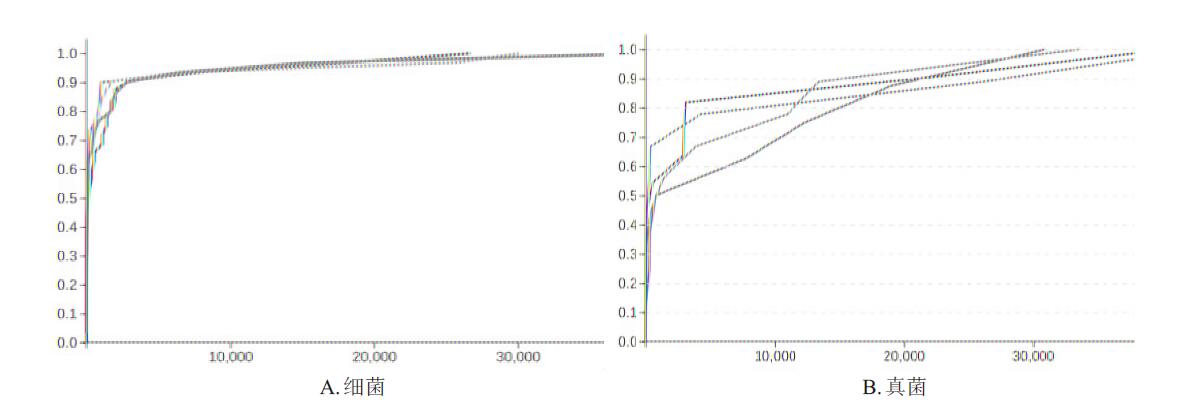
| 处理 | 细菌 | 真菌 | |||
|---|---|---|---|---|---|
| Chao1 | Simpson | Chao1 | Simpson | ||
| XCK | 2089.01±16.70a | 1.00±0.0001a | 541.33±22.55a | 0.97±0.005a | |
| A2 | 1684.33±98.36b | 0.97±0.0029b | 394.04±30.81b | 0.83±0.050b | |
| A3 | 1316.02±23.07c | 0.92±0.0053c | 439.33±33.65c | 0.93±0.009c | |
| A4 | 1628.67±138.54b | 0.99±0.0015b | 424.01±12.77b | 0.78±0.053b | |
| 处理 | 细菌 | 真菌 | |||
|---|---|---|---|---|---|
| Chao1 | Simpson | Chao1 | Simpson | ||
| XCK | 2089.01±16.70a | 1.00±0.0001a | 541.33±22.55a | 0.97±0.005a | |
| A2 | 1684.33±98.36b | 0.97±0.0029b | 394.04±30.81b | 0.83±0.050b | |
| A3 | 1316.02±23.07c | 0.92±0.0053c | 439.33±33.65c | 0.93±0.009c | |
| A4 | 1628.67±138.54b | 0.99±0.0015b | 424.01±12.77b | 0.78±0.053b | |
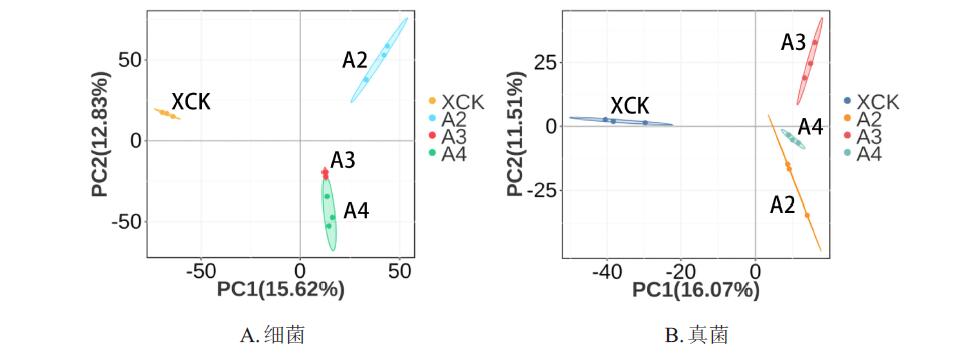
| [1] |
祝蕾, 严辉, 刘培, 等. 药用植物根际微生物对其品质形成的影响及其作用机制的研究进展[J]. 中草药, 2021, 52(13):4064-4073.
|
| [2] |
马晓晶, 郭娟, 唐金富, 等. 论中药资源可持续发展的现状与未来[J]. 中国中药杂志, 2015, 40(10):1887-1892.
|
| [3] |
杨毅, 田侃, 倪新兴, 等. 中药材品质影响因素实证研究[J]. 中药材, 2016, 39(6):1251-1256.
|
| [4] |
国家药典委员会. 中华人民共和国药典:2015年版一部[M]. 北京: 中国医药科技出版社, 2015:282-283.
|
| [5] |
四川省食品药品监督管理局. 四川省中药材标准[M]. 成都: 四川科学技术出版社, 2010:414-418.
|
| [6] |
四川省食品药品监督管理局. 四川省中药饮片炮制规范[M]. 成都: 四川科学技术出版社, 2016:375-376.
|
| [7] |
薛倩倩, 尹显梅, 尹鸿翔, 等. 叠鞘石斛多糖抗氧化作用研究[J]. 科学技术与工程, 2015, 15(12):153-156.
|
| [8] |
范益军, 淳泽, 罗傲雪, 等. 迭鞘石斛中性多糖DDP1-1的体内免疫活性[J]. 应用与环境生物学报, 2010, 16(3):376-379.
|
| [9] |
doi: 10.3389/fmicb.2018.01516 pmid: 30050510 |
| [10] |
doi: 10.1111/1574-6976.12028 pmid: 23790204 |
| [11] |
doi: 10.1094/MPMI-10-14-0334-FI pmid: 25514681 |
| [12] |
李熙英, 金海强, 贾斌. 不同生长年限人参地土壤微生物多样性研究初报[J]. 延边大学农学学报, 2011, 33(2):133-136.
|
| [13] |
doi: 10.1038/s41598-018-34177-1 |
| [14] |
母茂君, 张弟桂, 张华, 等. 太白贝母根际微生物分布与生物碱含量的相关性[J]. 中国中药杂志, 2019, 44(11):2231-2235.
|
| [15] |
唐彬彬, 董姚君, 贺密密, 等. 云南文山健康三七种植年限对根际微生物群落的影响[J]. 微生物学通报, 2020, 47(9):2857-2866.
|
| [16] |
张媛媛, 张彬. 苯酚-硫酸法与蒽酮-硫酸法测定绿茶茶多糖的比较研究[J]. 食品科学, 2016, 37(4):158-163.
doi: 10.7506/spkx1002-6630-201604028 |
| [17] |
鲍士旦. 土壤农化分析[M]. 北京: 中国农业出版社, 2000:11-23.
|
| [18] |
谭勇, 崔尹赡, 季秀玲, 等. 三七连作的根际、根内微生物变化与生态学研究进展[J]. 中草药, 2017, 48(2):391-399.
|
| [19] |
doi: 10.1016/j.apsb.2017.12.011 URL |
| [20] |
于春雷, 高嵩, 孙文松. 连作对辽细辛土壤理化性质和根际微生物群落特征的影响[J]. 江苏农业科学, 2022, 50(14):250-258.
|
| [21] |
王光华, 刘俊杰, 于镇华, 等. 土壤酸杆菌门细菌生态学研究进展[J]. 生物技术通报, 2016, 32(2):14-20.
doi: 10.13560/j.cnki.biotech.bull.1985.2016.02.002 |
| [22] |
丛微, 喻海茫, 于晶晶, 等. 人参种植对林地土壤细菌群落结构和代谢功能的影响[J]. 生态学报, 2021, 41(1):162-171.
|
| [23] |
pmid: 15107955 |
| [24] |
|
| [25] |
张嘉慧, 邢佳佳, 彭丽媛, 等. 丛枝菌根真菌提高感染青枯菌番茄根际土壤细菌群落多样性和稳定性及有益菌属相对丰度[J]. 植物营养与肥料学报, 2023, 29(1):120-131.
|
| [26] |
黄芳芳. 农药对三七根际土壤被孢霉的影响及其田间定殖能力[D]. 昆明: 云南大学, 2017.
|
| [27] |
张英英, 魏玉杰, 吴之涛, 等. 不同种植年限对特殊药材土壤化学性质和微生物多样性的影响[J]. 干旱地区农业研究, 2023, 41(1):150-159.
|
| [28] |
萨如拉, 于淼, 李媛媛, 等. 不同年限玉米秸秆还田对土壤微生物多样性的影响[J]. 中国土壤与肥料, 2023(11):34-40.
|
| [29] |
doi: 10.1007/s10327-017-0736-5 URL |
| [30] |
徐腾起. 生物有机肥对向日葵列当寄生的影响及其微生态机理研究[D]. 杨凌: 西北农林科技大学, 2024.
|
| [31] |
doi: 10.3389/fmicb.2023.1111087 URL |
| [32] |
纳小凡, 郑国琦, 彭励, 等. 不同种植年限宁夏枸杞根际微生物多样性变化[J]. 土壤学报, 2016, 53(1):241-252.
|
| [33] |
范寒雪, 邹世杰, 章圣龙, 等. 嗜冷假单胞菌BYAU-6的分离及低温秸秆降解能力解析[J]. 微生物学报, 2025, 65(8):3273-3286.
|
| [34] |
doi: 10.1016/S0734-9750(99)00014-2 URL |
| [35] |
doi: 10.1016/j.ecoenv.2022.113739 URL |
| [36] |
谢慧娜. 载体对腈纶废水生化处理过程中微生物群落结构影响[D]. 兰州: 兰州交通大学, 2018.
|
| [37] |
doi: 10.1016/j.ecoenv.2022.113452 URL |
| [38] |
巩婷, 温艳华, 陈尔东, 等. 担子菌类真菌新产物研究进展[J]. 菌物研究, 2017, 15(2):89-111.
|
| [39] |
doi: 10.3389/fbioe.2022.1054757 URL |
| [40] |
吴林坤, 林向民, 林文雄. 根系分泌物介导下植物-土壤-微生物互作关系研究进展与展望[J]. 植物生态学报, 2014, 38(3):298-310.
doi: 10.3724/SP.J.1258.2014.00027 |
| [41] |
栗圣榕, 谢巧, 廖莉, 等. 叠鞘石斛适宜采收期分析[J]. 中成药, 2020, 42(1):237-242.
|
| [42] |
|
| [43] |
冯璐, 李振凯, 王红, 等. 不同种植年限银柴胡根际土壤微生物群落结构变化[J]. 微生物学通报, 2024, 51(10):4132-4148.
|
| [44] |
doi: 10.1007/s11738-018-2798-1 |
| [1] | LUO Guohui, YU Shikang, ZHAI Yangni, GU Huizhan, LI Fucheng, WANG Bin, WU Tao. Characteristics of Allelochemicals and Microbial Diversity in Soils with Different Types of Tobacco Continuous Cropping Obstacles [J]. Chinese Agricultural Science Bulletin, 2026, 42(5): 101-108. |
| [2] | SU Yan, ZHAO Xiaoying, CHENG Risheng, XUE Shuqin, ZHANG Yinghua. Characteristics and Comprehensive Evaluation of Major Soil Nutrient Changes in Sunite Desert Grassland [J]. Chinese Agricultural Science Bulletin, 2026, 42(5): 109-116. |
| [3] | PENG Zicheng, LI Shuaihao, XIE Shirui, YANG Haichang, ZHANG Fenghua, LIU Feng, ZHOU Zhongkai, XU Yunjun. Synergistic Regulatory Effects of Planting Density and Nitrogen Fertilizer Interaction on Soybean Growth and Soil Nutrients in Saline-alkali Soil [J]. Chinese Agricultural Science Bulletin, 2026, 42(3): 109-118. |
| [4] | GU Yu, CHEN Ge, LIU Qiongfeng, ZHOU Junyu, XIE Jian, YANG Zengping, RAO Zhongxiu, LIANG Wandong, ZHANG Li’na, SHENG Hao, WU Haiyong. Effects of Organic Fertilizer Application on Rice Yield and Soil Physicochemical Properties [J]. Chinese Agricultural Science Bulletin, 2026, 42(2): 120-127. |
| [5] | ZHANG Dongmin, HUANG Wanli, CHEN Xinyi, ZHANG Chaokun, XIAO Shiwei. Effect of Intercropping Model of Ziziphus mauritiana-Soybeans on Soil Nutrients and Fruit Quality of Z. mauritiana [J]. Chinese Agricultural Science Bulletin, 2026, 42(1): 153-158. |
| [6] | LI Yanlan, CAI Shujiang, LI Xiaoliang, HU Xinzhou, LI Chengchun, LI Yihua, GAO Yuxi, ZHANG Yurong, YE Rong, GUAN Xiang, YANG Jincheng. Effects of Organic Fertilizer Replacing Part of Chemical Fertilizer on Soil Nutrients and Yield of Fresh Broad Beans [J]. Chinese Agricultural Science Bulletin, 2025, 41(34): 82-86. |
| [7] | LI Anning, WANG Yan, MA Jinhui, WANG Huimiao, SA Rula, TAI Jicheng, JIANG Shan, ZHAO Tingchao. Effect of Nitrogen-phosphorus Interactive Application on Physiological Characteristics of Soil and Seedlings in Corn-bean Composite Planting [J]. Chinese Agricultural Science Bulletin, 2025, 41(33): 81-87. |
| [8] | WU Jialong, HUANG Yayun, LIANG Chunmei, RUAN Yanzhu, XU Changchao. Effects of Replacing Partial Chemical Fertilizers with Agricultural and Forestry Waste Compost Leachate on Growth of Garden Seedlings and Soil Nutrients [J]. Chinese Agricultural Science Bulletin, 2025, 41(32): 46-53. |
| [9] | LIU Xiangrong, TANG Yun, ZHU Wei, XIAO Zhixiang, HE Liwei, NING Zhuo, WANG Hexin, DING Chunxia. Nutrient Abundance and Comprehensive Fertility Evaluation of Tobacco Planting Soil in Shaoyang [J]. Chinese Agricultural Science Bulletin, 2025, 41(30): 113-121. |
| [10] | ZHU Ting, DONG Kun, YANG Yong, ZHANG Lizhen, YIN Xiangao, YIN Jianqing, HUANG Jie, CHEN Yongdui, LU Jun, WU Kuo, DONG Jiahong. Effects of Continuous Cropping on Microbial Community in Rhizosphere Soil of Konjac [J]. Chinese Agricultural Science Bulletin, 2025, 41(30): 105-112. |
| [11] | ZHANG Jian, ZHOU Ling. Research on Status of Cotton Straw Crushing and Decomposition in Xinjiang Region [J]. Chinese Agricultural Science Bulletin, 2025, 41(3): 48-58. |
| [12] | ZHENG Yuchen, TAO Min, FANG Di’an, XU Dongpo, QIN Chuanjie. Characteristics of Plankton Community Structure and Estimation of Fish Productivity in Guangrong Reservoir [J]. Chinese Agricultural Science Bulletin, 2025, 41(29): 157-164. |
| [13] | ZHOU Xiaofeng, LI Jiaqi, ZHANG Lijun, LIN Haidong, LIN Xiaoxing, LI Xiang, YANG Xiping, HU Yajie. Effects of Magnesium Fertilization on Calcium and Magnesium Nutrients and Softness of Flue-cured Tobacco in Jingxi [J]. Chinese Agricultural Science Bulletin, 2025, 41(27): 36-43. |
| [14] | CHENG Wen, DING Rongrong, ZHANG Limin, WANG Guoping, WANG Haijuan. Analysis on Soil Nutrient Content Characteristics of Continuous High Yield Cotton Fields in 7th Division Reclamation Area [J]. Chinese Agricultural Science Bulletin, 2025, 41(27): 94-98. |
| [15] | TENZIN Tarchen, TUDENG Qunpei, CI Zhen, YIXI Yangzong, NIMA Cangjue, SANG Dan, DORJEEH Tondrob. Effects of Plantation Duration on Soil Nutrient Level and Microbial Community Characteristics of Alfalfa Artificial Grassland in Xizang River Valley Region [J]. Chinese Agricultural Science Bulletin, 2025, 41(24): 69-78. |
| Viewed | ||||||
|
Full text |
|
|||||
|
Abstract |
|
|||||
