Welcome to Chinese Agricultural Science Bulletin,

Chinese Agricultural Science Bulletin ›› 2026, Vol. 42 ›› Issue (19): 137-146.doi: 10.11924/j.issn.1000-6850.casb2026-0016
Previous Articles Next Articles
JIN Zhenyi1,2( ), REN Long2, YANG Li2, WANG Zhonghua1, WANG Qiang2()
Received:2026-01-04
Revised:2026-04-29
Online:2026-10-15
Published:2026-10-15
CLC Number:
JIN Zhenyi, REN Long, YANG Li, WANG Zhonghua, WANG Qiang. Effects of 4,8-DHT on Weeds Inhibition and Physiological-Biochemical Parameters[J]. Chinese Agricultural Science Bulletin, 2026, 42(19): 137-146.
Add to citation manager EndNote|Ris|BibTeX
URL: https://www.casb.org.cn/EN/10.11924/j.issn.1000-6850.casb2026-0016
| 基因编号 | 注释信息 | 引物序列 | |
|---|---|---|---|
| F | R | ||
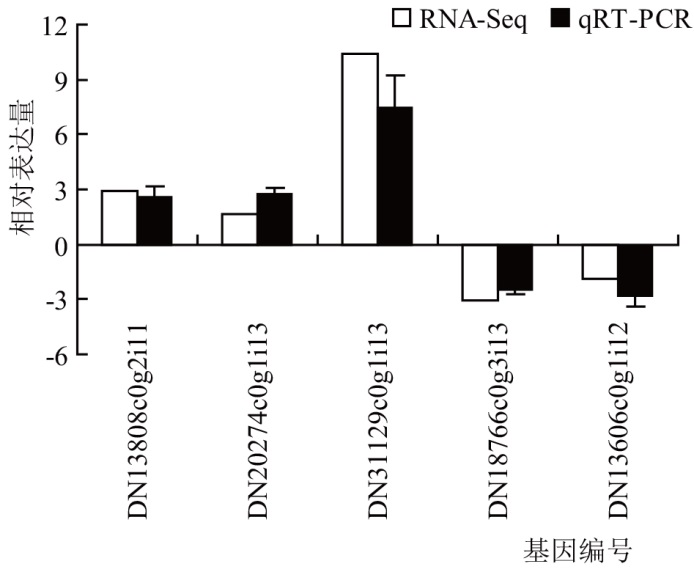
| DN13808c0g2i11 | glutathione S-transferase | CTTTTGGAGTTGAACCCGGT | ACCCATGCTGCATCCAAAAG |
| DN18766c0g3i13 | calcium-binding protein | AGTGCTCCGTTGAAGAATGC | TGATGATGATGTGGAAACGGC |
| DN13606c0g1i12 | calcium-binding protein | AAATCCCACACCACAACACC | TCATCTCCTTCAGCTCCGTG |
| DN20274c0g1i13 | formate dehydrogenase | AGGGAGAGGAGTTGGAAGGA | AAGGTCCCTGGTGATGATGG |
| DN31129c0g1i13 | phosphoribulokinase | GATCTCCAGCCTACATGCCA | CCAATCACCACTGGCTTGTC |
| - | actin | TTCGTGTGGCTCCTGAAGAA | AGGGTCTTGAATACGCCACT |
| 数据库 | 基因数目/个 | 比例/% |
|---|---|---|
| All | 49194 | 100.00 |
| KEGG | 7091 | 14.41 |
| Pfam | 22942 | 46.64 |
| eggNOG | 31014 | 63.04 |
| GO | 21418 | 43.54 |
| KOG | 18381 | 37.36 |
| Swissprot | 25079 | 50.98 |
| NR | 36737 | 74.68 |
| 数据库 | 基因数目/个 | 比例/% |
|---|---|---|
| All | 49194 | 100.00 |
| KEGG | 7091 | 14.41 |
| Pfam | 22942 | 46.64 |
| eggNOG | 31014 | 63.04 |
| GO | 21418 | 43.54 |
| KOG | 18381 | 37.36 |
| Swissprot | 25079 | 50.98 |
| NR | 36737 | 74.68 |
| [1] |
doi: 10.1146/annurev-arplant-042809-112119 pmid: 20192743 |
| [2] |
doi: 10.1021/acs.chemrev.7b00721 pmid: 29361827 |
| [3] |
|
| [4] |
|
| [5] |
doi: 10.1002/ps.7885 pmid: 38091278 |
| [6] |
张红梅, 陈玉湘, 徐士超, 等. 生物源除草活性物质开发及应用研究进展[J]. 农药学学报, 2021, 23(6):1031-1045.
|
| [7] |
|
| [8] |
付熙哲. 基于天然低共熔溶剂的山核桃蒲多酚提取、鉴定及溶解行为研究[D]. 杭州: 浙江大学, 2022.
|
| [9] |
|
| [10] |
doi: 10.3390/molecules21040528 URL |
| [11] |
doi: 10.1016/j.indcrop.2017.11.051 URL |
| [12] |
胡琪瑶, 范晓聪, 杨丽, 等. 4,8-DHT林地除草活性研究[J]. 浙江林业科技, 2020, 40(2):42-50.
|
| [13] |
doi: 10.1111/wbm.v24.3 URL |
| [14] |
原向阳, 张丽光, 黄蕾, 等. 缺磷胁迫下41%草甘膦异丙铵盐水剂对抗草甘膦大豆农艺性状和生理指标的影响[J]. 南方农业学报, 2015, 46(4):564-568.
|
| [15] |
doi: 10.1371/journal.pone.0177047 URL |
| [16] |
赵世杰, 许长成. 植物组织中丙二醛测定方法的改进[J]. 植物生理学通讯, 1994, 58(3):207-210.
|
| [17] |
黄业伟. 毛竹对盐胁迫的生理响应及耐盐相关基因的表达分析[J]. 杭州:浙江农林大学, 2010.
|
| [18] |
doi: 10.1007/s00299-015-1846-1 URL |
| [19] |
doi: 10.1038/nbt.1883 |
| [20] |
doi: 10.1038/nmeth.3176 pmid: 25402007 |
| [21] |
|
| [22] |
|
| [23] |
刘鹏飞, 王晓琴, 于娟, 等. 3种不同农作物水浸提液对桔梗化感作用的研究[J]. 种子, 2025, 44(4):63-69.
|
| [24] |
doi: 10.3390/agriculture12091338 URL |
| [25] |
阮坤非, 王天琪, 侯立娜, 等. 栾树凋落叶对3种中药材种子萌发及幼苗生长的化感效应[J]. 西北农林科技大学学报(自然科学版), 2024, 52(6):40-48.
|
| [26] |
王敬茹. 假蒟亭碱除草作用机制的初步研究[D]. 海口: 海南大学, 2022.
|
| [27] |
doi: 10.1016/j.plaphy.2014.03.001 URL |
| [28] |
doi: 10.1186/s40538-024-00646-1 |
| [29] |
田岐震. 臭椿酮除草作用机制初步研究[D]. 杨凌: 西北农林科技大学, 2021.
|
| [30] |
doi: 10.1021/acs.jafc.1c07819 URL |
| [1] | BI Yanliang, QI Shihan, LI Qiongwei, ZOU Xiaoxia, SI Tong. Physiological Mechanism of Seed Coating Agent in Promoting Peanut Seed Germination and Seedling Growth Under Low Temperature [J]. Chinese Agricultural Science Bulletin, 2026, 42(8): 44-52. |
| [2] | LIU Xueling, LIANG Boquan, YAO Bin, YANG Yunhai, ZHAN Che, SHEN Shicai, ZHANG Fudou, YANG Shaosong, ZHENG Fengping, KONG Yan, YUAN Jingjing, YAN Peirui, YAN Maopeng, XU Gaofeng. Allelopathic Effects of Brassica juncea (YRab2) Root Exudates on Four Invasive Weeds [J]. Chinese Agricultural Science Bulletin, 2026, 42(8): 183-190. |
| [3] | HU Mingzhu, ZHANG Junjie, SHI Xuerui, WANG Wei, DAI Jinxia. Study on Biological Characteristics and Optimization of Culture Conditions of Two Efficient Phosphate-Solubilizing Bacteria [J]. Chinese Agricultural Science Bulletin, 2026, 42(5): 42-49. |
| [4] | HAN Yue, XU Dong, CHEN Cheng, FAN Yuchao, ZHAO Rui, YU Peng, XIN Zhikun, LIU Guanghui. Influences of Exogenous Citric Acid on Seed Germination and Seedling Growth of Alfalfa [J]. Chinese Agricultural Science Bulletin, 2026, 42(19): 172-178. |
| [5] | ZHU Xiaojiang, BIAN Qingyong, FU Yanbo, MENG Ajing, WANG Zhiguo, RAO Xiaojuan, KAN Dexing, WU Chen, WU Yang, LI Ning. Effects of Different Functional Fertilizers on Cotton Seed Germination Characteristics [J]. Chinese Agricultural Science Bulletin, 2026, 42(16): 37-45. |
| [6] | HUANG Lang, CHEN Rui, YANG Runmei. Physiological and Biochemical Changes during Seed Germination of Critically Endangered Plant Syndiclis anlungensis [J]. Chinese Agricultural Science Bulletin, 2026, 42(12): 78-85. |
| [7] | XIAO Yaqin, ZHOU Zirui, RUAN Ying, LIU Chunlin. Effects of Different Concentrations of β-Ocimene on Germination of Maize Seeds [J]. Chinese Agricultural Science Bulletin, 2026, 42(11): 9-15. |
| [8] | GAO Yingqi, LIU Bingbing. Effects of Simulated Drought Stress on Seed Germination and Seedling Growth of Sophora alopecuroides [J]. Chinese Agricultural Science Bulletin, 2025, 41(32): 82-87. |
| [9] | GAO Huan, CHENG Wenli, WANG Yiru, WANG Haoyang, CHEN Dongbo, WANG Yang. Isolation and Identification of Endophytic Bacteria in Tomato Seeds and Their Effect for Seed Germination [J]. Chinese Agricultural Science Bulletin, 2025, 41(30): 52-59. |
| [10] | WANG Honglin, WU Zizhou, ZUO Yanchun, YAN Xu, YUAN Zhengcai, DENG Yuchuan, XIAO Lian, CHEN Hui, KOU Jing, DU Zhouhe. Effect of Storage Years at Room Temperature on Seed Germination and Physiological Characteristics of Wild-type Vicia sativa [J]. Chinese Agricultural Science Bulletin, 2025, 41(29): 15-23. |
| [11] | WANG Meiyan, ZHAI Minghui, YUAN Long, LI Bingbing, GUO Gaojie, ZHU Yaqi, WANG Rongjie, DING Ruirui. Effects of Exogenous Melatonin on Seed Germination and Seedling Growth of Helianthus annuus Under Cadmium Stress [J]. Chinese Agricultural Science Bulletin, 2025, 41(29): 24-29. |
| [12] | HONG Senrong, JI Lili. Induction Effect of Colchicine on Polyploidy of Medicago polymorpha [J]. Chinese Agricultural Science Bulletin, 2025, 41(22): 13-26. |
| [13] | LU Die, HU Yi, WANG Xin, SHAN Linge, WANG Wenhao, ZHAO Baolong, YANG Helong. Effects of Soaking Seeds with Wood Vinegar on Germination of Forage Seeds [J]. Chinese Agricultural Science Bulletin, 2025, 41(22): 126-133. |
| [14] | HONG Senrong, WANG Yi, LU Yaxuan, ZAITUNIGULI·Maimaititursun, LIU Lina, SUN Meiling. Effect of Glycine Betaine on Respiratory Electron Transfer During Seed Germination and Seedling Growth of Sorghum bicolor× S. sudanense Under Low Temperature Stress [J]. Chinese Agricultural Science Bulletin, 2025, 41(16): 156-164. |
| [15] | LUO Yan, LIU Chen, XIA Xin, ZHAO Kaiyuan, CHENG Xia. Effect of Malic Acid on the Growth and Photosynthesis of Industrial Hemp [J]. Chinese Agricultural Science Bulletin, 2025, 41(15): 51-58. |
| Viewed | ||||||
|
Full text |
|
|||||
|
Abstract |
|
|||||
