欢迎访问《中国农学通报》,

中国农学通报 ›› 2026, Vol. 42 ›› Issue (2): 184-190.doi: 10.11924/j.issn.1000-6850.casb2025-0202

• 植物保护·农药 • 上一篇    下一篇

耕作方式、有机肥、秸秆还田对小麦赤霉病和茎基腐病的影响

李保军1,2(), 温国昌1(), 陈洁1,2, 崔晓敬1, 贾良良3, 杨云马3, 杨璞1, 李红铁1   

  1. 1 邯郸市农业科学院, 河北邯郸 056001
    2 河北省作物杂种优势研究与利用重点实验室, 河北邯郸 056001
    3 河北省农林科学院资源环境研究所, 石家庄 050051
  • 收稿日期:2025-03-12 修回日期:2025-08-19 出版日期:2026-01-25 发布日期:2026-01-22
  • 通讯作者:
    温国昌,男,1989年出生,河北武安人,助理研究员,硕士,主要从事土壤肥料与作物栽培方面的研究。通信地址:056001 河北省邯郸市邯山区东环南路 邯郸市农业科学院,E-mail:
  • 作者简介:

    李保军,男,1972年出生,河北魏县人,研究员,本科,主要从事土壤肥料与作物栽培方面的研究。通信地址:056001 河北省邯郸市邯山区东环南路 邯郸市农业科学院,E-mail:

  • 基金资助:
    国家重点研发计划项目子课题“生物定向调控培育健康土壤关键技术集成与应用”(2021YFD1901004-8); 邯郸市科学技术研究与发展计划项目“邯郸市中低产粮田肥沃耕层培育关键技术研究”(23422012162); 邯郸市农业科学院自主创新项目“中低产粮田土壤质量提升技术长期定位研究”(NKY202408)

Effects of Tillage Methods, Organic Fertilizer and Straw Returning on Wheat Fusarium Head Blight and Crown Rot

LI Baojun1,2(), WEN Guochang1(), CHEN Jie1,2, CUI Xiaojing1, JIA Liangliang3, YANG Yunma3, YANG Pu1, LI Hongtie1   

  1. 1 Handan Academy of Agricultural Sciences, Handan, Hebei 056001
    2 The Key Laboratory of Crop Hybrid Advantage Research and Utilization of Hebei Province, Handan, Hebei 056001
    3 Institute of Agricultural Resources and Environment, Hebei Academy of Agriculture and Forestry Sciences, Shijiazhuang 050051
  • Received:2025-03-12 Revised:2025-08-19 Published:2026-01-25 Online:2026-01-22

摘要:

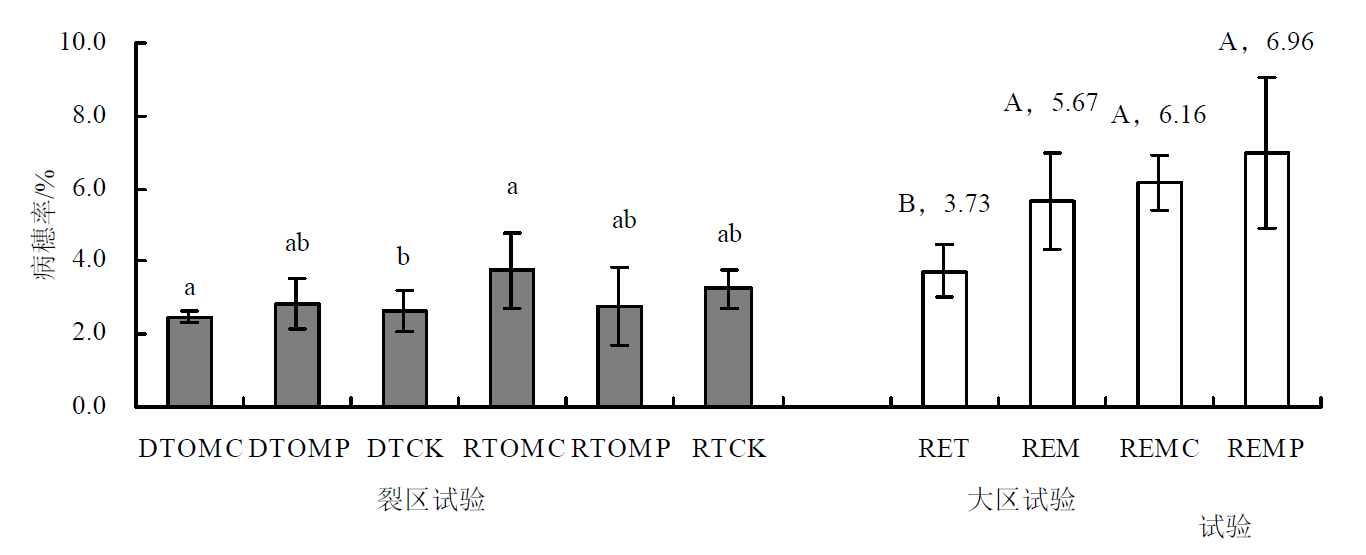
为探明耕作方式、有机肥替代部分化肥及秸秆还田对小麦赤霉病和茎基腐病的影响,于2022—2024年进行田间试验。试验采用裂区与大区对比设计:裂区设计中,主区设DT(隔年翻耕,耕深25 cm)、RT(连年旋耕,耕深15 cm)2个处理;副区设OMC(发酵牛粪有机肥替代25%基施化肥)、OMP(发酵猪粪有机肥替代25%基施化肥)、CK(常规施肥)3个处理。秸秆还田因素采用大区对比设计。结果表明,在多年单作棉花后的一个玉米-小麦轮作周期内,DT与RT处理间赤霉病病穗率差异不显著。在DT条件下,OMC处理较CK可显著降低小麦赤霉病的病穗率6.4个百分点(P<0.05),OMP处理降低不显著;在RT条件下,OMC和OMP处理对降低小麦赤霉病的病穗率均不显著;秸秆不还田下,OMC和OMP处理病穗率较CK分别升高1.2和1.8个百分点(P>0.05);玉米秸秆还田处理较不还田处理显著降低小麦赤霉病病穗率34.2%(P<0.05);相同遗传背景下,环境因子对产量的提升和赤霉病病穗率的降低存在矛盾。在多年单作棉花后的两个玉米-小麦轮作周期内,在CK条件下,DT翌年RT处理较连年RT处理显著降低茎基腐病病指9.0%(P<0.05);在DT条件下,OMC处理较CK显著降低茎基腐病病指34.2%(P<0.05),OMP处理降低不显著;在RT条件下,OMC处理较CK显著降低茎基腐病病指23.4%(P<0.05),而OMP处理显著增加茎基腐病病指;玉米秸秆还田处理较不还田处理显著降低小麦茎基腐的发病率和发病指数,其中病指防效为11.0%(P<0.05)。

关键词: 小麦, 耕作方式, 有机肥, 秸秆还田, 赤霉病, 茎基腐病

Abstract:

In order to explore the effects of tillage methods, organic fertilizer replacing part of chemical fertilizer and straw returning on Fusarium head blight and crown rot, the field experiments were carried out from 2022 to 2024. The two factors of tillage methods and organic fertilizer replacing part of chemical fertilizer were designed by split-plot design. The tillage methods were set as DT (tillage every other year, tillage depth of 25 cm) and RT (rotary tillage in successive years, tillage depth of 15 cm) in the main area, and the organic fertilizer replacing part of chemical fertilizer was set as OMC (fermented cow manure organic fertilizer replacing 25% basal fertilizer), OMP (fermented pig manure organic fertilizer replacing 25% basal fertilizer) and CK (conventional fertilization) in the sub-area. The factors of straw returning were designed by large area comparison. The results showed that there was no significant difference in the ear rate of scab between deep tillage and rotary tillage in a maize-wheat rotation cycle after years of monoculture of cotton. Under deep tillage, the application of fermented cow manure organic fertilizer could significantly reduce the disease spike rate of wheat scab, and the control effect of disease spike rate was 6.4%, while the effect of fermented pig manure organic fertilizer was not significant. Under rotary tillage, the application of fermented cow manure and pig manure organic fertilizer had no significant effect on reducing the spike rate of wheat scab. Under the condition of no straw returning, there was no significant difference in the disease spike rate of fermented cow manure or pig manure organic fertilizer, but there was an increasing trend. The ear rate of wheat scab in maize straw returning treatment was significantly lower than that in non-returning treatment, and the control effect of ear rate was 34.2%. Under the same genetic background, the increase of yield and the decrease of scab ear rate caused by environmental factors are a pair of contradictions. Based on two maize-wheat rotation cycles after multi-year monoculture of cotton, under conventional fertilization, rotary tillage in the next year of deep tillage can significantly reduce the incidence of stem base rot compared with continuous rotary tillage, and the disease index control effect is 9.0%. Under deep tillage, the application of fermented cow manure organic fertilizer could significantly reduce the incidence of stem base rot compared with conventional fertilization, and the disease index control effect was 34.2%, while the application of fermented pig manure organic fertilizer was not significant. Under rotary tillage, the application of fermented cow manure organic fertilizer could significantly reduce the incidence of stem rot, and the disease index control effect was 23.4%, while the application of fermented pig manure organic fertilizer increased significantly. The incidence and disease index of wheat stalk rot were significantly lower in the maize straw returning treatment than in the non-returning treatment, and the disease index control effect was 11.0%.

Key words: wheat, tillage methods, organic fertilizer, straw return, Fusarium head blight, crown rot