欢迎访问《中国农学通报》,

中国农学通报 ›› 2026, Vol. 42 ›› Issue (6): 1-13.doi: 10.11924/j.issn.1000-6850.casb2025-0566
• 农学·农业基础科学 • 下一篇
盛文旭1( ), 杨敏1, 王亚楠2, 郭亚雯1, 李昊昱1, 张敏1, 蔡瑞国1, 郭子糠1()
收稿日期:2025-07-04
修回日期:2026-01-20
出版日期:2026-03-25
发布日期:2026-03-30
通讯作者:
作者简介:盛文旭,男,2001年出生,黑龙江哈尔滨人,硕士生,研究方向为小麦籽粒锌吸收利用。E-mail:shengwenxu2001@163.com。
基金资助:
SHENG Wenxu1(), YANG Min1, WANG Yanan2, GUO Yawen1, LI Haoyu1, ZHANG Min1, CAI Ruiguo1, GUO Zikang1()
Received:2025-07-04
Revised:2026-01-20
Published:2026-03-25
Online:2026-03-30
摘要:
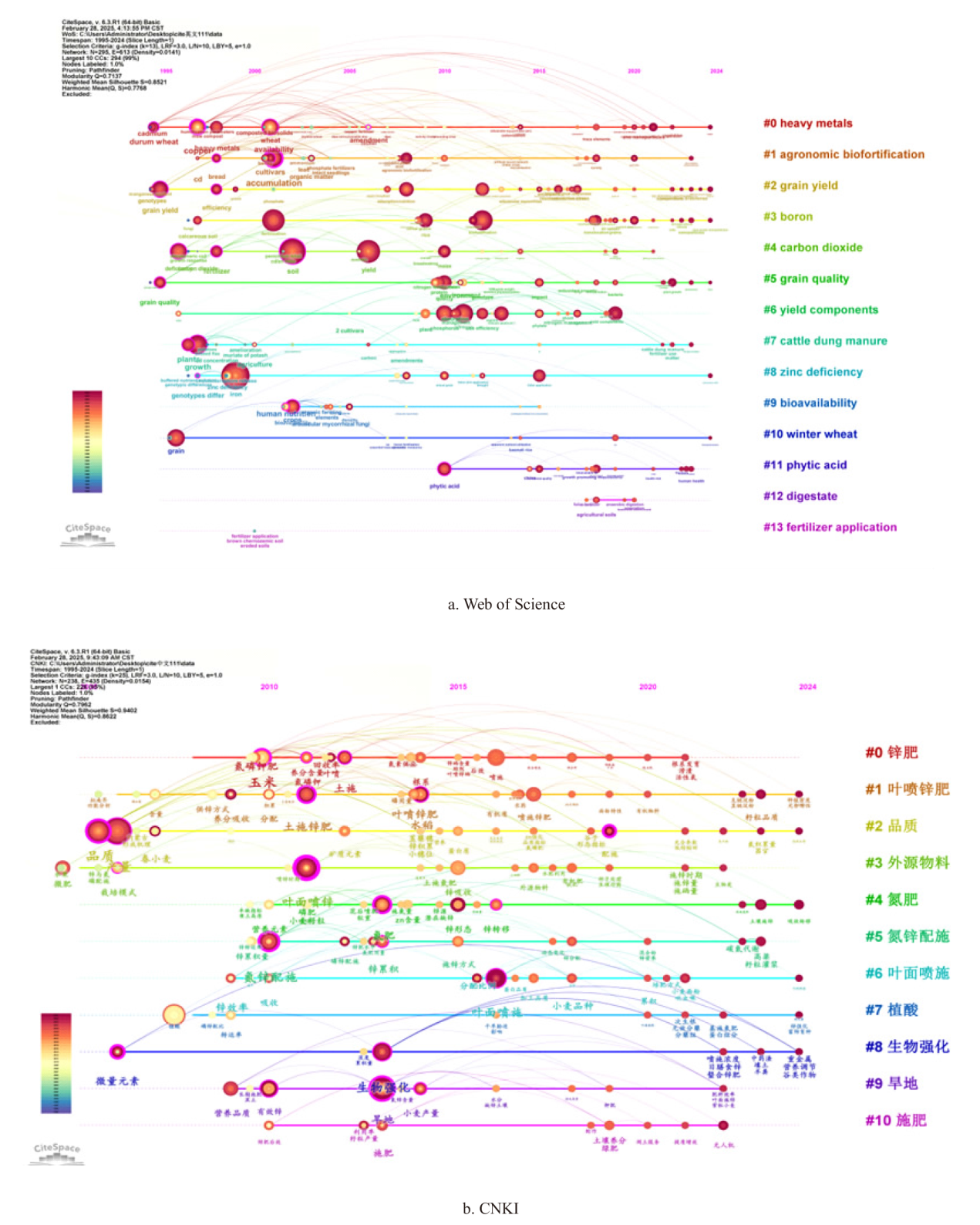
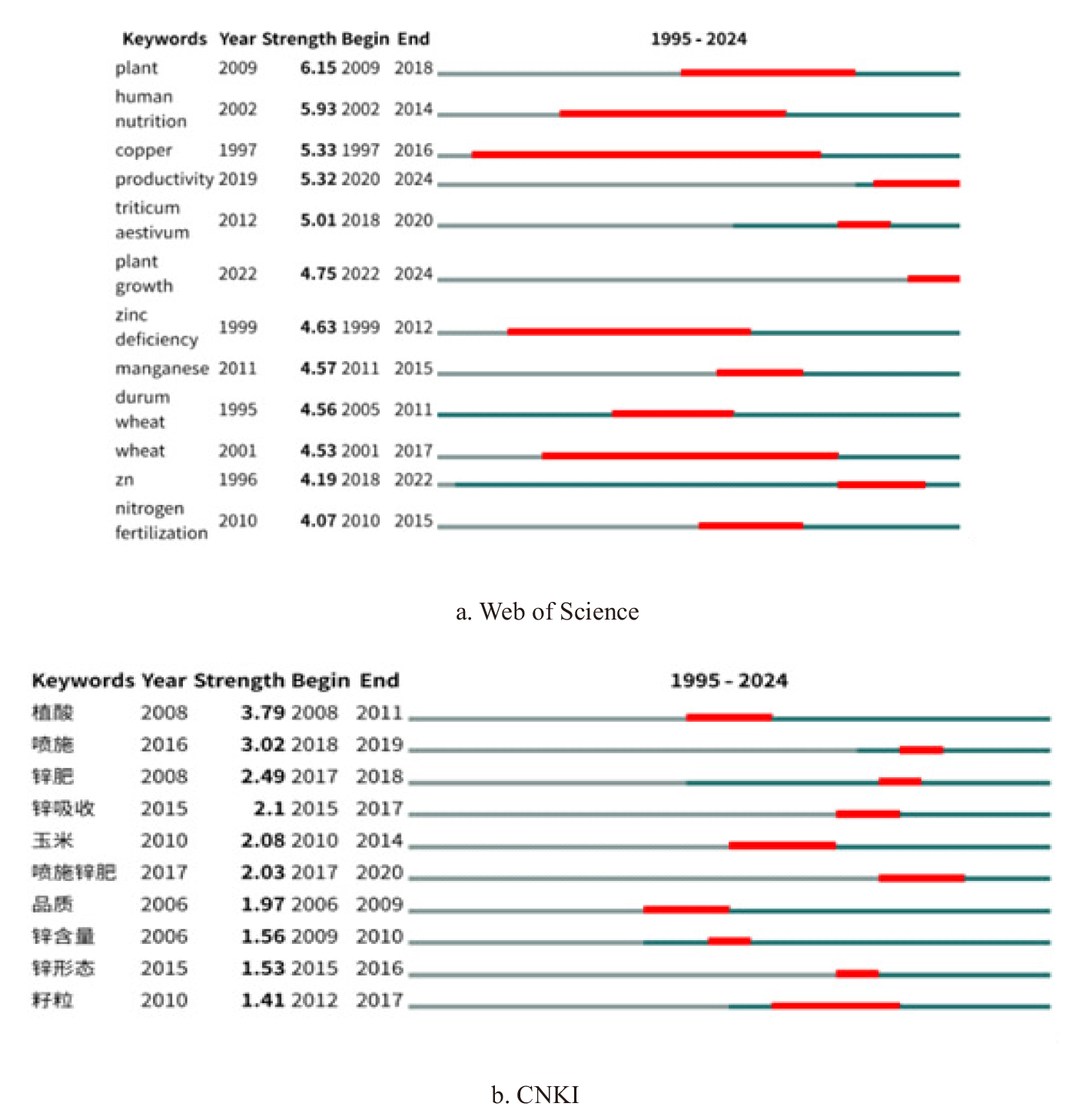
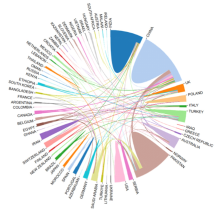
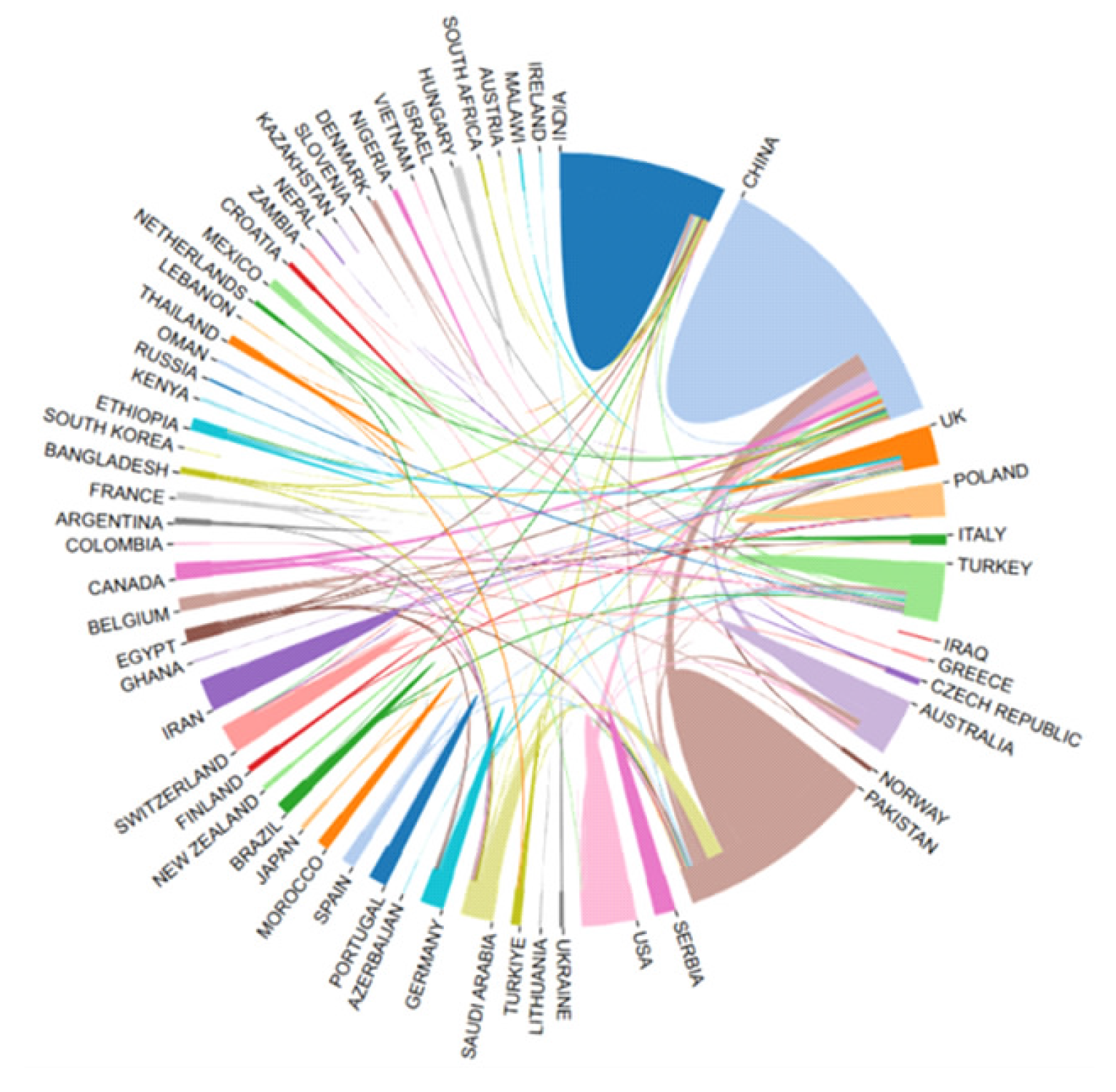
针对全球以小麦为主食人群面临膳食锌摄入不足,且小麦籽粒锌研究缺乏系统梳理的问题,为明确该领域研究现状与热点,基于中国知网(CNKI,172篇)和Web of Science核心合集(660篇)1995—2024年文献,采用CiteSpace和VOSviewer进行文献计量可视化分析,分析发文量前10位的国家、机构、期刊,被引频次前10位的文献及作者,通过关键词共现、聚类及时序演化挖掘研究热点,探究发文趋势、核心贡献者、研究热点及时序演化、国际合作网络。结果表明:(1)1995—2024年全球小麦籽粒锌的研究文献刊发数量呈上升趋势,澳大利亚、美国、中国和巴基斯坦在发文量与被引频次方面领先于其他国家,中国发文量(180篇)居首;(2)中文研究则侧重于叶喷锌肥和籽粒品质,英文研究热点聚焦于重金属、农艺生物强化;(3)中文研究以2016年为节点,历经籽粒品质、植酸、锌含量、锌形态(2005—2016年)和籽粒锌吸收、新型锌肥、喷施锌肥、喷施方式(2016—2024年)2个阶段。英文研究以2015年为界,历经小麦微量元素、缺素症、小麦营养和产量、小麦生殖(1995—2015年)和小麦锌元素、锌肥使用方式、产量增长和小麦繁殖(2016—2024年)2个阶段;(4)国际合作网络中,与中国研究关系密切的核心国家为巴基斯坦、澳大利亚、美国、加拿大、土耳其;(5)中国在小麦籽粒锌研究领域发文量占优,但缺乏高质量、高影响力的权威性文献。研究明确了小麦籽粒锌研究的全球格局与热点演化规律,中国需加强国际合作提升研究影响力。未来可聚焦遗传育种与农艺措施协同、新型锌肥研发等方向,强化不同生态区针对性研究,为锌营养强化提供技术支撑。
盛文旭, 杨敏, 王亚楠, 郭亚雯, 李昊昱, 张敏, 蔡瑞国, 郭子糠. 基于CNKI和Web of Science文献计量分析的小麦籽粒锌研究进展与热点[J]. 中国农学通报, 2026, 42(6): 1-13.
SHENG Wenxu, YANG Min, WANG Yanan, GUO Yawen, LI Haoyu, ZHANG Min, CAI Ruiguo, GUO Zikang. Research Progress and Hotspots of Grain Zinc in Wheat Based on Bibliometric Analysis of CNKI and Web of Science[J]. Chinese Agricultural Science Bulletin, 2026, 42(6): 1-13.
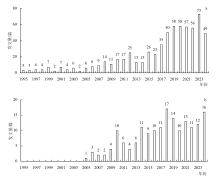
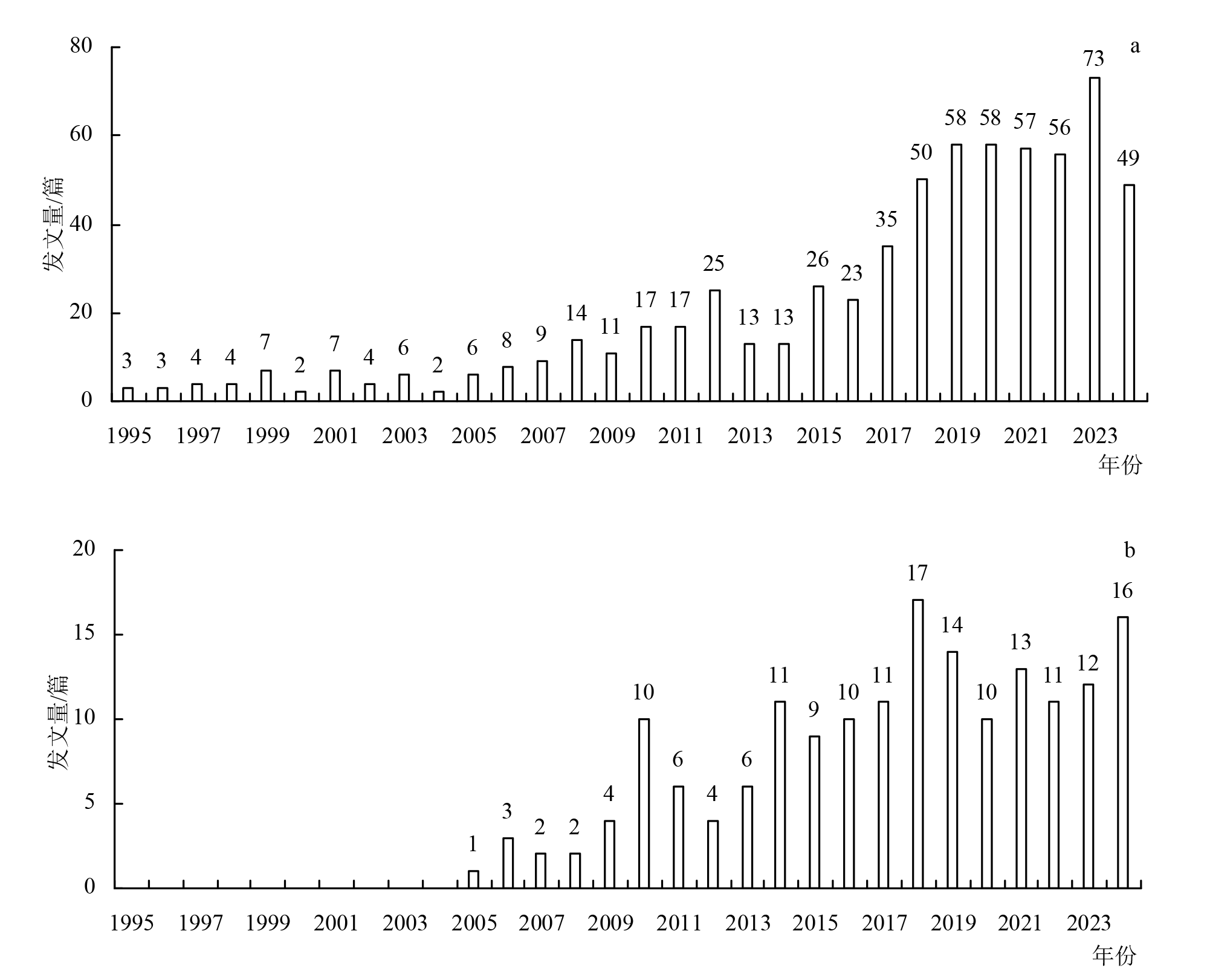
| 排名 | 机构名称 | 发文量 |
|---|---|---|
| 1 | 西北农林科技大学 | 50 |
| 2 | 中国农业大学 | 38 |
| 3 | 费萨拉巴德农业大学 | 37 |
| 4 | 萨班哲大学 | 36 |
| 5 | 西澳大利亚大学 | 26 |
| 6 | 河南农业大学 | 17 |
| 7 | 印度农业研究所 | 17 |
| 8 | 沙特国王大学 | 17 |
| 9 | 加拿大农业及农业食品部 | 16 |
| 10 | 巴哈丁扎卡里亚大学 | 16 |
| 排名 | 机构名称 | 发文量 |
|---|---|---|
| 1 | 西北农林科技大学 | 50 |
| 2 | 中国农业大学 | 38 |
| 3 | 费萨拉巴德农业大学 | 37 |
| 4 | 萨班哲大学 | 36 |
| 5 | 西澳大利亚大学 | 26 |
| 6 | 河南农业大学 | 17 |
| 7 | 印度农业研究所 | 17 |
| 8 | 沙特国王大学 | 17 |
| 9 | 加拿大农业及农业食品部 | 16 |
| 10 | 巴哈丁扎卡里亚大学 | 16 |
| 排名 | 期刊名 | 发文量 | ISSN | 2024年影响因子 |
|---|---|---|---|---|
| 1 | 《Journal of Plant Nutrition》 | 43 | 0190-4167 | 1.7 |
| 2 | 《Agronomy-Basel》 | 31 | 2073-4395 | 3.4 |
| 3 | 《Plant and Soil》 | 31 | 0032-079X | 4.1 |
| 4 | 《Communications in Soil Science and Plant Analysis》 | 25 | 0010-3624 | 1.4 |
| 5 | 《Field Crops Research》 | 19 | 0378-4290 | 6.4 |
| 6 | 《Frontiers in Plant Science》 | 19 | 1664-462X | 4.8 |
| 7 | 《Science of the Total Environment》 | 19 | 0048-9697 | 8.0 |
| 8 | 《Journal of Soil Science and Plant Nutrition》 | 16 | 0718-9516 | 3.1 |
| 9 | 《Journal of the Science of Food and Agriculture》 | 16 | 0022-5142 | 3.5 |
| 10 | 《Journal of Elementology》 | 15 | 1644-2296 | 0.7 |
| 排名 | 期刊名 | 发文量 | ISSN | 2024年影响因子 |
|---|---|---|---|---|
| 1 | 《Journal of Plant Nutrition》 | 43 | 0190-4167 | 1.7 |
| 2 | 《Agronomy-Basel》 | 31 | 2073-4395 | 3.4 |
| 3 | 《Plant and Soil》 | 31 | 0032-079X | 4.1 |
| 4 | 《Communications in Soil Science and Plant Analysis》 | 25 | 0010-3624 | 1.4 |
| 5 | 《Field Crops Research》 | 19 | 0378-4290 | 6.4 |
| 6 | 《Frontiers in Plant Science》 | 19 | 1664-462X | 4.8 |
| 7 | 《Science of the Total Environment》 | 19 | 0048-9697 | 8.0 |
| 8 | 《Journal of Soil Science and Plant Nutrition》 | 16 | 0718-9516 | 3.1 |
| 9 | 《Journal of the Science of Food and Agriculture》 | 16 | 0022-5142 | 3.5 |
| 10 | 《Journal of Elementology》 | 15 | 1644-2296 | 0.7 |
| 排名 | 机构名称 | 发文量/篇 |
|---|---|---|
| 1 | 西北农林科技大学 | 90 |
| 2 | 河南农业大学 | 20 |
| 3 | 山西农业大学 | 9 |
| 3 | 中国农业大学 | 9 |
| 5 | 扬州大学 | 8 |
| 6 | 南京农业大学 | 6 |
| 7 | 河南科技大学 | 5 |
| 7 | 浙江大学 | 5 |
| 9 | 华中农业大学 | 4 |
| 9 | 中国科学院新疆生态与地理研究所 | 4 |
| 排名 | 机构名称 | 发文量/篇 |
|---|---|---|
| 1 | 西北农林科技大学 | 90 |
| 2 | 河南农业大学 | 20 |
| 3 | 山西农业大学 | 9 |
| 3 | 中国农业大学 | 9 |
| 5 | 扬州大学 | 8 |
| 6 | 南京农业大学 | 6 |
| 7 | 河南科技大学 | 5 |
| 7 | 浙江大学 | 5 |
| 9 | 华中农业大学 | 4 |
| 9 | 中国科学院新疆生态与地理研究所 | 4 |
| 排名 | 来源期刊 | 发文量/篇 |
|---|---|---|
| 1 | 《植物营养与肥料学报》 | 9 |
| 2 | 《中国农业科学》 | 6 |
| 3 | 《农业环境科学学报》 | 5 |
| 4 | 《麦类作物学报》 | 5 |
| 5 | 《农业资源与环境学报》 | 5 |
| 6 | 《中国土壤与肥料》 | 4 |
| 7 | 《干旱地区农业研究》 | 3 |
| 8 | 《西北农林科技大学学报》 | 2 |
| 9 | 《河南农业科学》 | 2 |
| 10 | 《安徽农学通报》 | 2 |
| 排名 | 来源期刊 | 发文量/篇 |
|---|---|---|
| 1 | 《植物营养与肥料学报》 | 9 |
| 2 | 《中国农业科学》 | 6 |
| 3 | 《农业环境科学学报》 | 5 |
| 4 | 《麦类作物学报》 | 5 |
| 5 | 《农业资源与环境学报》 | 5 |
| 6 | 《中国土壤与肥料》 | 4 |
| 7 | 《干旱地区农业研究》 | 3 |
| 8 | 《西北农林科技大学学报》 | 2 |
| 9 | 《河南农业科学》 | 2 |
| 10 | 《安徽农学通报》 | 2 |
| 排名 | 第一作者 | 论文题目 | 被引频次 | 来源期刊 | 发表年份 |
|---|---|---|---|---|---|
| 1 | Cakmak I[ | 《Enrichment of cereal grains with zinc: Agronomic or genetic biofortification?》 | 1400 | 《Plant and soil》 | 2008 |
| 2 | Alloway B J[ | 《Soil factors associated with zinc deficiency in crops and humans》 | 656 | 《Environmental geochemistry and health》 | 2009 |
| 3 | White P[ | 《Biofortifying crops with essential mineral elements》 | 597 | 《Trends in plant science》 | 2005 |
| 4 | Cakmak I[ | 《Biofortification of durum wheat with zinc and iron》 | 537 | 《Cereal chemistry》 | 2010 |
| 5 | Cakmak I[ | 《Agronomic biofortification of cereals with zinc: A review》 | 526 | 《European journal of soil science》 | 2017 |
| 6 | Wang F[ | 《Responses of wheat yield, macro- and micro-nutrients, and heavy metals in soil and wheat following the application of manure compost on the North China plain》 | 418 | 《Plos one》 | 2016 |
| 7 | Cakmak I[ | 《Biofortification and localization of zinc in wheat grain》 | 404 | 《Journal of agricultural and food chemistry》 | 2010 |
| 8 | Fan M S[ | 《Evidence of decreasing mineral density in wheat grain over the last 160 years》 | 365 | 《Journal of trace elements in medicine and biology》 | 2008 |
| 9 | Bindraban P S[ | 《Exploring phosphorus fertilizers and fertilization strategies for improved human and environmental health》 | 300 | 《Biology and fertility of soils》 | 2020 |
| 10 | Velu G[ | 《Biofortification strategies to increase grain zinc and iron concentrations in wheat》 | 282 | 《Journal of cereal science》 | 2014 |
| 排名 | 第一作者 | 论文题目 | 被引频次 | 来源期刊 | 发表年份 |
|---|---|---|---|---|---|
| 1 | Cakmak I[ | 《Enrichment of cereal grains with zinc: Agronomic or genetic biofortification?》 | 1400 | 《Plant and soil》 | 2008 |
| 2 | Alloway B J[ | 《Soil factors associated with zinc deficiency in crops and humans》 | 656 | 《Environmental geochemistry and health》 | 2009 |
| 3 | White P[ | 《Biofortifying crops with essential mineral elements》 | 597 | 《Trends in plant science》 | 2005 |
| 4 | Cakmak I[ | 《Biofortification of durum wheat with zinc and iron》 | 537 | 《Cereal chemistry》 | 2010 |
| 5 | Cakmak I[ | 《Agronomic biofortification of cereals with zinc: A review》 | 526 | 《European journal of soil science》 | 2017 |
| 6 | Wang F[ | 《Responses of wheat yield, macro- and micro-nutrients, and heavy metals in soil and wheat following the application of manure compost on the North China plain》 | 418 | 《Plos one》 | 2016 |
| 7 | Cakmak I[ | 《Biofortification and localization of zinc in wheat grain》 | 404 | 《Journal of agricultural and food chemistry》 | 2010 |
| 8 | Fan M S[ | 《Evidence of decreasing mineral density in wheat grain over the last 160 years》 | 365 | 《Journal of trace elements in medicine and biology》 | 2008 |
| 9 | Bindraban P S[ | 《Exploring phosphorus fertilizers and fertilization strategies for improved human and environmental health》 | 300 | 《Biology and fertility of soils》 | 2020 |
| 10 | Velu G[ | 《Biofortification strategies to increase grain zinc and iron concentrations in wheat》 | 282 | 《Journal of cereal science》 | 2014 |
| 排名 | 第一作者 | 论文题目 | 被引频次 | 来源期刊 | 发表年份 |
|---|---|---|---|---|---|
| 1 | 陆欣春[ | 《氮锌配施对石灰性土壤锌形态及肥效的影响》 | 109 | 《土壤学报》 | 2010 |
| 2 | 郭九信[ | 《氮锌配施对小麦产量及氮锌含量的影响》 | 84 | 《南京农业大学学报》 | 2013 |
| 3 | 陆欣春[ | 《氮锌配施对不同冬小麦品种产量及锌营养的影响》 | 72 | 《中国生态农业学报》 | 2010 |
| 4 | 杨习文[ | 《喷施锌肥对小麦籽粒锌铁铜锰营养的影响》 | 56 | 《干旱地区农业研究》 | 2010 |
| 5 | 杨月娥[ | 《我国主要麦区小麦籽粒锌含量对叶喷锌肥的响应》 | 53 | 《植物营养与肥料学报》 | 2016 |
| 6 | 刘敦一[ | 《锌肥施用方式对小麦、玉米产量和籽粒锌含量的影响》 | 53 | 《中国土壤与肥料》 | 2014 |
| 7 | 王子腾[ | 《国内外主要粮食作物对施用锌肥响应的研究进展》 | 52 | 《植物营养与肥料学报》 | 2018 |
| 8 | 李宏云[ | 《不同水氮管理下锌与氮磷肥配合喷施对冬小麦锌营养品质的影响》 | 52 | 《中国农业科学》 | 2014 |
| 9 | 党红凯[ | 《高产冬小麦对锌的吸收、积累与分配》 | 52 | 《中国农业科学》 | 2010 |
| 10 | 董明[ | 《花后5天喷施锌肥有效提高小麦籽粒营养和加工品质》 | 52 | 《中国农业科学》 | 2018 |
| 排名 | 第一作者 | 论文题目 | 被引频次 | 来源期刊 | 发表年份 |
|---|---|---|---|---|---|
| 1 | 陆欣春[ | 《氮锌配施对石灰性土壤锌形态及肥效的影响》 | 109 | 《土壤学报》 | 2010 |
| 2 | 郭九信[ | 《氮锌配施对小麦产量及氮锌含量的影响》 | 84 | 《南京农业大学学报》 | 2013 |
| 3 | 陆欣春[ | 《氮锌配施对不同冬小麦品种产量及锌营养的影响》 | 72 | 《中国生态农业学报》 | 2010 |
| 4 | 杨习文[ | 《喷施锌肥对小麦籽粒锌铁铜锰营养的影响》 | 56 | 《干旱地区农业研究》 | 2010 |
| 5 | 杨月娥[ | 《我国主要麦区小麦籽粒锌含量对叶喷锌肥的响应》 | 53 | 《植物营养与肥料学报》 | 2016 |
| 6 | 刘敦一[ | 《锌肥施用方式对小麦、玉米产量和籽粒锌含量的影响》 | 53 | 《中国土壤与肥料》 | 2014 |
| 7 | 王子腾[ | 《国内外主要粮食作物对施用锌肥响应的研究进展》 | 52 | 《植物营养与肥料学报》 | 2018 |
| 8 | 李宏云[ | 《不同水氮管理下锌与氮磷肥配合喷施对冬小麦锌营养品质的影响》 | 52 | 《中国农业科学》 | 2014 |
| 9 | 党红凯[ | 《高产冬小麦对锌的吸收、积累与分配》 | 52 | 《中国农业科学》 | 2010 |
| 10 | 董明[ | 《花后5天喷施锌肥有效提高小麦籽粒营养和加工品质》 | 52 | 《中国农业科学》 | 2018 |
| 数据库 | 排名 | 作者姓名 | 被引频次 | 数据库 | 排名 | 作者姓名 | 被引频次 |
|---|---|---|---|---|---|---|---|
| Web of Science | 1 | Cakmak Ismail | 24 | CNKI | 1 | 田霄鸿 | 13 |
| 2 | Tian Xiaohong | 18 | 2 | 杨习文 | 8 | ||
| 3 | Wang Zhaohui | 18 | 3 | 王少霞 | 7 | ||
| 4 | Zou Chunqin | 17 | 4 | 陆欣春 | 7 | ||
| 5 | Zhang Wei | 12 | 5 | 李萌 | 7 | ||
| 6 | Wang Shaoxia | 11 | 6 | 赵爱青 | 7 | ||
| 7 | Shivay Yashbir Singh | 11 | 7 | 王朝辉 | 6 | ||
| 8 | Ozturk Levent | 10 | 8 | 刘珂 | 5 | ||
| 9 | Prasanna Radha | 10 | 9 | 买文选 | 5 | ||
| 10 | Shi Mei | 10 | 10 | 张腾 | 4 |
| 数据库 | 排名 | 作者姓名 | 被引频次 | 数据库 | 排名 | 作者姓名 | 被引频次 |
|---|---|---|---|---|---|---|---|
| Web of Science | 1 | Cakmak Ismail | 24 | CNKI | 1 | 田霄鸿 | 13 |
| 2 | Tian Xiaohong | 18 | 2 | 杨习文 | 8 | ||
| 3 | Wang Zhaohui | 18 | 3 | 王少霞 | 7 | ||
| 4 | Zou Chunqin | 17 | 4 | 陆欣春 | 7 | ||
| 5 | Zhang Wei | 12 | 5 | 李萌 | 7 | ||
| 6 | Wang Shaoxia | 11 | 6 | 赵爱青 | 7 | ||
| 7 | Shivay Yashbir Singh | 11 | 7 | 王朝辉 | 6 | ||
| 8 | Ozturk Levent | 10 | 8 | 刘珂 | 5 | ||
| 9 | Prasanna Radha | 10 | 9 | 买文选 | 5 | ||
| 10 | Shi Mei | 10 | 10 | 张腾 | 4 |
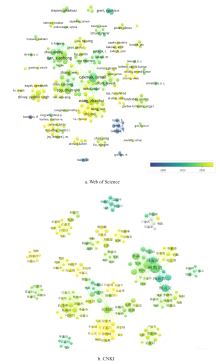
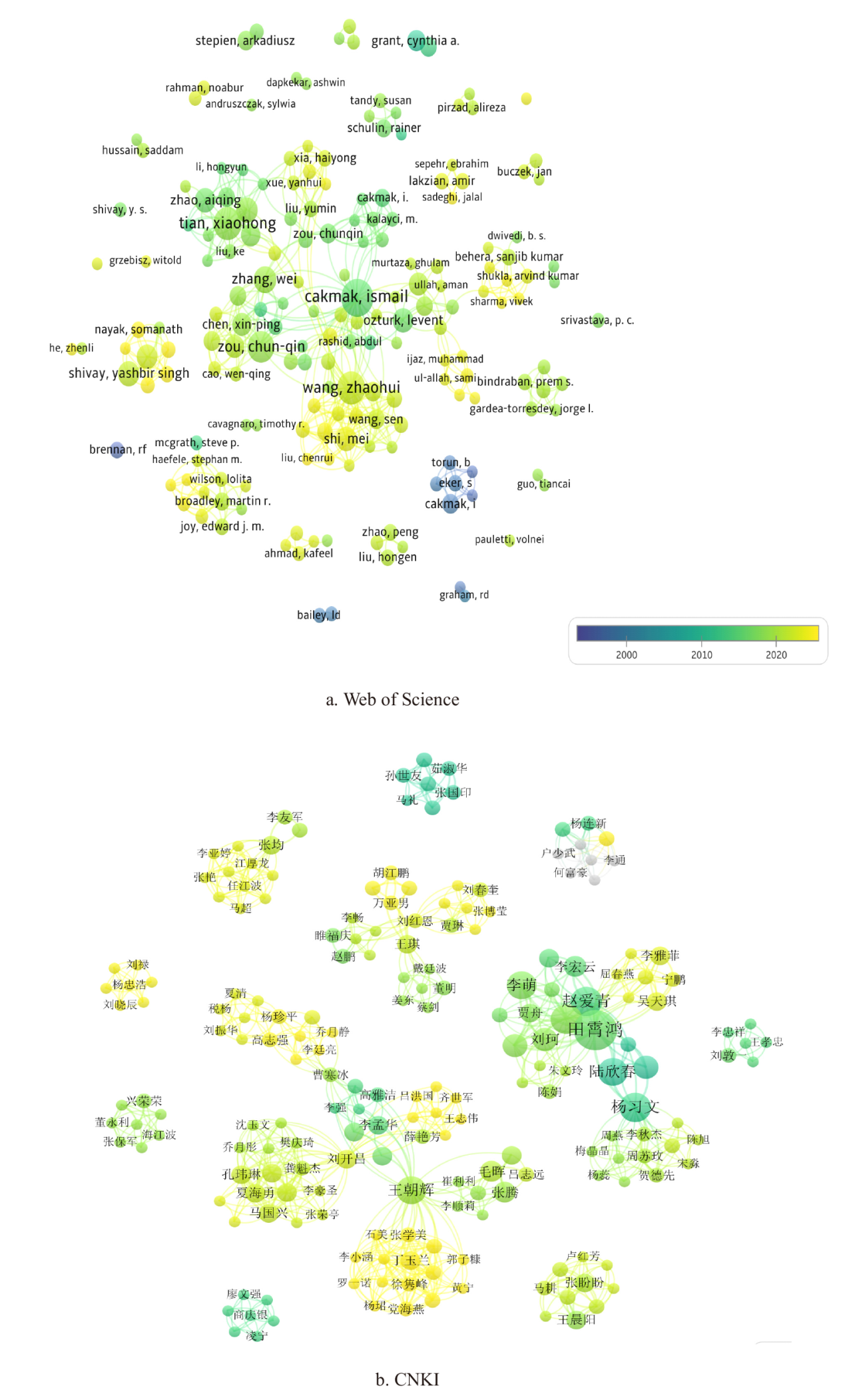
| [1] |
doi: 10.1016/j.jcs.2018.09.004 URL |
| [2] |
|
| [3] |
褚宏欣, 牟文燕, 党海燕, 等. 我国主要麦区小麦籽粒微量元素含量及营养评价[J]. 作物学报, 2022, 48(11):2853-2865.
doi: 10.3724/SP.J.1006.2022.11099 |
| [4] |
doi: 10.3389/fpls.2022.903819 URL |
| [5] |
褚宏欣, 党海燕, 王涛, 等. 我国主要麦区土壤有效铁锰铜锌丰缺状况评价及影响因素[J]. 土壤学报, 2024, 61(1):129-139.
|
| [6] |
doi: 10.3390/agronomy10020178 URL |
| [7] |
doi: 10.1556/CRC.39.2011.4.8 URL |
| [8] |
|
| [9] |
doi: 10.1177/1094428114562629 URL |
| [10] |
doi: 10.1016/j.gfs.2017.01.009 URL |
| [11] |
doi: 10.3390/agriculture14091530 URL |
| [12] |
doi: 10.1007/s11738-016-2300-x URL |
| [13] |
doi: 10.2134/agronj2017.08.0437 URL |
| [14] |
doi: 10.1016/j.fcr.2015.09.007 URL |
| [15] |
doi: 10.1016/j.jcs.2015.06.007 URL |
| [16] |
doi: 10.1007/s10705-021-10143-8 |
| [17] |
丁玉兰, 黄翠, 方佳创, 等. 旱地小麦锌吸收转移与籽粒锌含量的关系[J]. 植物营养与肥料学报, 2024, 30(9):1650-1664.
|
| [18] |
刘娟花. 施锌方式对石灰性土壤中锌形态转化及小麦锌吸收的影响[D]. 杨凌: 西北农林科技大学, 2016.
|
| [19] |
陆欣春. 石灰性土壤上供锌对不同基因型小麦生长及锌吸收的影响[D]. 杨凌: 西北农林科技大学, 2008.
|
| [20] |
曹玉贤. 小麦籽粒锌营养品质的影响因素研究[D]. 杨凌: 西北农林科技大学, 2010.
|
| [21] |
钟民正. 应用两种纳米材料(ZnONPs和Fe3O4NPs)对小麦锌铁吸收分布的交互影响研究[D]. 杨凌: 西北农林科技大学, 2021.
|
| [22] |
doi: 10.1007/s11104-007-9466-3 URL |
| [23] |
doi: 10.1007/s10653-009-9255-4 URL |
| [24] |
doi: 10.1016/j.tplants.2005.10.001 pmid: 16271501 |
| [25] |
doi: 10.1094/CCHEM-87-1-0010 URL |
| [26] |
doi: 10.1111/ejss.2018.69.issue-1 URL |
| [27] |
doi: 10.1371/journal.pone.0146453 URL |
| [28] |
doi: 10.1021/jf101197h pmid: 23654236 |
| [29] |
doi: 10.1016/j.jtemb.2008.07.002 URL |
| [30] |
doi: 10.1007/s00374-019-01430-2 |
| [31] |
doi: 10.1016/j.jcs.2013.09.001 URL |
| [32] |
陆欣春, 田霄鸿, 杨习文, 等. 氮锌配施对石灰性土壤锌形态及肥效的影响[J]. 土壤学报, 2010, 47(6):1202-1213.
|
| [33] |
郭九信, 廖文强, 凌宁, 等. 氮锌配施对小麦产量及氮锌含量的影响[J]. 南京农业大学学报, 2013, 36(2):77-82.
|
| [34] |
陆欣春, 田霄鸿, 杨习文, 等. 氮锌配施对不同冬小麦品种产量及锌营养的影响[J]. 中国生态农业学报, 2010, 18(5):923-928.
|
| [35] |
杨习文, 田霄鸿, 陆欣春, 等. 喷施锌肥对小麦籽粒锌铁铜锰营养的影响[J]. 干旱地区农业研究, 2010, 28(6):95-102.
|
| [36] |
杨月娥, 王森, 王朝辉, 等. 我国主要麦区小麦籽粒锌含量对叶喷锌肥的响应[J]. 植物营养与肥料学报, 2016, 22(3):579-589.
|
| [37] |
刘敦一, 庞丽丽, 张伟, 等. 锌肥施用方式对小麦、玉米产量和籽粒锌含量的影响[J]. 中国土壤与肥料, 2014(4):76-80.
|
| [38] |
王子腾, 耿元波. 国内外主要粮食作物对施用锌肥响应的研究进展[J]. 植物营养与肥料学报, 2018, 24(3):805-816.
|
| [39] |
李宏云, 王少霞, 李萌, 等. 不同水氮管理下锌与氮磷肥配合喷施对冬小麦锌营养品质的影响[J]. 中国农业科学, 2014, 47(20):4016-4026.
doi: 10.3864/j.issn.0578-1752.2014.20.010 |
| [40] |
党红凯, 李瑞奇, 孙亚辉, 等. 高产冬小麦对锌的吸收、积累与分配[J]. 中国农业科学, 2010, 43(9):1791-1799.
|
| [41] |
董明, 王琪, 周琴, 等. 花后5天喷施锌肥有效提高小麦籽粒营养和加工品质[J]. 植物营养与肥料学报, 2018, 24(1):63-70.
|
| [42] |
|
| [43] |
|
| [44] |
doi: 10.1111/nph.2010.189.issue-2 URL |
| [45] |
吴天琪, 李雅菲, 师江澜, 等. 基施氮肥及灌浆前期喷施锌肥对小麦籽粒富锌及蛋白组分含量的影响[J]. 中国农业科学, 2022, 55(10):1971-1986.
doi: 10.3864/j.issn.0578-1752.2022.10.008 |
| [46] |
doi: 10.1111/tpj.13655 pmid: 28771859 |
| [47] |
|
| [48] |
doi: 10.1016/j.scitotenv.2019.03.112 URL |
| [49] |
|
| [50] |
|
| [51] |
doi: 10.1002/jsfa.v91.13 URL |
| [52] |
doi: 10.1371/journal.pone.0191035 URL |
| [53] |
张诗琦, 刘含章, 胡能兵, 等. 小麦富锌育种的发展现状及研究趋势[J]. 安徽农学通报, 2024, 30(17):1-5.
doi: 10.16377/j.cnki.issn1007-7731.2024.17.001 |
| [54] |
杨珺. 高产高锌小麦缓解磷锌拮抗的营养机制[D]. 杨凌: 西北农林科技大学, 2024.
|
| [55] |
丁玉兰, 黄翠, 王星舒, 等. 黄土高原旱地小麦籽粒锌含量及分布对锌肥的响应[J]. 中国农业科学, 2024, 57(11):2176-2188.
doi: 10.3864/j.issn.0578-1752.2024.11.010 |
| [56] |
刘晨瑞. 有效磷影响小麦籽粒锌锰含量的土壤因子分析[D]. 杨凌: 西北农林科技大学, 2024.
|
| [57] |
徐利利. 小麦根蘖发育及籽粒产量品质对氮锌调控的响应[D]. 郑州: 河南农业大学, 2021.
|
| [58] |
杨瑜. 石灰性土壤绿肥轮作与施锌对小麦品质及土壤锌组分的影响[D]. 杨凌: 西北农林科技大学, 2021.
|
| [59] |
颜为, 孙金鞭, 吕洪国, 等. 不同锌源叶面喷施对冬小麦和夏玉米产量及籽粒营养品质的影响[J]. 农业环境科学学报, 2024, 43(3):504-515.
|
| [60] |
王澜, 蒋曦龙, 陈利容, 等. 土施和无人机配施锌肥对小麦产量和籽粒锌铁硒含量的影响[J]. 东北农业科学, 2022, 47(2):16-20.
|
| [61] |
梁佳文. 含锌硒钼水稻和小麦专用肥施用效果研究[D]. 武汉: 华中农业大学, 2024.
|
| [62] |
刘晓辰, 杨忠浩, 郭新送, 等. 腐植酸与锌肥配施对小麦籽粒产量、品质及锌含量的影响[J]. 腐植酸, 2023(4):47-52.
|
| [1] | 吕广德, 孙盈盈, 牟秋焕, 徐加利, 颜丽美, 徐慧媛, 尹逊栋, 陈永军, 钱兆国. 小麦新品种成熟期N、P养分利用效率鉴定[J]. 中国农学通报, 2026, 42(3): 11-19. |
| [2] | 李保军, 温国昌, 陈洁, 崔晓敬, 贾良良, 杨云马, 杨璞, 李红铁. 耕作方式、有机肥、秸秆还田对小麦赤霉病和茎基腐病的影响[J]. 中国农学通报, 2026, 42(2): 184-190. |
| [3] | 周佳慧, 唐浦林, 张诗野, 张爱华, 汪树理, 魏航, 任新龙, 郜玉钢, 王艳芳. 基于CNKI数据库的土壤酸化调节措施文献计量分析[J]. 中国农学通报, 2026, 42(2): 203-210. |
| [4] | 王君, 左希, 仇景涛, 杨武广, 钱晨诚. 晚播条件下不同小麦品种农艺性状和产量的差异性分析[J]. 中国农学通报, 2026, 42(2): 25-31. |
| [5] | 刘思汐, 黄祥庆, 代廷云, 孙加威, 陈慧欢, 高天, 唐雪琴, 杨玉萍, 阎洪. 播期、播量对成都平原地区冬小麦群体生长及产量的影响[J]. 中国农学通报, 2026, 42(2): 32-39. |
| [6] | 秦小欢, 焦多朵, 金铁棚, 孙师, 郜坤媛, 胡建霖. 人参属植物根系微生态研究态势分析[J]. 中国农学通报, 2026, 42(2): 84-92. |
| [7] | 李亚莉, 路国梁, 吴正虎, 郭飞, 张喜生, 刘安. 不同改良剂对冬小麦产量、养分吸收及土壤养分的影响[J]. 中国农学通报, 2026, 42(2): 128-132. |
| [8] | 田翠玲, 田家良. 不同生育期喷施海藻酸增效液对冬小麦光合特性及产量的影响[J]. 中国农学通报, 2025, 41(9): 25-31. |
| [9] | 任庆国, 吴广俊, 林平, 张继雨, 张鑫, 张永珊, 海涛. 小麦新品种‘菏麦26’的产量及品质特性研究[J]. 中国农学通报, 2025, 41(9): 32-37. |
| [10] | 徐静, 王超, 万小刚, 赵岳, 伍勇. 基于文献计量的中国植物内生真菌学位论文研究热点与趋势分析[J]. 中国农学通报, 2025, 41(8): 140-148. |
| [11] | 卢云峰, 李锐群, 曾润华, 李树忠, 王忠美, 李智海, 贾冬冬. 基于Web of Science文献计量的香蕉枯萎病研究态势分析[J]. 中国农学通报, 2025, 41(8): 149-158. |
| [12] | 薛远赛, 王锡久, 邹士国, 张守福, 刘光亚, 韩伟, 孙显. 复合寡糖对山东典型作物产量的影响[J]. 中国农学通报, 2025, 41(8): 50-56. |
| [13] | 王彦, 刘晓丽, 张怡, 陈宏灏. 基于CiteSpace的葡萄阿小叶蝉研究进展可视化分析[J]. 中国农学通报, 2025, 41(7): 121-127. |
| [14] | 王安娜, 秦健, 赵志刚, 赖多, 肖维强, 庄庆礼, 邵雪花, 阳成伟, 董涛. 基于CiteSpace的油梨采后保鲜研究进展与热点可视化分析[J]. 中国农学通报, 2025, 41(7): 145-153. |
| [15] | 范华, 程敦公, 刘建军, 刘爱峰. 不同筋力小麦品种混播的理化品质特性变化及对面包面条品质的影响[J]. 中国农学通报, 2025, 41(6): 148-152. |
| 阅读次数 | ||||||
|
全文 |
|
|||||
|
摘要 |
|
|||||
