欢迎访问《中国农学通报》,

中国农学通报 ›› 2026, Vol. 42 ›› Issue (2): 1-9.doi: 10.11924/j.issn.1000-6850.casb2025-0238
• 农学·农业基础科学 • 下一篇
徐铭婕1( ), 李念1, 郭书磊2, 韩赞平1()
收稿日期:2025-03-26
修回日期:2025-06-15
出版日期:2026-01-25
发布日期:2026-01-22
通讯作者:
作者简介:徐铭婕,女,2002年出生,江苏南通人,硕士研究生,研究方向:玉米分子遗传学。通信地址:471023 河南省洛阳市洛龙区河南科技大学农学院,E-mail:18921642961@163.com。
基金资助:
XU Mingjie1(), LI Nian1, GUO Shulei2, HAN Zanping1()
Received:2025-03-26
Revised:2025-06-15
Published:2026-01-25
Online:2026-01-22
摘要:
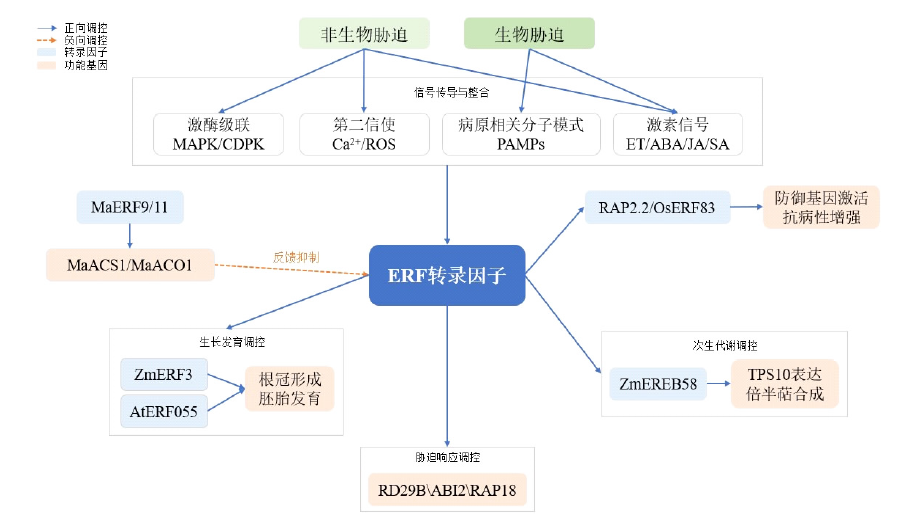
ERF(Ethylene Responsive Factor)转录因子是AP2/ERF家族的一个重要亚家族,其特征是高度保守的AP2结构域。它们特异性识别并结合靶基因启动子中的顺式作用元件,如GCC-box和DRE/CRT,在植物对生物和非生物胁迫的反应中发挥核心调节作用。ERF家族的成员主要参与调节对干旱、高盐、低温和缺氧等非生物胁迫的响应,而其他成员则通过水杨酸、茉莉酸等激素信号通路介导对病原体等生物胁迫的抗性。近年来,在玉米中发现多个参与胁迫响应的ERF关键成员,并通过遗传转化证实它们在增强抗旱性、耐盐性和抗病性等方面的关键作用。通过文献调研与归纳分析,本文综述玉米ERF转录因子的结构特征、功能分类,重点解析其在生物与非生物胁迫下的调控机制及网络。结果显示,ERF转录因子通过保守AP2结构域结合GCC-box、DRE/CRT等顺式元件,参与脱落酸(ABA)、茉莉酸(JA)、乙烯(ET)等激素信号通路,调控下游抗逆基因表达;已鉴定229个玉米AP2/ERF家族基因,其中105个ERF亚家族成员分别响应干旱、盐、极端温度等非生物胁迫及大斑病凸脐蠕孢、禾谷镰孢菌等生物胁迫,部分基因(如ZmERF21、ZmEREB92)具广谱抗逆潜力。ERF转录因子是玉米抗逆调控网络的核心节点,通过多途径协同增强抗逆性。未来需结合ChIP-seq、基因编辑等技术解析ERF靶标基因与互作网络,挖掘优异等位变异,为玉米抗逆分子设计育种提供基因资源与理论支撑。
徐铭婕, 李念, 郭书磊, 韩赞平. ERF转录因子调控玉米抗逆性的研究进展[J]. 中国农学通报, 2026, 42(2): 1-9.
XU Mingjie, LI Nian, GUO Shulei, HAN Zanping. Regulation of Stress Resistance in Maize by ERF Transcription Factors: A Review[J]. Chinese Agricultural Science Bulletin, 2026, 42(2): 1-9.
| 基因 | 结合元件 | 胁迫响应 | 参考文献 | |
|---|---|---|---|---|
| ZmSERF1 | 正调控拟南芥体细胞胚胎发生 | [ | ||
| ZmERF1 | 增强玉米盐、干旱、热胁迫抗性 | [ | ||
| ZmERF9 | 调控低磷胁迫 | [ | ||
| ZmERF018 | 增强玉米苗期的耐旱性 | [ | ||
| ZmERF21 | 增强玉米抗旱性 | [ | ||
| ZmERF98 | GCC-box、CE1-motif | 负调控玉米耐盐性 | [ | |
| ZmEREB3 | DRE/CRT、G-box | 增强干旱、盐、冷胁迫抗性 | [ | |
| ZmEREB14 | 调控玉米茎尖分生组织(SAM)发育和产量 | [ | ||
| ZmEREB17 | 调控淀粉合成 | [ | ||
| ZmEREB20 | 增强拟南芥盐胁迫抗性 | [ | ||
| ZmEREB24 | 增强玉米苗期抗旱性 | [ | ||
| ZmEREB25 | 调控玉米胚乳淀粉合成 | [ | ||
| ZmEREB46 | G-box、MBS | 正调控耐渍、干旱、叶表皮合成 | [ | |
| ZmEREB57 | O-box | 增强玉米盐胁迫抗性 | [ | |
| ZmEREB58 | GCC-box | 介导茉莉素诱导倍半萜挥发物的产生 | [ | |
| ZmEREB60 | 增强干旱胁迫抗性 | [ | ||
| ZmEREB87 | 增强拟南芥抗旱性 | [ | ||
| ZmEREB93 | DRE/CRT core | 负调控籽粒发育、淀粉合成、支撑根 | [ | |
| ZmEREB94 | 调控淀粉合成 | [ | ||
| ZmEREB97 | GCC-box | 正调控玉米根系硝酸盐吸收 | [ | |
| ZmEREB102 | 增强抗旱性和耐盐性 | [ | ||
| ZmEREB110 | 正调控玉米支撑根发育 | [ | ||
| ZmEREB130 | 负调控拟南芥生长和种子大小 | [ | ||
| ZmEREB137 | 增强干旱胁迫抗性 | [ | ||
| ZmEREB151 | 调控玉米小穗分生组织的同一性 | [ | ||
| ZmEREB156 | 调控淀粉合成 | [ | ||
| ZmEREB160 | 增强拟南芥抗旱性 | [ | ||
| ZmEREB167 | 负调控玉米籽粒大小与淀粉积累 | [ | ||
| ZmEREB179 | GCC-box | 负调控玉米耐渍性 | [ | |
| ZmEREB180 | 增强玉米抗涝性 | [ | ||
| ZmEREB192 | 调控玉米胚乳淀粉合成 | [ | ||
| ZmEREB204 | GCC-box/DRE | 增强玉米渗透性 | [ | |
| ZmEREB211 | 增强盐胁迫、渗透胁迫和 JA胁迫抗性 | [ |
| 基因 | 结合元件 | 胁迫响应 | 参考文献 | |
|---|---|---|---|---|
| ZmSERF1 | 正调控拟南芥体细胞胚胎发生 | [ | ||
| ZmERF1 | 增强玉米盐、干旱、热胁迫抗性 | [ | ||
| ZmERF9 | 调控低磷胁迫 | [ | ||
| ZmERF018 | 增强玉米苗期的耐旱性 | [ | ||
| ZmERF21 | 增强玉米抗旱性 | [ | ||
| ZmERF98 | GCC-box、CE1-motif | 负调控玉米耐盐性 | [ | |
| ZmEREB3 | DRE/CRT、G-box | 增强干旱、盐、冷胁迫抗性 | [ | |
| ZmEREB14 | 调控玉米茎尖分生组织(SAM)发育和产量 | [ | ||
| ZmEREB17 | 调控淀粉合成 | [ | ||
| ZmEREB20 | 增强拟南芥盐胁迫抗性 | [ | ||
| ZmEREB24 | 增强玉米苗期抗旱性 | [ | ||
| ZmEREB25 | 调控玉米胚乳淀粉合成 | [ | ||
| ZmEREB46 | G-box、MBS | 正调控耐渍、干旱、叶表皮合成 | [ | |
| ZmEREB57 | O-box | 增强玉米盐胁迫抗性 | [ | |
| ZmEREB58 | GCC-box | 介导茉莉素诱导倍半萜挥发物的产生 | [ | |
| ZmEREB60 | 增强干旱胁迫抗性 | [ | ||
| ZmEREB87 | 增强拟南芥抗旱性 | [ | ||
| ZmEREB93 | DRE/CRT core | 负调控籽粒发育、淀粉合成、支撑根 | [ | |
| ZmEREB94 | 调控淀粉合成 | [ | ||
| ZmEREB97 | GCC-box | 正调控玉米根系硝酸盐吸收 | [ | |
| ZmEREB102 | 增强抗旱性和耐盐性 | [ | ||
| ZmEREB110 | 正调控玉米支撑根发育 | [ | ||
| ZmEREB130 | 负调控拟南芥生长和种子大小 | [ | ||
| ZmEREB137 | 增强干旱胁迫抗性 | [ | ||
| ZmEREB151 | 调控玉米小穗分生组织的同一性 | [ | ||
| ZmEREB156 | 调控淀粉合成 | [ | ||
| ZmEREB160 | 增强拟南芥抗旱性 | [ | ||
| ZmEREB167 | 负调控玉米籽粒大小与淀粉积累 | [ | ||
| ZmEREB179 | GCC-box | 负调控玉米耐渍性 | [ | |
| ZmEREB180 | 增强玉米抗涝性 | [ | ||
| ZmEREB192 | 调控玉米胚乳淀粉合成 | [ | ||
| ZmEREB204 | GCC-box/DRE | 增强玉米渗透性 | [ | |
| ZmEREB211 | 增强盐胁迫、渗透胁迫和 JA胁迫抗性 | [ |
| 基因 | 结合元件 | 胁迫响应 | 参考文献 |
|---|---|---|---|
| ZmEREB61 | GCC-box | 增强玉米对大斑病凸脐蠕孢(E. turcicum)的抗性 | [ |
| ZmERF105 | GCC-box | 增强玉米对大斑病凸脐蠕孢(E. turcicum)的抗性 | [ |
| ZmERF147 | GCC-box | 增强玉米对禾谷镰孢菌(F. graminearum)的抗性 | [ |
| ZmEREB92 | GCC-box | 增强玉米对禾谷镰孢菌(F. graminearum)的抗性 | [ |
| 基因 | 结合元件 | 胁迫响应 | 参考文献 |
|---|---|---|---|
| ZmEREB61 | GCC-box | 增强玉米对大斑病凸脐蠕孢(E. turcicum)的抗性 | [ |
| ZmERF105 | GCC-box | 增强玉米对大斑病凸脐蠕孢(E. turcicum)的抗性 | [ |
| ZmERF147 | GCC-box | 增强玉米对禾谷镰孢菌(F. graminearum)的抗性 | [ |
| ZmEREB92 | GCC-box | 增强玉米对禾谷镰孢菌(F. graminearum)的抗性 | [ |
| [1] |
doi: 10.3390/plants9040491 URL |
| [2] |
艾蓉. 玉米ZmEREB211基因的克隆与功能研究[D]. 荆州: 长江大学, 2023.
|
| [3] |
张静. 逆境胁迫下玉米DNA去甲基化酶和AP2/ERF基因家族的全基因组鉴定与分析[D]. 芜湖: 安徽师范大学, 2020.
|
| [4] |
doi: 10.1104/pp.15.00677 pmid: 26103991 |
| [5] |
|
| [6] |
|
| [7] |
doi: 10.3390/genes14010194 URL |
| [8] |
doi: 10.1038/ng.654 |
| [9] |
doi: 10.1101/gad.10.23.3018 URL |
| [10] |
|
| [11] |
doi: 10.51539/biotech.734889 URL |
| [12] |
doi: 10.1101/gad.12.8.1145 URL |
| [13] |
doi: 10.1105/tpc.001941 pmid: 12172019 |
| [14] |
doi: 10.1105/tpc.15.00227 URL |
| [15] |
滕飞. 拟南芥AP2/ERF基因ERF055调控茎端分生组织发育的功能研究[D]. 泰安: 山东农业大学, 2013.
|
| [16] |
doi: 10.1242/jeb.089938 URL |
| [17] |
doi: 10.17179/excli2015-600 pmid: 27152109 |
| [18] |
|
| [19] |
|
| [20] |
doi: S1534-5807(17)30166-1 pmid: 28399398 |
| [21] |
doi: 10.1111/tpj.12994 pmid: 26303437 |
| [22] |
doi: 10.1007/s11103-013-0054-z URL |
| [23] |
doi: 10.1007/s11103-005-7294-5 pmid: 16021341 |
| [24] |
doi: 10.1016/j.bbagrm.2011.08.004 pmid: 21867785 |
| [25] |
doi: 10.1007/s00122-002-1131-x pmid: 12647068 |
| [26] |
doi: 10.1093/jxb/ert108 URL |
| [27] |
doi: 10.1111/nph.2012.195.issue-2 URL |
| [28] |
doi: S0981-9428(18)30564-3 pmid: 30590260 |
| [29] |
高一丹. 玉米体细胞胚胎发生相关基因ZmSERF1和ZmYUCCA5的研究[D]. 吉林: 吉林大学, 2020.
|
| [30] |
|
| [31] |
doi: 10.1007/s00122-022-04199-5 pmid: 36121453 |
| [32] |
doi: 10.3864/j.issn.0578-1752.2022.19.001 |
| [33] |
doi: S0176-1617(17)30119-0 pmid: 28549232 |
| [34] |
黄焕焕. 蔗糖/ABA响应因子ZmEREB156和ZmEREB17调控玉米胚乳淀粉合成的机理研究[D]. 雅安: 四川农业大学, 2016.
|
| [35] |
|
| [36] |
doi: 10.1126/science.1076920 pmid: 12424380 |
| [37] |
doi: 10.1007/s11356-014-3739-1 URL |
| [38] |
doi: 10.1007/s11738-016-2146-2 URL |
| [39] |
doi: 10.1016/j.plaphy.2020.12.027 pmid: 33395583 |
| [40] |
魏雪宁. 玉米ZmEREB57调控OPDA合成响应盐胁迫的作用机制研究[D]. 济南: 济南大学, 2023.
|
| [41] |
doi: 10.1111/pce.v45.2 URL |
| [42] |
王小东. 玉米ZmHDT103,ZmERF018和ZmCDPK5调控玉米苗期耐旱性的功能研究[D]. 兰州: 甘肃农业大学, 2024.
|
| [43] |
付家旭. ZmEREB24提高玉米苗期抗旱性的分子机制解析[D]. 郑州: 河南农业大学, 2023.
|
| [44] |
doi: 10.1016/j.plantsci.2022.111256 URL |
| [45] |
doi: 10.3390/ijms160612131 pmid: 26030672 |
| [46] |
doi: 10.1016/j.jplph.2022.153763 URL |
| [47] |
姚海梅. 玉米转录因子基因ZmEREB87的克隆及功能分析[D]. 兰州: 甘肃农业大学, 2016.
|
| [48] |
doi: 10.1016/j.wace.2015.08.001 URL |
| [49] |
doi: 10.1111/tpj.2008.53.issue-2 URL |
| [50] |
孙雅倩. ZmMPK16和ZmERF9在玉米低磷胁迫应答中的功能初探[D]. 雅安: 四川农业大学, 2020.
|
| [51] |
doi: 10.1111/pbi.13140 pmid: 31033158 |
| [52] |
doi: 10.1111/tpj.2006.46.issue-5 URL |
| [53] |
doi: 10.1093/pcp/pch118 URL |
| [54] |
杜文慧. 玉米盐胁迫转录组分析及ZmERF98基因响应盐胁迫的功能与调控机制[D]. 扬州: 扬州大学, 2023.
|
| [55] |
doi: 10.1111/pbi.14537 pmid: 39630144 |
| [56] |
胡曦月. 玉米转录因子ZmEREB192、ZmEREB25参与胚乳淀粉合成的研究[D]. 雅安: 四川农业大学, 2017.
|
| [57] |
doi: 10.1111/nph.v229.6 URL |
| [58] |
|
| [59] |
doi: 10.1371/journal.pgen.1003790 URL |
| [60] |
doi: 10.1007/s12042-020-09259-y |
| [61] |
梁昆. ZmEREB179调控玉米耐渍性功能及其分子机制研究[D]. 武汉: 华中农业大学, 2024.
|
| [62] |
|
| [63] |
|
| [64] |
|
| [65] |
|
| [66] |
|
| [67] |
|
| [1] | 刘桂民, 宿磊, 郑晓宁, 陈迪, 刘丙花, 孙铭婕, 刘幸红, 徐英梅. 中低产土壤接种根际促生细菌对玉米叶片生理特性的影响[J]. 中国农学通报, 2026, 42(3): 119-124. |
| [2] | 崔岭, 蒋晨炀, 牛世铎, 周萍, 郭剑, 陆大雷, 李广浩. 不同颜色鲜食糯玉米和甜糯玉米的品质差异[J]. 中国农学通报, 2026, 42(3): 20-27. |
| [3] | 张龙, 徐世强, 李静宇, 李旭龙, 王继华. 穿心莲ApDUF247基因家族鉴定、进化与功能分析[J]. 中国农学通报, 2026, 42(3): 99-108. |
| [4] | 黄金丽, 霍娇菡, 邱荣微, 林芳, 陆彩云, 许卫锋, 刘建平. 富含甘氨酸蛋白在植物响应非生物胁迫中的作用研究进展[J]. 中国农学通报, 2026, 42(2): 57-64. |
| [5] | 杨世波, 朱一帆, 吴会平, 余达文, 滕世华, 和旺伟, 万静, 段恒曦, 祖朝龙, 董庆, 沈嘉, 汪季涛. 外源植物调节剂对云南烤烟上部叶开片及品质的影响[J]. 中国农学通报, 2026, 42(1): 12-19. |
| [6] | 汪宝卿, 解备涛, 张立明. 不同耐旱性甘薯根系的转录组分析[J]. 中国农学通报, 2025, 41(9): 47-55. |
| [7] | 张宇羽, 王香宁, 曾雪娇, 官洁, 张毅, 李冰, 蔡艳. 控释氮肥与尿素配施对川东套作春玉米氮素吸收与利用的影响[J]. 中国农学通报, 2025, 41(8): 25-30. |
| [8] | 薛远赛, 王锡久, 邹士国, 张守福, 刘光亚, 韩伟, 孙显. 复合寡糖对山东典型作物产量的影响[J]. 中国农学通报, 2025, 41(8): 50-56. |
| [9] | 李梦寒, 胡文平, 董鑫, 普布桑珠, 宗巴吉. 种植密度和收获时期对林芝市粮饲通用型玉米产量的影响[J]. 中国农学通报, 2025, 41(7): 9-14. |
| [10] | 李相花, 范彩英, 徐芹, 侯剑, 王慧, 刘艳艳, 王恒, 刘光亚, 韩伟. 不同玉米大豆种植模式对作物产量、经济效益与土壤养分的影响[J]. 中国农学通报, 2025, 41(6): 22-28. |
| [11] | 李文宗, 许一凡, 陈建华, 胡超, 王贞, 黄雅敏. 富铁锌高叶酸玉米的创制及加工贮藏方法的探究[J]. 中国农学通报, 2025, 41(5): 135-142. |
| [12] | 孙广涛, 包桂荣, 邰继承, 萨如拉, 刘乃嘉, 于淼, 李安宁. 玉米花生间作对作物及土壤特性的影响[J]. 中国农学通报, 2025, 41(5): 7-12. |
| [13] | 陈朝辉, 魏廷邦. 水肥耦合对玉米光合作用、干物质积累量和产量的影响[J]. 中国农学通报, 2025, 41(4): 1-9. |
| [14] | 樊鹏, 王国兵, 杨建波, 王磊, 杨喜会, 杨青伟. 河南省冬小麦、夏玉米耕地地类单产比特征及其与耕地等别和地形的关系研究[J]. 中国农学通报, 2025, 41(36): 108-118. |
| [15] | 勾啸, 温鹏花, 阮沐宁, 方众力, 张鑫. 桂花OfBBXs基因家族鉴定及成花调控基因的备选[J]. 中国农学通报, 2025, 41(33): 121-130. |
| 阅读次数 | ||||||
|
全文 |
|
|||||
|
摘要 |
|
|||||
