欢迎访问《中国农学通报》,

中国农学通报 ›› 2026, Vol. 42 ›› Issue (20): 139-147.doi: 10.11924/j.issn.1000-6850.casb2026-0432
范雅倩1( ), 冯培1, 孙琪1, 池晨猛1, 李林1, 王云帆2, 刘志君2, 伦明宇2, 沈延京1, 田恒玖1,2()
收稿日期:2026-05-27
修回日期:2026-07-17
出版日期:2026-10-25
发布日期:2026-10-26
通讯作者:
作者简介:范雅倩,女,1986年出生,河北衡水人,高级工程师,主要从事野生动植物资源保护与监测方面的研究。通信地址:102115 北京松山国家级自然保护区管理处,E-mail:fyq1018@126.com。
基金资助:
FAN Yaqian1(), FENG Pei1, SUN Qi1, CHI Chenmeng1, LI Lin1, WANG Yunfan2, LIU Zhijun2, LUN Mingyu2, SHEN Yanjing1, TIAN Hengjiu1,2()
Received:2026-05-27
Revised:2026-07-17
Published:2026-10-25
Online:2026-10-26
摘要:
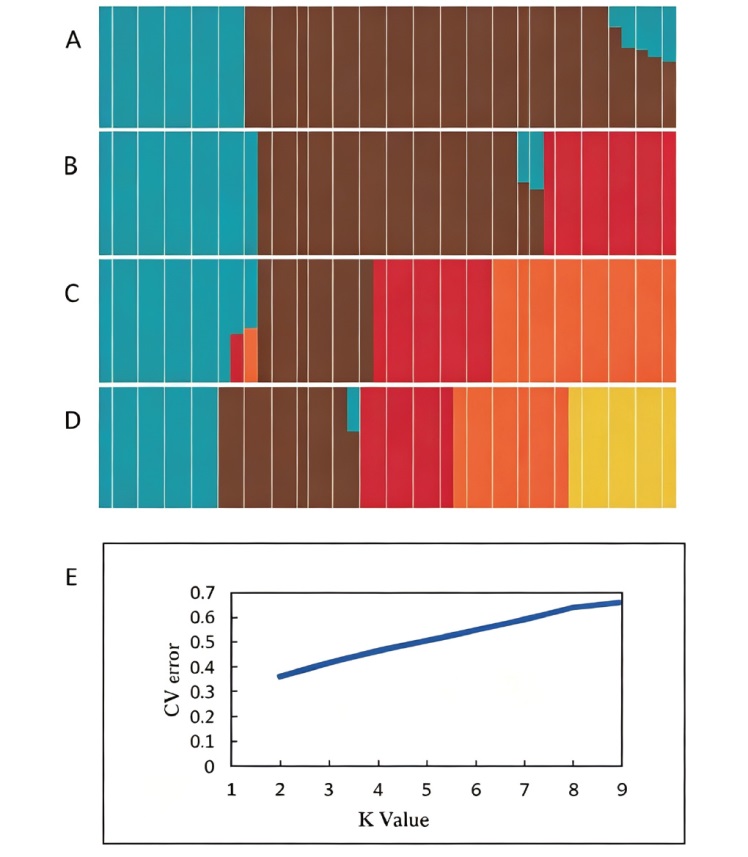
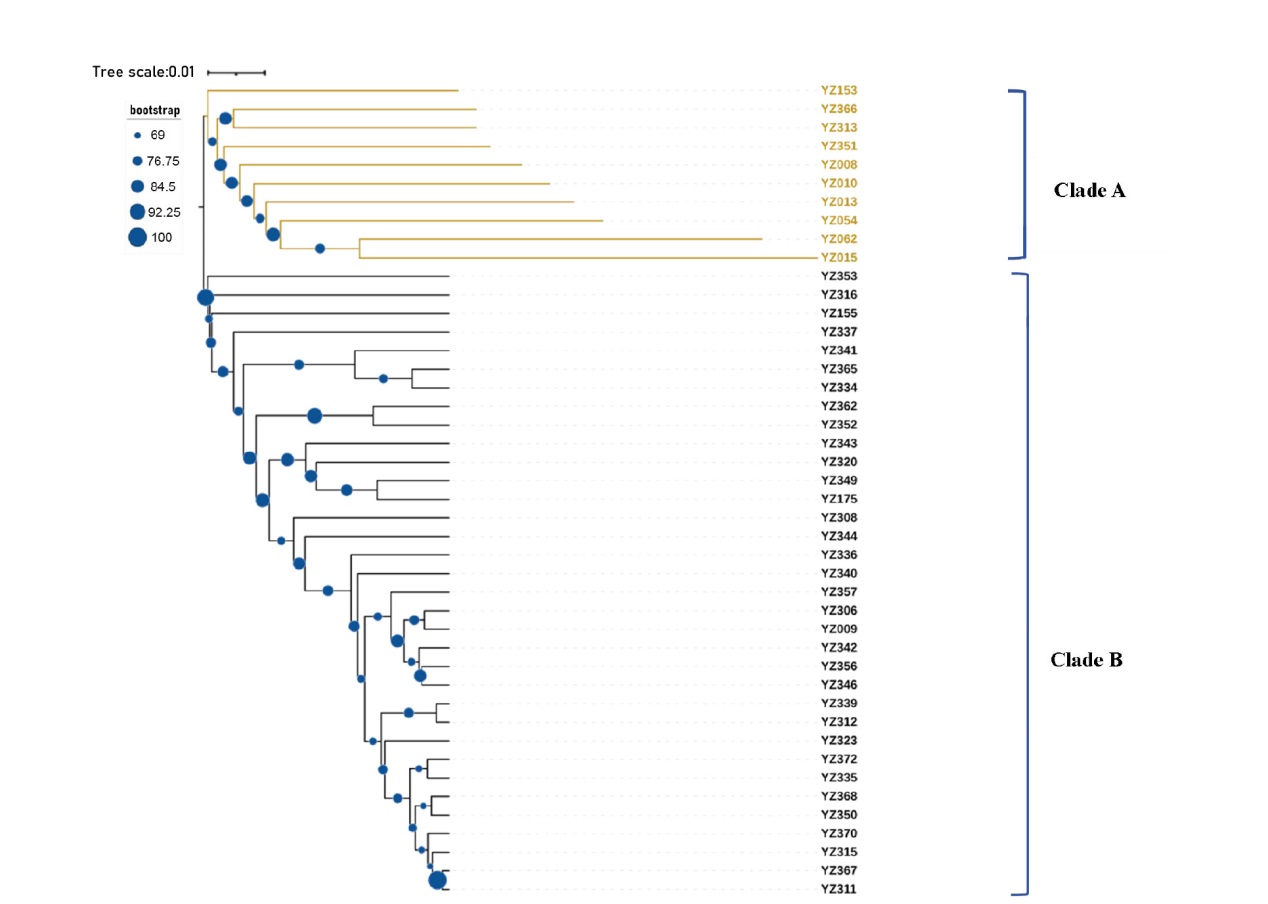
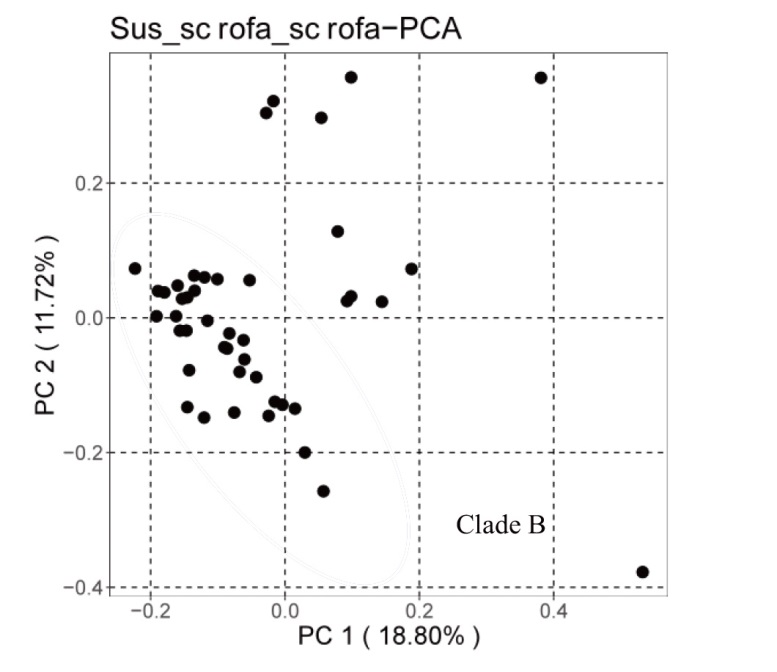
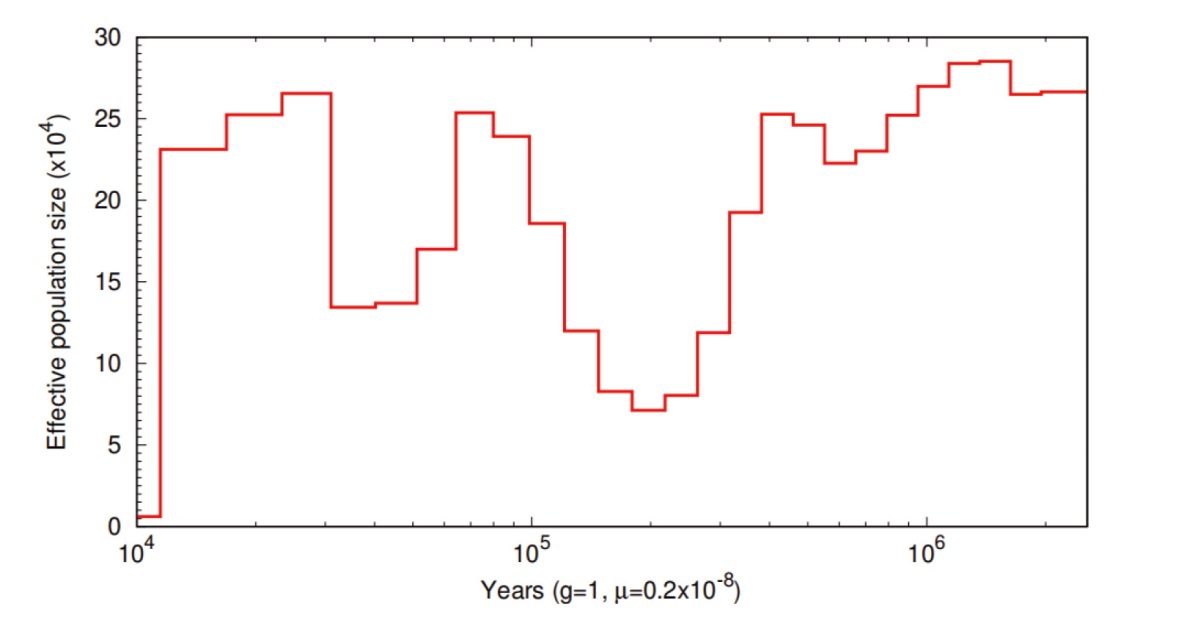
北京松山国家级自然保护区内,野猪(Sus scrofa)种群的分布和密度呈现增加趋势,该种群的扩张对本地野生动物种群和生态栖息地构成了潜在威胁。为了深入探究该保护区野猪种群的遗传结构和种群扩张的动态变化,本研究采用高通量测序技术和非损伤取样方法,对保护区内采集的122份野猪粪便样品进行遗传多样性和种群遗传结构分析。通过物种和个体鉴定分析,最终确认44个独立野猪个体的样品。遗传多样性分析显示,平均每个样本检测到1505393个SNP位点,观测杂合度平均为0.214,表明该保护区的野猪遗传多样性处于中等偏低水平。遗传结构和系统发育分析结果表明,松山保护区群体样本分为中低程度分化的亚群(Fst=0.059),其中分支B的平均近交系数(Fis)值为0.1810,分支A的平均近交系数值为0.061,表明分支B群体中存在中度近交现象。有效种群分析结果推测,北京松山国家级自然保护区内野猪群体数量早期可能存在较大波动。本研究提供了松山保护区野猪遗传基础数据,为制定保护管理策略、维护生态平衡提供了科学依据。
中图分类号:
范雅倩, 冯培, 孙琪, 池晨猛, 李林, 王云帆, 刘志君, 伦明宇, 沈延京, 田恒玖. 基于高通量测序技术的北京松山国家级自然保护区野猪种群的遗传多样性研究[J]. 中国农学通报, 2026, 42(20): 139-147.
FAN Yaqian, FENG Pei, SUN Qi, CHI Chenmeng, LI Lin, WANG Yunfan, LIU Zhijun, LUN Mingyu, SHEN Yanjing, TIAN Hengjiu. Genetic Diversity of Wild Boar Population (Sus scrofa) in Songshan Nature Reserve of Beijing Based on High-throughput Sequencing Technology[J]. Chinese Agricultural Science Bulletin, 2026, 42(20): 139-147.
| 样本 | SNP个数 | SNP纯合子个数 | SNP杂合子个数 | 观测杂合度 | 样本 | SNP个数 | SNP纯合子个数 | SNP杂合子个数 | 观测杂合度 |
|---|---|---|---|---|---|---|---|---|---|
| YZ008 | 2033948 | 1509520 | 524428 | 0.2578 | YZ337 | 1554672 | 1208183 | 346489 | 0.2229 |
| YZ009 | 1681186 | 1298871 | 383315 | 0.2278 | YZ339 | 1172476 | 965751 | 206725 | 0.1763 |
| YZ010 | 2299484 | 1668811 | 630673 | 0.2743 | YZ340 | 1124248 | 915201 | 209047 | 0.1859 |
| YZ013 | 2215920 | 1602934 | 612986 | 0.2766 | YZ341 | 1326222 | 1014971 | 311251 | 0.2347 |
| YZ015 | 4552783 | 2979886 | 1572897 | 0.3455 | YZ342 | 1202365 | 958244 | 244121 | 0.2030 |
| YZ054 | 2636721 | 1971237 | 665484 | 0.2524 | YZ343 | 979467 | 820225 | 159242 | 0.1626 |
| YZ062 | 4287663 | 2927298 | 1360365 | 0.3173 | YZ344 | 1433082 | 1144547 | 288535 | 0.2013 |
| YZ153 | 1681086 | 1298771 | 382315 | 0.2274 | YZ346 | 1250709 | 1012805 | 237904 | 0.1902 |
| YZ155 | 1570485 | 1234032 | 336453 | 0.2142 | YZ349 | 1362942 | 1067333 | 295609 | 0.2169 |
| YZ175 | 1379942 | 1092033 | 287909 | 0.2086 | YZ350 | 1109246 | 922323 | 186923 | 0.1685 |
| YZ306 | 921965 | 752845 | 169120 | 0.1834 | YZ351 | 1885319 | 1406650 | 478669 | 0.2539 |
| YZ308 | 851465 | 701335 | 150130 | 0.1763 | YZ352 | 1445672 | 1139441 | 306231 | 0.2118 |
| YZ311 | 1256069 | 1034335 | 221734 | 0.1765 | YZ353 | 1515072 | 1144721 | 370351 | 0.2444 |
| YZ312 | 1250401 | 1016792 | 233609 | 0.1868 | YZ356 | 1075728 | 876249 | 199479 | 0.1854 |
| YZ313 | 1464359 | 1090627 | 373732 | 0.2552 | YZ357 | 1146775 | 887133 | 259642 | 0.2264 |
| YZ315 | 1284590 | 1042518 | 242072 | 0.1884 | YZ362 | 1278540 | 1027070 | 251470 | 0.1967 |
| YZ316 | 1566519 | 1202818 | 363701 | 0.2322 | YZ365 | 1268117 | 997635 | 270482 | 0.2133 |
| YZ320 | 917496 | 757912 | 159584 | 0.1739 | YZ366 | 1625328 | 1193814 | 431514 | 0.2655 |
| YZ323 | 1161209 | 938362 | 222847 | 0.1919 | YZ367 | 1186441 | 979626 | 206815 | 0.1743 |
| YZ334 | 1125586 | 868720 | 256866 | 0.2282 | YZ368 | 1235544 | 1007834 | 227710 | 0.1843 |
| YZ335 | 1196527 | 989779 | 206748 | 0.1728 | YZ370 | 1243363 | 1039781 | 203582 | 0.1637 |
| YZ336 | 942968 | 772666 | 170302 | 0.1806 | YZ372 | 1111556 | 922600 | 188956 | 0.1700 |
| [1] |
doi: 10.1371/journal.pone.0238049 URL |
| [2] |
王文涛. 东北野猪(Sus scrofa ussuricus)遗传多样性及全基因组序列分析[D]. 哈尔滨: 东北林业大学, 2020.
|
| [3] |
李冲, 张伟伟, 王原. 野猪种群资源现状调查[J]. 畜牧业环境, 2023(3):11-13.
|
| [4] |
巨龙飞. 2022年北京冬奥会及冬残奥会延庆赛区野生动物多样性监测[D]. 北京: 北京林业大学, 2021.
|
| [5] |
doi: 10.3390/ijms21228774 URL |
| [6] |
doi: 10.1111/mec.14350 pmid: 28921802 |
| [7] |
doi: 10.1111/mec.15720 pmid: 33145846 |
| [8] |
doi: 10.1111/men.v22.4 URL |
| [9] |
doi: 10.1186/s12870-022-03449-4 |
| [10] |
doi: 10.1111/mec.2017.26.issue-20 URL |
| [11] |
doi: 10.1111/cobi.13157 pmid: 29935028 |
| [12] |
doi: 10.3390/genes14122141 URL |
| [13] |
doi: 10.1111/men.v24.4 URL |
| [14] |
doi: 10.1016/j.bbrc.2015.12.083 pmid: 26718401 |
| [15] |
doi: 10.4014/jmb.1904.04033 pmid: 31337187 |
| [16] |
蒋健, 巨龙飞, 范雅倩, 等. 基于红外相机调查的北京松山国家级自然保护区哺乳动物分布和日活动节律分析[J]. 四川动物, 2021, 40(4):374-382.
|
| [17] |
唐小澄, 杨婧, 董艳民, 等. 北京松山国家级自然保护区野猪种群遗传结构初步分析[J]. 兽类学报, 2025, 45(3):345-355.
|
| [18] |
邵昕宁, 宋大昭, 黄巧雯, 等. 基于粪便DNA及宏条形码技术的食肉动物快速调查及食性分析[J]. 生物多样性, 2019, 27(5):543-556.
doi: 10.17520/biods.2018214 |
| [19] |
doi: 10.1093/jmammal/gyae044 pmid: 40329956 |
| [20] |
doi: 10.1101/gr.107524.110 pmid: 20644199 |
| [21] |
doi: 10.21105/joss URL |
| [22] |
doi: 10.1186/1471-2164-15-162 |
| [23] |
doi: 10.1534/genetics.114.164350 pmid: 24700103 |
| [24] |
doi: 10.1111/mec.2016.25.issue-5 URL |
| [25] |
doi: 10.1007/s00335-008-9156-3 pmid: 19082661 |
| [26] |
doi: 10.1186/s12711-017-0345-y pmid: 28934946 |
| [27] |
doi: 10.1038/s41598-022-10698-8 pmid: 35513520 |
| [28] |
doi: 10.3390/genes14030654 URL |
| [29] |
doi: 10.2217/pgs-2021-0152 URL |
| [30] |
|
| [31] |
doi: 10.7717/peerj.18845 URL |
| [32] |
doi: 10.1111/jzo.2009.278.issue-2 URL |
| [33] |
doi: 10.1038/hdy.2016.75 |
| [34] |
|
| [1] | 刘强力, 敖曼, 关义新, 韩可, 陈松, 陈鑫, 白玉梅, 陈志远, 崔震海. 热源种质驱动温带玉米遗传改良的研究进展[J]. 中国农学通报, 2026, 42(8): 1-10. |
| [2] | 孙天琦, 周蕾, 徐林贵, 孙晓波, 陈勇, 隋春. 菘蓝基因组SSR位点分析及分子标记开发[J]. 中国农学通报, 2026, 42(2): 50-56. |
| [3] | 谢雨欣, 汪佳怡, 冯震, 李飞飞, 赵树琪, 李黎贝. 湖北陆地棉品种的表型性状分析及综合评价[J]. 中国农学通报, 2026, 42(12): 68-77. |
| [4] | 赵芳, 高运青, 高韶斌, 郑丽珍, 李姝彤, 尚启兵, 徐东旭, 关翔宇. 河北省绿豆种质资源主要农艺性状、经济性状遗传多样性分析及综合评价[J]. 中国农学通报, 2025, 41(5): 23-29. |
| [5] | 李静, 李海霞, 李正华, 郭成博, 王艳敏, 孙培琳, 白卉. 丁香种质资源表型性状遗传多样性分析[J]. 中国农学通报, 2025, 41(4): 74-83. |
| [6] | 彭翠英, 梁军生, 廖德志, 王旭军. 基于2种DNA条形码序列的多花黄精居群遗传多样性分析[J]. 中国农学通报, 2025, 41(33): 67-73. |
| [7] | 黄礼佳, 张招娟, 郭玉春, 张鑫. 14个彩色马铃薯品种主要性状表现及其SSR遗传多样性分析[J]. 中国农学通报, 2025, 41(32): 17-22. |
| [8] | 徐宇, 许志强, 严维辉, 李佳佳, 黄鸿兵, 李旭光, 刘远柱, 潘建林. 基于全基因组SNP变异分析江苏克氏原螯虾7个天然群体的遗传多样性特征[J]. 中国农学通报, 2025, 41(17): 144-151. |
| [9] | 叶开梅, 陈维, 任明刚, 吴家丽, 何大智, 牛力立. 18份谷子种质资源表型性状的遗传多样性分析及综合评价[J]. 中国农学通报, 2025, 41(17): 38-44. |
| [10] | 葛礼姣, 仇亮, 王小秋, 翟彩娇, 程玉静, 刘水东, 宋益民. 番茄种质资源重要农艺性状的遗传多样性分析[J]. 中国农学通报, 2025, 41(12): 34-45. |
| [11] | 林凡力, 彭建斐, 邓泽征, 郭璐璐, 姚廷山, 马皓月, 马冠华. MLST技术分析中国烟草野火病菌遗传多样性[J]. 中国农学通报, 2024, 40(9): 139-144. |
| [12] | 纪伟, 苏文英, 刘晓梅, 王一璞, 任立凯, 奚小艳, 陈克龙. 基于ISSR标记分析连云港地区野生灵芝种质资源遗传多样性及亲缘关系[J]. 中国农学通报, 2024, 40(6): 128-134. |
| [13] | 高凯利, 马学艳, 王海华, 李涵, 李燕华, 金武, 闻海波. 5个宽体金线蛭种群遗传多样性和遗传分化的SNP分析[J]. 中国农学通报, 2024, 40(29): 144-149. |
| [14] | 李珂, 马学艳, 杨轲, 陈琬雯, 金武, 闻海波. 梨形环棱螺6个地理种群遗传多样性与遗传分化分析[J]. 中国农学通报, 2024, 40(29): 150-156. |
| [15] | 苏海兰, 江保东, 朱雁鸣, 郑梅霞, 陈宏, 丁明月, 牛雨晴, 朱育菁. 黄精转录组SSR分子标记开发及种质遗传多样性分析[J]. 中国农学通报, 2024, 40(26): 30-37. |
| 阅读次数 | ||||||
|
全文 |
|
|||||
|
摘要 |
|
|||||
