欢迎访问《中国农学通报》,

中国农学通报 ›› 2026, Vol. 42 ›› Issue (20): 19-28.doi: 10.11924/j.issn.1000-6850.casb2025-0775
钟楠1( ), 牛洁2, 甘晓燕1, 陈虞超1, 田莉1, 石磊1, 秦垦2()
收稿日期:2025-09-21
修回日期:2026-01-11
出版日期:2026-10-25
发布日期:2026-10-26
通讯作者:
作者简介:钟楠,女,1993年出生,副研究员,博士研究生,主要从事植物遗传育种。通信地址:750002 宁夏银川市金凤区黄河东路590号,Tel:0951-6886756,E-mail:zhongnan15@foxmail.com。
基金资助:
ZHONG Nan1(), NIU Jie2, GAN Xiaoyan1, CHEN Yuchao1, TIAN Li1, SHI Lei1, QIN Ken2()
Received:2025-09-21
Revised:2026-01-11
Published:2026-10-25
Online:2026-10-26
摘要:
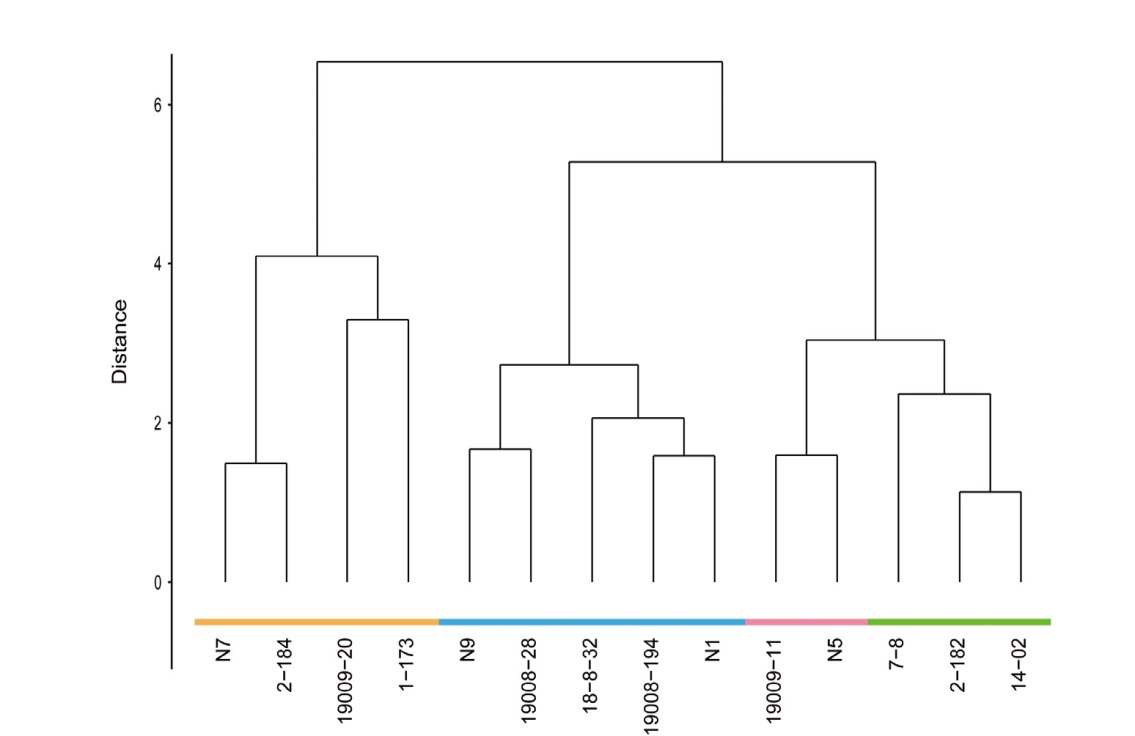
为明确温度对枸杞种子萌发及幼苗生长的影响,构建一套全面、科学的萌发期与幼苗期耐热性综合评价体系,从而为选育耐高温的枸杞品种提供理论依据与方法指导。本研究以14个不同特性的枸杞品种为试验材料,分别设置萌发期(21℃、28℃、35℃、38℃)和幼苗期(25℃、28℃、35℃、38℃)进行了多维度的温度胁迫处理,测定发芽率、发芽势、发芽指数、活力指数、根长、芽长及根冠比等形态指标,计算各指标的耐热系数。采用主成分分析、隶属函数分析和聚类分析等方法,对枸杞品种的耐热性进行综合评价。结果表明:温度低于35℃时,14个品种的种子均能正常萌发;35℃条件下,幼苗根长与芽长生长受到显著抑制;当温度升至38℃时,幼苗基本停止生长,进入热激休克状态。主成分分析将8个单项指标转化为3个相互独立的综合指标,累计贡献率达91.24%,能够全面反映枸杞的耐热性信息。基于耐热性综合评价D值,将14个枸杞品种划分为三大类,其中品种14-02、2-182和7-8表现为耐热类型,而N7、2-184和19009-20为极不耐热类型。本研究建立的综合评价方法操作简便、结果可靠,可快速初步鉴定枸杞品种的耐热性,为耐热枸杞新品种培育提供有效的技术支撑。
中图分类号:
钟楠, 牛洁, 甘晓燕, 陈虞超, 田莉, 石磊, 秦垦. 不同枸杞品种萌发期和幼苗期耐热指标筛选及耐热性评价[J]. 中国农学通报, 2026, 42(20): 19-28.
ZHONG Nan, NIU Jie, GAN Xiaoyan, CHEN Yuchao, TIAN Li, SHI Lei, QIN Ken. Screening of Heat Tolerance Indexes and Evaluation of Heat Tolerance in Different Wolfberry Varieties at Germination and Seedling Growth Stages[J]. Chinese Agricultural Science Bulletin, 2026, 42(20): 19-28.
| 编号 | 品种名称 | 千粒重/g |
|---|---|---|
| 1 | N1 | 0.88 |
| 2 | N5 | 0.88 |
| 3 | N7 | 0.72 |
| 4 | N9 | 1.14 |
| 5 | 14-02 | 1.18 |
| 6 | 7-8 | 0.87 |
| 7 | 1-173 | 1.12 |
| 8 | 2-182 | 0.64 |
| 9 | 2-184 | 0.96 |
| 10 | 19008-28 | 0.87 |
| 11 | 19008-194 | 1.23 |
| 12 | 19009-11 | 0.76 |
| 13 | 19009-20 | 0.95 |
| 14 | 18-8-32 | 1.04 |
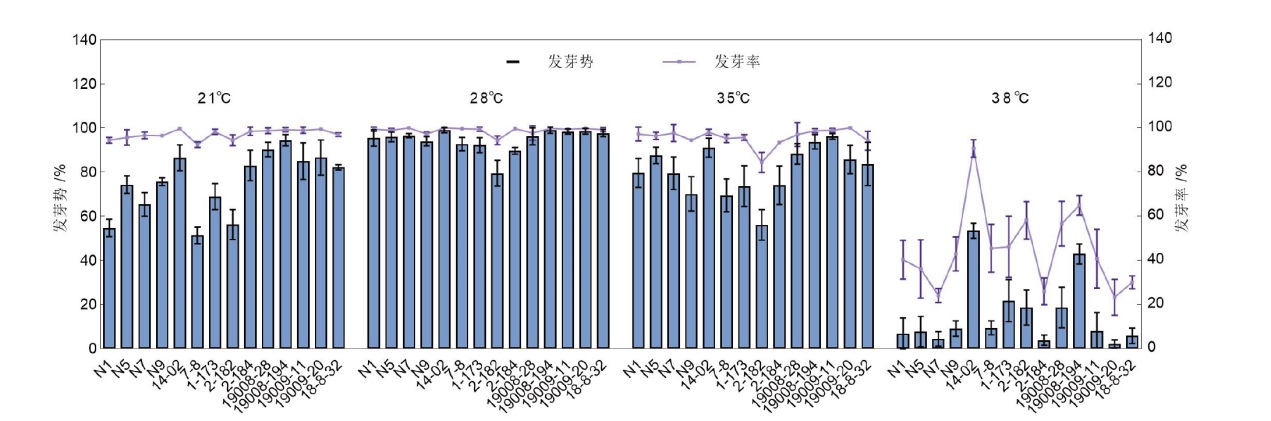
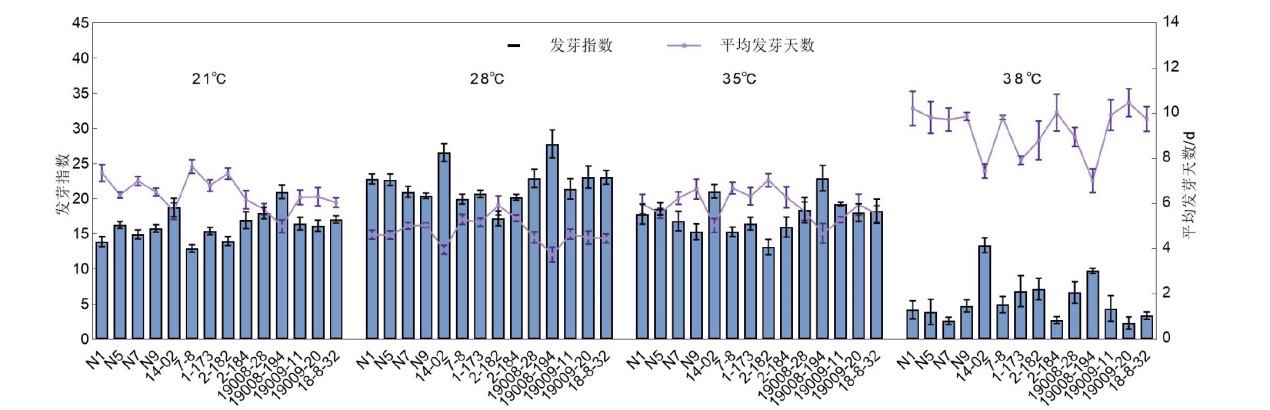
| 品种名称 | 发芽率 | 发芽势 | 发芽指数 | ||||||||
|---|---|---|---|---|---|---|---|---|---|---|---|
| 21℃ | 35℃ | 38℃ | 21℃ | 35℃ | 38℃ | 21℃ | 35℃ | 38℃ | |||
| N1 | 0.95±0.01a | 0.98±0.03ab | 0.37±0.06d | 0.57±0.04c | 0.84±0.05ab | 0.04±0.02c | 0.61±0.03b | 0.78±0.06ab | 0.16±0.03c | ||
| N5 | 0.97±0.04a | 0.97±0.02ab | 0.30±0.07de | 0.78±0.04b | 0.91±0.03ab | 0.04±0.01c | 0.77±0.02ab | 0.82±0.04ab | 0.13±0.02c | ||
| N7 | 0.97±0.02a | 0.98±0.05ab | 0.24±0.03e | 0.68±0.06bc | 0.83±0.08b | 0.05±0.03c | 0.71±0.03ab | 0.80±0.07ab | 0.12±0.03c | ||
| N9 | 0.99±0.01a | 0.96±0.02ab | 0.48±0.03cd | 0.81±0.02b | 0.75±0.09b | 0.08±0.02c | 0.75±0.03ab | 0.75±0.06b | 0.23±0.04bc | ||
| 14-02 | 1.00±0.01a | 0.98±0.01ab | 0.91±0.04a | 0.87±0.06ab | 0.92±0.05ab | 0.54±0.03a | 0.65±0.05ab | 0.79±0.04ab | 0.50±0.04a | ||
| 7-8 | 0.93±0.01a | 0.96±0.02ab | 0.51±0.05c | 0.55±0.04c | 0.76±0.08b | 0.12±0.02bc | 0.72±0.03ab | 0.77±0.03b | 0.25±0.06bc | ||
| 1-173 | 0.99±0.01a | 0.97±0.01ab | 0.46±0.14cd | 0.75±0.06b | 0.79±0.11b | 0.24±0.10bc | 0.74±0.03ab | 0.79±0.04ab | 0.33±0.11b | ||
| 2-182 | 1.00±0.03a | 0.88±0.04b | 0.62±0.09bc | 0.71±0.09bc | 0.70±0.09b | 0.27±0.07b | 0.70±0.04ab | 0.76±0.06b | 0.41±0.09ab | ||
| 2-184 | 0.99±0.02a | 0.94±0.01ab | 0.26±0.06de | 0.93±0.08ab | 0.82±0.10b | 0.04±0.03c | 0.74±0.06ab | 0.79±0.07ab | 0.14±0.03c | ||
| 19008-28 | 1.01±0.01a | 1.01±0.02a | 0.58±0.10bc | 0.94±0.03ab | 0.92±0.05ab | 0.15±0.07bc | 0.77±0.04ab | 0.80±0.08ab | 0.29±0.07bc | ||
| 19008-194 | 0.99±0.01a | 0.99±0.01a | 0.65±0.04b | 0.95±0.03a | 0.94±0.04ab | 0.43±0.05ab | 0.84±0.04a | 0.82±0.06ab | 0.35±0.01b | ||
| 19009-11 | 1.00±0.01a | 0.99±0.01a | 0.34±0.02de | 0.86±0.08ab | 0.98±0.01a | 0.04±0.02c | 0.78±0.04a | 0.90±0.01a | 0.16±0.01c | ||
| 19009-20 | 1.00±0.01a | 1.00±0.00a | 0.23±0.08e | 0.88±0.08ab | 0.87±0.06ab | 0.03±0.02c | 0.71±0.03ab | 0.78±0.05ab | 0.10±0.04c | ||
| 18-8-32 | 0.98±0.01a | 0.95±0.04ab | 0.30±0.03de | 0.84±0.01ab | 0.86±0.10ab | 0.06±0.04c | 0.81±0.02a | 0.79±0.08ab | 0.15±0.02c | ||
| 品种名称 | 根长(7 d) | 芽长(7 d) | 根冠比(7 d) | ||||||||
|---|---|---|---|---|---|---|---|---|---|---|---|
| 25℃ | 35℃ | 38℃ | 25℃ | 35℃ | 38℃ | 25℃ | 35℃ | 38℃ | |||
| 1.09±0.15b | 0.44±0.16a | 0.13±0.06a | 1.09±0.15b | 1.34±0.29ab | 0.57±0.14b | 0.49±0.13ab | 0.80±0.25c | 0.72±0.20a | 0.27±0.13b | ||
| 0.79±0.17c | 0.28±0.14ab | 0.14±0.05a | 0.79±0.17c | 0.64±0.12e | 0.41±0.09b | 0.29±0.07b | 1.23±0.27a | 0.70±0.35a | 0.47±0.23a | ||
| 1.02±0.46b | 0.20±0.13b | 0.10±0.04a | 1.02±0.46b | 1.14±0.23bc | 0.67±0.13ab | 0.52±0.13ab | 0.94±0.34bc | 0.30±0.19bc | 0.20±0.10b | ||
| 0.79±0.40c | 0.17±0.07b | 0.08±0.02a | 0.79±0.40c | 0.90±0.12cd | 0.54±0.14b | 0.43±0.08b | 0.99±0.12bc | 0.32±0.14bc | 0.17±0.03b | ||
| 1.03±0.12b | 0.27±0.10ab | 0.10±0.03a | 1.03±0.12b | 1.03±0.18c | 0.60±0.18ab | 0.50±0.14ab | 0.99±0.22bc | 0.46±0.23b | 0.20±0.08b | ||
| 0.78±0.32c | 0.26±0.11ab | 0.16±0.04a | 0.78±0.32c | 0.83±0.18d | 0.51±0.13b | 0.49±0.12ab | 1.03±0.25b | 0.48±0.15b | 0.32±0.10ab | ||
| 1.30±0.35a | 0.26±0.12ab | 0.13±0.04a | 1.30±0.35a | 1.29±0.29b | 0.75±0.15a | 0.65±0.10a | 1.03±0.18b | 0.36±0.14bc | 0.21±0.08b | ||
| 0.67±0.48c | 0.25±0.12ab | 0.14±0.06a | 0.67±0.48c | 0.93±0.30cd | 0.71±0.19ab | 0.57±0.13ab | 0.85±0.33bc | 0.37±0.16bc | 0.27±0.13b | ||
| 0.94±0.18bc | 0.30±0.13ab | 0.10±0.03a | 0.94±0.18bc | 1.13±0.22bc | 0.70±0.12ab | 0.44±0.11b | 0.87±0.25bc | 0.42±0.15bc | 0.23±0.06b | ||
| 0.76±0.26c | 0.27±0.12ab | 0.14±0.05a | 0.76±0.26c | 1.24±0.24b | 0.65±0.20ab | 0.59±0.14ab | 0.61±0.20d | 0.42±0.17bc | 0.26±0.13b | ||
| 0.78±0.20c | 0.16±0.07b | 0.12±0.04a | 0.78±0.20c | 0.85±0.20d | 0.71±0.18ab | 0.56±0.07ab | 0.94±0.24bc | 0.24±0.08c | 0.23±0.08b | ||
| 1.02±0.26b | 0.29±0.09ab | 0.18±0.05a | 1.02±0.26b | 0.80±0.09de | 0.58±0.12b | 0.50±0.12ab | 1.32±0.22a | 0.54±0.17a | 0.38±0.11ab | ||
| 1.18±0.33ab | 0.25±0.07ab | 0.14±0.04a | 1.18±0.33ab | 1.47±0.33a | 0.64±0.06ab | 0.58±0.15ab | 0.83±0.23c | 0.39±0.11bc | 0.24±0.08b | ||
| 1.06±0.15b | 0.29±0.15ab | 0.10±0.02a | 1.06±0.15b | 0.99±0.09cd | 0.72±0.15ab | 0.52±0.12ab | 1.01±0.16bc | 0.38±0.14bc | 0.19±0.05b | ||
| 品种名称 | 根长(14 d) | 芽长(14 d) | |||||
|---|---|---|---|---|---|---|---|
| 25℃ | 35℃ | 38℃ | 25℃ | 35℃ | 38℃ | ||
| N1 | 0.69±0.12c | 0.33±0.14ab | 0.09±0.03a | 1.21±0.20a | 0.60±0.16a | 0.33±0.09a | |
| N5 | 0.68±0.15c | 0.33±0.20ab | 0.09±0.03a | 0.68±0.11d | 0.43±0.09b | 0.27±0.06a | |
| N7 | 0.65±0.20cd | 0.18±0.13b | 0.04±0.01a | 0.96±0.19bc | 0.53±0.11ab | 0.33±0.08a | |
| N9 | 0.84±0.18bc | 0.22±0.11b | 0.05±0.02a | 0.88±0.12bc | 0.41±0.12b | 0.26±0.06a | |
| 14-02 | 0.97±0.13ab | 0.38±0.17a | 0.10±0.04a | 0.88±0.15bc | 0.56±0.18ab | 0.30±0.09a | |
| 7-8 | 0.80±0.27bc | 0.23±0.11b | 0.10±0.03a | 0.87±0.14c | 0.51±0.12ab | 0.36±0.06a | |
| 1-173 | 0.73±0.17c | 0.15±0.06b | 0.06±0.01a | 1.00±0.21b | 0.46±0.11b | 0.33±0.05a | |
| 2-182 | 0.63±0.36cd | 0.19±0.14b | 0.10±0.05a | 0.98±0.27bc | 0.55±0.11ab | 0.39±0.08a | |
| 2-184 | 0.50±0.11d | 0.24±0.08b | 0.04±0.01a | 0.89±0.16bc | 0.62±0.14a | 0.26±0.07a | |
| 19008-28 | 0.46±0.13d | 0.19±0.11b | 0.06±0.02a | 0.87±0.15c | 0.52±0.10ab | 0.33±0.08a | |
| 19008-194 | 0.91±0.19b | 0.17±0.07b | 0.06±0.03a | 0.75±0.12cd | 0.54±0.13ab | 0.36±0.10a | |
| 19009-11 | 1.09±0.24a | 0.22±0.10b | 0.10±0.03a | 0.84±0.12c | 0.54±0.11ab | 0.38±0.10a | |
| 19009-20 | 0.53±0.09d | 0.15±0.05b | 0.06±0.02a | 1.09±0.23ab | 0.50±0.05ab | 0.34±0.06a | |
| 18-8-32 | 0.85±0.10bc | 0.27±0.15ab | 0.06±0.02a | 0.77±0.11cd | 0.55±0.15ab | 0.32±0.09a | |
| 品种名称 | 总长(14 d) | 根冠比(14 d) | |||||
|---|---|---|---|---|---|---|---|
| 25℃ | 35℃ | 38℃ | 25℃ | 35℃ | 38℃ | ||
| N1 | 0.77±0.11bc | 0.37±0.12ab | 0.12±0.04a | 0.56±0.15e | 0.50±0.14b | 0.24±0.06a | |
| N5 | 0.68±0.13c | 0.33±0.13ab | 0.13±0.03a | 0.99±0.20bc | 0.75±0.33a | 0.32±0.08a | |
| N7 | 0.65±0.17cd | 0.19±0.11b | 0.08±0.02a | 0.71±0.17de | 0.27±0.22c | 0.13±0.04b | |
| N9 | 0.85±0.15b | 0.24±0.11b | 0.09±0.03a | 0.95±0.24c | 0.53±0.24b | 0.20±0.09a | |
| 14-02 | 0.90±0.10ab | 0.41±0.13a | 0.12±0.04a | 1.06±0.21bc | 0.66±0.21ab | 0.24±0.09a | |
| 7-8 | 0.81±0.24b | 0.28±0.10b | 0.14±0.03a | 0.89±0.26cd | 0.44±0.18bc | 0.26±0.10a | |
| 1-173 | 0.75±0.07bc | 0.19±0.06b | 0.09±0.01a | 0.75±0.18d | 0.35±0.14bc | 0.16±0.04a | |
| 2-182 | 0.80±0.25bc | 0.26±0.12b | 0.15±0.04a | 0.67±0.33de | 0.36±0.20bc | 0.24±0.17a | |
| 2-184 | 0.56±0.09d | 0.29±0.09b | 0.07±0.02a | 0.58±0.16de | 0.37±0.09bc | 0.16±0.04a | |
| 19008-28 | 0.52±0.12d | 0.24±0.10b | 0.10±0.02a | 0.54±0.15e | 0.37±0.19bc | 0.17±0.06a | |
| 19008-194 | 0.89±0.16ab | 0.24±0.08b | 0.11±0.03a | 1.28±0.33ab | 0.30±0.11c | 0.16±0.07a | |
| 19009-11 | 0.99±0.17a | 0.27±0.09b | 0.14±0.04a | 1.33±0.29a | 0.42±0.17bc | 0.27±0.10a | |
| 19009-20 | 0.61±0.10cd | 0.20±0.05b | 0.10±0.03a | 0.48±0.07e | 0.30±0.09c | 0.17±0.05a | |
| 18-8-32 | 0.84±0.09b | 0.34±0.14ab | 0.12±0.04a | 1.14±0.17b | 0.48±0.15bc | 0.21±0.09a | |
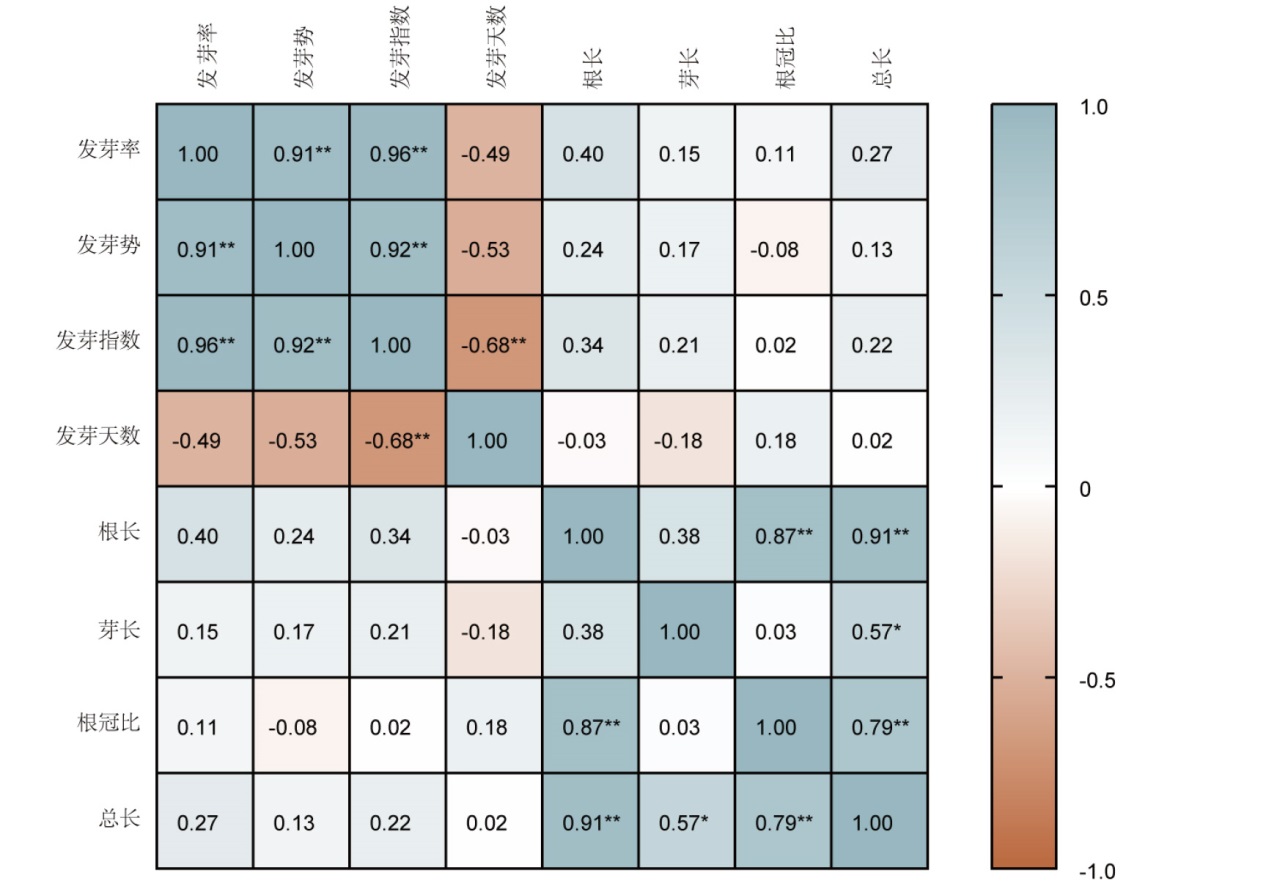
| 指标 | 因子载荷 | 指标 | 因子载荷 | ||||
|---|---|---|---|---|---|---|---|
| 主成分1 | 主成分2 | 主成分3 | 主成分1 | 主成分2 | 主成分3 | ||
| 发芽率 | 0.88 | -0.35 | 0.21 | 根冠比 | 0.40 | 0.81 | 0.37 |
| 发芽势 | 0.80 | -0.49 | 0.11 | 总长 | 0.63 | 0.74 | -0.15 |
| 发芽指数 | 0.89 | -0.44 | 0.08 | 特征值 | 3.74 | 2.56 | 1.00 |
| 发芽天数 | -0.54 | 0.53 | 0.19 | 贡献率/% | 46.78% | 32.01% | 12.45% |
| 根长 | 0.71 | 0.67 | 0.11 | 累计贡献率/% | 46.78% | 78.79% | 91.24% |
| 芽长 | 0.44 | 0.24 | -0.85 | 权重 | 0.51 | 0.35 | 0.14 |
| 品种名称 | 综合指标值 | 隶属函数值 | D值 | 综合评价 | |||||
|---|---|---|---|---|---|---|---|---|---|
| CI1 | CI2 | CI3 | µ1 | µ2 | µ3 | ||||
| N1 | -0.50 | 1.68 | 0.07 | 0.33 | 0.79 | 0.42 | 0.504820297 | 6 | |
| N5 | -0.61 | 2.27 | 1.74 | 0.31 | 0.91 | 0.99 | 0.615196247 | 4 | |
| N7 | -2.34 | -1.21 | -1.00 | 0.03 | 0.21 | 0.06 | 0.094929131 | 14 | |
| N9 | -1.12 | -0.97 | 1.33 | 0.23 | 0.25 | 0.85 | 0.322599103 | 10 | |
| 14-02 | 3.56 | -1.23 | 1.78 | 1.00 | 0.20 | 1.00 | 0.72038216 | 1 | |
| 7-8 | 1.48 | 1.60 | -0.37 | 0.66 | 0.78 | 0.27 | 0.645955097 | 3 | |
| 1-173 | 0.31 | -2.23 | -0.49 | 0.46 | 0.00 | 0.23 | 0.269221476 | 11 | |
| 2-182 | 3.26 | 0.22 | -1.17 | 0.95 | 0.50 | 0.00 | 0.661011711 | 2 | |
| 2-184 | -2.51 | -1.44 | 0.65 | 0.00 | 0.16 | 0.62 | 0.140283149 | 13 | |
| 19008-28 | -0.07 | -1.08 | -0.18 | 0.40 | 0.23 | 0.33 | 0.333621838 | 9 | |
| 19008-194 | 1.61 | -1.57 | -0.79 | 0.68 | 0.13 | 0.13 | 0.412656449 | 7 | |
| 19009-11 | 0.42 | 2.70 | -0.82 | 0.48 | 1.00 | 0.12 | 0.614854639 | 5 | |
| 19009-20 | -2.25 | 0.43 | -0.72 | 0.04 | 0.54 | 0.15 | 0.232402263 | 12 | |
| 18-8-32 | -1.24 | 0.83 | -0.02 | 0.21 | 0.62 | 0.39 | 0.377308977 | 8 | |
| [1] |
中国气象局气候变化中心. 中国气候变化蓝皮书(2024)[M]. 北京: 科学出版社, 2024.
|
| [2] |
|
| [3] |
doi: 10.1038/nature16467 |
| [4] |
doi: 10.1038/s43016-025-01158-3 pmid: 40251295 |
| [5] |
doi: 10.1016/j.jpba.2020.113859 URL |
| [6] |
陈柳, 段傲宜, 李宜静, 等. 枸杞多糖的生物活性及应用研究进展[J]. 食品工业科技, 2025, 46(19):455-467.
|
| [7] |
程汝阳, 宋蔚宁, 蒋鑫, 等. 枸杞子及其复方在中枢神经系统疾病中的应用研究进展[J]. 中国实验方剂学杂志, 2025, 31(22):273-281.
|
| [8] |
罗青, 张波, 曹有龙. 枸杞落花落果的原因探讨及对策[J]. 宁夏农林科技, 2011, 52(7):69-70.
|
| [9] |
赵琴, 潘静, 曹兵, 等. 气温升高与干旱胁迫对宁夏枸杞光合作用的影响[J]. 生态学报, 2015, 35(18):6016-6022.
|
| [10] |
杨君妍, 闫淼, 吴海波, 等. 高温对不同厚皮甜瓜品种种子萌发的影响及其耐热性综合评价[J]. 新疆农业科学, 2024, 61(6):1386-1396.
doi: 10.6048/j.issn.1001-4330.2024.06.011 |
| [11] |
沈丹婷, 刘晓嵩, 唐东梅, 等. 高温胁迫下菠菜种子萌发特性及耐热性[J]. 上海交通大学学报, 2012, 30(4):31-38.
|
| [12] |
姚佳睿, 吕金钊, 陈康, 等. 不同油麦菜品种萌发期耐热指标筛选及耐热性评价[J]. 西北农业学报, 2024, 33(3):511-520.
|
| [13] |
秦小雅, 秦贝贝, 尹自成, 等. 枸杞高温耐受性的初步分析[J]. 分子植物育种, 2025, 23(7):2372-2378.
|
| [14] |
宋松泉, 刘军, 徐恒恒, 等. 脱落酸代谢与信号传递及其调控种子休眠与萌发的分子机制[J]. 中国农业科学, 2020, 53(5):857-873.
doi: 10.3864/j.issn.0578-1752.2020.05.001 |
| [15] |
徐恒恒, 黎妮, 刘树君, 等. 种子萌发及其调控的研究进展[J]. 作物学报, 2014, 40(7):1141-1156.
|
| [16] |
doi: 10.1146/annurev-arplant-050718-095919 pmid: 30786235 |
| [17] |
江敏, 王广伦, 李明璐, 等. 基于模型的水稻高温热害风险评估与动态预警[J]. 中国水稻科学, 2025, 39(1):128-142.
doi: 10.16819/j.1001-7216.2025.240306 |
| [18] |
doi: 10.1016/j.xplc.2023.100629 URL |
| [19] |
doi: 10.1016/j.molp.2023.09.013 URL |
| [20] |
王丽婧, 曾涛, 高山. 宁夏中宁枸杞生长季光热资源对发育期的影响[J]. 陕西农业科学, 2023, 69(3):93-97.
|
| [21] |
吴红霏, 施招婉, 王瑞, 等. 瓜类作物响应高温逆境的研究进展[J]. 中国农学通报, 2025, 41(12):26-33.
doi: 10.11924/j.issn.1000-6850.casb2024-0608 |
| [22] |
朱亚迪, 王慧琴, 王洪章, 等. 不同夏玉米品种大喇叭口期耐热性评价和鉴定指标筛选[J]. 作物学报, 2022, 48(12):3130-3143.
doi: 10.3724/SP.J.1006.2022.13079 |
| [23] |
雷刚, 方荣, 周坤华, 等. 辣椒种质资源苗期耐热性综合评价体系的建立[J]. 中国农业科技导报, 2025, 27(3):60-70.
|
| [24] |
芦娟, 柴春山, 王子婷, 等. 黑果枸杞种子萌发及幼苗生长效应研究[J]. 甘肃林业科技, 2023, 48(4):39-44,51.
|
| [1] | 高琴, 陈欢欢, 朱启法, 夏浩, 余飞, 沈嘉, 姜超强. 皖南烟区烤烟中部叶化学成分与感官质量关系研究[J]. 中国农学通报, 2026, 42(7): 204-209. |
| [2] | 杨鑫, 张明金, 李斌, 张永辉, 谢强, 王建安. 带茎采烤方式对上部烟叶烘烤质量的影响[J]. 中国农学通报, 2026, 42(7): 210-218. |
| [3] | 郭锦华, 孙宗玖, 李培英, 张勇娟, 任梦龙. 新疆狗牙根新品系生物学特性与坪用性综合评价[J]. 中国农学通报, 2026, 42(7): 77-84. |
| [4] | 程凡一, 周启轩, 兰凌恺, 张若曦, 尹一迪, 侯博寒, 多良玉, 顾嘉庚, 姚奕铎, 张梓烁, 郎徐平. 缺钾胁迫对枸杞幼苗生长及抗氧化特性的影响[J]. 中国农学通报, 2026, 42(7): 92-96. |
| [5] | 曾佩, 喻宏磊, 李玥康, 刘博懿. 基于Pettitt检验的赣抚平原灌区气象要素突变特征及关联性研究[J]. 中国农学通报, 2026, 42(6): 164-170. |
| [6] | 李施蒙, 南志强, 白玛央珍, 王晋雄. 西藏地区引种油菜的农艺性状综合评价与适应性分析[J]. 中国农学通报, 2026, 42(6): 31-40. |
| [7] | 郑筱媛, 陈靖瑜, 王惠聪, 王振江, 王丹. 38份桑椹种质资源果实品质分析及综合评价[J]. 中国农学通报, 2026, 42(6): 72-84. |
| [8] | 王正凤, 赵锋, 刘静, 包奇军. 基于多性状的饲草大麦种质资源评价与筛选[J]. 中国农学通报, 2026, 42(5): 1-11. |
| [9] | 苏岩, 赵晓英, 成日晟, 薛淑琴, 张英华. 苏尼特荒漠草原土壤主要养分变化特征及综合评价[J]. 中国农学通报, 2026, 42(5): 109-116. |
| [10] | 官纪元, 陈哲, 张群英. 授粉品种对‘自由’黑莓结实性和果实品质的影响[J]. 中国农学通报, 2026, 42(5): 77-82. |
| [11] | 廖源源, 郑章云, 张梓韬, 陈力, 夏川林, 任杰群, 谭立新. 42份桑树种质资源表型及叶片营养品质的分析[J]. 中国农学通报, 2026, 42(4): 105-116. |
| [12] | 罗静, 杜珊珊, 姚青青, 王东力, 何忠盛, 孙绘健, 王瑞军. NaCl和Na2SO4盐胁迫对陆地棉种子萌发的影响及耐盐种质的筛选[J]. 中国农学通报, 2026, 42(3): 48-56. |
| [13] | 杨伟, 张晨旭, 刘敏洁, 马国盛, 刘文辉, 鲍根生, 孔繁梅. 青海高寒地区不同燕麦品种生产性能和营养品质综合评价[J]. 中国农学通报, 2026, 42(19): 154-162. |
| [14] | 薛风娟, 徐成体, 赵媛媛, 加羊吉, 张海英, 孙浩, 蒲小剑. 高寒牧区青饲系列小黑麦品种的籽粒性状与光合特性研究[J]. 中国农学通报, 2026, 42(18): 15-24. |
| [15] | 刘祥婷, 王晓苹, 洪自强, 王文秀, 郑国琦, 吴宏亮, 康建宏, 杨涓. 覆盖处理对枸杞根际微生物群落的影响及关键驱动因子解析[J]. 中国农学通报, 2026, 42(17): 97-105. |
| 阅读次数 | ||||||
|
全文 |
|
|||||
|
摘要 |
|
|||||
