欢迎访问《中国农学通报》,

中国农学通报 ›› 2026, Vol. 42 ›› Issue (13): 124-134.doi: 10.11924/j.issn.1000-6850.casb2025-0991
和亮1( ), 张亦涛2(), 董奎军3()
收稿日期:2026-01-04
修回日期:2026-04-23
出版日期:2026-07-15
发布日期:2026-07-09
通讯作者:
作者简介:和亮,男,1984年出生,河北涿鹿人,工程师,硕士,研究方向:废弃物资源化利用。通信地址:100044 北京市西城区车公庄大街北里乙37号,E-mail:heliang@bdc.cn。
基金资助:
HE Liang1(), ZHANG Yitao2(), DONG Kuijun3()
Received:2026-01-04
Revised:2026-04-23
Published:2026-07-15
Online:2026-07-09
摘要:
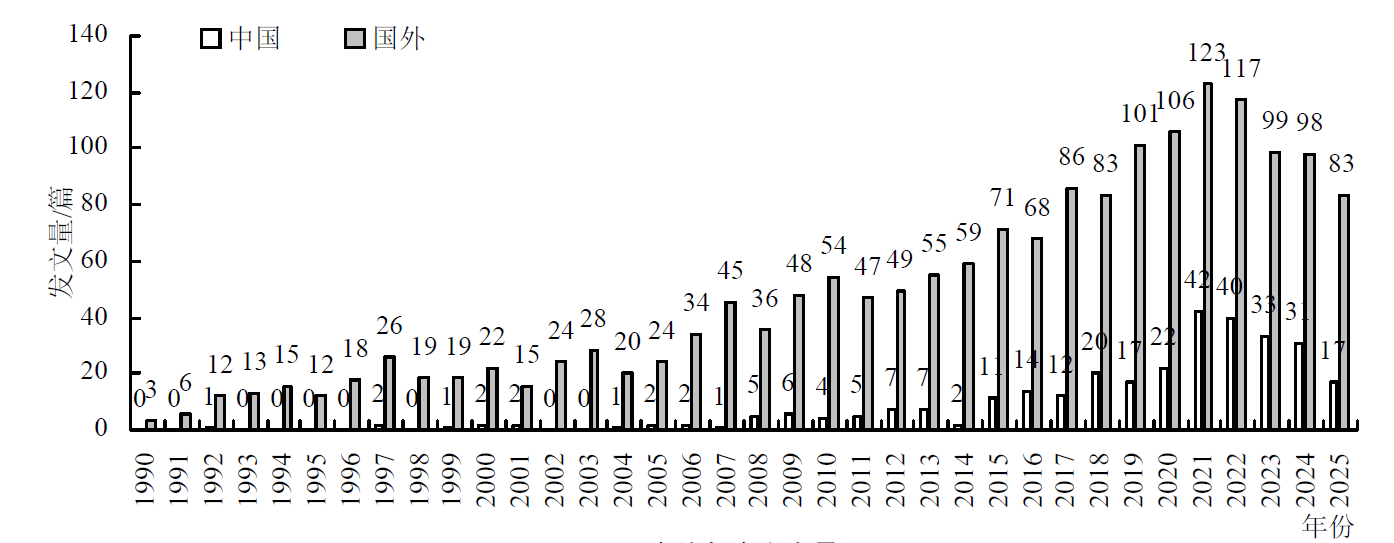
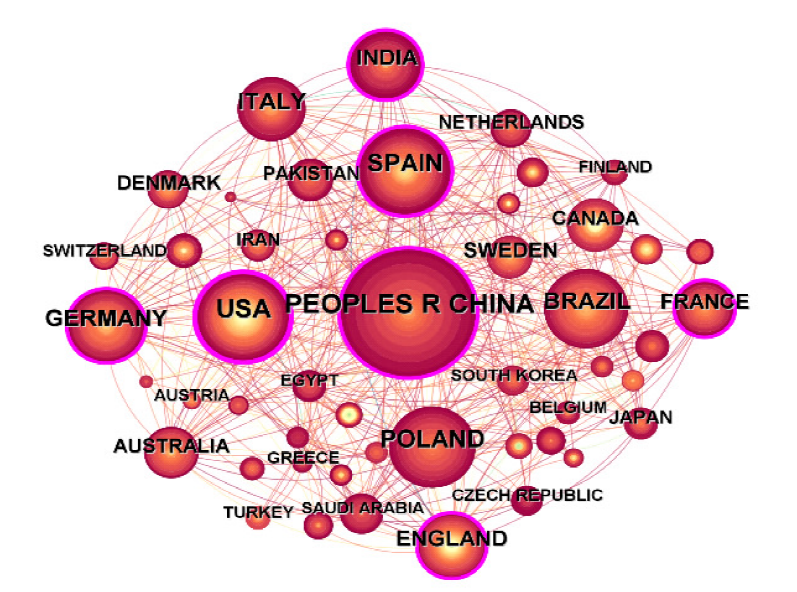
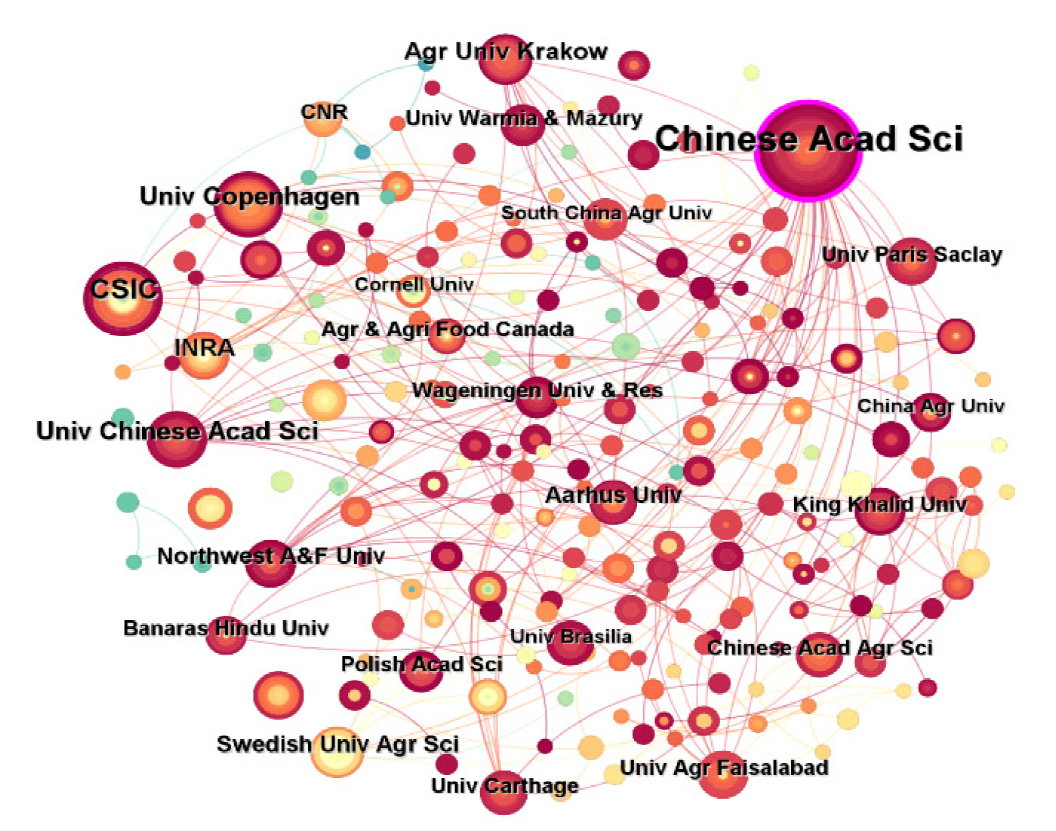
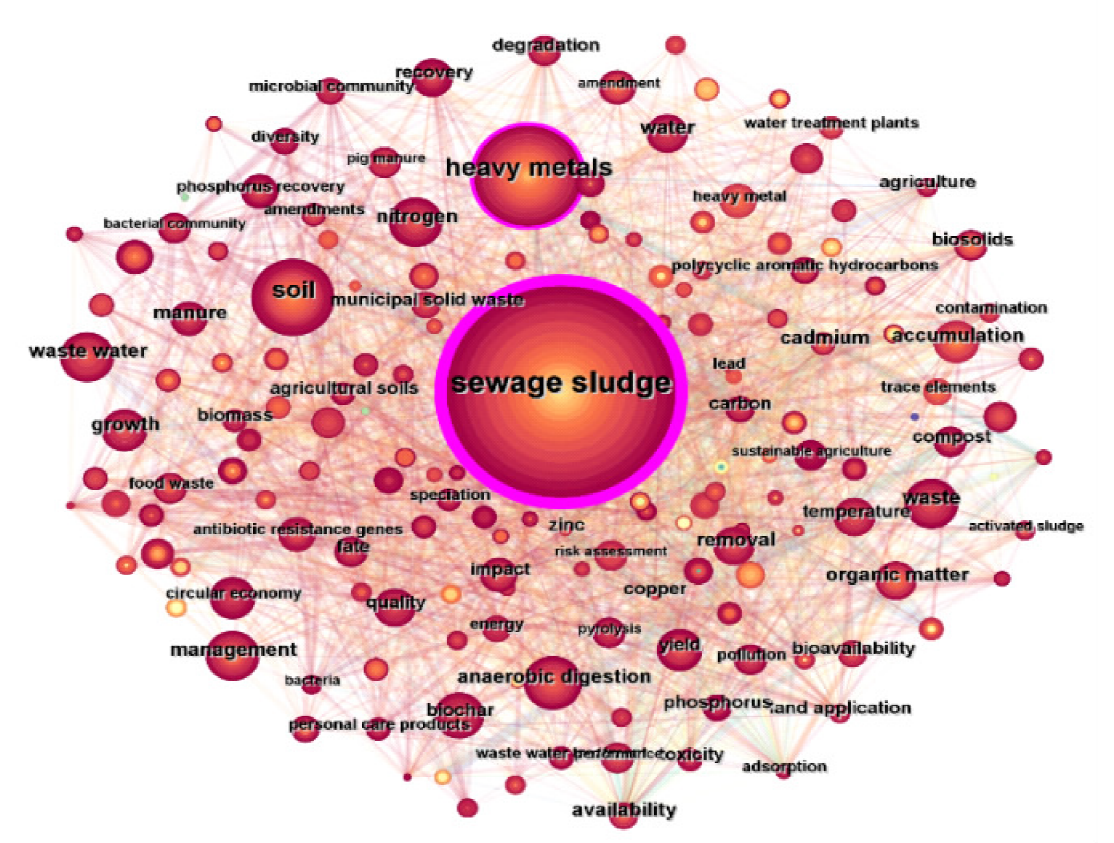
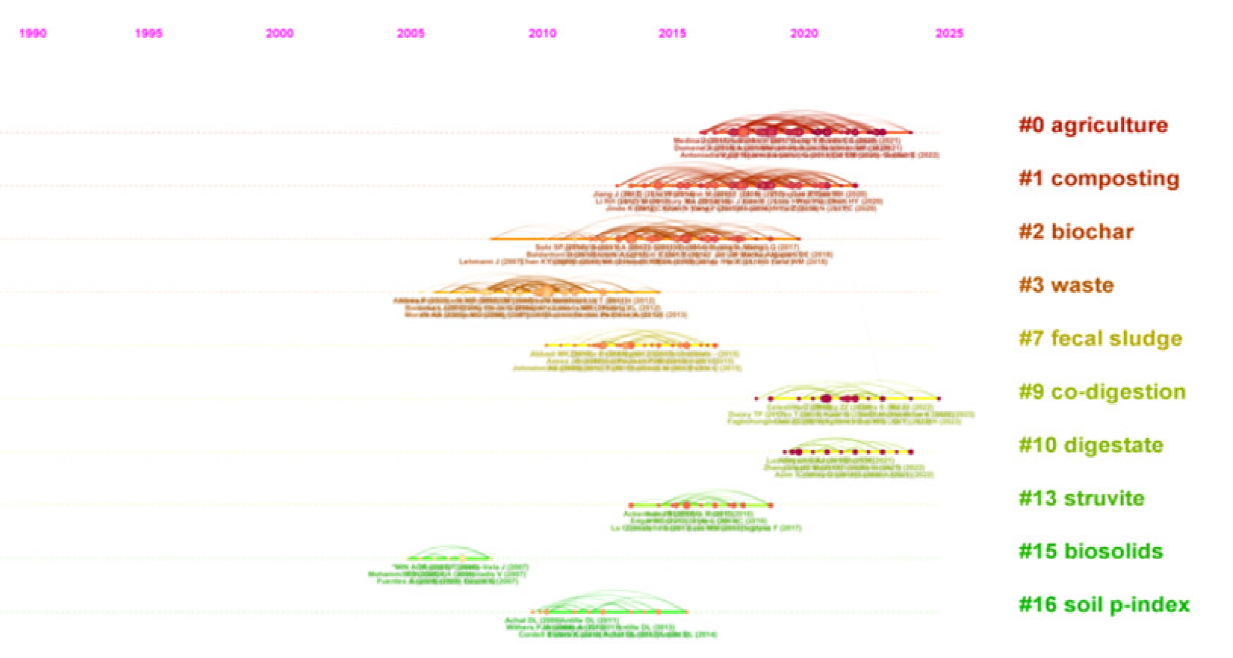
适量生活污泥替代化肥对改善农田土壤的理化及生物学性质具有积极作用,明确生活污泥在农业利用领域的国内外研究发展趋势,可为实现生活废弃物资源化利用、提高农田肥力提供参考依据。本研究基于1990—2025年发表的英文文献,利用文献共被引、关键词共现等文献计量分析法,分析该领域国内外研究的发展历程、热点和前沿差异。结果发现,相较于欧美等发达国家,中国虽然在20世纪90年代末期和21世纪初期英文发文量较少,但截至2025年已成为该领域文献发文量最多的国家,占全球总量的15%,其研究中介中心性指标达到0.13。美国的发文量略低于中国,但中介中心性最高,为0.26。在全球高被引的20篇热点论文中,有2篇来自于中国。中国科学院在全球研究机构中发文量最多,中国与欧美等发达国家在该研究领域已具备显著的影响力,并发挥着引领作用。从研究内容来看,国内外研究的共同焦点集中在污泥、土壤、重金属等方面,2020—2025年该领域热点逐渐转向农业、堆肥、联合硝化、沼渣等关键技术研究。综上,中国与欧美等国在污泥农田利用领域均处于世界前列,当前国内外研究主要关注污泥处理技术及其在农田的合理应用。在未来研究中,应注重新型污泥产品在农田领域的安全性、稳定性,重点评估污泥及其副产物中微塑料等新型污染物的环境风险,深入解析污泥施用对土壤微生物群落结构与数量动态的作用机制,完善污泥的养分回收利用体系,在提高发文质量的同时,积极推动科学研究与生产实际相结合,构建多学科、多领域交叉融合的发展模式,最大限度促进农业可持续发展。
中图分类号:
和亮, 张亦涛, 董奎军. 国内外生活污泥农田利用研究发展态势[J]. 中国农学通报, 2026, 42(13): 124-134.
HE Liang, ZHANG Yitao, DONG Kuijun. Research and Development Trend of Farmland Utilization of Sewage Sludge at Home and Abroad[J]. Chinese Agricultural Science Bulletin, 2026, 42(13): 124-134.
| 序号 | 国家或地区 | 发文量 | 中介中心性(BC) | 起始年份 |
|---|---|---|---|---|
| 1 | 中国 | 306 | 0.13 | 1997 |
| 2 | 美国 | 194 | 0.26 | 1991 |
| 3 | 西班牙 | 180 | 0.19 | 1994 |
| 4 | 波兰 | 170 | 0.09 | 1995 |
| 5 | 巴西 | 130 | 0.06 | 1994 |
| 6 | 德国 | 119 | 0.14 | 1995 |
| 7 | 意大利 | 118 | 0.08 | 1995 |
| 8 | 英国 | 98 | 0.1 | 1992 |
| 9 | 法国 | 87 | 0.2 | 1995 |
| 10 | 瑞典 | 75 | 0.08 | 1998 |
| 序号 | 国家或地区 | 发文量 | 中介中心性(BC) | 起始年份 |
|---|---|---|---|---|
| 1 | 中国 | 306 | 0.13 | 1997 |
| 2 | 美国 | 194 | 0.26 | 1991 |
| 3 | 西班牙 | 180 | 0.19 | 1994 |
| 4 | 波兰 | 170 | 0.09 | 1995 |
| 5 | 巴西 | 130 | 0.06 | 1994 |
| 6 | 德国 | 119 | 0.14 | 1995 |
| 7 | 意大利 | 118 | 0.08 | 1995 |
| 8 | 英国 | 98 | 0.1 | 1992 |
| 9 | 法国 | 87 | 0.2 | 1995 |
| 10 | 瑞典 | 75 | 0.08 | 1998 |
| 序号 | 刊名 | 影响因子IF(2024) | 中科院分区 | 发文量/篇 | 占比/% |
|---|---|---|---|---|---|
| 1 | Science of the total environment | 8.0 | 2区 | 129 | 7.33 |
| 2 | Environmental science and pollution research | 4.4 | 3区 | 67 | 3.81 |
| 3 | Chemosphere | 8.1 | 2区 | 57 | 3.24 |
| 4 | Journal of environmental management | 8.4 | 2区 | 52 | 2.95 |
| 5 | Waste management | 7.1 | 2区 | 50 | 2.84 |
| 6 | Sustainability | 3.3 | 3区 | 41 | 2.33 |
| 7 | Water science and technology | 2.6 | 4区 | 40 | 2.27 |
| 8 | Environmental pollution | 7.3 | 2区 | 39 | 2.22 |
| 9 | Communications in soil science and plant analysis | 1.4 | 4区 | 35 | 1.99 |
| 10 | Journal of environmental quality | 2.3 | 3区 | 30 | 1.70 |
| 序号 | 刊名 | 影响因子IF(2024) | 中科院分区 | 发文量/篇 | 占比/% |
|---|---|---|---|---|---|
| 1 | Science of the total environment | 8.0 | 2区 | 129 | 7.33 |
| 2 | Environmental science and pollution research | 4.4 | 3区 | 67 | 3.81 |
| 3 | Chemosphere | 8.1 | 2区 | 57 | 3.24 |
| 4 | Journal of environmental management | 8.4 | 2区 | 52 | 2.95 |
| 5 | Waste management | 7.1 | 2区 | 50 | 2.84 |
| 6 | Sustainability | 3.3 | 3区 | 41 | 2.33 |
| 7 | Water science and technology | 2.6 | 4区 | 40 | 2.27 |
| 8 | Environmental pollution | 7.3 | 2区 | 39 | 2.22 |
| 9 | Communications in soil science and plant analysis | 1.4 | 4区 | 35 | 1.99 |
| 10 | Journal of environmental quality | 2.3 | 3区 | 30 | 1.70 |
| 序号 | 第一作者 | 刊名 | 影响因子IF(2024) | 被引频次 | 国家或地区 |
|---|---|---|---|---|---|
| 1 | Nicholson F A | Science of the total environment | 8.0 | 953 | 英国 |
| 2 | Radjenovic J | Water research | 12.4 | 935 | 西班牙 |
| 3 | Leslie H A | Environment international | 9.7 | 820 | 荷兰 |
| 4 | Piehl S | Scientific reports | 3.9 | 603 | 德国 |
| 5 | Muchuweti A | Agriculture ecosystems & environment | 6.4 | 489 | 英国 |
| 6 | Magni S | Science of the total environment | 8 | 443 | 意大利 |
| 7 | Tambone F | Chemosphere | 8.1 | 407 | 意大利 |
| 8 | Verlicchi P | Science of the total environment | 8 | 395 | 意大利 |
| 9 | Fijalkowski K | Journal of environmental management | 8.4 | 376 | 波兰 |
| 10 | Diaz-cruz M S | TrAC-Trends in analytical chemistry | 12 | 353 | 西班牙 |
| 11 | Gimenogarcia E | Environmental pollution | 7.3 | 340 | 西班牙 |
| 12 | Gaze W H | The ISME journal | 10 | 336 | 英国 |
| 13 | Singh R P | Chemosphere | 8.1 | 322 | 印度 |
| 14 | Adam C | Water research | 7.1 | 319 | 德国 |
| 15 | Smith P | Global change biology | 12.1 | 312 | 英国 |
| 16 | Zhang L S | Environmental science & technology | 11.3 | 292 | 中国 |
| 17 | Angelidaki I | Applied biochemistry and biotechnology | 3.3 | 290 | 丹麦 |
| 18 | Sutton M A | Atmospheric environment | 3.7 | 278 | 英国 |
| 19 | Li Q L | Environmental pollution | 7.3 | 277 | 中国 |
| 20 | Giller K E | Plant and soil | 4.1 | 264 | 英国 |
| 序号 | 第一作者 | 刊名 | 影响因子IF(2024) | 被引频次 | 国家或地区 |
|---|---|---|---|---|---|
| 1 | Nicholson F A | Science of the total environment | 8.0 | 953 | 英国 |
| 2 | Radjenovic J | Water research | 12.4 | 935 | 西班牙 |
| 3 | Leslie H A | Environment international | 9.7 | 820 | 荷兰 |
| 4 | Piehl S | Scientific reports | 3.9 | 603 | 德国 |
| 5 | Muchuweti A | Agriculture ecosystems & environment | 6.4 | 489 | 英国 |
| 6 | Magni S | Science of the total environment | 8 | 443 | 意大利 |
| 7 | Tambone F | Chemosphere | 8.1 | 407 | 意大利 |
| 8 | Verlicchi P | Science of the total environment | 8 | 395 | 意大利 |
| 9 | Fijalkowski K | Journal of environmental management | 8.4 | 376 | 波兰 |
| 10 | Diaz-cruz M S | TrAC-Trends in analytical chemistry | 12 | 353 | 西班牙 |
| 11 | Gimenogarcia E | Environmental pollution | 7.3 | 340 | 西班牙 |
| 12 | Gaze W H | The ISME journal | 10 | 336 | 英国 |
| 13 | Singh R P | Chemosphere | 8.1 | 322 | 印度 |
| 14 | Adam C | Water research | 7.1 | 319 | 德国 |
| 15 | Smith P | Global change biology | 12.1 | 312 | 英国 |
| 16 | Zhang L S | Environmental science & technology | 11.3 | 292 | 中国 |
| 17 | Angelidaki I | Applied biochemistry and biotechnology | 3.3 | 290 | 丹麦 |
| 18 | Sutton M A | Atmospheric environment | 3.7 | 278 | 英国 |
| 19 | Li Q L | Environmental pollution | 7.3 | 277 | 中国 |
| 20 | Giller K E | Plant and soil | 4.1 | 264 | 英国 |
| [1] |
doi: 10.1016/j.jclepro.2019.117844 URL |
| [2] |
|
| [3] |
|
| [4] |
|
| [5] |
doi: 10.1016/j.scitotenv.2016.06.083 URL |
| [6] |
|
| [7] |
doi: 10.1021/acs.est.8b02213 URL |
| [8] |
|
| [9] |
李杰, 陈超美. CiteSpace科技文本挖掘及可视化[M]. 北京: 首都经济贸易大学出版社, 2017:77-88.
|
| [10] |
邱均平. 文献计量学[M]. 北京: 科学出版社, 2019:1-13.
|
| [11] |
刘波, 李学斌, 何高吉, 等. 基于Web of Science数据库的土壤呼吸知识图谱分析[J]. 土壤通报, 2021:443-453.
|
| [12] |
封亮, 王淑彬, 唐海鹰, 等. 乡村生态文明研究知识图谱:基于CiteSpace V可视化分析[J]. 生态与农村环境学报, 2021:137-144.
|
| [13] |
赵洪猛, 王慎强, 赵旭, 等. 基于CiteSpace的土壤碳氮磷交互研究可视化分析[J]. 土壤, 2022, 54(4):682-690.
|
| [14] |
doi: S0956-053X(18)30043-6 pmid: 29395735 |
| [15] |
|
| [16] |
|
| [17] |
|
| [18] |
|
| [19] |
doi: 10.1016/j.envres.2021.112043 URL |
| [20] |
doi: S0960-8524(17)31322-6 pmid: 28818795 |
| [21] |
|
| [22] |
doi: 10.1016/j.jece.2024.112610 URL |
| [23] |
|
| [24] |
doi: 10.1016/j.jece.2021.106031 URL |
| [25] |
|
| [26] |
doi: 10.1016/j.scitotenv.2017.09.240 URL |
| [27] |
doi: 10.1016/j.biortech.2021.126532 URL |
| [28] |
|
| [29] |
doi: 10.1016/j.biortech.2021.126400 URL |
| [30] |
doi: 10.1016/j.jclepro.2018.10.055 URL |
| [31] |
|
| [32] |
|
| [33] |
doi: 10.1186/s40538-023-00448-x |
| [34] |
doi: 10.1016/j.jhazmat.2008.03.046 pmid: 18456400 |
| [35] |
doi: 10.1038/srep33611 pmid: 27650801 |
| [36] |
|
| [37] |
|
| [38] |
doi: 10.1016/j.jclepro.2022.133539 URL |
| [39] |
doi: 10.1016/j.jenvman.2025.128080 URL |
| [40] |
|
| [41] |
何强, 吉芳英, 李家杰. 污泥处理处置及资源化途径与新技术[J]. 给水排水, 2016, 52(2):1-3.
|
| [42] |
李琼, 华珞, 徐兴华, 等. 城市污泥农用的环境效应及控制标准的发展现状[J]. 中国生态农业学报, 2011, 19(2):468-476.
|
| [43] |
doi: 10.1007/s13369-014-1100-0 URL |
| [44] |
doi: 10.1590/S1415-43662014000300008 URL |
| [45] |
doi: 10.1016/S0929-1393(01)00191-3 URL |
| [46] |
|
| [47] |
余杰, 田宁宁, 王凯军, 等. 中国城市污水处理厂污泥处理、处置问题探讨分析[J]. 环境工程学报, 2007(1):82-86.
|
| [48] |
doi: 10.1007/s10337-017-3464-2 |
| [49] |
|
| [50] |
doi: 10.1071/SR9850131 URL |
| [51] |
|
| [52] |
doi: 10.1016/0960-8524(94)90159-7 URL |
| [53] |
doi: 10.1016/S0960-8524(99)00074-7 URL |
| [54] |
doi: 10.1080/00103624.2023.2282989 URL |
| [55] |
doi: 10.1016/j.resconrec.2019.104647 URL |
| [56] |
doi: 10.1016/S2095-3119(13)60429-3 URL |
| [57] |
doi: 10.1016/j.agee.2007.11.005 URL |
| [58] |
doi: 10.17221/36/2018-SWR URL |
| [59] |
doi: 10.1016/j.energy.2024.131456 URL |
| [60] |
doi: 10.1016/j.scitotenv.2024.174773 URL |
| [61] |
doi: 10.1016/j.chemosphere.2020.129082 URL |
| [62] |
doi: 10.1016/j.jclepro.2024.142249 URL |
| [63] |
doi: 10.1080/00103624.2012.675390 URL |
| [64] |
doi: 10.1016/S1002-0160(12)60012-5 URL |
| [65] |
|
| [66] |
doi: 10.1016/j.scitotenv.2018.03.167 URL |
| [67] |
doi: S0960-8524(19)30173-7 pmid: 30735933 |
| [68] |
doi: 10.1016/j.biortech.2022.128544 URL |
| [69] |
doi: 10.1016/j.scitotenv.2023.161386 URL |
| [70] |
doi: 10.1016/j.jece.2024.113290 URL |
| [71] |
doi: 10.1016/j.chemosphere.2010.05.026 pmid: 20542316 |
| [72] |
doi: 10.1016/j.biortech.2014.02.098 pmid: 24650613 |
| [73] |
doi: 10.1016/j.biortech.2012.01.072 pmid: 22325901 |
| [74] |
|
| [75] |
doi: 10.1016/S2095-3119(13)60564-X URL |
| [76] |
doi: 10.1016/j.agwat.2015.06.002 URL |
| [77] |
doi: 10.1002/wer.v96.8 URL |
| [78] |
doi: 10.1016/j.scitotenv.2024.174311 URL |
| [79] |
doi: 10.1016/j.watres.2024.121524 URL |
| [1] | 黄殷洪, 郭金金, 薛杨, 曾文, 陈亚娟, 袁勇. 基于知识图谱的三七总皂苷文献计量与可视化分析[J]. 中国农学通报, 2026, 42(9): 207-218. |
| [2] | 王丽娜, 齐国超, 任翠梅, 顾鑫, 张宏宇, 王迪, 芮海英. 3种农业废弃物对苏打盐碱荒地改良效果的研究[J]. 中国农学通报, 2026, 42(9): 76-81. |
| [3] | 袁梦, 马梓涵, 熊欢, 姜爱丽. 海带的生物降解及海藻提取物在农业领域中的应用[J]. 中国农学通报, 2026, 42(7): 105-112. |
| [4] | 陈燕, 吴玲, 曹凡, 郭聪, 黄欣, 金雨晴, 王莹, 徐秋霞, 谷青青, 柯裴蓓, 宁仪杭, 李玉娟. 人工纳米材料在植物抗性提升及土壤改良中的研究进展[J]. 中国农学通报, 2026, 42(7): 153-162. |
| [5] | 谭德龙, 程堂根, 齐海军, 曹海顺, 谢卓林, 黄叙豪, 林泽钦, 吴廷全. 韭菜绿色植保方案筛选[J]. 中国农学通报, 2026, 42(7): 176-183. |
| [6] | 盛文旭, 杨敏, 王亚楠, 郭亚雯, 李昊昱, 张敏, 蔡瑞国, 郭子糠. 基于CNKI和Web of Science文献计量分析的小麦籽粒锌研究进展与热点[J]. 中国农学通报, 2026, 42(6): 1-13. |
| [7] | 魏丹, 崔福星, 潘虹, 李虹, 郭媛, 杨立宾, 付晓宇, 李海军. 火干扰对土壤动物的影响—基于文献计量分析[J]. 中国农学通报, 2026, 42(6): 111-119. |
| [8] | 张小磊, 王玉钟. 乡村振兴视域下河南省黄河滩迁建地区生态农业发展策略研究[J]. 中国农学通报, 2026, 42(3): 213-218. |
| [9] | 黄维, 潘荟晓, 吴炫柯, 何燕, 谭孟祥, 刘永裕. 广西双季稻产量灾损风险区划及致灾气象因子分析[J]. 中国农学通报, 2026, 42(3): 144-154. |
| [10] | 陈雷, 李连蓉, 张秋圆, 段双刚, 吴俨, 姚琼. 纳米农药及载体材料的研究现状[J]. 中国农学通报, 2026, 42(3): 155-162. |
| [11] | 周佳慧, 唐浦林, 张诗野, 张爱华, 汪树理, 魏航, 任新龙, 郜玉钢, 王艳芳. 基于CNKI数据库的土壤酸化调节措施文献计量分析[J]. 中国农学通报, 2026, 42(2): 203-210. |
| [12] | 秦小欢, 焦多朵, 金铁棚, 孙师, 郜坤媛, 胡建霖. 人参属植物根系微生态研究态势分析[J]. 中国农学通报, 2026, 42(2): 84-92. |
| [13] | 马明君, 石美亮, 常舒冬. 饶阳县葡萄农业气候资源变化分析及趋势展望[J]. 中国农学通报, 2026, 42(2): 153-162. |
| [14] | 杨玉洁, 杏相龙, 白玉锋, 李晓宇. 干旱区典型植被柽柳属研究进展[J]. 中国农学通报, 2026, 42(13): 44-54. |
| [15] | 王姣姣, 李静, 王红丽, 赵婧, 孙坤, 陈大为. 桔绿木霉HT-1分生孢子固体发酵优化及其对2种作物幼苗生长的影响[J]. 中国农学通报, 2026, 42(11): 39-49. |
| 阅读次数 | ||||||
|
全文 |
|
|||||
|
摘要 |
|
|||||
