欢迎访问《中国农学通报》,

中国农学通报 ›› 2026, Vol. 42 ›› Issue (20): 54-63.doi: 10.11924/j.issn.1000-6850.casb2026-0169
叶晓梅1( ), 牛晓卫2, 王鹏3, 薛睿哲3, 韩侠3(), 徐伟洲3, 陈书军4
收稿日期:2026-02-28
修回日期:2026-05-15
出版日期:2026-10-25
发布日期:2026-10-26
通讯作者:
作者简介:叶晓梅,女,1973年出生,高级工程师,本科,主要从事造林绿化、苗木培育、森林经营,资源保护等工作。通信地址:719000 陕西省榆林市榆阳区长虹路26号 榆林市榆阳区城郊林场,Tel:0912-3823100,E-mail:604258447@qq.com。
基金资助:
YE Xiaomei1(), NIU Xiaowei2, WANG Peng3, XUE Ruizhe3, HAN Xia3(), XU Weizhou3, CHEN Shujun4
Received:2026-02-28
Revised:2026-05-15
Published:2026-10-25
Online:2026-10-26
摘要:
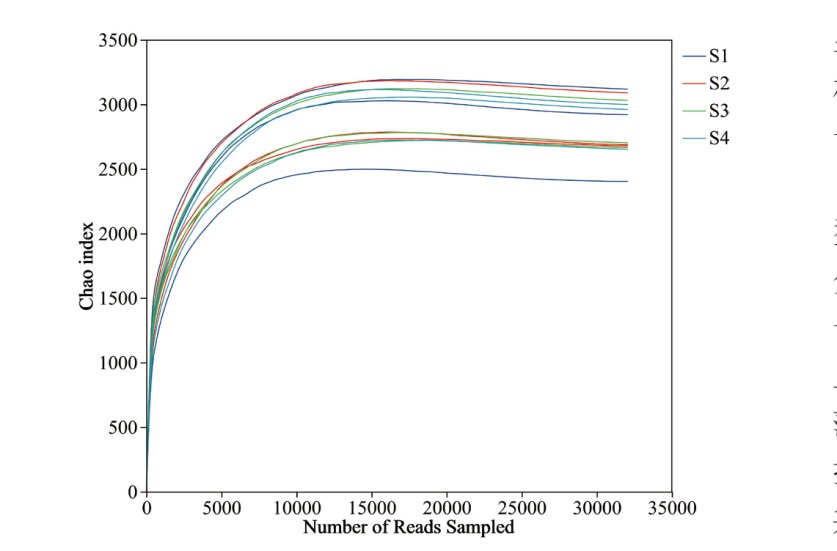
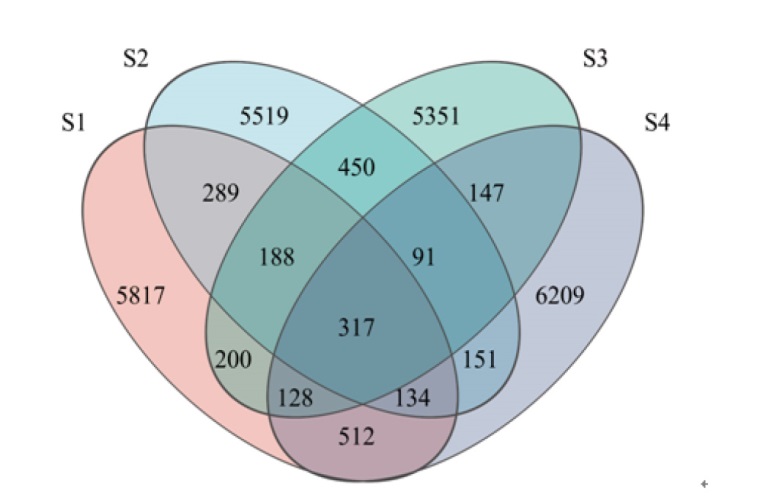
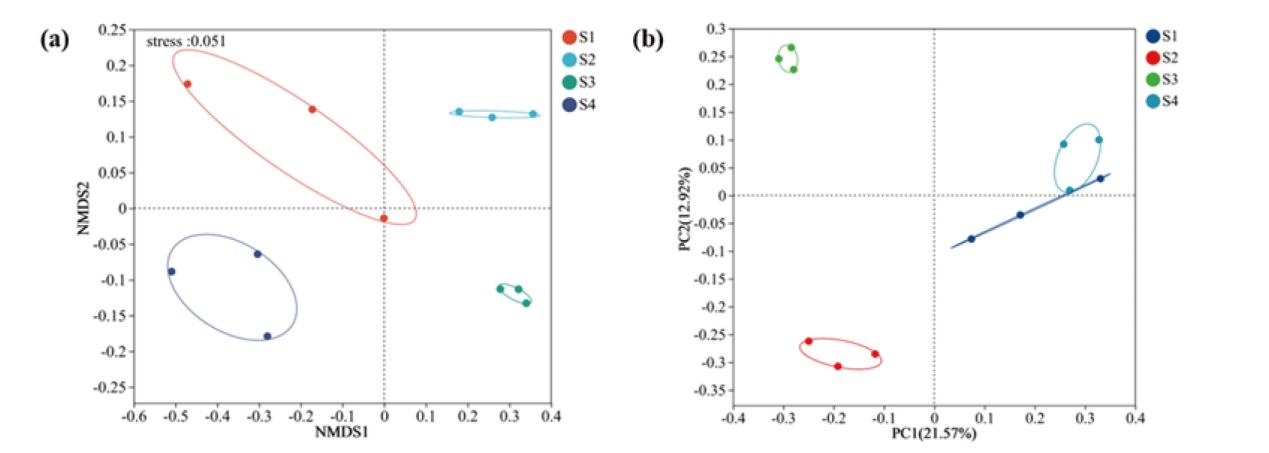
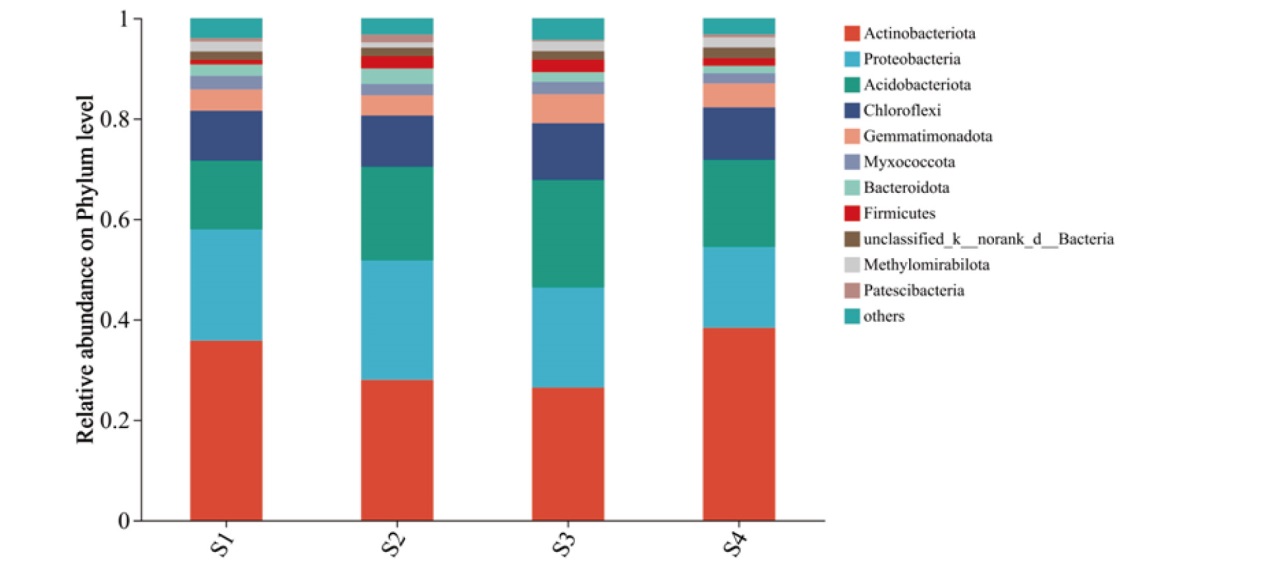
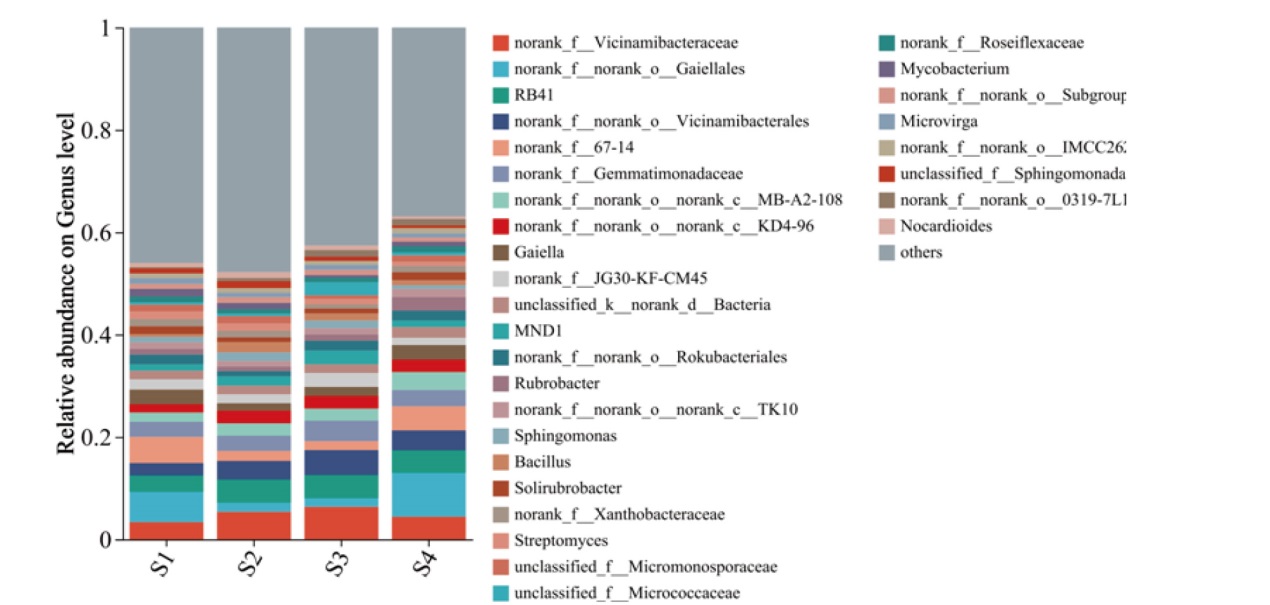
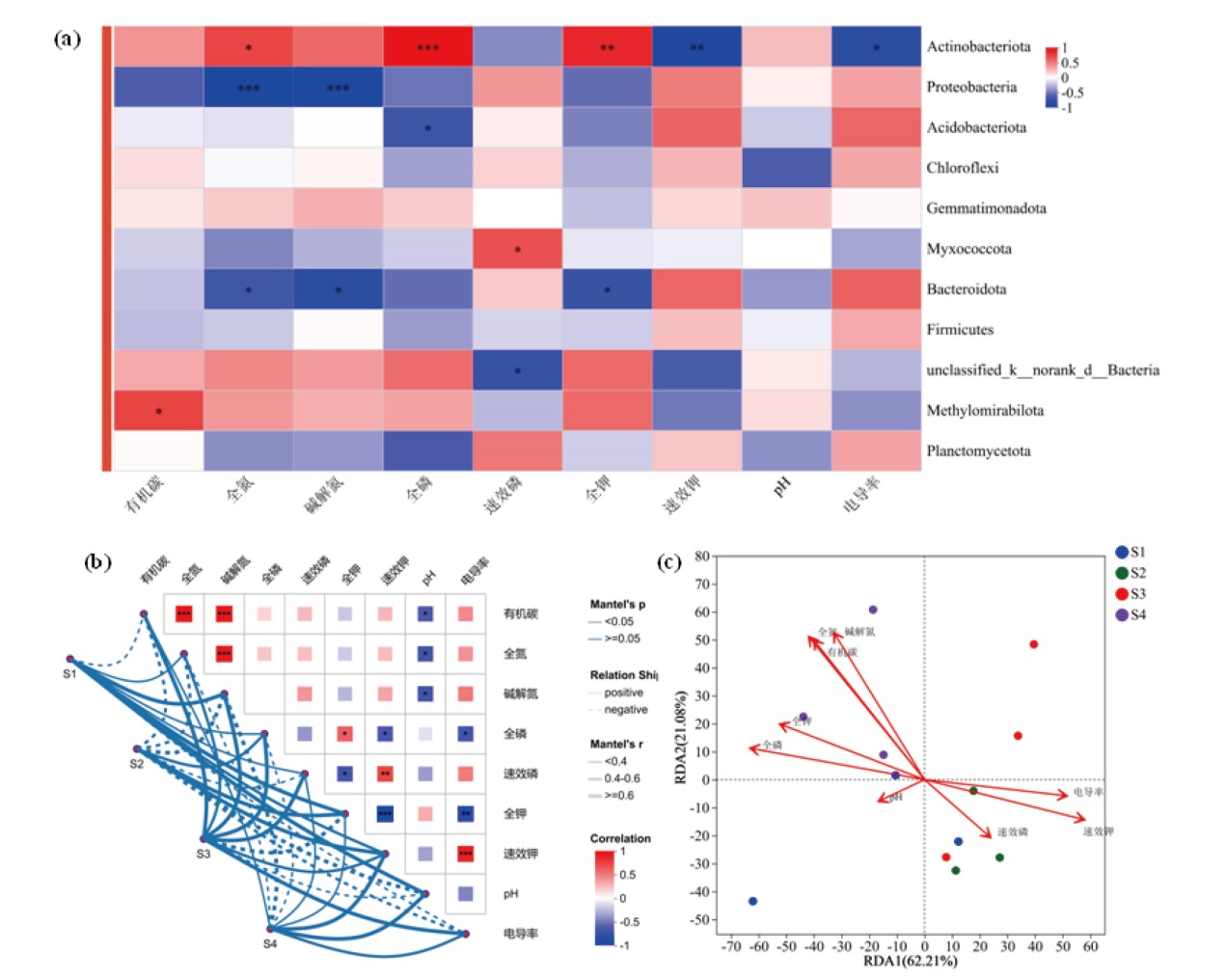
本研究旨在揭示陕北沿黄土石山区不同林分类型下土壤细菌群落组成差异,并识别其关键环境驱动因子。以侧柏林、油松-紫穗槐混交林、枣树林和油松-火炬混交林为研究对象,采用16S rRNA高通量测序和土壤理化分析方法,系统比较不同林分类型对土壤细菌群落特征的影响。结果显示,4种林分类型的土壤细菌OTU数目排序为油松-火炬混交林(6209)>侧柏林(5817)>油松-紫穗槐混交林(5519)>枣树林(5351),且β多样性在林分间差异显著。优势菌门为放线菌门(26.42%~38.33%)、变形菌门(16.13%~23.81%)和酸性菌门(13.66%~21.41%)。土壤理化性质解释了83.29%的细菌群落组成变异,其中全氮(r2=0.8279)、有机碳(r2=0.7772)和全磷(r2=0.7765)被确定为驱动细菌群落结构变化的关键因子。总体而言,林分类型显著影响陕北沿黄土石山区土壤细菌群落的结构组成,全氮、土壤有机碳和全磷是驱动该差异的核心土壤环境因素。
中图分类号:
叶晓梅, 牛晓卫, 王鹏, 薛睿哲, 韩侠, 徐伟洲, 陈书军. 陕北沿黄土石山区不同林分类型的土壤细菌群落特征[J]. 中国农学通报, 2026, 42(20): 54-63.
YE Xiaomei, NIU Xiaowei, WANG Peng, XUE Ruizhe, HAN Xia, XU Weizhou, CHEN Shujun. Soil Bacterial Community Characteristics of Different Forest Types in Rocky Mountain Area Along Yellow River in Northern Shaanxi[J]. Chinese Agricultural Science Bulletin, 2026, 42(20): 54-63.
| 林分类型 | 坐标 | 海拔/m | 林分密度/(株/hm2) | 地貌 | 林地主要植物 |
|---|---|---|---|---|---|
| 侧柏林 | 110°44’ E、37°40’ N | 758 | 1208 | 梁峁坡地 | 侧柏P. orientalis 河朔荛花Wikstroemia chamaedaphne 白莲蒿Artemisia sacrorum Ledeb |
| 油松-紫穗槐混交林 | 110°46’ E、37°39’ N | 830 | 1000 | 梁峁坡地 | 油松P. tabulaeformis 紫穗槐A. fruticose 白羊草Bothriochloa ischaemum |
| 枣林 | 110°47’ E、37°34’ N | 665.7 | 500 | 河川地 | 枣树Z. jujuba 酸枣Z. jujuba var. 糙隐子草Cleistogenes squarrosa |
| 油松-火炬混交林 | 110°30’ E、38°12’ N | 784 | 1917 | 沟坡地 | 油松P. tabulaeformis 杠柳Periploca sepium 阿尔泰狗娃花Aster altaicus |
| 土壤理化性质 | 侧柏林 | 油松-紫穗槐混交林 | 枣树林 | 油松-火炬混交林 |
|---|---|---|---|---|
| SOC/(g/kg) | 7.48±1.63 ab | 4.04±0.43 b | 6.12±0.26 ab | 9.37±1.34 a |
| TN/(g/kg) | 0.71±0.17 ab | 0.45±0.03 b | 0.74±0.16 ab | 0.93±0.07 a |
| HN/(mg/kg) | 38.27±7.94 ab | 33.57±3.97 b | 51.26±7.22 a | 52.22±4.41 a |
| TP/(g/kg) | 0.60±0.04 b | 0.50±0.01 b | 0.49±0.04 b | 0.73±0.02 a |
| AP/(mg/kg) | 1.87±0.68 ab | 2.13±0.22 ab | 3.56±1.09 a | 1.13±0.04 b |
| TK/(g/kg) | 26.37±0.53 a | 22.54±0.77 b | 23.28±0.90 b | 26.62±0.66 a |
| AK/(mg/kg) | 106.91±25.71 b | 184.48±29.88 a | 180.67±16.73 a | 107.48±2.40 b |
| pH | 8.46±0.10 | 8.38±0.06 | 8.49±0.06 | 8.41±0.02 |
| EC/(μs/cm) | 74.36±5.76 c | 94.43±7.19 a | 91.23±2.68 ab | 76.13±1.98 bc |
| 碳氮比(C:N) | 8.39±2.33 | 8.98±0.33 | 8.74±2.76 | 10.09±0.38 |
| 碳磷比(C:P) | 9.33±2.42 ab | 7.94±0.76 b | 11.01±2.40 ab | 12.72±1.96 a |
| 氮磷比(N:P) | 1.24±0.70 | 0.88±0.01 | 1.46±0.33 | 1.26±0.21 |
| [1] |
doi: 10.1139/cjm-2017-0752 pmid: 30114373 |
| [2] |
李劲, 程铭昊, 张溢, 等. 神农架国家公园不同植被类型土壤微生物群落结构及功能[J]. 生态学报, 2025, 45(10):4842-4854.
|
| [3] |
张薇, 魏海雷, 高洪文, 等. 土壤微生物多样性及其环境影响因子研究进展[J]. 生态学杂志, 2005(1):48-52.
|
| [4] |
doi: 10.1038/s41559-019-1084-y |
| [5] |
安芳娇, 牛子儒, 刘婷娜, 等. 干旱区不同植被类型土壤细菌群落结构及代谢功能特征[J]. 环境科学, 2025(8):1-13.
|
| [6] |
doi: 10.1111/j.1574-6941.2006.00260.x pmid: 17313585 |
| [7] |
doi: 10.1016/j.soilbio.2018.12.008 URL |
| [8] |
刘菁, 杨博. 陕西沿黄土石山区生态环境治理及产业发展探讨[J]. 防护林科技, 2024(4):82-84.
|
| [9] |
张宇, 秦媛媛, 张科, 等. 榆林市沿黄土石山区生态治理及产业发展[J]. 温带林业研究, 2022, 5(2):39-43.
|
| [10] |
张锡唐, 石长春, 高荣, 等. 沿黄土石山区几种针叶树造林生长情况研究[J]. 防护林科技, 2023(1):10-12,20.
|
| [11] |
鲍士旦. 土壤农化分析(第三版)[M]. 北京: 中国农业出版社, 2000:25-114.
|
| [12] |
韩彦隆, 杨文源, 韩敏, 等. 荒漠草原毛刺锦鸡儿灌丛根际土壤细菌群落结构及多样性[J]. 草地学报, 2025, 33(10):3215-3224.
doi: 10.11733/j.issn.1007-0435.2025.10.009 |
| [13] |
王子寅, 刘秉儒, 李子豪, 等. 荒漠草原柠条灌丛堆不同发育阶段土壤细菌群落结构特征[J]. 生物技术通报, 2022, 38(7):205-214.
doi: 10.13560/j.cnki.biotech.bull.1985.2022-0248 |
| [14] |
|
| [15] |
doi: 10.1126/science.aap9516 URL |
| [16] |
樊骐瑞, 郝建华, 张秀娟, 等. 晋西北半干旱区不同灌丛土壤细菌群落特征[J]. 生态学杂志, 2025, 44(5):1474-1482.
|
| [17] |
doi: 10.1016/j.apsoil.2016.07.001 URL |
| [18] |
|
| [19] |
doi: 10.1016/j.scitotenv.2021.152496 URL |
| [20] |
|
| [21] |
doi: 10.1890/05-1839 pmid: 17601128 |
| [22] |
管鸿智, 黄荣珍, 朱丽琴, 等. 红壤区不同生态恢复林分的土壤微生物群落差异[J]. 森林与环境学报, 2023, 43(2):177-184.
|
| [23] |
冯汉华, 吴斌, 伍国清, 等. 喀斯特不同植被类型土壤细菌群落与功能特征[J]. 森林与环境学报, 2024, 44(2):148-156.
|
| [24] |
张健, 徐明. 黄土丘陵区不同植被类型土壤细菌群落多样性特征[J]. 生态与农村环境学报, 2022, 38(2):225-235.
|
| [25] |
|
| [26] |
doi: 10.1016/j.ecoinf.2019.101020 URL |
| [27] |
doi: 10.1111/1462-2920.13660 pmid: 28063185 |
| [28] |
doi: 10.1016/j.soilbio.2014.06.014 URL |
| [29] |
doi: 10.1016/j.apsoil.2017.03.015 URL |
| [30] |
doi: 10.3389/fmicb.2017.00187 pmid: 28232824 |
| [31] |
伏媛媛, 郝龙飞, 岳永杰, 等. 科尔沁沙地不同林龄杨树人工林土壤微生物群落特征[J]. 东北林业大学学报, 2025, 53(7):91-98,107.
|
| [1] | 张洁, 邵文奇, 马洪波, 陈川, 章安康, 李传哲. 缓释氮肥对江苏水稻产量及肥料利用率的影响[J]. 中国农学通报, 2026, 42(8): 104-109. |
| [2] | 颜宏, 陈太春, 冯志珍, 陈志杰, 徐进, 许西梅, 董振, 付博. 耕作措施对小麦土壤理化性质、微生物群落及产量的影响[J]. 中国农学通报, 2026, 42(8): 110-119. |
| [3] | 朱谣, 王顺旺, 袁露溢, 李万仙, 李永辉, 王昌梅, 吴凯, 蒋金和, 张无敌, 尹芳. 尾菜沼液灌溉量对食叶草产量品质、土壤酶活性及养分的影响[J]. 中国农学通报, 2026, 42(4): 139-145. |
| [4] | 黄建凤, 逄玉万, 吴昭云, 张木, 黄巧义, 黄旭, 付弘婷, 李苹, 吴永沛. 不同稻秆覆盖量对辣椒生长及土壤细菌群落的影响[J]. 中国农学通报, 2026, 42(20): 88-97. |
| [5] | 陈宝珠, 黄继川, 许杨贵, 彭一平, 李珠娴, 梁健仪, 钟文亮, 晏育伟, 涂玉婷. 不同轮作模式对迟菜心种植土壤微生态的影响[J]. 中国农学通报, 2026, 42(2): 93-102. |
| [6] | 徐兴阳, 杨宗云, 耿宇, 马左玉, 王晓云, 侯永强, 盘四光, 潘义宏. 紫花苜蓿-烤烟轮作模式下氮磷钾配施对植烟土壤性质与烟叶产质量的影响[J]. 中国农学通报, 2026, 42(19): 51-59. |
| [7] | 张俊青, 吴少阳, 张艳, 侯健, 吴海龙. 呼伦贝尔草原6种不同植物群落与土壤耦合特征[J]. 中国农学通报, 2026, 42(15): 119-128. |
| [8] | 冯志珍, 陈太春, 颜宏, 梁建强, 赵文娟, 秦涛. 生物肥料对连作芹菜土壤环境、生长指标和产量的影响[J]. 中国农学通报, 2026, 42(13): 55-65. |
| [9] | 冯志珍, 陈太春, 颜宏, 陈志杰, 李英梅, 徐进, 郭欢, 秦涛, 付博. 小麦茎基腐病发病与健康土壤理化性质和微生物群落结构比较分析[J]. 中国农学通报, 2026, 42(12): 109-118. |
| [10] | 张冬敏, 黄婉莉, 陈心怡, 张朝坤, 肖世伟. 毛叶枣-大豆间作模式对毛叶枣土壤养分及果实品质的影响[J]. 中国农学通报, 2026, 42(1): 153-158. |
| [11] | 王昕, 朱长宽, 谢云超, 姜瑶, 金冉冉, 张俊鹏. 滴灌水肥一体化技术发展与思考[J]. 中国农学通报, 2025, 41(35): 147-155. |
| [12] | 王鹏, 薛睿哲, 韩侠, 徐伟洲, 陈书军, 田相林. 降雨对陕北沿黄土石山区人工林土壤水分动态变化特征的影响[J]. 中国农学通报, 2025, 41(31): 79-87. |
| [13] | 颜栋, 张军强, 钟月华, 冯冰, 吴华山, 马洪波. 椰糠覆盖对小麦产量、盐碱地土壤理化性质及细菌群落结构的影响[J]. 中国农学通报, 2025, 41(29): 63-68. |
| [14] | 孔令羽, 吴则蒽, 孟云杉, 胡树文. 新型复合改良剂对土默川盐碱耕地性质及玉米产量影响研究[J]. 中国农学通报, 2025, 41(21): 85-95. |
| [15] | 万婷婷, 何浩, 程李洋, 李帅, 余梦梦, 秦洁, 李铈阔, 李俊华. 哈茨木霉菌配施改良剂对盐碱土理化特性及棉花抗盐碱响应的协同机制[J]. 中国农学通报, 2025, 41(21): 145-155. |
| 阅读次数 | ||||||
|
全文 |
|
|||||
|
摘要 |
|
|||||
