Welcome to Chinese Agricultural Science Bulletin,

Chinese Agricultural Science Bulletin ›› 2026, Vol. 42 ›› Issue (2): 84-92.doi: 10.11924/j.issn.1000-6850.casb2025-0493
Previous Articles Next Articles
QIN Xiaohuan1,2,3( ), JIAO Duoduo1,2,3, JIN Tiepeng1, SUN Shi1, GAO Kunyuan1, HU Jianlin1,2()
Received:2025-06-18
Revised:2025-08-15
Online:2026-01-25
Published:2026-01-22
QIN Xiaohuan, JIAO Duoduo, JIN Tiepeng, SUN Shi, GAO Kunyuan, HU Jianlin. Analysis of Research Trends in Root Microecology of Panax Plant[J]. Chinese Agricultural Science Bulletin, 2026, 42(2): 84-92.
Add to citation manager EndNote|Ris|BibTeX
URL: https://www.casb.org.cn/EN/10.11924/j.issn.1000-6850.casb2025-0493
| 序号 | 期刊 | 国家 | 论文数量 | 论文百分比/% | 影响因子(2023) |
|---|---|---|---|---|---|
| 1 | Journal of Ginseng Research | 韩国 | 42 | 6.442 | 6.8 |
| 2 | Molecules | 瑞士 | 23 | 3.528 | 4.2 |
| 3 | Journal of Agricultural and Food Chemistry | 美国 | 19 | 2.914 | 5.7 |
| 4 | Frontiers in Microbiology | 瑞士 | 17 | 2.607 | 4.0 |
| 5 | Industrial Crops and Products | 荷兰 | 14 | 2.147 | 5.6 |
| 6 | Plant Cell Tissue and Organ Culture | 荷兰 | 12 | 1.84 | 2.3 |
| 7 | Plant and Soil | 荷兰 | 11 | 1.687 | 3.9 |
| 8 | Agronomy-Basel | 瑞士 | 8 | 1.227 | 3.3 |
| 9 | Antonie van Leeuwenhoek International Journal of General and Molecular Microbiology | 荷兰 | 8 | 1.227 | 1.8 |
| 10 | Applied Soil Ecology | 荷兰 | 8 | 1.227 | 4.8 |
| 序号 | 期刊 | 国家 | 论文数量 | 论文百分比/% | 影响因子(2023) |
|---|---|---|---|---|---|
| 1 | Journal of Ginseng Research | 韩国 | 42 | 6.442 | 6.8 |
| 2 | Molecules | 瑞士 | 23 | 3.528 | 4.2 |
| 3 | Journal of Agricultural and Food Chemistry | 美国 | 19 | 2.914 | 5.7 |
| 4 | Frontiers in Microbiology | 瑞士 | 17 | 2.607 | 4.0 |
| 5 | Industrial Crops and Products | 荷兰 | 14 | 2.147 | 5.6 |
| 6 | Plant Cell Tissue and Organ Culture | 荷兰 | 12 | 1.84 | 2.3 |
| 7 | Plant and Soil | 荷兰 | 11 | 1.687 | 3.9 |
| 8 | Agronomy-Basel | 瑞士 | 8 | 1.227 | 3.3 |
| 9 | Antonie van Leeuwenhoek International Journal of General and Molecular Microbiology | 荷兰 | 8 | 1.227 | 1.8 |
| 10 | Applied Soil Ecology | 荷兰 | 8 | 1.227 | 4.8 |
| 序号 | 作者 | 国家 | 机构 | 论文数量 | 占论文百分比/% |
|---|---|---|---|---|---|
| 1 | Paek KY | 韩国 | 忠北大学 | 36 | 5.521 |
| 2 | Hahn EJ | 韩国 | 水原大学 | 25 | 3.834 |
| 3 | Wang Y | 中国 | 文山学院 | 21 | 3.221 |
| 4 | Cui XM | 中国 | 昆明理工大学 | 18 | 2.761 |
| 5 | Yang DC | 韩国 | 庆熙大学 | 18 | 2.761 |
| 6 | Chen SL | 中国 | 成都中医药大学 | 17 | 2.607 |
| 7 | Li Y | 中国 | 中国医学科学院 | 17 | 2.607 |
| 8 | Wang J | 中国 | 天津大学 | 17 | 2.607 |
| 9 | Dong LL | 中国 | 安徽财经大学 | 16 | 2.454 |
| 10 | Gao WY | 中国 | 天津大学 | 15 | 2.301 |
| 序号 | 作者 | 国家 | 机构 | 论文数量 | 占论文百分比/% |
|---|---|---|---|---|---|
| 1 | Paek KY | 韩国 | 忠北大学 | 36 | 5.521 |
| 2 | Hahn EJ | 韩国 | 水原大学 | 25 | 3.834 |
| 3 | Wang Y | 中国 | 文山学院 | 21 | 3.221 |
| 4 | Cui XM | 中国 | 昆明理工大学 | 18 | 2.761 |
| 5 | Yang DC | 韩国 | 庆熙大学 | 18 | 2.761 |
| 6 | Chen SL | 中国 | 成都中医药大学 | 17 | 2.607 |
| 7 | Li Y | 中国 | 中国医学科学院 | 17 | 2.607 |
| 8 | Wang J | 中国 | 天津大学 | 17 | 2.607 |
| 9 | Dong LL | 中国 | 安徽财经大学 | 16 | 2.454 |
| 10 | Gao WY | 中国 | 天津大学 | 15 | 2.301 |
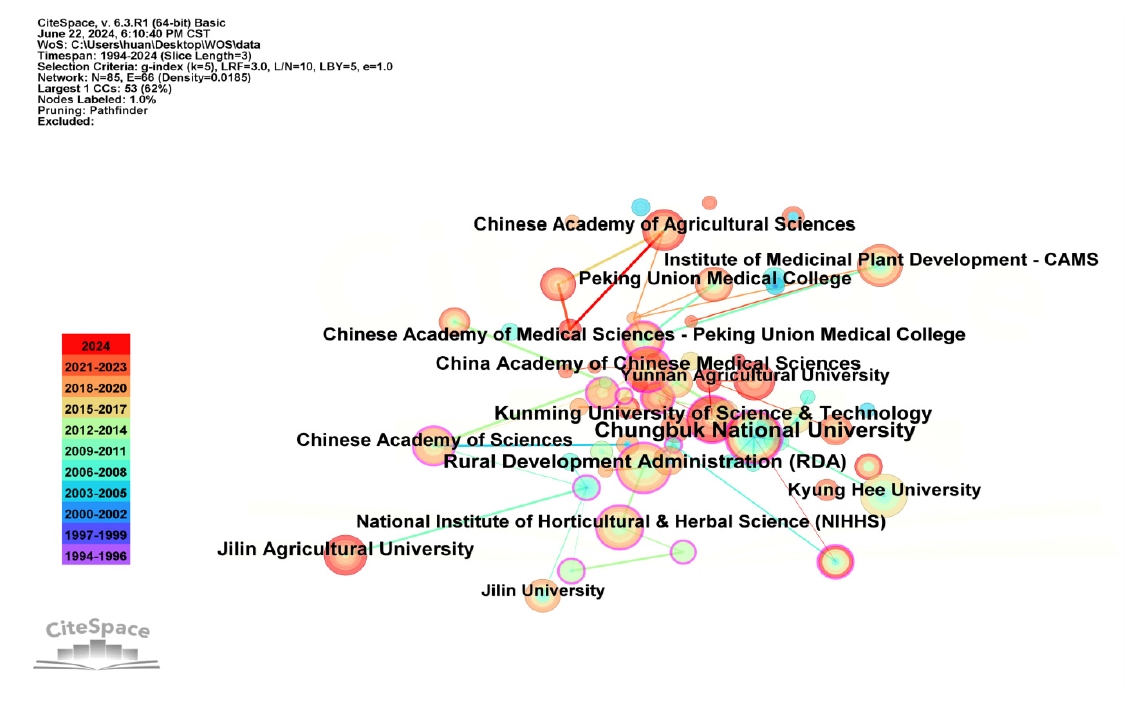
| 序号 | 研究单位 | 国家 | 论文数量 | 占论文百分比/% |
|---|---|---|---|---|
| 1 | 忠北大学 | 韩国 | 48 | 7.362 |
| 2 | 农村振兴厅 | 韩国 | 35 | 5.368 |
| 3 | 昆明理工大学 | 中国 | 32 | 4.908 |
| 4 | 中国中医科学院 | 中国 | 30 | 4.601 |
| 5 | 吉林农业大学 | 中国 | 29 | 4.448 |
| 6 | 中国医学科学院-北京协和医学院 | 中国 | 27 | 4.141 |
| 7 | 中国科学院 | 中国 | 27 | 4.141 |
| 8 | 北京协和医学院 | 中国 | 26 | 3.988 |
| 9 | 庆熙大学 | 韩国 | 25 | 3.834 |
| 10 | 中国医学科学院药用植物研究所 | 中国 | 24 | 3.681 |
| 序号 | 研究单位 | 国家 | 论文数量 | 占论文百分比/% |
|---|---|---|---|---|
| 1 | 忠北大学 | 韩国 | 48 | 7.362 |
| 2 | 农村振兴厅 | 韩国 | 35 | 5.368 |
| 3 | 昆明理工大学 | 中国 | 32 | 4.908 |
| 4 | 中国中医科学院 | 中国 | 30 | 4.601 |
| 5 | 吉林农业大学 | 中国 | 29 | 4.448 |
| 6 | 中国医学科学院-北京协和医学院 | 中国 | 27 | 4.141 |
| 7 | 中国科学院 | 中国 | 27 | 4.141 |
| 8 | 北京协和医学院 | 中国 | 26 | 3.988 |
| 9 | 庆熙大学 | 韩国 | 25 | 3.834 |
| 10 | 中国医学科学院药用植物研究所 | 中国 | 24 | 3.681 |
| 序号 | 关键词 | 频次 | 中心性 |
|---|---|---|---|
| 1 | 人参(Panax ginseng) | 238 | 0.37 |
| 2 | 三七(Panax notoginseng) | 112 | 0.75 |
| 3 | 生长(Growth) | 93 | 0.66 |
| 4 | 皂苷(Saponins) | 67 | 0.11 |
| 5 | 多样性(Diversity) | 66 | 0.22 |
| 6 | 人参皂苷(Ginsenosides) | 66 | 0.03 |
| 7 | 鉴别(Identification) | 62 | 0.13 |
| 8 | 西洋参(American ginseng) | 48 | 0.18 |
| 9 | 人参(Ginseng) | 46 | 0.03 |
| 10 | 生物合成(Biosynthesis) | 43 | 0.31 |
| 11 | 土壤(Soil) | 37 | 0.53 |
| 12 | 积累(Accumulation) | 36 | 0.52 |
| 13 | 植物(Plant) | 29 | 0.03 |
| 14 | 微生物群落(Microbial community) | 27 | 0.06 |
| 15 | 叶片(Leaves) | 26 | 0.7 |
| 16 | 酸(Acid) | 25 | 0.85 |
| 17 | 不定根(Adventitious roots) | 25 | 0.2 |
| 18 | 茉莉酸甲酯(Methyl jasmonate) | 24 | 0.22 |
| 19 | 表达(Expression) | 23 | 0.03 |
| 20 | 群落(Community) | 23 | 0 |
| 序号 | 关键词 | 频次 | 中心性 |
|---|---|---|---|
| 1 | 人参(Panax ginseng) | 238 | 0.37 |
| 2 | 三七(Panax notoginseng) | 112 | 0.75 |
| 3 | 生长(Growth) | 93 | 0.66 |
| 4 | 皂苷(Saponins) | 67 | 0.11 |
| 5 | 多样性(Diversity) | 66 | 0.22 |
| 6 | 人参皂苷(Ginsenosides) | 66 | 0.03 |
| 7 | 鉴别(Identification) | 62 | 0.13 |
| 8 | 西洋参(American ginseng) | 48 | 0.18 |
| 9 | 人参(Ginseng) | 46 | 0.03 |
| 10 | 生物合成(Biosynthesis) | 43 | 0.31 |
| 11 | 土壤(Soil) | 37 | 0.53 |
| 12 | 积累(Accumulation) | 36 | 0.52 |
| 13 | 植物(Plant) | 29 | 0.03 |
| 14 | 微生物群落(Microbial community) | 27 | 0.06 |
| 15 | 叶片(Leaves) | 26 | 0.7 |
| 16 | 酸(Acid) | 25 | 0.85 |
| 17 | 不定根(Adventitious roots) | 25 | 0.2 |
| 18 | 茉莉酸甲酯(Methyl jasmonate) | 24 | 0.22 |
| 19 | 表达(Expression) | 23 | 0.03 |
| 20 | 群落(Community) | 23 | 0 |
| 物种 | 根际真菌 | 根际细菌 | 内生真菌 | 内生细菌 | 参考文献 |
|---|---|---|---|---|---|
| 人参 (Panax ginseng) | 子囊菌门(Ascomycota) 担子菌门(Basidiomycota) 被孢霉门(Mortierellomycota) | 酸杆菌门(Acidobacteriota) 变形菌门(Proteobacteria) 放线菌门(Actinobacteriota) | 子囊菌门(Ascomycota) 接合菌门(Zygomycota) 担子菌门(Basidiomycota) | 变形菌门(Proteobacteria) 厚壁菌门(Firmicutes) 放线菌门(Actinobacteria) 拟杆菌门(Bacteroidetes) | [ |
| 三七 (Panax notoginseng) | 担子菌门(Basidiomycota) 子囊菌门(Ascomycota) 被孢霉门(Mortierellomycota) | 放线菌门(Actinobacteriota) 变形菌门(Proteobacteria) 绿弯菌门(Chloroflexi) 酸杆菌门(Acidobacteriota) | 厚壁菌门(Firmicutes) 变形菌门(Proteobacteria) 拟杆菌门(Bacteroidetes) 芽孢杆菌属(Bacillus) 类芽孢杆菌属(Paenibacillus) | [ | |
| 西洋参 (Panax quinquefolium) | 子囊菌门(Ascomycota) 担子菌门(Basidiomycota) | 变形菌门(Proteobacteria) 酸杆菌门(Acidobacteria) 拟杆菌门(Bacteroidetes) | 子囊菌门(Ascomycota) | [ | |
| 越南参 (Panax vietnamensis) | 木霉属(Trichoderma) 镰孢属(Fusarium) 被孢霉属(Mortierella) | 假单胞菌属(Pseudomonas) 慢生根瘤菌属 (Bradyrhizobium) | [ |
| 物种 | 根际真菌 | 根际细菌 | 内生真菌 | 内生细菌 | 参考文献 |
|---|---|---|---|---|---|
| 人参 (Panax ginseng) | 子囊菌门(Ascomycota) 担子菌门(Basidiomycota) 被孢霉门(Mortierellomycota) | 酸杆菌门(Acidobacteriota) 变形菌门(Proteobacteria) 放线菌门(Actinobacteriota) | 子囊菌门(Ascomycota) 接合菌门(Zygomycota) 担子菌门(Basidiomycota) | 变形菌门(Proteobacteria) 厚壁菌门(Firmicutes) 放线菌门(Actinobacteria) 拟杆菌门(Bacteroidetes) | [ |
| 三七 (Panax notoginseng) | 担子菌门(Basidiomycota) 子囊菌门(Ascomycota) 被孢霉门(Mortierellomycota) | 放线菌门(Actinobacteriota) 变形菌门(Proteobacteria) 绿弯菌门(Chloroflexi) 酸杆菌门(Acidobacteriota) | 厚壁菌门(Firmicutes) 变形菌门(Proteobacteria) 拟杆菌门(Bacteroidetes) 芽孢杆菌属(Bacillus) 类芽孢杆菌属(Paenibacillus) | [ | |
| 西洋参 (Panax quinquefolium) | 子囊菌门(Ascomycota) 担子菌门(Basidiomycota) | 变形菌门(Proteobacteria) 酸杆菌门(Acidobacteria) 拟杆菌门(Bacteroidetes) | 子囊菌门(Ascomycota) | [ | |
| 越南参 (Panax vietnamensis) | 木霉属(Trichoderma) 镰孢属(Fusarium) 被孢霉属(Mortierella) | 假单胞菌属(Pseudomonas) 慢生根瘤菌属 (Bradyrhizobium) | [ |
| [1] |
|
| [2] |
doi: 10.1038/srep22006 |
| [3] |
王希付, 张雪, 赵荣华, 等. 丛枝菌根真菌在药用植物中的作用及机制研究进展[J]. 中国实验方剂学杂志, 2020, 26(11):217-226.
|
| [4] |
doi: 10.3389/fpls.2022.1062982 URL |
| [5] |
doi: 10.1186/s12866-020-02081-2 |
| [6] |
doi: 10.1002/jssc.v30:6 URL |
| [7] |
方悦, 唐梦雪, 丰志培. 全球参类药材贸易网络的特征分析[J]. 南京中医药大学学报(社会科学版), 2022, 23(5):316-323.
|
| [8] |
doi: 10.1016/j.pmpp.2022.101878 URL |
| [9] |
doi: 10.1016/j.scitotenv.2018.03.219 URL |
| [10] |
|
| [11] |
doi: S1369-5274(17)30014-0 pmid: 28437663 |
| [12] |
doi: 10.1186/s12863-023-01154-1 pmid: 37710149 |
| [13] |
|
| [14] |
doi: 10.1186/s12866-021-02430-9 pmid: 34991491 |
| [15] |
doi: 10.1038/s41598-017-16181-z |
| [16] |
doi: 10.3389/fmicb.2021.673512 URL |
| [17] |
|
| [18] |
doi: 10.1007/s00284-020-02068-2 pmid: 32506240 |
| [19] |
doi: 10.1016/j.ecolind.2022.109748 URL |
| [20] |
doi: 10.1016/j.scitotenv.2024.170005 URL |
| [21] |
doi: 10.1186/s12870-023-04282-z |
| [22] |
|
| [23] |
doi: 10.1038/ismej.2011.159 URL |
| [24] |
doi: 10.1016/j.jgr.2015.04.004 pmid: 26843819 |
| [25] |
doi: 10.1007/s11104-018-03928-4 |
| [26] |
doi: 10.1016/j.apsoil.2022.104397 URL |
| [27] |
doi: 10.1007/s11104-021-05000-0 |
| [28] |
doi: 10.3389/fmicb.2024.1283492 URL |
| [29] |
|
| [30] |
|
| [31] |
doi: 10.3389/fmicb.2021.676880 URL |
| [32] |
|
| [33] |
doi: 10.1016/j.indcrop.2022.114544 URL |
| [34] |
|
| [35] |
|
| [36] |
doi: 10.1016/j.apsoil.2021.104229 URL |
| [37] |
doi: 10.1166/mex.2023.2369 URL |
| [38] |
|
| [39] |
doi: 10.1016/j.geoderma.2019.114155 URL |
| [40] |
|
| [41] |
doi: 10.1016/j.rhisph.2022.100568 URL |
| [42] |
doi: 10.1146/arplant.2023.74.issue-1 URL |
| [43] |
doi: 10.3389/fmicb.2023.1194224 URL |
| [44] |
doi: 10.1016/j.jgr.2023.11.005 URL |
| [1] | ZHOU Jiahui, TANG Pulin, ZHANG Shiye, ZHANG Aihua, WANG Shuli, WEI Hang, REN Xinlong, GAO Yugang, WANG Yanfang. Bibliometric Analysis of Soil-Acidification-Regulation Measures Based on CNKI Database [J]. Chinese Agricultural Science Bulletin, 2026, 42(2): 203-210. |
| [2] | LU Yunfeng, LI Ruiqun, ZENG Runhua, LI Shuzhong, WANG Zhongmei, LI Zhihai, JIA Dongdong. A Bibliometric Study on Banana Fusarium Wilt Based on Web of Science Database [J]. Chinese Agricultural Science Bulletin, 2025, 41(8): 149-158. |
| [3] | XU Jing, WANG Chao, WAN Xiaogang, ZHAO Yue, WU Yong. Analysis of Research Hotspots and Trends of Academic Dissertations on Plant Endophytic Fungi in China Based on Bibliometrics [J]. Chinese Agricultural Science Bulletin, 2025, 41(8): 140-148. |
| [4] | WANG Anna, QIN Jian, ZHAO Zhigang, LAI Duo, XIAO Weiqiang, ZHUANG Qingli, SHAO Xuehua, YANG Chengwei, DONG Tao. Research Progress and Hotspot Visualization Analysis of Postharvest Preservation of Avocado Based on CiteSpace [J]. Chinese Agricultural Science Bulletin, 2025, 41(7): 145-153. |
| [5] | WANG Yan, LIU Xiaoli, ZHANG Yi, CHEN Honghao. Visual Analysis of Research Progress on Arboridia kakogawana Based on CiteSpace [J]. Chinese Agricultural Science Bulletin, 2025, 41(7): 121-127. |
| [6] | WANG Ping, ZHANG Tongzhen, SUN Zhenrong, WANG Fei, LIU Shanxia. Visual Analysis of Production Status and Research Progress of High-gluten Wheat Based on CiteSpace [J]. Chinese Agricultural Science Bulletin, 2025, 41(35): 122-132. |
| [7] | QIAN Hailin, WANG Shiyan, REN Peng, YANG Fang, CHANG Jiaqi, CHANG Yangyang, WANG Dongyin. Research Hotspots and Trends of Cyperus esculentus Based on Bibliometric Analysis [J]. Chinese Agricultural Science Bulletin, 2025, 41(32): 145-157. |
| [8] | WEI Dan, CUI Fuxing, LI Hong, PAN Hong, GUO Yuan, YANG Libin, FU Xiaoyu, LI Haijun. Research Status and Hotspot Analysis of Soil Fauna Based on CiteSpace [J]. Chinese Agricultural Science Bulletin, 2025, 41(29): 137-145. |
| [9] | WANG Yan, CHEN Honghao, LIU Xiaoli, MA Jianhua. Progress and Trend of Research on Scale Insects Based on VOSviewer and CiteSpace [J]. Chinese Agricultural Science Bulletin, 2025, 41(24): 151-164. |
| [10] | HU Minghang, ZHOU Yuliu, YE Yanhui, JING Aohang, LIU Shuang, REN Shiqiang, HAN Yanying. Evolution, Hot Spots and Future Paths of Water-fertilizer Coupling Research:A CiteSpace-based Bibliometrics and Knowledge Mapping Analysis [J]. Chinese Agricultural Science Bulletin, 2025, 41(22): 89-99. |
| [11] | ZHANGYincui, LIU Xiaoting, YAO Tuo. Research Progress on Application of Synthetic Microbial Communities in Agriculture: A Bibliometric Analysis Based on VOSviewer and CiteSpace [J]. Chinese Agricultural Science Bulletin, 2025, 41(20): 143-156. |
| [12] | TIAN Yuan, LI Jingsi, ZHANG Yanhua, JIANG Ruiyuan. Visual Analysis in Research Progress of Cornus spp. Based on CiteSpace [J]. Chinese Agricultural Science Bulletin, 2025, 41(17): 45-53. |
| [13] | GUO Yuan, ZHANG Shifang, WEI Dan, CHANG Xudong, FU Xiaoyu, LI Haijun, LIU Yingzhu, ZHU Shibing. Visualization Analysis of Research Status and Trend of Rana dybowskii Based on CiteSpace [J]. Chinese Agricultural Science Bulletin, 2025, 41(17): 137-143. |
| [14] | ZHOU Yuliu, JING Aohang, YE Yanhui, REN Shiqiang, HAN Yanying. Visual Analysis of Research on Apple Tree Fertilization Based on Bibliometrics [J]. Chinese Agricultural Science Bulletin, 2025, 41(16): 108-118. |
| [15] | HU Lizhe, ZHANG Bo, HU Danling, DAI Xiaofeng, CHEN Jieyin, SUN Yongwei, KONG Zhiqiang. Current Research Status and Development Trends of Astragalus membranaceus Based on Visual Mapping Analysis with VOSviewer and CiteSpace [J]. Chinese Agricultural Science Bulletin, 2025, 41(14): 137-148. |
| Viewed | ||||||
|
Full text |
|
|||||
|
Abstract |
|
|||||
