Welcome to Chinese Agricultural Science Bulletin,

Chinese Agricultural Science Bulletin ›› 2026, Vol. 42 ›› Issue (20): 183-196.doi: 10.11924/j.issn.1000-6850.casb2025-1034
Previous Articles Next Articles
SUN Bowen1,2( ), ZHOU Shiwei2, KONG Cuncui2, LI Lianzhen3, QU Fanzhu1()
Received:2025-12-26
Revised:2026-08-04
Online:2026-10-25
Published:2026-10-26
CLC Number:
SUN Bowen, ZHOU Shiwei, KONG Cuncui, LI Lianzhen, QU Fanzhu. Research Status and Trends of Microalgae in Soil Improvement Based on Bibliometric Analysis[J]. Chinese Agricultural Science Bulletin, 2026, 42(20): 183-196.
Add to citation manager EndNote|Ris|BibTeX
URL: https://www.casb.org.cn/EN/10.11924/j.issn.1000-6850.casb2025-1034
| 排名 | 国家 | 发文量/篇 | 所占比重/% | 中介中心性 | 首次发文时间 |
|---|---|---|---|---|---|
| 1 | 中国 | 139 | 20.20 | 0.21 | 2011 |
| 2 | 印度 | 87 | 12.65 | 0.14 | 2011 |
| 3 | 美国 | 72 | 10.47 | 0.19 | 2010 |
| 4 | 巴西 | 49 | 7.12 | 0.05 | 2014 |
| 5 | 西班牙 | 47 | 6.83 | 0.09 | 2012 |
| 6 | 德国 | 43 | 6.25 | 0.20 | 2010 |
| 7 | 意大利 | 34 | 4.94 | 0.06 | 2011 |
| 8 | 澳大利亚 | 32 | 4.65 | 0.04 | 2011 |
| 9 | 俄罗斯 | 31 | 4.51 | 0.10 | 2011 |
| 10 | 埃及 | 27 | 3.92 | 0.02 | 2017 |
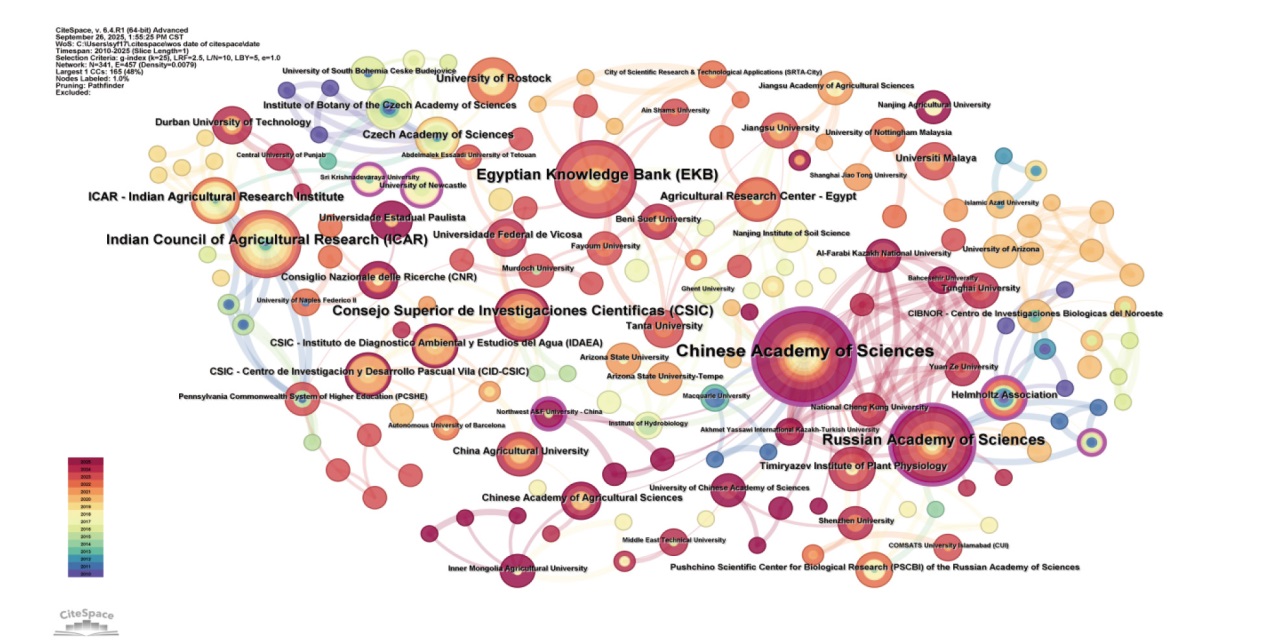
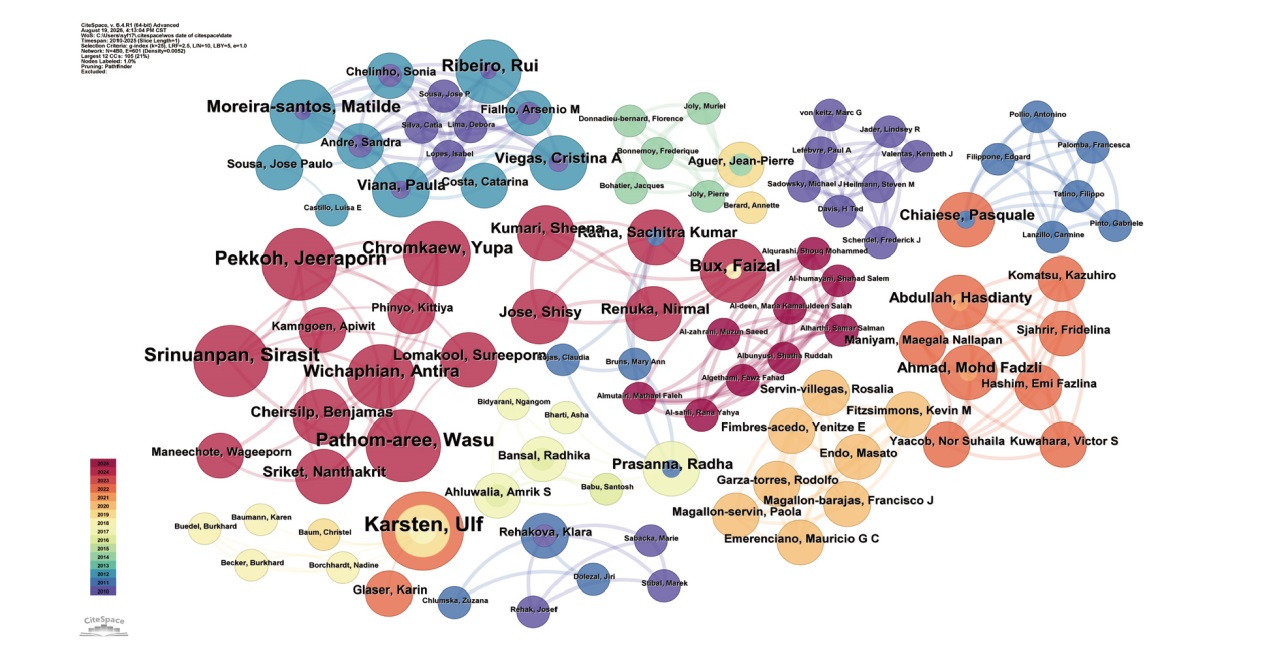
| 排序 | CNKI | WOS | |||||
|---|---|---|---|---|---|---|---|
| 作者姓名 | 发文量/篇 | 在总发文量中的占比/% | 作者姓名 | 发文量/篇 | 在总发文量中的占比/% | ||
| 1 | 边建文 | 5 | 3.05 | Karsten U | 6 | 0.87 | |
| 2 | 孟宪刚 | 4 | 2.44 | Srinuanpan S | 5 | 0.73 | |
| 3 | 崔岩 | 3 | 1.83 | Pathom-aree W | 5 | 0.73 | |
| 4 | 段鹏程 | 3 | 1.83 | Chang J S | 5 | 0.73 | |
| 5 | 陈士超 | 3 | 1.83 | Pekkoh J | 5 | 0.73 | |
| 6 | 傅华龙 | 2 | 1.22 | Chen L Z | 4 | 0.58 | |
| 7 | 兰书琼 | 2 | 1.22 | Ribeiro R | 4 | 0.58 | |
| 8 | 刘敏 | 2 | 1.22 | Lu Q | 4 | 0.58 | |
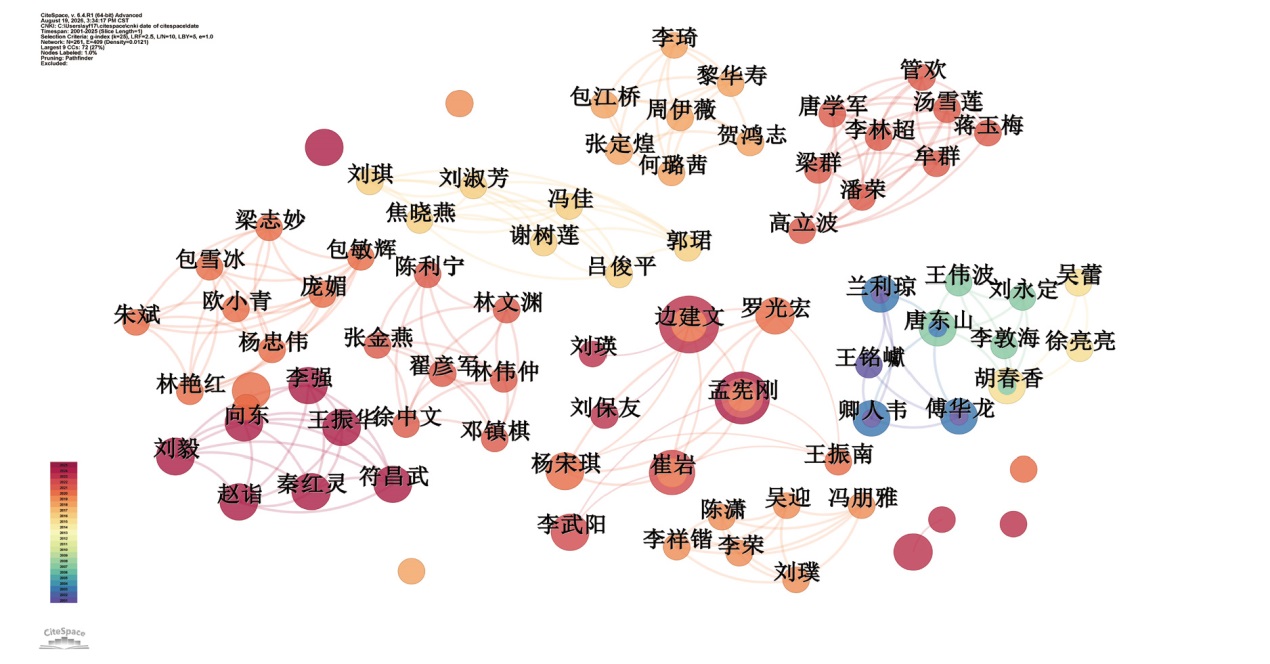
| 排序 | 频次/次 | 作者 | 文章题目 | 期刊 | 年份 |
|---|---|---|---|---|---|
| 1 | 56 | 刘淑芳 | 施用微藻对黄瓜生长及土壤质量的影响 | 山西农业科学 | 2016 |
| 2 | 55 | 边建文 | 微藻生物肥料的农业应用研究进展 | 中国土壤与肥料 | 2020 |
| 3 | 52 | 唐东山 | 人工藻结皮对库布齐沙地土壤酶活性的影响 | 水生生物学报 | 2007 |
| 4 | 50 | 唐东山 | 利用土壤微藻改良贫瘠土壤的研究 | 四川大学学报 | 2003 |
| 5 | 39 | 杨荧 | 微藻富集重金属的机制及在环境修复中的应用综述 | 江苏农业科学 | 2019 |
| 6 | 35 | 张靖洁 | 微藻源生物刺激剂的制备及在设施农业中的应用 | 生物技术通报 | 2019 |
| 7 | 35 | 包江桥 | 固氮蓝藻的农业应用研究进展 | 中国生态农业学报 | 2018 |
| 8 | 34 | 杜琼 | 土壤微藻的种类及其功能研究进展 | 生物学通报 | 2015 |
| 9 | 34 | 李彦文 | 固相萃取-高效液相色谱串联质谱法同时测定土壤中3种微囊藻毒素 | 分析化学 | 2013 |
| 10 | 28 | 邱智超 | 藻类资源在农业种植业中的应用研究进展 | 农业资源与环境学报 | 2022 |
| 排序 | 频次/次 | 作者 | 文章题目 | 期刊 | 年份 |
|---|---|---|---|---|---|
| 1 | 65 | Alvarez A L | Microalgae, soil and plants: A critical review of microalgae as renewable resources for agriculture | Algal Research | 2021 |
| 2 | 49 | Ronga D | Microalgal Biostimulants and Biofertilisers in Crop Productions | Agronomy | 2019 |
| 3 | 43 | Renuka N | Microalgae as multi-functional options in modern agriculture: current trends, prospects and challenges | Biotechnology Advances | 2018 |
| 4 | 32 | Abinandan S | Soil microalgae and cyanobacteria: the biotechnological potential in the maintenance of soil fertility and health | Critical Reviews in Biotechnology | 2019 |
| 5 | 31 | Dineshkumar R | The Impact of Using Microalgae as Biofertilizer in Maize | Waste and Biomass Valorization | 2019 |
| 6 | 27 | Gonçalves A L | The Use of Microalgae and Cyanobacteria in the Improvement of Agricultural Practices: A Review on Their Biofertilising, Biostimulating and Biopesticide Roles | Applied Sciences | 2021 |
| 7 | 26 | Rachidi F | Microalgae polysaccharides bio-stimulating effect on tomato plants: Growth and metabolic distribution | Biotechnology Reports | 2020 |
| 8 | 26 | Dineshkumar R | Microalgae as Bio-fertilizers for Rice Growth and Seed Yield Productivity | Waste and Biomass Valorization | 2018 |
| 9 | 23 | Chiaiese P | Renewable Sources of Plant Biostimulation: Microalgae as a Sustainable Means to Improve Crop Performance | Frontiers in Plant Science | 2018 |
| 10 | 23 | Kapoore R V | Algae biostimulants: A critical look at microalgal biostimulants for sustainable agricultural practices | Biotechnology Advances | 2021 |
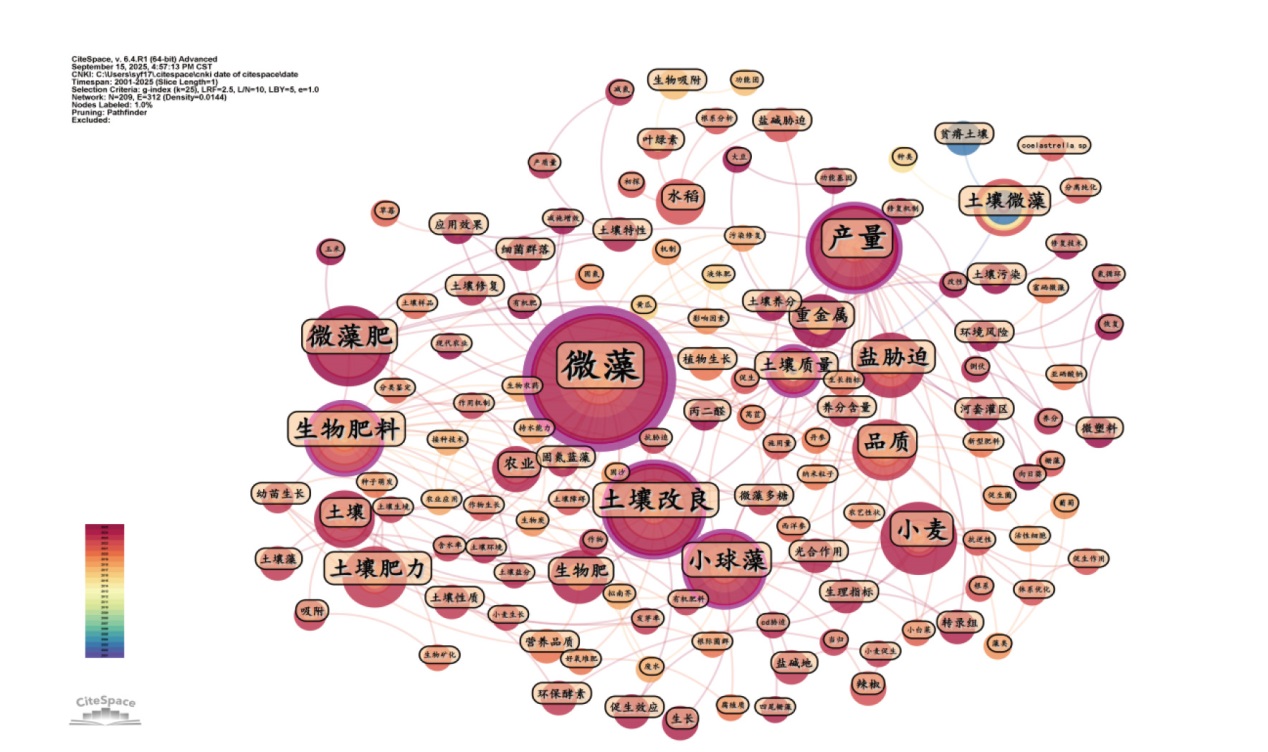
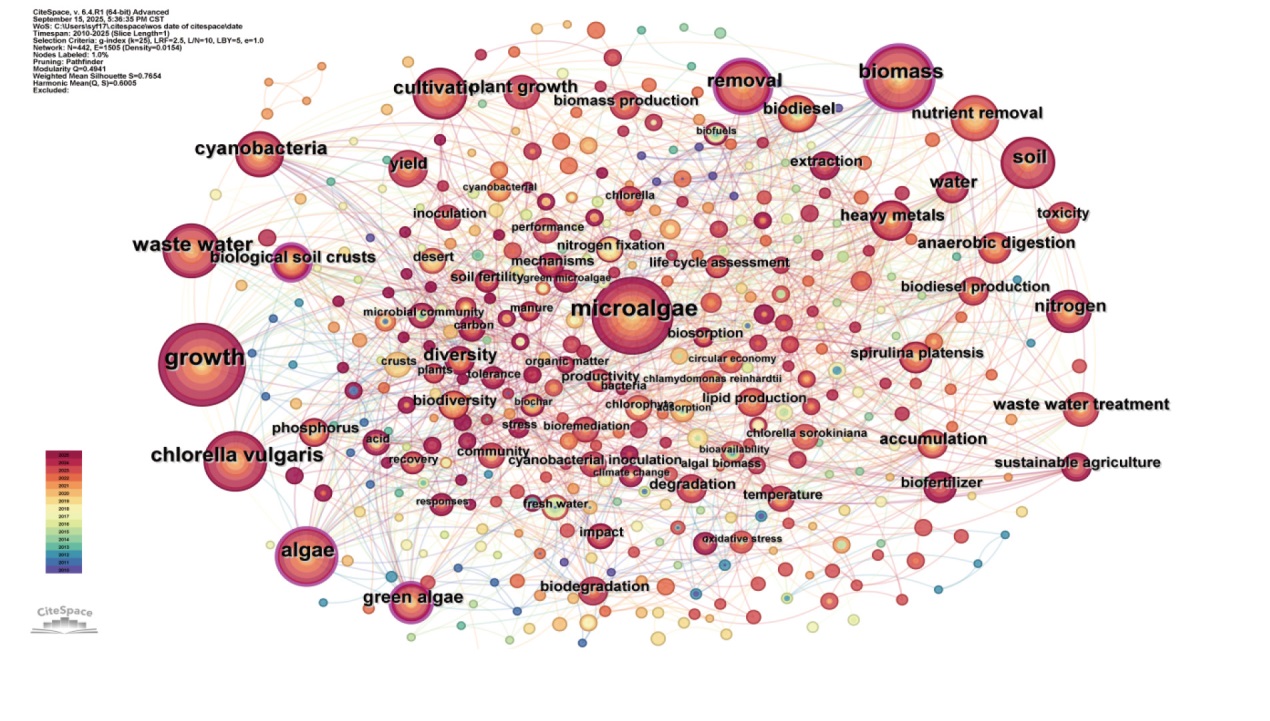
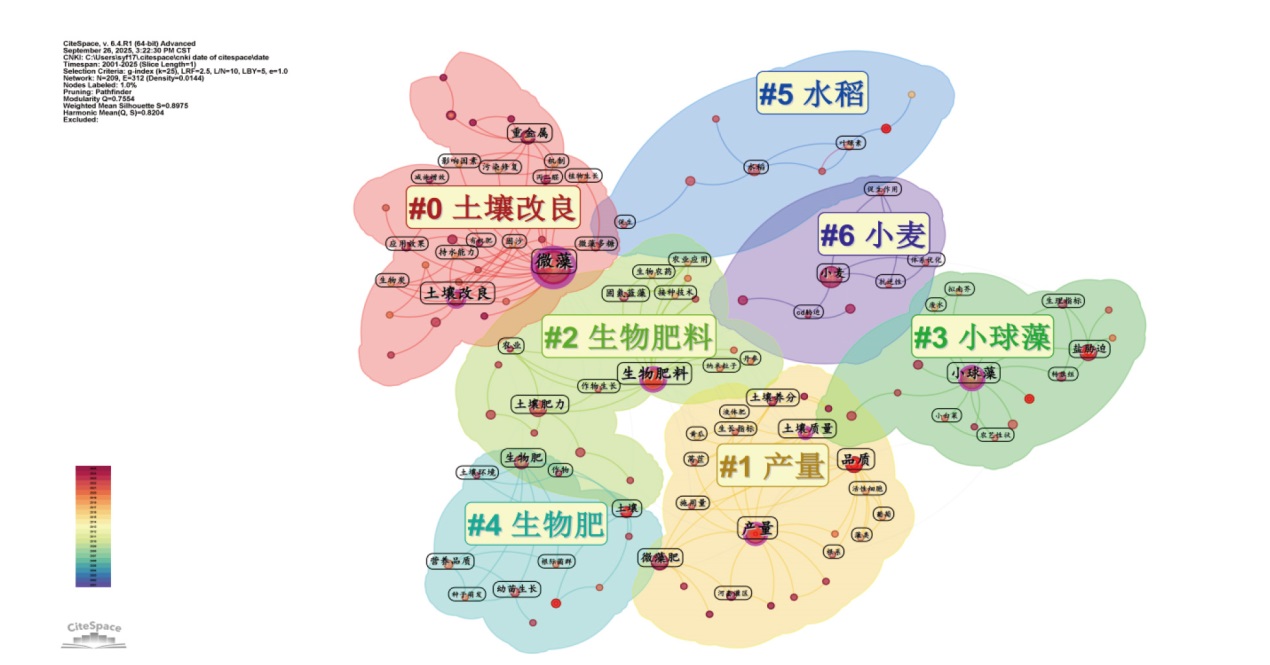
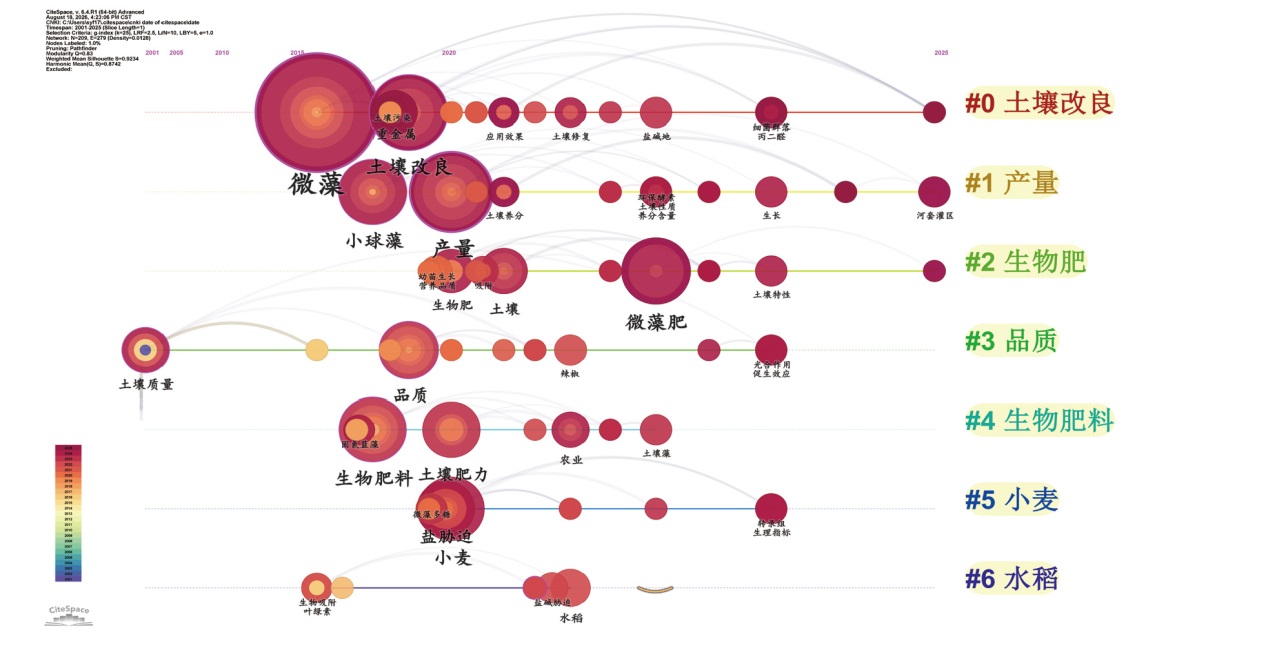
| 关键词 | 出现年份 | 强度 | 开始年份 | 结束年份 |
|---|---|---|---|---|
| 土壤微藻 | 2001 | 2.21 | 2001 | 2015 |
| 土壤质量 | 2001 | 0.84 | 2001 | 2016 |
| 生物吸附 | 2016 | 1.32 | 2016 | 2017 |
| 生物肥料 | 2018 | 1.31 | 2018 | 2022 |
| 品质 | 2019 | 1.58 | 2019 | 2022 |
| 盐胁迫 | 2020 | 1.26 | 2020 | 2022 |
| 土壤 | 2021 | 0.69 | 2021 | 2023 |
| 吸附 | 2021 | 0.69 | 2021 | 2023 |
| 产量 | 2020 | 0.68 | 2021 | 2023 |
| 养分含量 | 2023 | 0.68 | 2023 | 2025 |
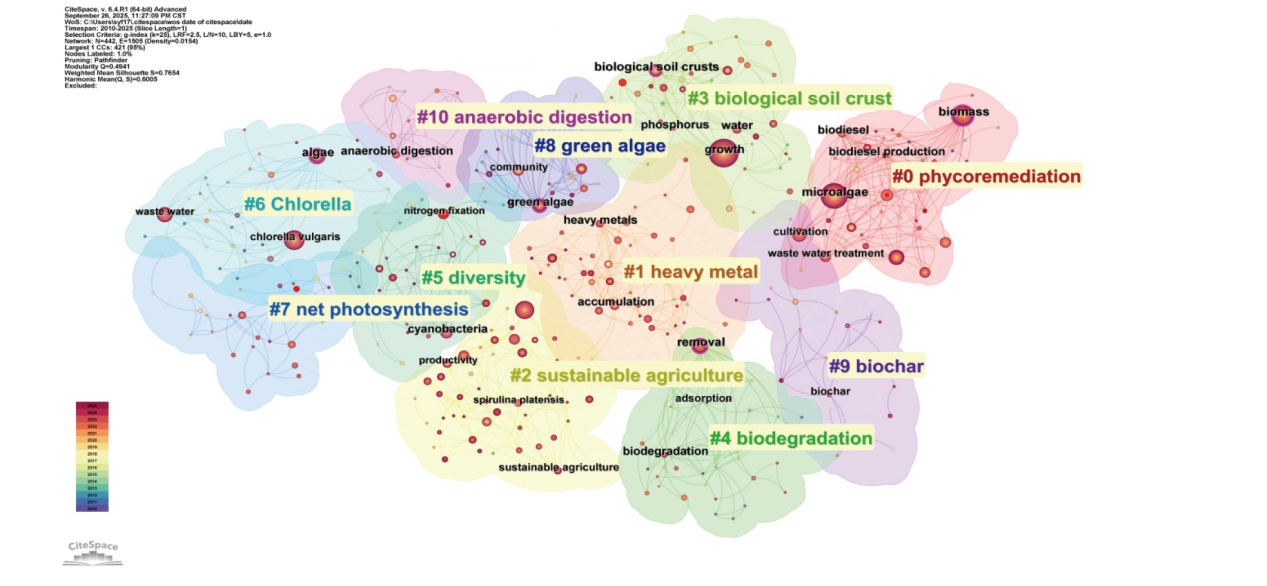
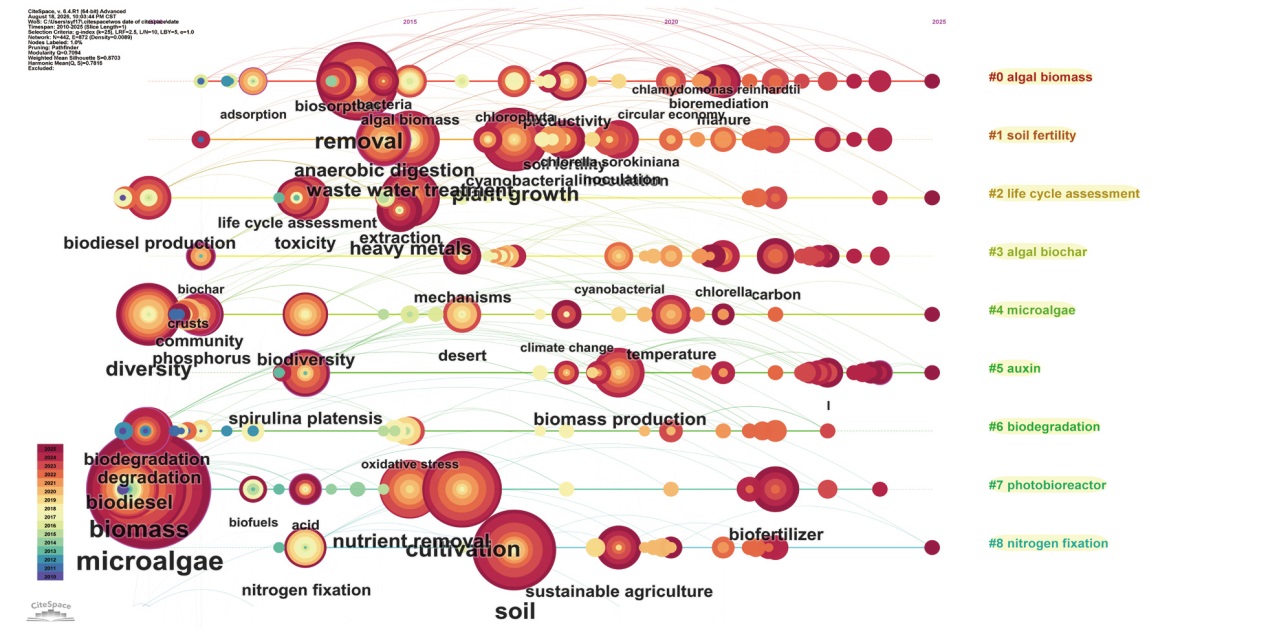
| 关键词 | 出现时间 | 强度 | 开始年份 | 结束年份 |
|---|---|---|---|---|
| nitrogen fixation | 2013 | 4.53 | 2013 | 2020 |
| biodiesel | 2010 | 3.75 | 2013 | 2017 |
| accumulation | 2010 | 3.54 | 2013 | 2018 |
| fresh water | 2015 | 3.81 | 2015 | 2016 |
| biodiesel production | 2010 | 3.63 | 2015 | 2017 |
| photosynthesis | 2015 | 3.31 | 2015 | 2019 |
| desert | 2016 | 3.91 | 2016 | 2020 |
| biological crusts | 2018 | 3.17 | 2018 | 2022 |
| crusts | 2011 | 4.25 | 2019 | 2020 |
| nutrient removal | 2015 | 3.48 | 2019 | 2021 |
| [1] |
冉继伟, 李鑫, 田彦芳, 等. 不同管理模式下土壤质量演变的研究态势分析——基于文献计量[J]. 农业大数据学报, 2020, 2(4):95-106.
doi: 10.19788/j.issn.2096-6369.200412 |
| [2] |
doi: 10.1146/energy.2024.49.issue-1 URL |
| [3] |
doi: 10.1007/s42977-021-00103-2 |
| [4] |
doi: 10.1039/D2VA00158F URL |
| [5] |
doi: 10.3390/su151612413 URL |
| [6] |
|
| [7] |
doi: 10.3390/su7010988 URL |
| [8] |
doi: 10.1016/j.worlddev.2020.104954 URL |
| [9] |
doi: 10.3389/fenvs.2022.1035332 URL |
| [10] |
doi: 10.1016/j.biortech.2011.08.030 pmid: 21924898 |
| [11] |
doi: 10.3390/md14100191 URL |
| [12] |
曹德菊, 杨训, 张千, 等. 重金属污染环境的微生物修复原理研究进展[J]. 安全与环境学报, 2016, 16(6):315-321.
|
| [13] |
董海文. 藻菌协同贴壁培养模式对微藻生长和废水处理影响研究[D]. 济南: 齐鲁工业大学, 2023.
|
| [14] |
崔桂鹏, 肖春蕾, 雷加强, 等. 大国治理:中国荒漠化防治的战略选择与未来愿景[J]. 中国科学院院刊, 2023, 38(7):943-955.
|
| [15] |
doi: 10.1016/j.jenvman.2023.117736 URL |
| [16] |
朱梅. 耐盐小球藻的分离及其提高小白菜耐盐性效应的研究[D]. 太原: 山西农业大学, 2021.
|
| [17] |
但琼洁. 国内外从废水中去除药品和个人护理产品研究的比较分析——基于文献计量法[J]. 中原工学院学报, 2021, 32(1):66-73.
|
| [18] |
doi: 10.1007/s11192-022-04406-6 |
| [19] |
doi: 10.1093/rev/3.3.151 URL |
| [20] |
徐东, 何建清, 黄秋月, 等. 基于CiteSpace的国内外园林废弃物堆肥研究进展的可视化分析[J]. 安徽农业科学, 2023, 51(24):230-239.
|
| [21] |
doi: 10.1038/504211a |
| [22] |
农业农村部. 全国高标准农田建设规划(2021—2030年)[EB/OL]. (2021-09-06)[2025-09-28]. http://www.moa.gov.cn/govpublic/FZJHS/202109/t20210916_6376036.htm.
|
| [23] |
国家发展和改革委员会. “十四五”生物经济发展规划[EB/OL]. (2022-05-10)[2025-09-28]. https://www.ndrc.gov.cn/xxgk/zcfb/ghwb/202205/t20220510_1323047.html.
|
| [24] |
国家标准化管理委员会. 高标准农田建设通则[EB/OL]. (2022-03-09)[2025-09-28]. https://openstd.samr.gov.cn/bzgk/std/newGbInfo?hcno=56806B705B9632406C71BA8E7CD7B8EF.
|
| [25] |
周璞, 毛馨卉, 侯华丽, 等. 澳大利亚和欧盟土壤战略比较与借鉴[J]. 中国国土资源经济, 2023, 36(1):60-66.
|
| [26] |
doi: 10.3390/su162411218 URL |
| [27] |
doi: 10.1007/s11192-010-0283-8 URL |
| [28] |
胡炎, 杨帆, 杨宁, 等. 盐碱地资源分析及利用研究展望[J]. 土壤通报, 2023, 54(2):489-494.
|
| [29] |
doi: 10.1007/s40710-015-0070-x URL |
| [30] |
刘学明, 董志强, 孙东晓. 土壤修复的项目现状与行业趋势[J]. 环境保护前沿, 2021(11):1096.
|
| [31] |
doi: 10.18520/cs/v115/i11/2052-2062 URL |
| [32] |
中国科学院. 新疆生地所与俄罗斯科学院地理研究所签署合作备忘录[EB/OL]. (2025-09-18)[2025-09-28]. https://egi.cas.cn/xwdt/gjhz/202509/t20250918_7971378.html.
|
| [33] |
中国科学院. 亚热带生态所获批建设首批湖南省国际科技创新合作基地[EB/OL]. (2018-04-08)[2025-09-28]. http://cnern.cern.ac.cn/getContent.action?id=55808&class_id=aka14&article_class_id=5.
|
| [34] |
doi: 10.1007/s11162-012-9264-5 URL |
| [35] |
姜万, 张壹, 杨伟丹, 等. 盐碱地改良及盐碱地农业的研究现状与发展趋势——基于CiteSpace可视化分析[J]. 现代园艺, 2024, 47 (12):32-35.
|
| [36] |
李丽颖. 实施沃田科技行动解决耕地要害问题[J]. 中国食品, 2022, 50(1):146-147.
|
| [37] |
盛小平, 孙倩倩. 国内科学数据开放共享主题的作者合作关系与合作研究内容分析[J]. 图书情报工作, 2021, 65(23):13-21.
doi: 10.13266/j.issn.0252-3116.2021.23.002 |
| [38] |
陈文杰. 基于超图的科研合作推荐研究[J]. 数据分析与知识发现, 2023, 7(4):68-76.
doi: 10.11925/infotech.2096-3467.2022.0430 |
| [39] |
杜红平, 王元地. 学术论文参考文献引用的科学化范式研究[J]. 中国科技期刊研究, 2017, 28(1):18-23.
doi: 10.11946/cjstp.201609010764 |
| [40] |
尹相旭, 张更平, 李晓菲. 基于关键词统计的情报学研究现状分析[J]. 情报杂志, 2009, 28(11):1-4.
|
| [41] |
doi: 10.3389/fnut.2024.1460675 URL |
| [42] |
邓雨瑶, 周峰越, 粟原章. 基于知识图谱的AIGC技术在环境设计方面的研究现状与展望[J]. 产业创新研究, 2025(14):42-44.
|
| [43] |
陈士超, 张印, 郭富强, 等. 微藻肥对河套灌区盐渍化农田玉米生长及产量的影响[J]. 水土保持研究, 2026, 33(1):174-183.
|
| [44] |
doi: 10.1515/johh-2016-0009 URL |
| [45] |
牛耀红. 新农人与农业技术传播体系整合研究[J]. 哈尔滨工业大学学报(社会科学版), 2017, 19(4):56-61.
|
| [46] |
国务院. 土壤污染防治行动计划[EB/OL]. (2016-05-28)[2025-09-28]. http://www.gov.cn/zhengce/content/2016-05/31/content_5078377.htm.
|
| [47] |
农业农村部. 农业绿色发展技术导则(2018—2030年)[EB/OL]. (2018-07-02)[2025-09-28]. https://www.gov.cn/gongbao/content/2018/content_5350058.htm.
|
| [48] |
中国植物营养与肥料学会. 农业农村部微藻资源农业利用重点实验室学术委员会会议暨肥料新质生产力创新与应用学术研讨会在江西南昌举办[EB/OL]. (2024-10-30)[2025-09-28]. https://www.cspnf.org.cn/col/col5600/art/2024/art_b852233b7b3747b49b21ba41ec85066c.html.
|
| [49] |
doi: 10.1080/15324982.2011.565858 URL |
| [50] |
doi: 10.1016/j.scitotenv.2022.158689 URL |
| [51] |
李万君, 李艳军. 美国农业补贴政策演变及对我国的启示[J]. 农业现代化研究, 2025, 46(3):268-272.
|
| [52] |
刘武兵, 李婷. 欧盟共同农业政策改革:2014—2020[J]. 世界农业, 2015(6):65-69.
|
| [53] |
doi: 10.1016/j.jclepro.2016.10.195 URL |
| [54] |
田容瑞. 微藻液体肥对土壤真菌群落特征的影响研究[D]. 太原: 山西大学, 2024.
|
| [55] |
刘帅彤. 色球藻修复硝酸盐污染土壤的效果和机理研究[D]. 济南: 山东大学, 2025.
|
| [56] |
何梅琳, 迟巧云, 王长海. 极地微藻对极端环境的适应机制研究进展[J]. 南京农业大学学报, 2019, 42(2):201-208.
|
| [57] |
熊伟, 黄云, 付乾, 等. 微藻生物膜营养环境对微藻生长和油脂积累影响[J]. 中国环境科学, 2016, 36(8):2463-2469.
|
| [58] |
廖利民. 基于微藻培养技术的废水资源化利用研究[D]. 呼和浩特: 内蒙古科技大学, 2025.
|
| [59] |
doi: 10.3390/md21080445 URL |
| [60] |
doi: 10.3390/md21020093 URL |
| [61] |
doi: 10.3390/biology12050703 URL |
| [62] |
许歆. 秦皇岛近海浮游植物群落结构变化及其组学研究[D]. 青岛: 中国科学院大学(中国科学院海洋研究所), 2017.
|
| [63] |
赵江, 侯琤, 沈峥, 等. 微藻在农业可持续发展中的应用研究进展[J]. 农业工程学报, 2024, 40(3):14-25.
|
| [64] |
doi: 10.1002/jctb.v96.3 URL |
| [1] | HUANG Yinhong, GUO Jinjin, XUE Yang, ZENG Wen, CHEN Yajuan, YUAN Yong. Panax notoginseng Saponins: Bibliometric Analysis and Visual Analysis Based on Knowledge Graph Analysis [J]. Chinese Agricultural Science Bulletin, 2026, 42(9): 207-218. |
| [2] | CHEN Yan, WU Ling, CAO Fan, GUO Cong, HUANG Xin, JIN Yuqing, WANG Ying, XU Qiuxia, GU Qingqing, KE Peibei, NING Yihang, LI Yujuan. Research Progress of Engineered Nanomaterials in Plant Resistance Enhancement and Soil Improvement [J]. Chinese Agricultural Science Bulletin, 2026, 42(7): 153-162. |
| [3] | SHENG Wenxu, YANG Min, WANG Yanan, GUO Yawen, LI Haoyu, ZHANG Min, CAI Ruiguo, GUO Zikang. Research Progress and Hotspots of Grain Zinc in Wheat Based on Bibliometric Analysis of CNKI and Web of Science [J]. Chinese Agricultural Science Bulletin, 2026, 42(6): 1-13. |
| [4] | WEI Dan, CUI Fuxing, PAN Hong, LI Hong, GUO Yuan, YANG Libin, FU Xiaoyu, LI Haijun. Effects of Fire Disturbance on Soil Fauna Based on Bibliometric Analysis [J]. Chinese Agricultural Science Bulletin, 2026, 42(6): 111-119. |
| [5] | ZHOU Jiahui, TANG Pulin, ZHANG Shiye, ZHANG Aihua, WANG Shuli, WEI Hang, REN Xinlong, GAO Yugang, WANG Yanfang. Bibliometric Analysis of Soil-Acidification-Regulation Measures Based on CNKI Database [J]. Chinese Agricultural Science Bulletin, 2026, 42(2): 203-210. |
| [6] | QIN Xiaohuan, JIAO Duoduo, JIN Tiepeng, SUN Shi, GAO Kunyuan, HU Jianlin. Analysis of Research Trends in Root Microecology of Panax Plant [J]. Chinese Agricultural Science Bulletin, 2026, 42(2): 84-92. |
| [7] | HUANG Zelin, YI Qifei. Research Progress and Visual Analysis of Orchid Fertilizer Based on CiteSpace [J]. Chinese Agricultural Science Bulletin, 2026, 42(19): 94-106. |
| [8] | YANG Siyu, HU Minghang, TONG Lingchen, HAN Yanying, YE Yanhui. Research Progress on Effects of Nitrogen and Phosphorus Addition on Soil Respiration: Bibliometric Mapping Analysis and Systematic Review of Publications in Global Core Journals (2015 to 2025) [J]. Chinese Agricultural Science Bulletin, 2026, 42(16): 157-169. |
| [9] | SHI Xiujuan, ZHAO Ruiming, QI Yaodong, LI Mengfei, WEI Xueping. Research Progress and Emerging Trends in Plant Radiation Breeding and Space Breeding [J]. Chinese Agricultural Science Bulletin, 2026, 42(15): 36-47. |
| [10] | QU Yuankai, PAN Dongyun, CHEN Hongjiang, SUN Hongzhu, LI Mingtan, XIE Jiali, SUN Liwei, CUI Xiutao. Application of Seaweed Extracts in Agriculture Production and Their Impact on Crop Stress Resistance [J]. Chinese Agricultural Science Bulletin, 2026, 42(14): 203-209. |
| [11] | WANG Yu, WANG Xie, LUO Yongxia. Impact of Interactions Between Microplastics and Heavy Metals in Soil: Based on Bibliometric and Visualization Analysis [J]. Chinese Agricultural Science Bulletin, 2026, 42(14): 172-180. |
| [12] | LIU Cunzhen, LI Qidong, DONG Haibin, GAO Changyu, JIANG Qishen, YIN Yanting, HOU Xiangyang. Research on Herdsman Households' Cooperation at Home and Abroad Based on Visual Analysis of CiteSpace: Review, Comparison and Reflection [J]. Chinese Agricultural Science Bulletin, 2026, 42(14): 181-194. |
| [13] | HE Liang, ZHANG Yitao, DONG Kuijun. Research and Development Trend of Farmland Utilization of Sewage Sludge at Home and Abroad [J]. Chinese Agricultural Science Bulletin, 2026, 42(13): 124-134. |
| [14] | YANG Yujie, XING Xianglong, BAI Yufeng, LI Xiaoyu. Research Progress on Tamarix spp. as Typical Vegetation in Arid Regions [J]. Chinese Agricultural Science Bulletin, 2026, 42(13): 44-54. |
| [15] | CHEN Qiuru, WANG Jingjing, LU Can, XIAO Shihong, WEI Long, LI Yifan, WANG Xiaojun, XIE Jiawei, YIN Zuoyun. A Study on Fronts Trends of Plant Purification of Water Quality Based on CiteSpace [J]. Chinese Agricultural Science Bulletin, 2026, 42(10): 106-116. |
| Viewed | ||||||
|
Full text |
|
|||||
|
Abstract |
|
|||||
