Welcome to Chinese Agricultural Science Bulletin,

Chinese Agricultural Science Bulletin ›› 2026, Vol. 42 ›› Issue (20): 71-79.doi: 10.11924/j.issn.1000-6850.casb2026-0317
Previous Articles Next Articles
WANG Jingjing1( ), WEI Leijia2, LIN Jin1, YUAN Jiaqi1, CHEN Dan1, FANG Huan1, BI Lidong1()
Received:2026-04-20
Revised:2026-07-25
Online:2026-10-25
Published:2026-10-26
CLC Number:
WANG Jingjing, WEI Leijia, LIN Jin, YUAN Jiaqi, CHEN Dan, FANG Huan, BI Lidong. Impact of Different Parent Materials on Drying Shrinkage Characteristics of Paddy Soils in Red Soil Regions[J]. Chinese Agricultural Science Bulletin, 2026, 42(20): 71-79.
Add to citation manager EndNote|Ris|BibTeX
URL: https://www.casb.org.cn/EN/10.11924/j.issn.1000-6850.casb2026-0317
| 土样编号 | 土样母质 | 发生层次 | 土层深度/cm | 采样地点 |
|---|---|---|---|---|
| QC | 第四纪红色黏土 | 耕作层 | 0~17 | 江西省红壤研究所 (28°21′ N,116°10′ E) |
| 犁底层 | 17~28 | |||
| RS | 河积物 | 耕作层 | 0~17 | 南昌市进贤县温圳镇联里村 (28°20′ N,116°6′ E) |
| 犁底层 | 17~31 | |||
| AR | 泥质岩类风化物 | 耕作层 | 0~13 | 南昌市进贤县白圩乡连沅村 (28°15′ N,116°14′ E) |
| 犁底层 | 13~22 | |||
| LS | 湖积物 | 耕作层 | 0~11 | 南昌市进贤县民和镇寺前万家 (28°24′ N,116°13′ E) |
| 犁底层 | 11~20 | |||
| ACR | 酸性结晶岩类风化物 | 耕作层 | 0~14 | 南昌市进贤县民和镇白家合 (28°19′ N,116°22′ E) |
| 犁底层 | 14~26 | |||
| Q | 石英岩类风化物 | 耕作层 | 0~18 | 南昌市进贤县观花岭林场南 (28°25′ N,116°27′ E) |
| 犁底层 | 18~27 |
| 土样编号 | 土层 | 土层深度/cm | 土壤容重/(g/cm3) | 土粒密度/(g/cm3) | 黏粒量/% | 粉粒量/% | 有机质量/(g/kg) | >0.25 mm的土壤水稳性团聚体质量百分数/% | pH |
|---|---|---|---|---|---|---|---|---|---|
| QC | 耕作层 | 0~17 | 1.16 | 2.49 | 17.16 | 79.67 | 20.10 | 34.23 | 6.46 |
| 犁底层 | 17~28 | 1.60 | 2.60 | 17.90 | 78.95 | 14.00 | 26.57 | 6.41 | |
| RS | 耕作层 | 0~17 | 1.28 | 2.57 | 22.27 | 74.74 | 27.74 | 42.47 | 5.96 |
| 犁底层 | 17~31 | 1.41 | 2.65 | 21.83 | 75.60 | 14.06 | 34.00 | 5.93 | |
| AR | 耕作层 | 0~13 | 1.31 | 2.49 | 11.66 | 81.96 | 28.77 | 24.17 | 5.32 |
| 犁底层 | 13~22 | 1.56 | 2.69 | 16.92 | 78.79 | 9.70 | 17.40 | 5.49 | |
| LS | 耕作层 | 0~11 | 1.40 | 2.48 | 16.51 | 78.84 | 35.75 | 54.90 | 5.28 |
| 犁底层 | 11~20 | 1.51 | 2.65 | 20.43 | 77.72 | 8.54 | 20.77 | 5.62 | |
| ACR | 耕作层 | 0~14 | 1.33 | 2.45 | 13.06 | 78.58 | 44.49 | 58.63 | 4.83 |
| 犁底层 | 14~26 | 1.64 | 2.63 | 16.88 | 79.34 | 9.89 | 35.37 | 4.70 | |
| Q | 耕作层 | 0~18 | 1.24 | 2.45 | 18.81 | 77.61 | 37.83 | 64.50 | 4.93 |
| 犁底层 | 18~27 | 1.63 | 2.62 | 20.48 | 76.95 | 10.33 | 36.73 | 5.37 |
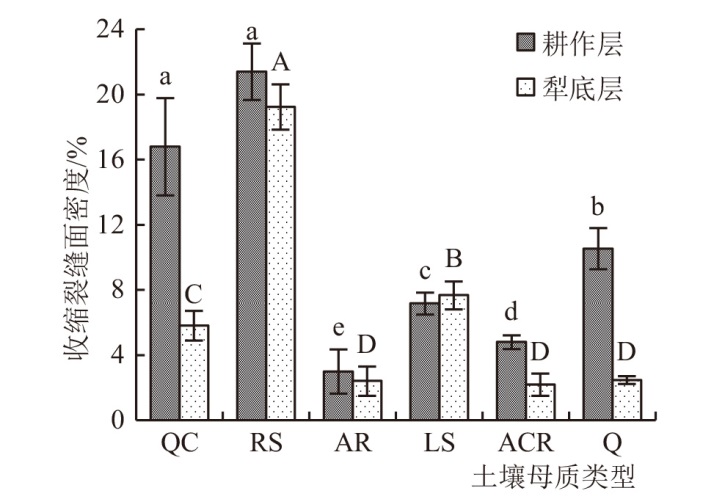
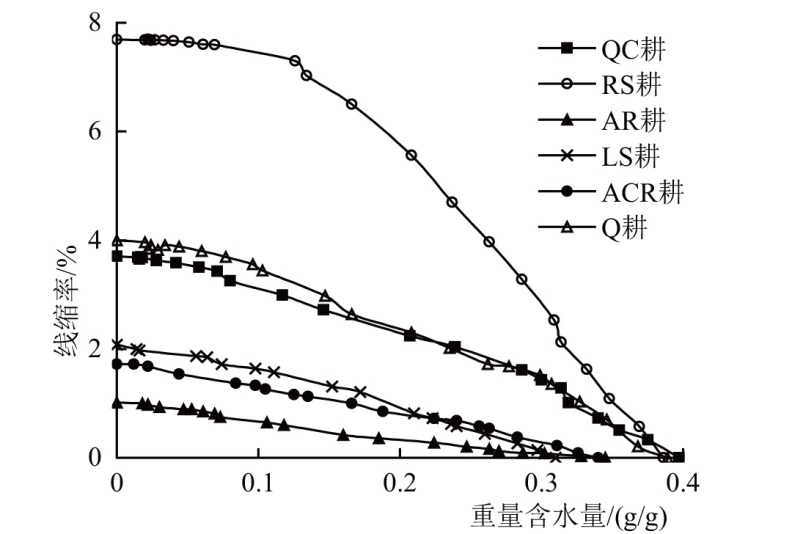
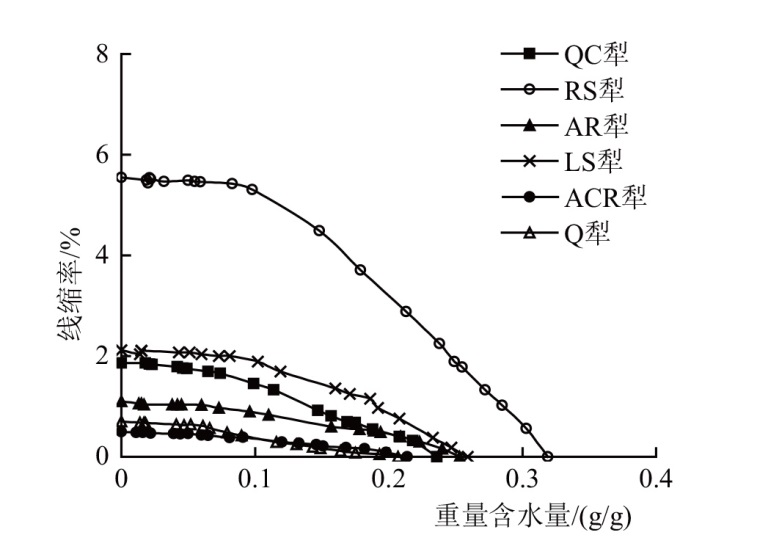
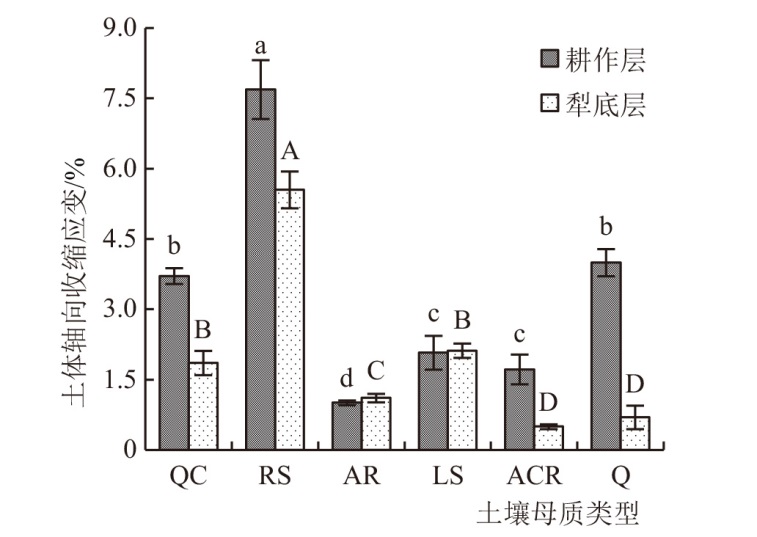
| 指标 | 土壤轴向收缩应变 | 收缩裂缝面密度 | 几何因子 | 土壤容重 | 土壤总孔隙度 | 黏粒含量 | 粉粒含量 | 有机质含量 | 水稳性团聚体含量 |
|---|---|---|---|---|---|---|---|---|---|
| 土壤轴向收缩应变 | 1 | 0.958** | 0.007 | -0.579* | 0.676* | 0.602* | -0.708** | 0.219 | 0.261 |
| 收缩裂缝面密度 | 0.958** | 1 | 0.246 | -0.610* | 0.719** | 0.585* | -0.620* | 0.126 | 0.184 |
| 几何因子 | 0.007 | 0.246 | 1 | -0.027 | 0.048 | 0.166 | 0.083 | -0.327 | -0.089 |
| [1] |
魏翠兰, 高伟达, 李录久, 等. 不同初始条件对砂姜黑土收缩特征的影响[J]. 农业机械学报, 2017, 48(10):229-236,271.
|
| [2] |
邢旭光, 马孝义. 土壤失水过程对土体收缩特性的影响[J]. 农业机械学报, 2016, 47(6):148-153.
|
| [3] |
魏玉杰, 吴新亮, 蔡崇法. 崩岗体剖面土壤收缩特性的空间变异性[J]. 农业机械学报, 2015, 46(6):153-159.
|
| [4] |
doi: 10.1016/S1002-0160(20)60041-8 URL |
| [5] |
doi: 10.1007/BF00300424 URL |
| [6] |
doi: 10.1016/S0016-7061(02)00136-2 URL |
| [7] |
doi: 10.1016/j.enggeo.2013.07.001 URL |
| [8] |
doi: 10.2136/sssaj2004.0146 URL |
| [9] |
|
| [10] |
张展羽, 朱文渊, 朱磊, 等. 根系及盐分含量对农田土壤干缩裂缝发育规律的影响[J]. 农业工程学报, 2014, 30(20):83-89.
|
| [11] |
doi: 10.1007/s11769-015-0779-5 URL |
| [12] |
邢旭光, 马孝义, 康端刚. 盐阳离子类型及浓度对土壤持水及干缩开裂的作用效果[J]. 农业工程学报, 2016, 32(9):115-122.
|
| [13] |
doi: 10.2136/sssaj2006.0156 URL |
| [14] |
冷挺, 唐朝生, 施斌. 干湿循环条件下重塑膨胀土的裂隙发育特征及量化研究[J]. 工程地质学报, 2016, 24(5):856-862.
|
| [15] |
张展羽, 李文杰, 王策, 等. 多级干湿循环对农田土壤干缩裂缝演变特征的影响[J]. 农业机械学报, 2016, 47(12):172-177,252.
|
| [16] |
李焱, 汤红英, 邹晨阳. 多次干湿循环对红土裂隙性和力学特性影响[J]. 南昌大学学报(工科版), 2018, 40(3):253-256,261.
|
| [17] |
李雄威, 王爱军, 王勇, 等. 持续蒸发作用下膨胀土裂隙和湿热特性室内模型试验[J]. 岩土力学, 2014, 35(S1):141-148.
|
| [18] |
周云艳, 徐琨, 陈建平, 等. 基于CT扫描与细观力学的植物侧根固土机理分析[J]. 农业工程学报, 2014, 30(1):1-9.
|
| [19] |
邢旭光, 柳烨, 马孝义. 土壤添加物对土-水曲线和土体收缩的影响[J]. 水科学进展, 2016, 27(1):40-48.
|
| [20] |
诸莉燕, 毕利东, 柳开楼. 基于图像处理的土壤颜色判别方法研究[J]. 广东农业科学, 2018, 45(12):125-130.
|
| [21] |
江西省进贤县农业区划委员会. 进贤县土壤[M]. 南昌: 江西科学技术出版社, 1985.
|
| [22] |
中国科学院南京土壤研究所. 土壤理化分析[M]. 上海: 上海科学技术出版社, 1978.
|
| [23] |
南京农学院. 土壤农化分析[M]. 北京: 农业出版社, 1980.
|
| [24] |
毕利东, 张斌, 潘继花. 运用Image J软件分析土壤结构特征[J]. 土壤, 2009, 41(4):654-658.
|
| [25] |
doi: 10.3390/environments5040045 URL |
| [26] |
|
| [27] |
赵诚斋, 赵渭生. 水稻土的水理性质与土壤耕作的关系[J]. 土壤学报, 1983(2):140-153.
|
| [28] |
黄传琴. 干湿交替过程中土壤胀缩特征的试验研究[D]. 杨陵: 西北农林科技大学, 2008.
|
| [29] |
刘艳丽. 长期施肥下水稻土土壤性质变化及其与生产力的关系研究[D]. 南京: 南京农业大学, 2007.
|
| [30] |
马毅杰. 长江中下游土壤矿物组成与其土壤肥力[J]. 长江流域资源与环境, 1994(1):1-8.
|
| [31] |
张中彬, 彭新华. 土壤裂隙及其优先流研究进展[J]. 土壤学报, 2015, 52(3):477-488.
|
| [32] |
宋春丽. 旱作条件下不同母质红壤磷吸附作用及其影响因素研究[J]. 中国农学通报, 2016, 32(2):129-134.
doi: 10.11924/j.issn.1000-6850.casb15080072 |
| [33] |
袁红, 盛浩, 廖超林, 等. 湖南省几种母质类型水稻土土壤肥力特征[J]. 中国农学通报, 2014, 30(3):151-156.
|
| [34] |
林少雯, 陈延玲, 刘树堂, 等. 长期定位施肥对潮土土壤黏土矿物影响的研究[J]. 华北农学报, 2017, 32(4):142-147.
doi: 10.7668/hbnxb.2017.04.023 |
| [35] |
刘智杰, 黄丽, 李峰, 等. 秸秆还田对水稻土黏土矿物组成和钾素释放的影响[J]. 土壤通报, 2018, 49(6):1390-1396.
|
| [36] |
邓博, 郭澎, 卫磊嘉, 等. 外源添加物对不同土地利用方式下土壤肥力的影响[J]. 中国农学通报, 2024, 40(8):91-100.
doi: 10.11924/j.issn.1000-6850.casb2023-0569 |
| [37] |
doi: 10.1016/j.geoderma.2009.08.018 URL |
| [38] |
赵颖文, 孔令伟, 郭爱国, 等. 典型红粘土与膨胀土的对比试验研究[J]. 岩石力学与工程学报, 2004(15):2593-2598.
|
| [39] |
陈宇龙. 云南膨胀土的微观结构特征[J]. 岩土工程学报, 2013, 35 (S1):334-339.
|
| [1] | ZHANG Zongyang, LIU Chunguang. Research Progress on Carbon Sequestration Pathway of Paddy Soil Microorganisms [J]. Chinese Agricultural Science Bulletin, 2026, 42(18): 77-85. |
| [2] | HUANG Yingmei, LIANG Yongxin, WU Jialong, ZHANG Juntao, XU Changchao, LIANG Chunmei. Carbon Release Characteristics of Garden Waste Biochar and Its Impact on Soil Carbon Fractions [J]. Chinese Agricultural Science Bulletin, 2026, 42(16): 147-156. |
| [3] | LIU Xiaoyang, YIN Mei, FU Libo, WANG Wei, WANG Zhiyuan, CHEN Hua, YANG Yanxian, ZHANG Qing, YANG Jida, WANG Yingxue, CHEN Jianfeng. Impact of Sheep Manure Replacing Chemical Fertilizer at Equal Nitrogen Rate on Yield and Quality of Zucchini [J]. Chinese Agricultural Science Bulletin, 2025, 41(32): 23-29. |
| [4] | YE Chengcheng, ZHU Jie, LI Zicheng, ZHANG Mingkui. Response of Different Organic Carbon Fractions to Organic Carbon Accumulation in Typical Paddy Soils [J]. Chinese Agricultural Science Bulletin, 2025, 41(28): 78-86. |
| [5] | LIU Jia, WAN Li, XIA Wenjian, LIU Guangrong, PENG Chunrui, CHEN Jin. Opportunities and Challenges for Improving Quality and Productivity of Arable Land in Red Soil Region of Southern China [J]. Chinese Agricultural Science Bulletin, 2025, 41(26): 9-12. |
| [6] | LIU Yan, DONG Ming, HUANG Qian, LIANG Jiafeng, WANG Mengjie. Study on Influence of Soil Minerals on Determination of Red Soil Organic Matter Content by Loss-on-ignition Method [J]. Chinese Agricultural Science Bulletin, 2025, 41(12): 74-79. |
| [7] | REYIHANGULI Kadier, ZHOU Yinuo, ZHANG Yi, ZHANG Ziwei, XING Ruping, MA Xin, XU Chong, LIU Wenli, WU Jinggui, LI Jianming. Difference in Effects of Different Manure Application on Soil Physical Properties of Sloping Farmland in Black Soil Area [J]. Chinese Agricultural Science Bulletin, 2024, 40(35): 89-98. |
| [8] | YIN Honghui, HU Zongling, YU Xiaofen, ZHAO Xingneng, LI Pengfei, HU Jiayun, Mao Yanting, ZHANG Lixia, QIU Xueli. Effects of Chlorination on Growth and Development of Flue-cured Tobacco and Yield and Quality of Tobacco Leaves in Chlorine-poor Red Soil [J]. Chinese Agricultural Science Bulletin, 2024, 40(35): 76-81. |
| [9] | LIANG Hui, CHEN Yunsong, LI Jie, CHEN Yulan, HUANG Rong, WANG Changquan, LI Bing. Effect of Dry and Wet Alternation on Change of Potassium Effective Form in Tobacco-planting Soil [J]. Chinese Agricultural Science Bulletin, 2024, 40(27): 83-89. |
| [10] | LI Huajian, DENG Guojun, LUO Zhenyuan, NONG Quandong, LI Chunqing, NONG Bin, CHEN Biqin, HU Xiaozhang, LIU Na, WEN Heming. Effects of Intercropping Patterns on Physicochemical Properties of Red Soil and Soybean Qualities [J]. Chinese Agricultural Science Bulletin, 2024, 40(26): 8-14. |
| [11] | LIU Liaoyuan. Effects of Five Conditioners on Speciation of Cadmium in Paddy Soil and Evaluation of Their Passivation Efficacy [J]. Chinese Agricultural Science Bulletin, 2024, 40(24): 79-86. |
| [12] | WANG Haoji, GUAN Huilin, SHI Mengxin, DENG Sidi, DONG Mingxing, LU Zicun, WANG Haibo, HAO Yunying, XU Wumei. Effects of Tobacco Stalk Biochar with Different Particle Sizes on Physicochemical Properties of Acidic Red Soil [J]. Chinese Agricultural Science Bulletin, 2023, 39(33): 85-91. |
| [13] | LIU Jianxiang, GUO Yunzhou, DU Dongying, ZHANG Qinbin, LI Congping. Effects of Different Manures on Red Soil Productivity in Yunnan Plateau [J]. Chinese Agricultural Science Bulletin, 2023, 39(26): 67-75. |
| [14] | WEI Lan, QIU Chaocai, HUANG Lianxi, LI Xiang, HUANG Qing, ZHENG Xiaodong, LIN Qimei, LIU Zhongzhen, CHEN Weisheng. Four Biochar-based Conditioners Reducing Cd Accumulation in Brown Rice to Different Degrees [J]. Chinese Agricultural Science Bulletin, 2023, 39(12): 146-153. |
| [15] | ZENG Jie, YU Lang, DABU Xilatu, LI Yunju. Effects of Phosphorus-based Soil Conditioner on Growth of Chinese Cabbage in Low-phosphorus Red Soil [J]. Chinese Agricultural Science Bulletin, 2022, 38(9): 81-87. |
| Viewed | ||||||
|
Full text |
|
|||||
|
Abstract |
|
|||||
