Welcome to Chinese Agricultural Science Bulletin,

Chinese Agricultural Science Bulletin ›› 2026, Vol. 42 ›› Issue (21): 207-218.doi: 10.11924/j.issn.1000-6850.casb2025-0624
ZHENG Yao1,2( ), LIU Tingyan2, XU Gangchun1,2
Received:2025-07-20
Revised:2026-03-11
Online:2026-11-10
Published:2026-11-10
CLC Number:
ZHENG Yao, LIU Tingyan, XU Gangchun. Comparison on Changes of Planktonic Community Structure and Diversity in Greenhouse-raised Chinese Soft Shelled Turtles in Hot Season After Wastewater Treatment Between Jiangsu and Anhui Provinces[J]. Chinese Agricultural Science Bulletin, 2026, 42(21): 207-218.
Add to citation manager EndNote|Ris|BibTeX
URL: https://www.casb.org.cn/EN/10.11924/j.issn.1000-6850.casb2025-0624
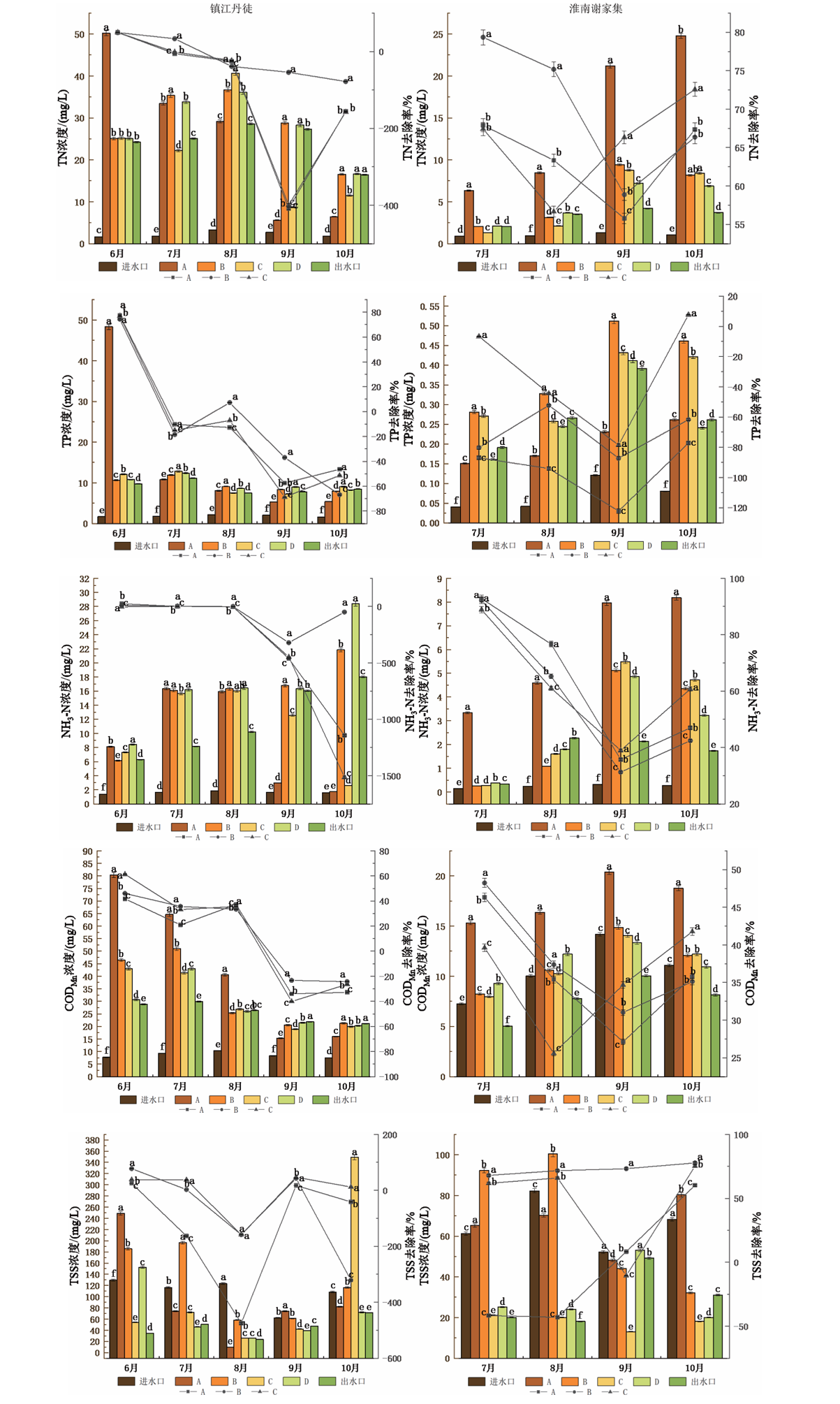
| 采样区 | 位点 | TN | TP | NH3-N | CODMn |
|---|---|---|---|---|---|
| 江苏镇江丹徒 | A | 0.2003 | 0.4019 | 0.1819 | 0.2160 |
| D | 0.1640 | 0.3148 | 0.1922 | 0.3290 | |
| 安徽淮南谢家集 | A | 0.2823 | 0.2498 | 0.2279 | 0.2399 |
| D | 0.2494 | 0.2841 | 0.2451 | 0.2214 |
| 采样区 | 位点 | TN | TP | NH3-N | CODMn |
|---|---|---|---|---|---|
| 江苏镇江丹徒 | A | 0.2003 | 0.4019 | 0.1819 | 0.2160 |
| D | 0.1640 | 0.3148 | 0.1922 | 0.3290 | |
| 安徽淮南谢家集 | A | 0.2823 | 0.2498 | 0.2279 | 0.2399 |
| D | 0.2494 | 0.2841 | 0.2451 | 0.2214 |
| 采样区 | 位点 | 6月 | 7月 | 8月 | 9月 | 10月 |
|---|---|---|---|---|---|---|
| 江苏镇江丹徒 | A | 73.834 | 25.829 | 21.329 | 12.928 | 12.928 |
| D | 23.129 | 27.529 | 22.829 | 22.129 | 21.229 | |
| 安徽淮南谢家集 | A | / | 6.633 | 7.134 | 9.336 | 9.836 |
| D | / | 5.821 | 6.032 | 7.234 | 6.633 |
| 采样区 | 位点 | 6月 | 7月 | 8月 | 9月 | 10月 |
|---|---|---|---|---|---|---|
| 江苏镇江丹徒 | A | 73.834 | 25.829 | 21.329 | 12.928 | 12.928 |
| D | 23.129 | 27.529 | 22.829 | 22.129 | 21.229 | |
| 安徽淮南谢家集 | A | / | 6.633 | 7.134 | 9.336 | 9.836 |
| D | / | 5.821 | 6.032 | 7.234 | 6.633 |
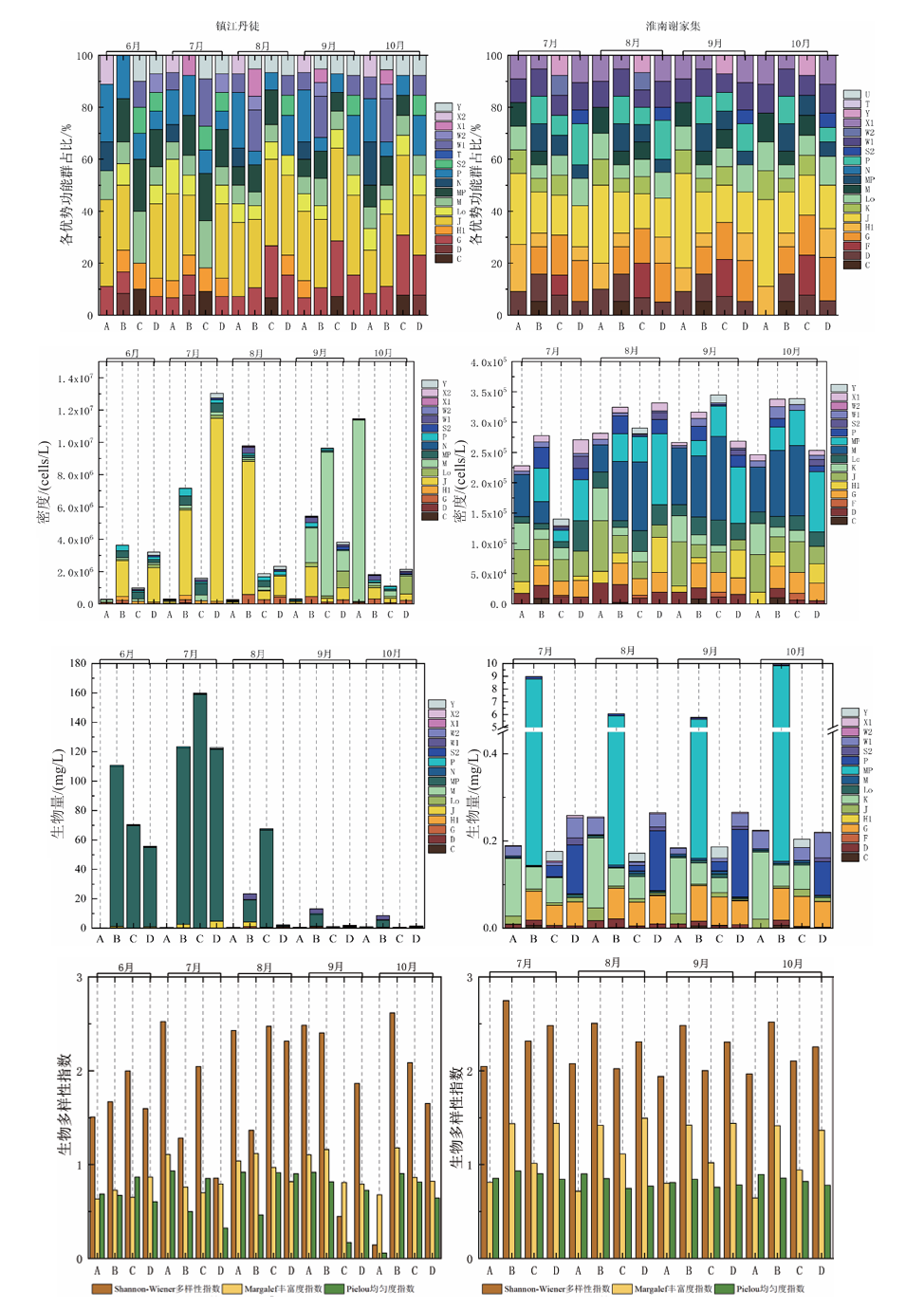
| 镇江丹徒优势功能群 | A | B | C | D | 淮南谢家集优势功能群 | A | B | C | D |
|---|---|---|---|---|---|---|---|---|---|
| G | 0.02 | 0.06 | - | 0.04 | C | - | 0.02 | - | - |
| J | 0.03 | 0.66 | 0.04 | 0.64 | D | 0.05 | 0.07 | 0.04 | 0.05 |
| Lo | - | 0.02 | - | 0.11 | F | - | - | 0.02 | - |
| M | 0.91 | 0.10 | 0.65 | 0.06 | G | - | 0.12 | - | - |
| MP | - | 0.05 | 0.12 | - | G | - | - | 0.11 | - |
| P | - | 0.05 | - | 0.03 | G | - | - | - | 0.10 |
| P | - | - | 0.04 | - | H1 | 0.07 | - | - | 0.13 |
| S2 | - | - | - | 0.02 | H1 | - | 0.05 | - | - |
| W1 | - | 0.02 | - | - | J | 0.27 | 0.09 | 0.13 | 0.10 |
| Y | - | - | 0.03 | 0.04 | K | 0.19 | 0.05 | 0.06 | - |
| Lo | 0.07 | 0.05 | 0.10 | 0.12 | |||||
| M | 0.28 | 0.27 | 0.25 | - | |||||
| MP | - | 0.13 | 0.15 | 0.34 | |||||
| P | - | 0.08 | - | 0.06 | |||||
| S2 | - | - | - | 0.05 | |||||
| W1 | 0.03 | 0.04 | - | - | |||||
| X1 | 0.03 | 0.03 | - | 0.05 | |||||
| Y | - | - | 0.04 | - | |||||
| 种类数 | 3 | 7 | 5 | 7 | 种类数 | 9 | 12 | 9 | 9 |
| 江苏镇江丹徒参数 | 轴1 | 轴2 | 轴3 | 轴4 | 安徽淮南谢家集参数 | 轴1 | 轴2 | 轴3 | 轴4 |
|---|---|---|---|---|---|---|---|---|---|
| 特征值 | 0.2831 | 0.0721 | 0.0033 | 0.0005 | 特征值 | 0.2221 | 0.1647 | 0.0335 | 0.0163 |
| 累积解释量 | 28.31 | 35.52 | 35.85 | 35.9 | 累积解释量 | 22.21 | 38.68 | 42.03 | 43.66 |
| 伪典范系数 | 0.6977 | 0.4221 | 0.7395 | 0.4943 | 伪典范系数 | 0.6496 | 0.7446 | 0.8433 | 0.5883 |
| 累积拟合解释量/% | 78.83 | 98.90 | 99.83 | 99.96 | 累积拟合解释量/% | 49.75 | 86.65 | 94.17 | 97.81 |
| 镇江丹徒轮虫 | A | B | C | D | 淮南谢家集轮虫 | A | B | C | D |
|---|---|---|---|---|---|---|---|---|---|
| 前节晶囊轮虫 | 0.15 | 0.10 | 0.02 | - | 前节晶囊轮虫 | 0.25 | 0.10 | 0.17 | 0.09 |
| 角突臂尾轮虫 | 0.17 | 0.06 | - | - | 角突臂尾轮虫 | 0.02 | - | - | 0.03 |
| 剪形臂尾轮虫 | 0.04 | - | - | - | 萼花臂尾轮虫 | 0.06 | 0.07 | 0.16 | 0.13 |
| 扁平泡轮虫 | 0.24 | - | - | - | 尾三肢轮虫 | 0.05 | - | - | - |
| 萼花臂尾轮虫 | - | 0.06 | - | - | 沟痕泡轮虫 | 0.04 | 0.03 | 0.03 | 0.03 |
| 可变臂尾轮虫 | - | 0.03 | - | - | 扁平泡轮虫 | 0.02 | 0.03 | 0.07 | 0.06 |
| 长三肢轮虫 | - | 0.04 | 0.07 | 0.22 | 剪形臂尾轮虫 | - | 0.40 | - | 0.12 |
| 尾三肢轮虫 | - | 0.07 | 0.07 | 0.16 | 顶生三肢轮虫 | - | 0.04 | - | - |
| 沟痕泡轮虫 | - | 0.03 | - | - | 壶状臂尾轮虫 | - | - | 0.04 | 0.03 |
| 长足轮虫 | - | 0.14 | 0.61 | 0.16 | 可变臂尾轮虫 | - | - | 0.08 | 0.07 |
| 大型溞 | - | 0.07 | 0.03 | - | 裂足臂尾轮虫 | - | - | - | 0.02 |
| 棘爪网纹溞 | 0.04 | 0.04 | - | - | 棘爪网纹溞 | - | - | - | 0.09 |
| 无节幼体 | 0.07 | - | - | - | 棘爪低额溞 | - | - | - | 0.03 |
| 广布中剑水蚤 | 0.08 | - | - | - | 无节幼体 | 0.14 | 0.19 | 0.04 | 0.04 |
| 桡足幼体 | 0.04 | 0.02 | 0.02 | 0.03 | |||||
| 广布中剑水蚤 | 0.07 | - | 0.03 | - | |||||
| 种类数 | 7 | 10 | 5 | 3 | 种类数 | 9 | 8 | 9 | 13 |
| 江苏镇江丹徒参数 | 轴1 | 轴2 | 轴3 | 轴4 | 安徽淮南谢家集参数 | 轴1 | 轴2 | 轴3 | 轴4 |
|---|---|---|---|---|---|---|---|---|---|
| 特征值 | 0.1024 | 0.0183 | 0.0001 | 0.6951 | 特征值 | 0.6826 | 0.0782 | 0.0121 | 0.0098 |
| 累积解释量 | 10.24 | 12.07 | 12.09 | 81.60 | 累积解释量 | 68.26 | 76.07 | 77.28 | 78.27 |
| 伪典范系数 | 0.3672 | 0.2764 | 0.4358 | 0.0000 | 伪典范系数 | 0.8882 | 0.9281 | 0.8597 | 0.8863 |
| 累积拟合解释量/% | 84.74 | 99.91 | 100.00 | - | 累积拟合解释量/% | 86.70 | 96.62 | 98.16 | 99.41 |
| [1] |
王钰钦, 郑尧, 钱信宇, 等. 中国水产养殖尾水污染现状及净化技术研究进展[J]. 农学学报, 2022, 12(3):65-70.
|
| [2] |
魏宾, 方洁, 顾雪林, 等. 基于“三池两坝”组合流程的池塘养殖尾水净化效能[J]. 水产养殖, 2021, 42(11):27-34.
|
| [3] |
刘婷燕, 王晓飞, 尹统统, 等. 不同养殖池塘经标准化改造后尾水净化效果及水质评价[J]. 中国农学通报, 2023, 39(26):154-164.
doi: 10.11924/j.issn.1000-6850.casb2022-0803 |
| [4] |
刘婷燕, 王晓飞, 唐海军, 等. 标准化池塘改造后尾水处理区后生浮游动物群落结构[J]. 西南农业学报, 2025, 38(10):2264-2276.
|
| [5] |
doi: 10.3390/w14111743 URL |
| [6] |
doi: 10.3390/su14031132 URL |
| [7] |
doi: 10.1093/plankt/24.5.417 URL |
| [8] |
doi: 10.1002/rra.v37.8 URL |
| [9] |
安睿, 王凤友, 于洪贤, 等. 三环泡湿地浮游动物功能群季节变化及其影响因子[J]. 生态学报, 2017, 37(6):1851-1860.
|
| [10] |
向劲, 吴启藩, 宋锐, 等. 循环水养殖池塘中浮游动植物功能群特征及水质评价[J]. 水产学杂志, 2022, 37(1):81-89.
|
| [11] |
孙梦凡, 姜玲俐, 姚钰萍, 等. 夏季持续高温对升金湖浮游动物群落结构的影响[J]. 水生态学杂志, 2026, 47(2):141-150.
|
| [12] |
三峰, 沈建忠, 万成炎, 等. 太湖新银鱼种群摄食对小江浮游动物群落结构的影响[J]. 水生态学杂志, 2024, 45(3):138-147.
|
| [13] |
张建波, 王丑明, 黄代中, 等. 洞庭湖后生浮游动物群落结构及水质生物学评价[J]. 长江流域资源与环境, 2023, 32(2):394-402.
|
| [14] |
丹超, 马旭洲, 张文博, 等. 河蟹生态养殖池塘后生浮游动物群落结构及水质生态学评价[J]. 生态与农村环境学报, 2021, 37(2):208-216.
|
| [15] |
唐燕, 江敏, 吴昊, 等. 凡纳滨对虾养殖池塘及外河道中后生浮游动物群落结构差异及其影响因素[J]. 上海海洋大学学报, 2022, 31(5):1120-1135.
|
| [16] |
张佳敏, 高健, 杨诚, 等. 以鲢、鳙放养为主的武山湖后生浮游动物群落结构特征[J]. 长江流域资源与环境, 2021, 30(8):1848-1857.
|
| [17] |
doi: 10.1007/s10661-014-3763-0 URL |
| [18] |
牛天新, 郑洁敏, 查燕. 空心菜生态浮岛对外塘甲鱼养殖水体的修复作用[J]. 浙江农业科学, 2019, 60(11):2096-2099.
doi: 10.16178/j.issn.0528-9017.20191151 |
| [19] |
陈重军, 张蕊, 吴伟祥, 等. 温室甲鱼养殖废水蔬菜浮床处理效能及影响因素研究[J]. 生态科学, 2014, 33(6):1067-1072.
|
| [20] |
陈重军, 张蕊, 向坤, 等. 生物过滤和蔬菜浮床组合系统对温室甲鱼废水的处理效果[J]. 应用生态学报, 2014, 25(8):2390-2396.
|
| [21] |
张思勇. 土地利用类型不同的两个邻近通江湖泊后生浮游动物群落结构特征研究[D]. 合肥: 安徽大学, 2023.
|
| [22] |
陈丹青, 马旭洲, 张文博, 等. 泰兴高沙土地区幼蟹塘浮游动物群落结构及水质评价[J]. 江西农业大学学报, 2021, 43(3):649-659.
|
| [23] |
龚进玲, 杜红春, 朱挺兵, 等. 杞麓湖中浮游动物群落的结构及其与水环境因素的关系[J]. 湿地科学, 2023, 21(3):358-366.
|
| [24] |
刘同琳. 苏州城区河道后生浮游动物群落结构特征的研究及水质评价[D]. 上海: 上海海洋大学, 2021.
|
| [25] |
罗欢, 吴琼, 陈倩, 等. 生态修复后九曲湾水库浮游动物优势种演替及生态位特征分析[J]. 生态环境学报, 2021, 30(2):320-330.
doi: 10.16258/j.cnki.1674-5906.2021.02.011 |
| [1] | CAI Tong, MA Ning, LI Kai, WANG Lin, YANG Wenbo, KANG Haiyun, LI Yang, CHEN Bingliang, WANG Xiaomei, YUAN Lilai. Ecological Health Assessment of Habitat in Naqu River Basin Based on Planktonic Index of Biotic Integrity [J]. Chinese Agricultural Science Bulletin, 2026, 42(17): 67-75. |
| [2] | ZHENG Yao, LIU Tingyan, XU Gangchun. Phytoplankton Community Structure of Continuous Three-level Purification Zones and Ponds After Standardized Transformation in Suzhou City [J]. Chinese Agricultural Science Bulletin, 2026, 42(13): 196-207. |
| [3] | WANG Chenlong, MIN Jie, LIANG Rui, TAN Xiongyu, WANG Shuo, Umut Hasan. Composition and Diversity of Microbial Bacterial Communities in Paddy Rice Rhizosphere Soil [J]. Chinese Agricultural Science Bulletin, 2025, 41(4): 84-93. |
| [4] | XU Jia, ZHENG Jianhua, HE Peng, GU Le, HUO Yao, TANG Shunjie. Growth Models and Smart Planting Technologies for Greenhouse Tomatoes: Research Progress and Future Prospects [J]. Chinese Agricultural Science Bulletin, 2025, 41(27): 54-70. |
| [5] | HU Jia, CHEN Xin. Effect of High Temperature Weather Factors on Different Growth Stages of Pleurotus eryngii [J]. Chinese Agricultural Science Bulletin, 2024, 40(36): 57-62. |
| [6] | ZHONG Liqiang, ZHOU Liying, ZHANG Shiyong, LIU Hongyan, CHEN Xiaohui, WANG Minghua. Study on Relationship Between Odor Material Geosmin and Environmental Factors in Aquaculture Ponds [J]. Chinese Agricultural Science Bulletin, 2024, 40(27): 159-164. |
| [7] | ZHAO Yipeng, ZHAO Xinyong, HU Tingting, LUO Jingsheng, WANG Yunxia. Artificial Cultivation and Regulation of Duckweed and Its Role in Rice Field Ecosystem [J]. Chinese Agricultural Science Bulletin, 2024, 40(22): 72-80. |
| [8] | CHEN Aiping. Reproductive Phenology and Influencing Factors of Seed Germination of Extremely Small Populations of Betula fujianensis [J]. Chinese Agricultural Science Bulletin, 2023, 39(32): 47-55. |
| [9] | GONG Miao, WANG Xiaorong, LIU Qingping, HE Yong, XIA Shaodan, HU Xingyi. Variation of Negative Oxygen Ion and its Relationship with Main Meteorological Factors in Qianshan National Forest Park [J]. Chinese Agricultural Science Bulletin, 2023, 39(30): 101-107. |
| [10] | CAO Hongmei, HU Guiping, HUANG Zhenxia, SHI Xuping, CAI Xiang, WANG Feng, LIU Yuxin, WANG Yawei, WANG Lixian. Effects of Remote Straw Mulching on Crop Habitat Diseases, Insect Pests, Grass Damage and Soil Environmental Factors [J]. Chinese Agricultural Science Bulletin, 2023, 39(20): 100-108. |
| [11] | SUN Hui, WU Zhongneng, MIAO Tingting, LIU Junlong, SU Xiaohua, DING Changjun, CAO Zhihua, YAN Caixia, WANG Tao. Effects of Different Fertilization Treatments on Soil Microbial Communities in Poplar Forest Land [J]. Chinese Agricultural Science Bulletin, 2023, 39(2): 36-43. |
| [12] | FANG Minjie. Characteristics of Phytoplankton Community in Integrated Multi-Trophic Aquaculture Seawater Ponds [J]. Chinese Agricultural Science Bulletin, 2023, 39(2): 135-141. |
| [13] | WANG Shuo, ZHENG Xiuwen, LIU Guan, ZHANG Mengmeng. Research Progress on Regulation of Anthocyanins in Fruit Trees by Environmental Factors and Endogenous Substances [J]. Chinese Agricultural Science Bulletin, 2023, 39(19): 51-57. |
| [14] | SONG Ge, SHI Feng. Humic Substances Involved in Plant Abiotic Stress Response: A Review on the Mechanism [J]. Chinese Agricultural Science Bulletin, 2023, 39(15): 59-68. |
| [15] | WANG Yan, WANG Liwei, ZHAO Hongyan, ZHAO Min, YANG Hongyan. Characteristics of Nutrients and Microbial Community Composition of Different Panax ginseng Cultivation Soil [J]. Chinese Agricultural Science Bulletin, 2022, 38(5): 60-68. |
| Viewed | ||||||
|
Full text |
|
|||||
|
Abstract |
|
|||||
