Welcome to Chinese Agricultural Science Bulletin,

Chinese Agricultural Science Bulletin ›› 2026, Vol. 42 ›› Issue (19): 82-93.doi: 10.11924/j.issn.1000-6850.casb2025-0905
Previous Articles Next Articles
ZHAO Gang1( ), WANG Yue2, ZHU Hai1, DUAN Huaping1, ZHANG Li1, LIU Ping3, WEN Jing1(), GUO Lianjin1()
Received:2025-11-05
Revised:2026-06-16
Online:2026-10-15
Published:2026-10-15
CLC Number:
ZHAO Gang, WANG Yue, ZHU Hai, DUAN Huaping, ZHANG Li, LIU Ping, WEN Jing, GUO Lianjin. Integrated Analysis of Hormone Metabolome and Transcriptome to Reveal Regulatory Mechanism of Blue Light on Tuberous Root Expansion in Tetrastigma hemsleyanum[J]. Chinese Agricultural Science Bulletin, 2026, 42(19): 82-93.
Add to citation manager EndNote|Ris|BibTeX
URL: https://www.casb.org.cn/EN/10.11924/j.issn.1000-6850.casb2025-0905
| 基因全称 | 相关激素 | 通路类型与基因序列号 | 序列号 | 基因名称 | 上游与下游引物序列(5’-3’) |
|---|---|---|---|---|---|
| gibberellin 2-beta-dioxygenase | GA | 赤霉素2-β-氧化酶/[EC:1.14.11.13] | C_AA119470.1 | ThGA2oX1518F | CTCGGTCATAGTCACGGTCG |
| ThGA2oX1518R | CCTATGTTCCCCACACCACC | ||||
| C_AA119471.1 | ThGA2oX4873F | GGATTTGGAGAGCACACCGA | |||
| ThGA2oX4873R | CAAGGAGTCACCGACGTTGA | ||||
| gibberellin 3-beta-dioxygenase | GA | 赤霉素3-氧化酶/[EC 1.14.11.15] | C_AA119472.1 | ThGA3oX731F | ATGGCCAAGCTCGGATATCG |
| ThGA3oX731R | TGCTAGCATGATCAACCGCA | ||||
| gibberellin-44 dioxygenase | GA | 赤霉素20-氧化酶/[EC1.14.11.12] | C_AA119469.1 | ThGA20X731F | GGGCGATACAAGAGTTGCCT |
| ThGA20X731R | AGGAGTCACCACCTTGTCCT | ||||
| F-box protein GID2 | GA | 赤霉素受体/K14495 | C_AA119473.1 | ThGID511F | TGCTGTACGAGGTGCTCAAG |
| ThGID511R | GCAGCCGATATTAGCCCAGT | ||||
| C_AA119474.1 | ThGID931F | CGTCTCATTCTCCTCGGTCG | |||
| ThGID931R | CCTCGTCTTTTCCCCAACGA | ||||
| auxin-responsive protein (AUX/IAA) | IAA | 生长素(反应)受体/K14484 | C_AA119467.1 | ThAUX/IAA142F | ACAACCATGCTTCCCCTCAG |
| ThAUX/IAA142R | CCCCAAGGAACATCTCCCAC | ||||
| C_AA119468.1 | ThAUX/IAA338F | GAGGAGGAGGGCCAGAGTAA | |||
| ThAUX/IAA338R | CCAGGAAGTCCAAGCCTCAG | ||||
| histidine kinase 2/3/4 | CK | 细胞分裂素受体/[EC:2.7.13.3] | C_AA119465.1 | ThAHK414F | TGTTGGTGGATCCTCGTTGG |
| ThAHK414R | GCAGTCACAAGTTCAGCAGC | ||||
| C_AA119464.1 | ThAHK1093F | ACCCATCTGCCATTGACCAG | |||
| ThAHK1093R | ATCGTCCACCCATGTTGCTT | ||||
| jasmonic acid-amino synThetase | JA | 茉莉酸氨基合酶/[EC:6.3.2.52] | C_AA120328.1 | ThJAR452F | TTCGCTTTTCTCCTCGCCAT |
| ThJAR452R | GAATCCGGCTAAGCGTCTGA | ||||
| jasmonate-zim-domain protein | JA | 茉莉酸ZIM蛋白/K13464 | C_AA120329.1 | ThJAZL2663F | GGATTTTGCAGACTCCGGGA |
| ThJAZL2663R | TTCCTTCAGGACTGCACGTC | ||||
| C_AA120330.1 | ThJAZL3667F | TGGCAAGAATGAGGCTGGAG | |||
| ThJAZL3667R | ATAGGCCGTGTTGTCCCAAG | ||||
| myelocytomatosis | MYC | MYC 类转录因子/K13422 | C_AA119475.1 | ThMYC213F | AGTTTGAAGAGGATGGGGCG |
| ThMYC213R | GAACTTGGGAAGCACCTCCA |
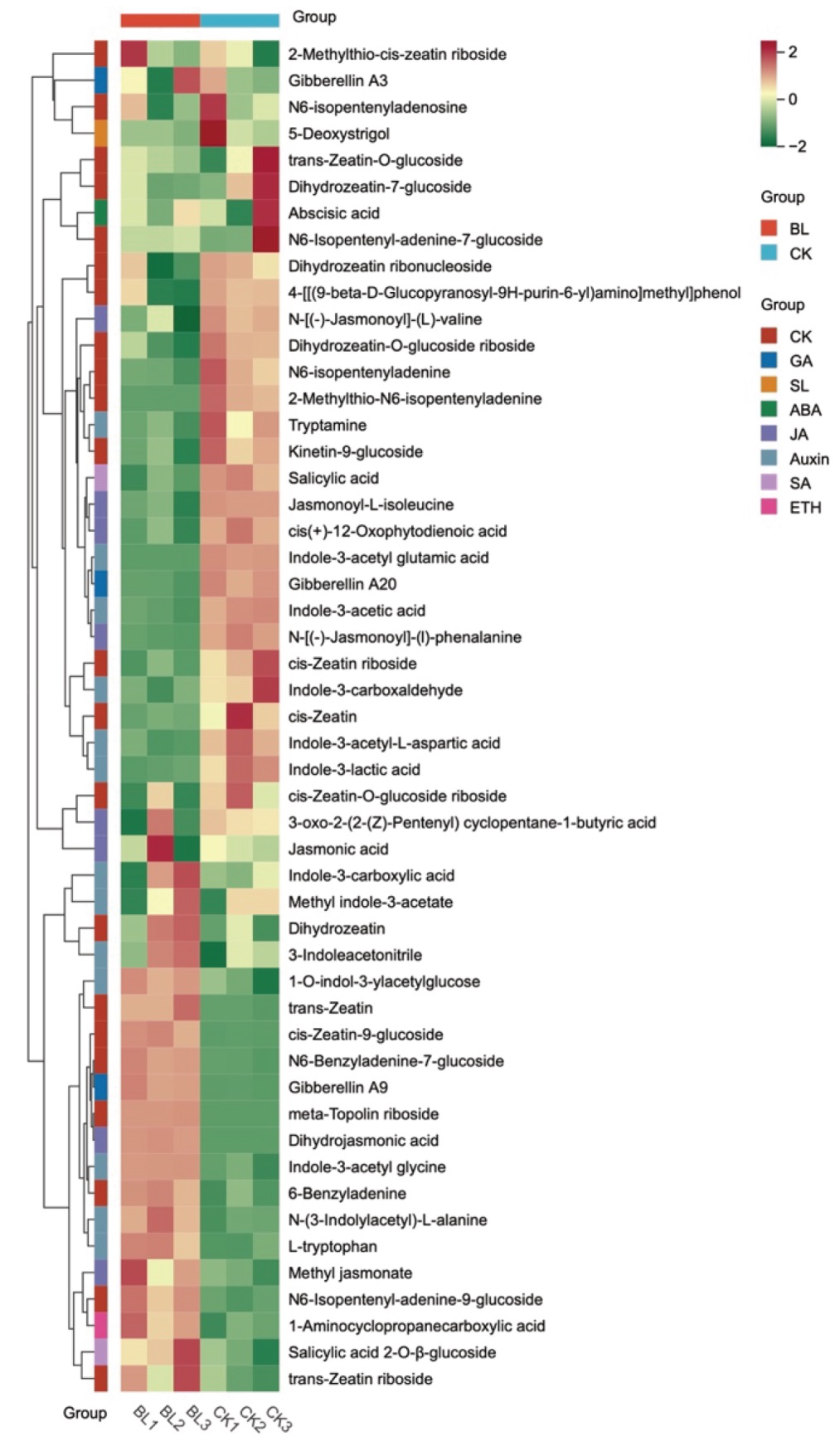
| 名称缩写 | 代谢物英文名称 | 代谢物中文名称 | 物质类别 | 差异倍数 | 积累趋势 |
|---|---|---|---|---|---|
| 2MeSiP | 2-meThylthio-N6-isopentenyladenine | 2-甲硫基异戊烯基腺嘌呤 | CK | 0 | down |
| cZ9G | cis-zeatin-9-glucoside | 顺式-玉米素-9-葡糖苷 | CK | 5.9 | up |
| mTR | meta-topolin riboside | N-(3-羟基苄基)腺苷 | CK | Inf | up |
| GA20 | gibberellin A20 | 赤霉素20 | GA | 0.40 | down |
| IIAA-Glu | indole-3-acetyl glutamic acid | 吲哚乙酸-谷氨酸 | IAA | 0 | down |
| AA-Gly | indole-3-acetyl glycine | 吲哚乙酸-甘氨酸 | IAA | 2.0 | up |
| H2JA | dihydrojasmonic acid | 二氢茉莉酸 | JA | Inf | up |
| JA-ILE | jasmonoyl-L-isoleucine | 茉莉酸-异亮氨酸 | JA | 0.5 | down |
| JA-Phe | N-[(-)-Jasmonoyl]-(l)-phenalanine | 茉莉酸-苯丙氨酸 | JA | 0.38 | down |
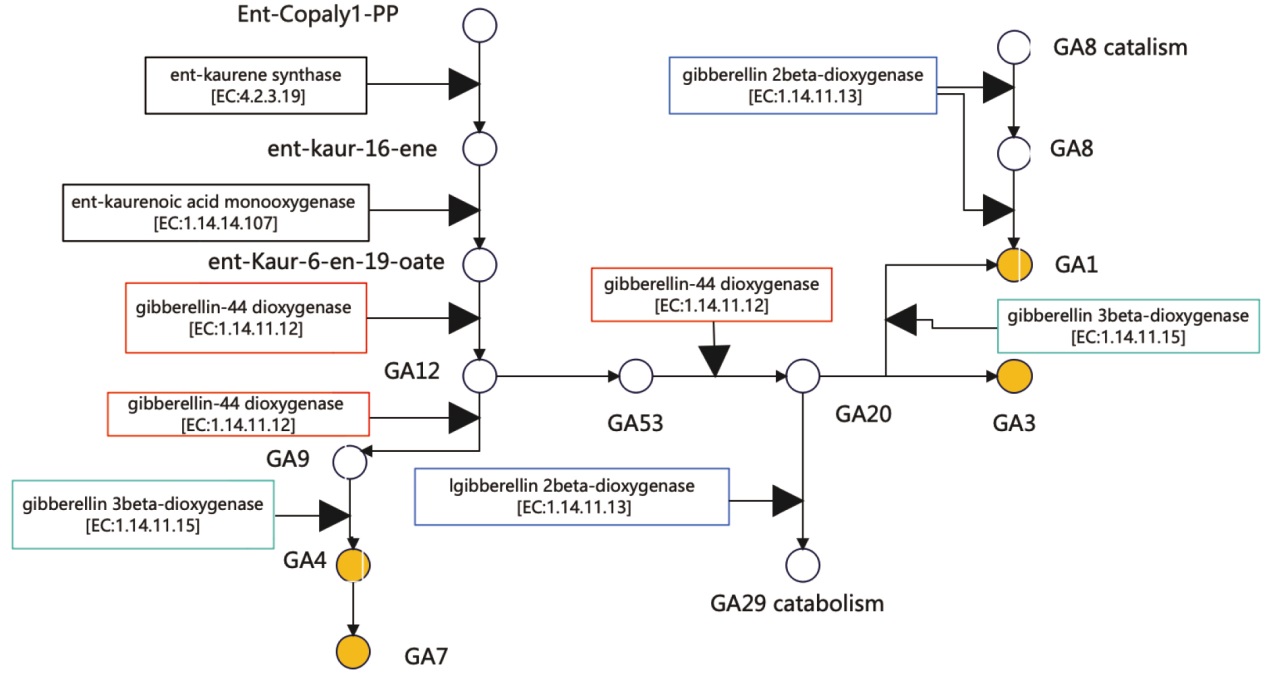
| 基因名称 | 处理组 | 表达量 | 基因名称 | 处理组 | 表达量 |
|---|---|---|---|---|---|
| GA2oX4831 | CG | 0.99±0.13 | AUX142 | CG | 0.10±0.14 |
| SBL | 0.22±0.02** | SBL | 2.23±0.33** | ||
| ThGA2oX1518 | CG | 1.07±0.20 | AUX338 | CG | 1.13±0.16 |
| SBL | 2.30±0.50** | SBL | 1.05±0.25 | ||
| ThGA3oX731 | CG | 0.94±0.14 | ThAHK414 | CG | 1.05±0.22 |
| SBL | 0.18±0.03** | SBL | 0.05±0.03** | ||
| ThGA20oX731 | CG | 0.99±0.21 | ThAHK1093 | CG | 1.09±0.18 |
| SBL | 0.32±0.08** | SBL | 0.41±0.20** | ||
| ThGID511 | CG | 0.94±0.18 | ThJAR452 | CG | 0.96±0.23 |
| SBL | 1.53±0.06** | SBL | 0.25±0.04** | ||
| ThGID931 | CG | 1.13±0.09 | ThJAZL3667 | CG | 0.10±0.17 |
| SBL | 1.17±0.14 | SBL | 0.97±0.32 | ||
| ThJAZL2663 | CG | 0.99±0.18 | ThMYC213 | CG | 0.96±0.08 |
| SBL | 0.50±0.13** | SBL | 0.30±0.11** |
| [1] |
李朝銮. 中国植物志[M]. 北京: 科学出版社,1998:122.
|
| [2] |
doi: 10.3389/fphar.2020.550497 URL |
| [3] |
胡竹元, 余志怡, 徐斌. 三叶青总黄酮增强三阴性乳腺癌细胞对EGFR-TKI敏感性的机制研究[J]. 中国临床药理学杂志, 2022, 38(8):772-776.
|
| [4] |
赵刚, 武思梦, 张悦, 等. 三叶青早期结瘤类基因ThENODL1及ThENODL2的克隆及表达分析[J]. 生命科学研究, 2023, 27(1):23-30.
|
| [5] |
张海燕, 段文学, 解备涛, 等. 不同时期干旱胁迫对甘薯块根产量形成及内源激素的影响[A]. //见:山东作物学会2018年学术年会论文集[C]. 济南: 山东省农业科学院,2018:18.
|
| [6] |
doi: 10.2174/0113892029251472230921053135 URL |
| [7] |
孙鹏. 植物激素对甜菜块根增长和糖分积累的调控作用[D]. 呼和浩特: 内蒙古农业大学, 2014.
|
| [8] |
杨鑫, 罗兴录, 覃宏宇, 等. 木薯内源激素含量与块根淀粉积累关系研究[J]. 中国农学通报, 2013, 29(33):158-164.
|
| [9] |
闻静, 赵刚, 杨玉琪, 等. 三叶青块根发育比较转录组分析[J]. 分子植物育种, 2019, 17(17):5660-5667.
|
| [10] |
doi: 10.1111/tpj.16169 pmid: 36864731 |
| [11] |
doi: 10.1016/j.plaphy.2024.108824 URL |
| [12] |
|
| [13] |
doi: 10.1186/s13059-016-0881-8 pmid: 26813401 |
| [14] |
闻静, 林国卫, 刘洁, 等. 三叶青早花基因的克隆及其对光质与光周期信号的响应[J]. 分子植物育种, 2023, 21(7):2245-2252.
|
| [15] |
doi: 10.1006/meth.2001.1262 URL |
| [16] |
杨颜萌, 张家兴, 李亚茹, 等. 光质对黄芩生长与生理生化特征的影响[J]. 应用生态学报, 2024, 35(2):424-430.
doi: 10.13287/j.1001-9332.202402.004 |
| [17] |
吴思昊. 三叶青块根的发育与成分积累的调控机制研究[D]. 杭州: 浙江农林大学, 2024.
|
| [18] |
doi: 10.1111/jipb.v57.9 URL |
| [19] |
doi: 10.1242/dev.131870 pmid: 27624827 |
| [20] |
doi: 10.1105/tpc.105.039172 URL |
| [21] |
doi: 10.1038/sj.emboj.7600659 URL |
| [22] |
doi: 10.1038/s41598-024-84763-9 |
| [23] |
doi: 10.1186/s12870-023-04598-w pmid: 38057702 |
| [24] |
doi: S1674-2052(17)30373-8 pmid: 29269022 |
| [25] |
pmid: 16669769 |
| [26] |
CIOĆM, DZIURKA M, PAWŁOWSKA B. Changes in endogenous phytohormones of Gerbera jamesonii axillary shoots multiplied under different light emitting diodes light quality[J]. Molecules, 2022, 27(6):1804.
doi: 10.3390/molecules27061804 URL |
| [27] |
doi: 10.1093/jxb/erz297 pmid: 31232453 |
| [28] |
doi: 10.1007/978-1-4939-9884-5_11 pmid: 31707658 |
| [29] |
陈笛, 郭永春, 陈雪津, 等. 红蓝光调控茉莉开花的转录组分析[J]. 生物工程学报, 2020, 36(9):1869-1886.
|
| [30] |
doi: 10.1146/arplant.2021.72.issue-1 URL |
| [31] |
doi: 10.1242/dev.030049 URL |
| [32] |
doi: 10.1016/j.jplph.2022.153904 URL |
| [33] |
|
| [34] |
doi: 10.1016/j.xplc.2021.100245 URL |
| [35] |
doi: 10.3389/fpls.2022.943662 URL |
| [36] |
doi: 10.1007/s00425-023-04217-w pmid: 37543957 |
| [37] |
doi: 10.1016/j.pbi.2022.102194 URL |
| [38] |
doi: 10.1038/nature05960 |
| [39] |
doi: 10.3390/ijms22189768 URL |
| [40] |
doi: 10.3390/ijms24043511 URL |
| [41] |
doi: 10.1073/pnas.1912199117 URL |
| [1] | LUO Yanyu, WEI Liguo, LIU Weiguang, YANG Zhijian, ZHANG Jinzhong, CHEN Jiwei, HUANG Shaoli. Transcriptome Analysis of Sucrose Induced Areca Taro in Vitro and Key Genes Screening [J]. Chinese Agricultural Science Bulletin, 2026, 42(6): 54-63. |
| [2] | QI Mingwei, QIN Yishan, YAO Yingyun, LAI Zixin, LUO Shanwei, ZHOU Libin, LUO Wenlong. Biological Effects and Transcriptome Analysis of Brassica rapa var. parachinensis Seed Irradiated by Carbon Ion Beam [J]. Chinese Agricultural Science Bulletin, 2026, 42(15): 54-64. |
| [3] | WANG Baoqing, XIE Beitao, ZHANG Liming. Transcriptome Analysis in Roots of Sweetpotato with Different Drought Tolerance [J]. Chinese Agricultural Science Bulletin, 2025, 41(9): 47-55. |
| [4] | YUE Kaixin, WANG Jiaqi, LIU Naixin. Transcriptome Analysis of Sugar Beet Seed Germination Response Under Drought Stress [J]. Chinese Agricultural Science Bulletin, 2025, 41(3): 114-122. |
| [5] | LIU Jianxin, ZHENG Wenxin, LV Xuefeng, XING Weiting, QUAN Kaili. Mining of Muscle Growth-Related Genes in Dexin Mutton Type Fine-wool Sheep [J]. Chinese Agricultural Science Bulletin, 2025, 41(21): 76-84. |
| [6] | QUAN Kaili, ZHENG Wenxin, LV Xuefeng, XING Weiting, LIU Jianxin. Differential Expression Analysis of Hypothalamus During Estrous Cycle in Xinjiang Goats with Different Fertility Levels [J]. Chinese Agricultural Science Bulletin, 2025, 41(21): 64-75. |
| [7] | LIU Jia, HUANG Darong, YAO Meiying, LIU Shuo, ZHANG Yuping, ZHANG Guowei. Investigation of Molecular Mechanism of Different Chilling Requirements Between Two Apricot Cultivars [J]. Chinese Agricultural Science Bulletin, 2025, 41(1): 33-41. |
| [8] | YANG Min, ZHOU Chenping, LI Qingmeng, KUANG Ruibin, WU Xiaming, WEI Yuerong. ‘Huanghy’ and ‘Jinchui’ Papaya’s Fruits: Storage Quality & Characteristics and Transcriptome Analysis [J]. Chinese Agricultural Science Bulletin, 2024, 40(6): 57-66. |
| [9] | ZHANG Jingjing, CHEN Bin, ZHUO Yuchen, WENG Kejia, LIN Ershu, CHEN Yushu, FAN Haiping. Transcriptome Analysis of Head Kidney Anti-LMBV Responses in Largemouth Bass (Micropterus salmoides) [J]. Chinese Agricultural Science Bulletin, 2024, 40(35): 148-155. |
| [10] | LANG Tao, YANG Feiyang, PU Zhigang, ZHANG Cong, LI Ming, YU Ma, QU Huijuan, WU Jingyu, ZHANG Lu, DIAO Du, FENG Junyan. Application of Transcriptome Sequencing Technology in Sweetpotato (Ipomoea batatas L.) Research [J]. Chinese Agricultural Science Bulletin, 2024, 40(30): 94-102. |
| [11] | LUO Xiuqin, WEI Zhuowen, CAI Jie, AN Feifei, CHEN Songbi, XUE Jingjing. Explanation of Integrative Analysis of Metabolome and Transcriptome for Anthocyanins Synthesis Mechanism in Cassava Leaves [J]. Chinese Agricultural Science Bulletin, 2024, 40(24): 100-106. |
| [12] | LIANG Zhantu, QUAN Linfa, LIANG Shengxi, CHEN Bingxu, MA Qun, YAO Qiong. Transcriptome Analysis of Lepidoptera Insects Based on CiteSpace [J]. Chinese Agricultural Science Bulletin, 2023, 39(8): 142-148. |
| [13] | HONG Senrong, ZHU Yingying, LI Ziying, HU Mingyan, OUYANG Kehui. The Plantlets of Medicago polymorpha L. and Medicago sativa L. Under Salt Stress: Transcriptome Analysis and Salt Tolerance Gene Screening [J]. Chinese Agricultural Science Bulletin, 2023, 39(3): 111-118. |
| [14] | MEI Yu, WANG Jihua, CAI Shike. Anoectochilus roxburghii (Wall.) Lindl. in Response to Heat Stress: Transcriptomic Analysis [J]. Chinese Agricultural Science Bulletin, 2023, 39(3): 97-103. |
| [15] | QIN Helan, LIANG Fang, JIN Yingshan, LI Zijing, ZHANG Hua, HU Xuefan. Transcriptomic Analysis of the Mosaic Leaf Mutant in Heliopsis helianthoides [J]. Chinese Agricultural Science Bulletin, 2023, 39(29): 1-7. |
| Viewed | ||||||
|
Full text |
|
|||||
|
Abstract |
|
|||||
