Welcome to Chinese Agricultural Science Bulletin,

Chinese Agricultural Science Bulletin ›› 2026, Vol. 42 ›› Issue (3): 57-64.doi: 10.11924/j.issn.1000-6850.casb2025-0123
Previous Articles Next Articles
WEI Xiaojuan( ), YANG Deren, ZHANG Xing, LIU Kai, LAN Jinxuan
Received:2025-03-22
Revised:2025-06-16
Online:2026-02-15
Published:2026-02-09
WEI Xiaojuan, YANG Deren, ZHANG Xing, LIU Kai, LAN Jinxuan. Preliminary Identifying Camellia Hybrids F1 by Using SSR Molecular Makers[J]. Chinese Agricultural Science Bulletin, 2026, 42(3): 57-64.
Add to citation manager EndNote|Ris|BibTeX
URL: https://www.casb.org.cn/EN/10.11924/j.issn.1000-6850.casb2025-0123
| 序号 | 杂交亲本 | 开花时间 | 花型 | 花色 | 优良性状 |
|---|---|---|---|---|---|
| 1 | 宛田红花油茶 | 12月下旬至2月上旬 | 半重瓣形 | 深红色 | 坐果率高,花大果大 |
| 2 | 广宁红花油茶 | 1月中旬至2月下旬 | 半重瓣形 | 红色 | 坐果率高,花大果大 |
| 3 | 普通金花茶 | 12月下旬至3月下旬 | 半重瓣形 | 金黄色 | 花量大,适应性强 |
| 4 | 香花油茶 | 12月上旬至2月中旬 | 单瓣形 | 白色 | 花量大,坐果率高 |
| 5 | 越南抱茎山茶 | 四季开花 | 半重瓣 | 红色 | 花期长,花粉丰富 |
| 6 | 杜鹃红山茶 | 四季开花 | 单瓣形 | 红色 | 四季开花,花粉丰富 |
| 序号 | 杂交亲本 | 开花时间 | 花型 | 花色 | 优良性状 |
|---|---|---|---|---|---|
| 1 | 宛田红花油茶 | 12月下旬至2月上旬 | 半重瓣形 | 深红色 | 坐果率高,花大果大 |
| 2 | 广宁红花油茶 | 1月中旬至2月下旬 | 半重瓣形 | 红色 | 坐果率高,花大果大 |
| 3 | 普通金花茶 | 12月下旬至3月下旬 | 半重瓣形 | 金黄色 | 花量大,适应性强 |
| 4 | 香花油茶 | 12月上旬至2月中旬 | 单瓣形 | 白色 | 花量大,坐果率高 |
| 5 | 越南抱茎山茶 | 四季开花 | 半重瓣 | 红色 | 花期长,花粉丰富 |
| 6 | 杜鹃红山茶 | 四季开花 | 单瓣形 | 红色 | 四季开花,花粉丰富 |
| 序号 | 杂交组合简写 | 母本(♀) | 父本(♂) |
|---|---|---|---|
| 1 | WT♀×GN♂ | 宛田红花油茶 | 广宁红花油茶 |
| 2 | WT♀×PT♂ | 宛田红花油茶 | 普通金花茶 |
| 3 | WT♀×XH♂ | 宛田红花油茶 | 香花油茶 |
| 4 | WT♀×BJ♂ | 宛田红花油茶 | 越南抱茎茶 |
| 5 | GN♀×WT♂ | 广宁红花油茶 | 宛田红花油茶 |
| 6 | GN♀×PT♂ | 广宁红花油茶 | 普通金花茶 |
| 7 | GN♀×XH♂ | 广宁红花油茶 | 香花油茶 |
| 8 | XH♀×DJ♂ | 香花油茶 | 杜鹃红山茶 |
| 序号 | 杂交组合简写 | 母本(♀) | 父本(♂) |
|---|---|---|---|
| 1 | WT♀×GN♂ | 宛田红花油茶 | 广宁红花油茶 |
| 2 | WT♀×PT♂ | 宛田红花油茶 | 普通金花茶 |
| 3 | WT♀×XH♂ | 宛田红花油茶 | 香花油茶 |
| 4 | WT♀×BJ♂ | 宛田红花油茶 | 越南抱茎茶 |
| 5 | GN♀×WT♂ | 广宁红花油茶 | 宛田红花油茶 |
| 6 | GN♀×PT♂ | 广宁红花油茶 | 普通金花茶 |
| 7 | GN♀×XH♂ | 广宁红花油茶 | 香花油茶 |
| 8 | XH♀×DJ♂ | 香花油茶 | 杜鹃红山茶 |
| 组合简写 | 杂交组合 | 授粉数/朵 | 坐果数/个 | 收果数/个 | 籽粒数/粒 | |
|---|---|---|---|---|---|---|
| 母本(♀) | 父本(♂) | |||||
| WT♀×GN♂ | 宛田红花油茶 | 广宁红花油茶 | 35 | 9 | 5 | 47 |
| WT♀×PT♂ | 宛田红花油茶 | 普通金花茶 | 58 | 30 | 12 | 19 |
| WT♀×XH♂ | 宛田红花油茶 | 香花油茶 | 35 | 4 | 3 | 5 |
| WT♀×BJ♂ | 宛田红花油茶 | 越南抱茎茶 | 33 | 6 | 3 | 31 |
| GN♀×WT♂ | 广宁红花油茶 | 宛田红花油茶 | 46 | 6 | 2 | 17 |
| GN♀×PT♂ | 广宁红花油茶 | 普通金花茶 | 67 | 16 | 5 | 12 |
| GN♀×XH♂ | 广宁红花油茶 | 香花油茶 | 36 | 3 | 2 | 15 |
| XH♀×DJ♂ | 香花油茶 | 杜鹃红山茶 | 51 | 4 | 1 | 4 |
| 组合简写 | 杂交组合 | 授粉数/朵 | 坐果数/个 | 收果数/个 | 籽粒数/粒 | |
|---|---|---|---|---|---|---|
| 母本(♀) | 父本(♂) | |||||
| WT♀×GN♂ | 宛田红花油茶 | 广宁红花油茶 | 35 | 9 | 5 | 47 |
| WT♀×PT♂ | 宛田红花油茶 | 普通金花茶 | 58 | 30 | 12 | 19 |
| WT♀×XH♂ | 宛田红花油茶 | 香花油茶 | 35 | 4 | 3 | 5 |
| WT♀×BJ♂ | 宛田红花油茶 | 越南抱茎茶 | 33 | 6 | 3 | 31 |
| GN♀×WT♂ | 广宁红花油茶 | 宛田红花油茶 | 46 | 6 | 2 | 17 |
| GN♀×PT♂ | 广宁红花油茶 | 普通金花茶 | 67 | 16 | 5 | 12 |
| GN♀×XH♂ | 广宁红花油茶 | 香花油茶 | 36 | 3 | 2 | 15 |
| XH♀×DJ♂ | 香花油茶 | 杜鹃红山茶 | 51 | 4 | 1 | 4 |
| 杂交组合 简写 | 杂交组合 | 出苗数量/株 | 6个月生长情况 | ||
|---|---|---|---|---|---|
| 母本(♀) | 父本(♂) | 平均苗高/cm | 平均地径/mm | ||
| WT♀×GN♂ | 宛田红花油茶 | 广宁红花油茶 | 41 | 21.5 | 4.2 |
| WT♀×PT♂ | 宛田红花油茶 | 普通金花茶 | 9 | 20.3 | 4.6 |
| WT♀×XH♂ | 宛田红花油茶 | 香花油茶 | 1 | 14.5 | 2.5 |
| WT♀×BJ♂ | 宛田红花油茶 | 越南抱茎茶 | 13 | 15.7 | 3.1 |
| GN♀×WT♂ | 广宁红花油茶 | 宛田红花油茶 | 12 | 20.8 | 4.6 |
| GN♀×PT♂ | 广宁红花油茶 | 普通金花茶 | 5 | 19.8 | 3.6 |
| GN♀×XH♂ | 广宁红花油茶 | 香花油茶 | 2 | 15.2 | 2.7 |
| XH♀×DJ♂ | 香花油茶 | 杜鹃红山茶 | 1 | 16.2 | 3.1 |
| 杂交组合 简写 | 杂交组合 | 出苗数量/株 | 6个月生长情况 | ||
|---|---|---|---|---|---|
| 母本(♀) | 父本(♂) | 平均苗高/cm | 平均地径/mm | ||
| WT♀×GN♂ | 宛田红花油茶 | 广宁红花油茶 | 41 | 21.5 | 4.2 |
| WT♀×PT♂ | 宛田红花油茶 | 普通金花茶 | 9 | 20.3 | 4.6 |
| WT♀×XH♂ | 宛田红花油茶 | 香花油茶 | 1 | 14.5 | 2.5 |
| WT♀×BJ♂ | 宛田红花油茶 | 越南抱茎茶 | 13 | 15.7 | 3.1 |
| GN♀×WT♂ | 广宁红花油茶 | 宛田红花油茶 | 12 | 20.8 | 4.6 |
| GN♀×PT♂ | 广宁红花油茶 | 普通金花茶 | 5 | 19.8 | 3.6 |
| GN♀×XH♂ | 广宁红花油茶 | 香花油茶 | 2 | 15.2 | 2.7 |
| XH♀×DJ♂ | 香花油茶 | 杜鹃红山茶 | 1 | 16.2 | 3.1 |
| 组合 简写 | 采样 编号 | MSCjaH46 | NJFUC57 | TUGMS28 | 多引物 验证 结果 | |||||||||||||||
|---|---|---|---|---|---|---|---|---|---|---|---|---|---|---|---|---|---|---|---|---|
| 母带 | 父带 | 杂新带 | 共计 条带 | 结果 | 母带 | 父带 | 杂新带 | 共计 条带 | 结果 | 母带 | 父带 | 杂新带 | 共计 条带 | 结果 | ||||||
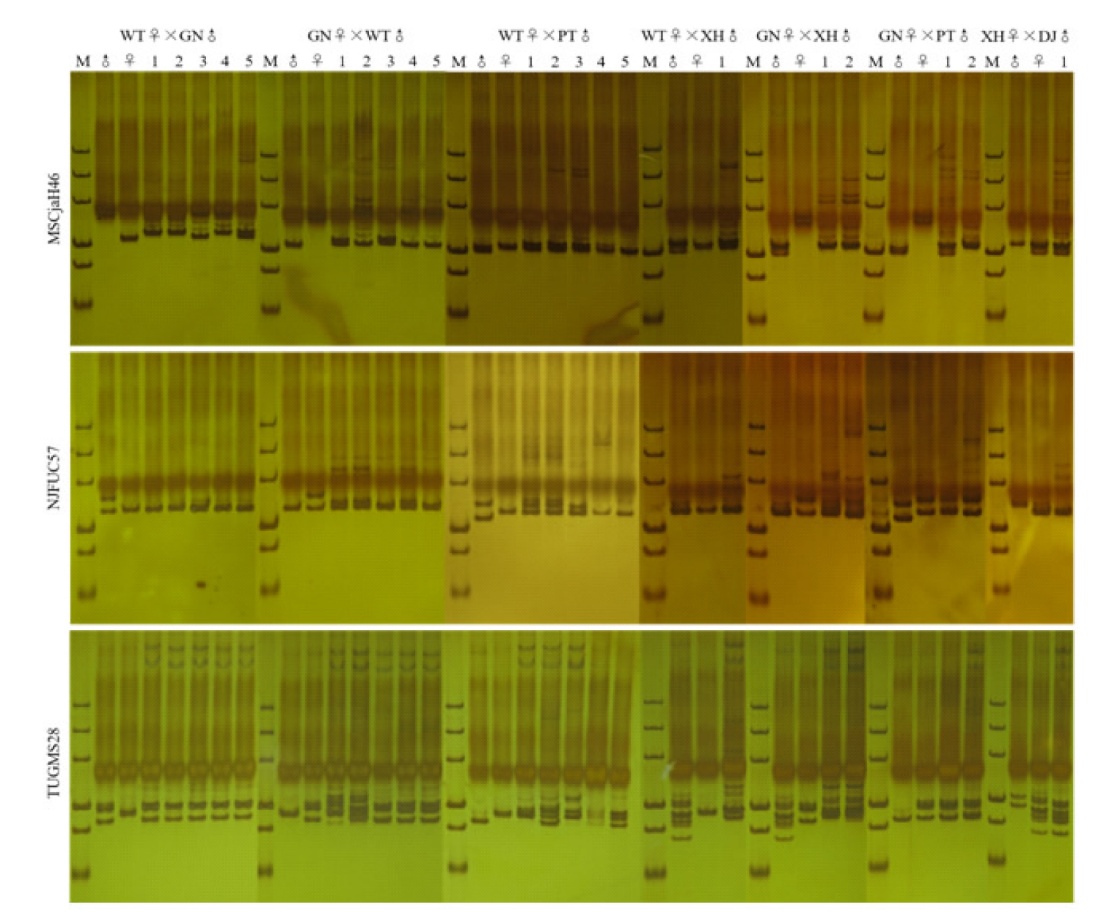
| WT♀×GN♂ | 1-1 | / | / | 1 | 1 | - | - | - | 0 | 1 | - | 3 | 0 | 0 | 3 | - | - | |||
| 1-2 | / | / | 1 | 1 | - | - | - | 0 | 1 | - | 2 | 0 | 0 | 2 | - | - | ||||
| 1-3 | 1 | 1 | 0 | 2 | + | - | - | 0 | 1 | - | 2 | 0 | 0 | 2 | - | + | ||||
| 1-4 | / | 1 | 1 | 2 | - | - | - | 0 | 1 | - | 2 | 0 | 0 | 2 | - | - | ||||
| 1-5 | / | 1 | 1 | 2 | - | - | - | 0 | 1 | - | 2 | 0 | 0 | 2 | - | - | ||||
| WT♀×PT♂ | 9-1 | - | - | 1 | 2 | - | 1 | 1 | 1 | 3 | + | 0 | 1 | 1 | 2 | - | + | |||
| 9-2 | - | - | 1 | 2 | - | 1 | 1 | 1 | 3 | + | 1 | 1 | 1 | 3 | + | ++ | ||||
| 9-3 | - | - | 1 | 2 | - | 1 | 1 | 0 | 2 | + | 0 | 1 | 1 | 2 | - | + | ||||
| 9-4 | - | - | 1 | 2 | - | 0 | 1 | 0 | 1 | - | / | / | / | / | / | - | ||||
| 9-5 | - | - | 0 | 1 | - | 0 | 1 | 0 | 1 | - | 1 | 1 | 1 | 3 | + | + | ||||
| WT♀×XH♂ | 11-1 | 1 | - | 2 | 4 | - | - | - | 2 | 3 | - | 1 | 1 | 1 | 3 | + | + | |||
| GN♀×WT♂ | 2-1 | 1 | 0 | 1 | 2 | - | - | - | 1 | 2 | - | 1 | 1 | 1 | 3 | + | + | |||
| 2-2 | 1 | 1 | - | 2 | + | - | - | 1 | 2 | - | 1 | 2 | 1 | 4 | + | ++ | ||||
| 2-3 | 1 | 0 | 1 | 2 | - | - | - | 0 | 1 | - | 0 | 2 | 0 | 2 | 自交 | - | ||||
| 2-4 | 1 | 1 | 0 | 2 | + | - | - | 1 | 2 | - | 1 | 2 | 0 | 3 | + | ++ | ||||
| 2-5 | 1 | 1 | 0 | 2 | + | - | - | 0 | 1 | - | 1 | 2 | 0 | 3 | + | ++ | ||||
| GN♀×PT♂ | 14-1 | 2 | 0 | 0 | 2 | 自交 | 0 | 2 | 0 | 2 | 自交 | - | 2 | 0 | 3 | - | - | |||
| 14-2 | 1 | 1 | 1 | 3 | + | 0 | 2 | 2 | 4 | - | 1 | 2 | 0 | 4 | + | ++ | ||||
| GN♀×XH♂ | 13-1 | 1 | 1 | 4 | 6 | + | 1 | 1 | 2 | 4 | + | 1 | 1 | 2 | 4 | + | +++ | |||
| 13-2 | 1 | 1 | 4 | 6 | + | 1 | 1 | 1 | 3 | + | 1 | 1 | 2 | 4 | + | +++ | ||||
| XH♀×DJ♂ | 25-1 | - | 2 | 2 | 5 | - | 0 | 1 | 2 | 3 | - | 1 | 5 | 0 | 6 | + | + | |||
| 组合 简写 | 采样 编号 | MSCjaH46 | NJFUC57 | TUGMS28 | 多引物 验证 结果 | |||||||||||||||
|---|---|---|---|---|---|---|---|---|---|---|---|---|---|---|---|---|---|---|---|---|
| 母带 | 父带 | 杂新带 | 共计 条带 | 结果 | 母带 | 父带 | 杂新带 | 共计 条带 | 结果 | 母带 | 父带 | 杂新带 | 共计 条带 | 结果 | ||||||
| WT♀×GN♂ | 1-1 | / | / | 1 | 1 | - | - | - | 0 | 1 | - | 3 | 0 | 0 | 3 | - | - | |||
| 1-2 | / | / | 1 | 1 | - | - | - | 0 | 1 | - | 2 | 0 | 0 | 2 | - | - | ||||
| 1-3 | 1 | 1 | 0 | 2 | + | - | - | 0 | 1 | - | 2 | 0 | 0 | 2 | - | + | ||||
| 1-4 | / | 1 | 1 | 2 | - | - | - | 0 | 1 | - | 2 | 0 | 0 | 2 | - | - | ||||
| 1-5 | / | 1 | 1 | 2 | - | - | - | 0 | 1 | - | 2 | 0 | 0 | 2 | - | - | ||||
| WT♀×PT♂ | 9-1 | - | - | 1 | 2 | - | 1 | 1 | 1 | 3 | + | 0 | 1 | 1 | 2 | - | + | |||
| 9-2 | - | - | 1 | 2 | - | 1 | 1 | 1 | 3 | + | 1 | 1 | 1 | 3 | + | ++ | ||||
| 9-3 | - | - | 1 | 2 | - | 1 | 1 | 0 | 2 | + | 0 | 1 | 1 | 2 | - | + | ||||
| 9-4 | - | - | 1 | 2 | - | 0 | 1 | 0 | 1 | - | / | / | / | / | / | - | ||||
| 9-5 | - | - | 0 | 1 | - | 0 | 1 | 0 | 1 | - | 1 | 1 | 1 | 3 | + | + | ||||
| WT♀×XH♂ | 11-1 | 1 | - | 2 | 4 | - | - | - | 2 | 3 | - | 1 | 1 | 1 | 3 | + | + | |||
| GN♀×WT♂ | 2-1 | 1 | 0 | 1 | 2 | - | - | - | 1 | 2 | - | 1 | 1 | 1 | 3 | + | + | |||
| 2-2 | 1 | 1 | - | 2 | + | - | - | 1 | 2 | - | 1 | 2 | 1 | 4 | + | ++ | ||||
| 2-3 | 1 | 0 | 1 | 2 | - | - | - | 0 | 1 | - | 0 | 2 | 0 | 2 | 自交 | - | ||||
| 2-4 | 1 | 1 | 0 | 2 | + | - | - | 1 | 2 | - | 1 | 2 | 0 | 3 | + | ++ | ||||
| 2-5 | 1 | 1 | 0 | 2 | + | - | - | 0 | 1 | - | 1 | 2 | 0 | 3 | + | ++ | ||||
| GN♀×PT♂ | 14-1 | 2 | 0 | 0 | 2 | 自交 | 0 | 2 | 0 | 2 | 自交 | - | 2 | 0 | 3 | - | - | |||
| 14-2 | 1 | 1 | 1 | 3 | + | 0 | 2 | 2 | 4 | - | 1 | 2 | 0 | 4 | + | ++ | ||||
| GN♀×XH♂ | 13-1 | 1 | 1 | 4 | 6 | + | 1 | 1 | 2 | 4 | + | 1 | 1 | 2 | 4 | + | +++ | |||
| 13-2 | 1 | 1 | 4 | 6 | + | 1 | 1 | 1 | 3 | + | 1 | 1 | 2 | 4 | + | +++ | ||||
| XH♀×DJ♂ | 25-1 | - | 2 | 2 | 5 | - | 0 | 1 | 2 | 3 | - | 1 | 5 | 0 | 6 | + | + | |||
| [1] |
刘福平. 茶花育种研究现状与趋势[J]. 广西农业科学, 2008, 39(6):815-819.
|
| [2] |
高继银, 帕克斯, 杜跃强. 山茶属植物主要原种彩色图集[M]. 杭州: 浙江科学技术出版社,2005:23-24.
|
| [3] |
张国彬, 冯玲玲, 周吉源. 山茶属植物的研究现状与展望[J]. 湖北林业科技, 2004(2):45-49.
|
| [4] |
肖调江, 夏丽芳. 山茶属植物资源的开发与利用[J]. 中国野生植物, 1991(1):44-45.
|
| [5] |
韦晓娟, 廖健明, 马锦林, 等. 金花茶与部分山茶属植物杂交育种初报[J]. 广西林业科学, 2016, 45(4):431-436.
|
| [6] |
吴丽君, 陈达, 陈文荣, 等. 几种金花茶组植物的远缘杂交育种[J]. 福建农林大学学报(自然科学版), 2018, 47(1):32-37.
|
| [7] |
汤忠皓, 黄连冬. 金花茶杂交育种初报[J]. 北京林业大学学报, 1987, 9(4):374-379.
|
| [8] |
柴胜丰, 韦霄, 蒋运生, 等. 濒危植物金花茶开花物候和生殖构件特征[J]. 热带亚热带植物学报, 2009, 17(1):5-11.
|
| [9] |
张俊丽, 李彤丰, 苏月娥, 等. 以杜鹃红山茶为母本的优良种间杂交父本筛选[J]. 亚热带植物科学, 2022, 51(3):184-190.
|
| [10] |
朱美霞, 李英芝, 王建书, 等. 利用SSR方法鉴定棉花品种纯度[J]. 安徽农业科学, 2005, 33(11):2010-2016.
|
| [11] |
罗玉兰, 张冬梅. SSR标记及形态性状鉴定红刺玫和月季杂交F1代[J]. 分子植物育种, 2007, 5(6):839-842.
|
| [12] |
谭振馨, 李汝玉, 李群, 等. 玉米杂交种SSR标记纯度鉴定方法研究[J]. 山东农业科学, 2004(4):8-11.
|
| [13] |
罗军武, 施兆鹏, 李家贤, 等. RAPD分子标记技术在茶树亲子鉴定中的应用[J]. 湖南农业大学学报(自然科学版), 2002, 28(6):502-505.
|
| [14] |
张景荣, 刘军. 名贵茶花种质资源的RAPD分析[J]. 西北植物学报, 2006, 26(4):683-687.
|
| [15] |
侯渝嘉, 何桥, 梁国鲁, 等. 茶树杂交后代的ISSR分析[J]. 西南农业大学学报(自然科学版), 2006, 2(2):267-270.
|
| [16] |
姚明哲, 黄海涛, 余继忠, 等. ISSR在茶树品种分子鉴别和亲缘关系研究中的适用性分析[J]. 茶叶科学, 2005, 25(2):153-157.
|
| [17] |
孙庆磊, 梁月荣, 丁兆堂, 等. AFLP分子标记及其在茶树遗传育种中的应用[J]. 茶叶, 2004, 30(4):203-206.
|
| [18] |
唐绍清, 杜林方, 王燕. 山茶属金花茶组金花茶系的AFLP分析[J]. 武汉植物学研究, 2004, 22(1):44-48.
|
| [19] |
李琳琳, 黄万坚, 刘信凯, 等. 应用SSR分子标记技术鉴定张氏红山茶杂交F1代真实性的研究[J]. 园林植物研究与应用, 2014(2):44-47.
|
| [20] |
|
| [21] |
韦晓娟, 廖健明, 梁建昆, 等. 不同基质及生长调节剂对越南抱茎茶扦插生根的影响[J]. 北方园艺, 2015(1):68-71.
|
| [22] |
韦晓娟, 梁晓静, 陈金艳, 等. 不同基质对越南抱茎茶容器苗生长的影响[J]. 林业科技开发, 2013(3):114-117.
|
| [23] |
卫兆芬. 中国山茶属一新种[J]. 植物研究, 1986, 6(4)141-143.
|
| [24] |
马锦林, 叶航, 叶创兴. 香花油茶—山茶属短柱茶组一新种[J]. 广西植物, 2012, 32(6):753-755.
|
| [25] |
韦晓娟, 马锦林, 叶航, 等. 香花油茶的园林应用[J]. 广西林业科学, 2014, 43(1):130-132.
|
| [26] |
张恩慧, 王晓云, 覃子海, 等. 广西普通油茶种质资源遗传多样性的SSR分析[J]. 广西植物, 2016, 36(7):806-811.
|
| [27] |
李海波, 丁红梅, 陈友吾, 等. 12个油茶品种的SSR特征指纹鉴别[J]. 中国粮油学报, 2017, 32(10):171-178.
|
| [28] |
黄勇. 小果油茶与普通油茶居群遗传结构及种间杂交渐渗[J]. 应用生态学报, 2013, 24(8):2345-2352.
|
| [29] |
GB/T26911—2011.植物新品种特异性、一致性、稳定性测试指南山茶属[S]. 北京: 中国标准出版社.
|
| [30] |
韦晓娟, 杨卓颖, 张幸, 等. 优良山茶属植物杂交育种研究[J]. 热带作物学报, 2025, 46(1)83-93.
doi: 10.3969/j.issn.1000-2561.2025.01.009 |
| [1] | ZHANG Xing, WU Jianyun, WEI Xiaojuan, LI Huijuan, HUANG Xiaolu, YANG Deren. Adaptability Evaluation of 6 Rare Camellia Species Introduced in Nanning [J]. Chinese Agricultural Science Bulletin, 2025, 41(13): 32-40. |
| [2] | WANG Lianrun, WAN Hong, TAO Pang, CHEN Xia, LI Kunming, SHA Yucang, DING Renzhan. Genetic Relationship Analysis of Wild Actinidia Germplasm Resources in Yunnan Based on SSR [J]. Chinese Agricultural Science Bulletin, 2024, 40(4): 98-102. |
| [3] | HAN Xiaoxia, MIN Ziyang, LI Yongqi, YUAN Zuhua, HU Xinjun. Rapid Identification of ‘Xingshu Zaojia’ Luffa Hybrid Purity by SSR Molecular Markers [J]. Chinese Agricultural Science Bulletin, 2023, 39(31): 44-49. |
| [4] | SHAO Xuehua, LAI Duo, XIAO Weiqiang, LIU Chuanhe, HE Han, KUANG Shizi. Psidium guajava L.: Genetic Diversity Analysis Based on ISSR Markers and Construction of Fingerprints [J]. Chinese Agricultural Science Bulletin, 2023, 39(21): 39-47. |
| [5] | SHANG Na, REN Aizhi, LIU Bing, ZHAO Peibao. Isolation and Identification of the Pathogen Causing Leaf Spot on Trifolium repens [J]. Chinese Agricultural Science Bulletin, 2022, 38(4): 81-85. |
| [6] | ZHAO Yaru, PI Zhi, LIU Rui, MA Yuyan, WU Zedong. Genetic Diversity Analysis of Monogerm Cytoplasmic Male Sterile Lines and Maintainer Lines of Sugar Beet [J]. Chinese Agricultural Science Bulletin, 2022, 38(30): 35-40. |
| [7] | Xu Ming, Wang Qiong, Li Dongling, Zheng Yuhong, Xu Zenglai. 5 Polygonum tinctorium Ait. Populations: Genetic Diversity Analysis Based on ISSR Marker [J]. Chinese Agricultural Science Bulletin, 2021, 37(21): 134-139. |
| [8] | Wang Qun, Bi Yunqing, He Chengxing, Guo Zhixiang, Zhong Dewei, Li Junhong, Chen Qianzhao, You Jihua, Huang Zhenghui, Li Jinbin. Anthracnose Disease on Prunus salicina ‘Banbianhong’: Investigation and Pathogen Identification [J]. Chinese Agricultural Science Bulletin, 2021, 37(15): 128-136. |
| [9] | . Screening of SSR Molecular Markers for Identifying the Authenticity of Nulli-Tetrasomes of Wheat [J]. Chinese Agricultural Science Bulletin, 2018, 34(20): 47-54. |
| [10] | . Screening and Application of SSR Markers’Polymorphism of Capsicum Whole Genome [J]. Chinese Agricultural Science Bulletin, 2018, 34(17): 56-61. |
| [11] |
Liu Wei,Wang Yunyun,Zhao Wujuan,Zhao Xuehui and Dong Zhigang.
Genetic Diversity of 21 Kinds of Grape Germplasm Resources |
| [12] | Che Zhuo,Chang Hong, and Zhang Wei. Identification of Maize Hybrid Varieties Using SSR Marker [J]. Chinese Agricultural Science Bulletin, 2016, 32(18): 28-32. |
| [13] | . Establishment of DNA Fingerprint Database of Rice Varieties in Shanghai [J]. Chinese Agricultural Science Bulletin, 2015, 31(3): 7-15. |
| [14] | 柏国清, and . Analysis of Genetic Diversity of Glycine soja Germplasm Resources in Shaanxi Province [J]. Chinese Agricultural Science Bulletin, 2015, 31(24): 99-105. |
| [15] | . Advances of SSR Marker Technology and Its Applications in Cotton Genetics and Breeding [J]. Chinese Agricultural Science Bulletin, 2009, 25(22): 0-0. |
| Viewed | ||||||
|
Full text |
|
|||||
|
Abstract |
|
|||||
